How the wheel, pedals, gear selector, lights and instruments evolved from tillers and hand levers to electric power steering, automated gearboxes and touchscreens.
Car controls are the steering, pedal, gear, lighting and instrument systems used to drive a road vehicle. Most began as crude devices and were refined or automated over time, from the steering wheel of 1894 to today's touchscreens.
Car controls are the components drivers use to steer, accelerate, brake, change gear, signal and park a powered road vehicle, whether it is a car, truck or bus. Steering wheels and pedals have been part of the car since its earliest days, but many other controls have changed in response to what drivers need. The result is a set of inputs that now range from simple levers to computer-managed gearboxes and touchscreens.
What are the basic car controls?
The core controls are the steering wheel, the brake and accelerator pedals, the gear selector or clutch, the lighting and signal switches, and the instruments that report speed, fuel and engine condition. Each one has a history of its own, and most began as a crude or specialised device before becoming standardised. Over time, some have been automated and others have moved onto screens.
Manual transmissions became less common as automatic technology improved, and modern cars also carry controls that do not drive the vehicle at all. Climate control, navigation, entertainment and wipers are now operated from the same cabin. The clutch, throttle and brake remain the most important, because they connect the driver to the moving car.
Steering, pedals and gears each began as a crude device, and most were refined or automated over time.
How did the steering wheel replace the tiller?
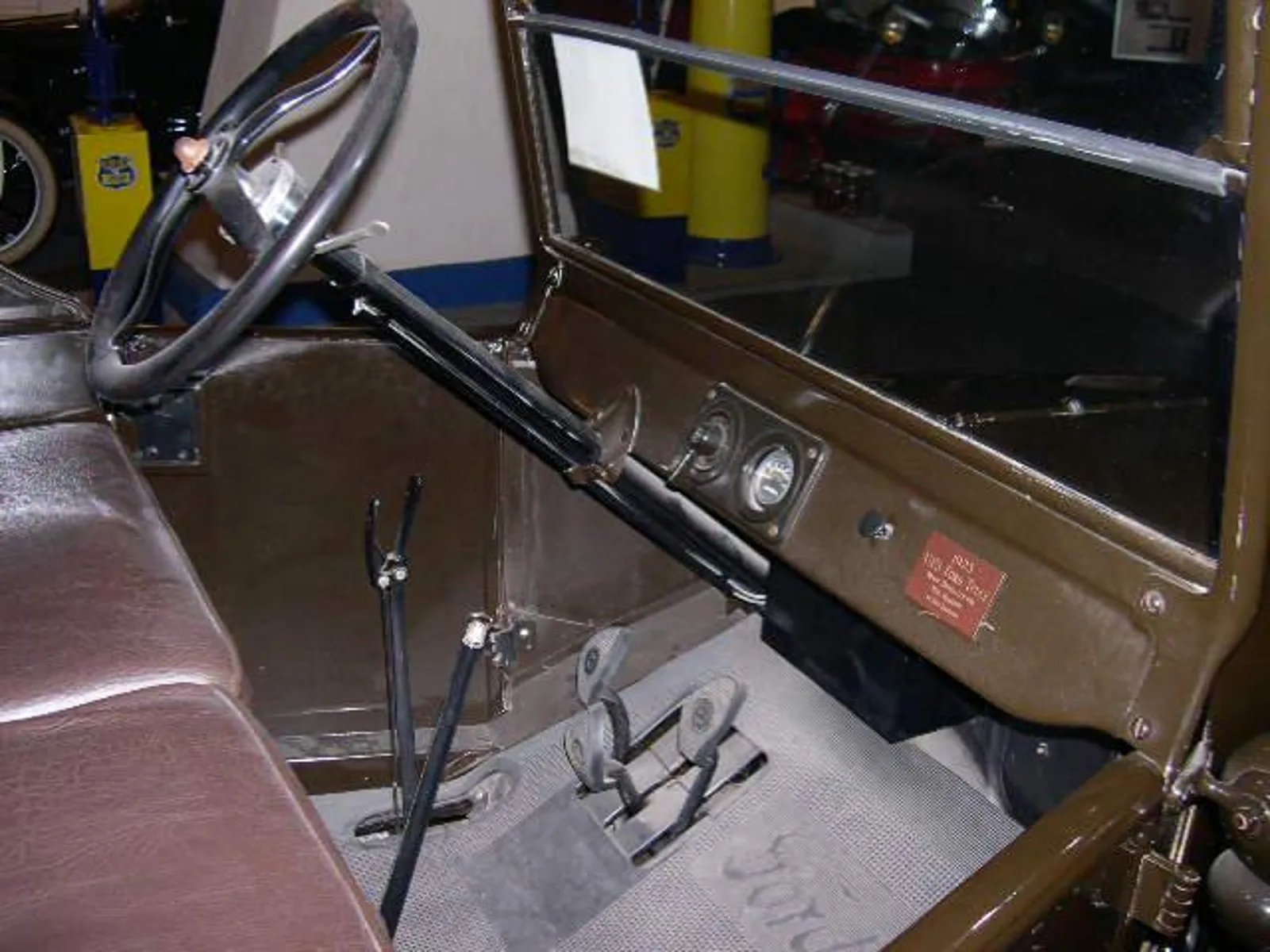
The first automobiles were steered with a tiller, which was sometimes placed on the left, sometimes on the right and sometimes in the centre. A steering wheel first appeared in 1894, when Alfred Vacheron raced a Panhard et Levassor in the Paris-Rouen event. By 1898 steering wheels had become standard on Panhard et Levassor cars, and Packard introduced them in the United States in 1899.
By 1908 the wheel was fitted to most models, and it has remained the principal steering control ever since.
Power steering later took over much of the effort involved in turning the wheel. Early systems used hydraulics to reduce the driver's effort. Hydraulic steering is now giving way to electric power steering, which removes the hydraulic pump and raises fuel efficiency.
How do the brake and parking controls work?
In a modern car the four-wheel braking system is operated by a pedal placed to the left of the accelerator. Most cars also have a parking brake that acts on the rear wheels. Less commonly, the Saab 99 and the Citroen Xantia used a parking brake acting on the front wheels,.
Parking brakes have taken several forms. The traditional hand brake is a lever between the front seats, but other cars have used a lever beside the driver's seat, as in the Porsche 911, a knob pulled from the dash in the Volkswagen Transporter, or a foot-operated pedal in the Nissan Leaf. Most of these work through a spring-loaded cable that a ratchet holds until released.
From the 2000s, direct-acting electronic parking brakes operated by a switch began to replace cable systems. The Volkswagen eGolf is one example. Rally cars take a different approach, using a hydraulic handbrake for the rear wheels, usually operated by a long vertical lever. It is designed for handbrake turns rather than parking, so it has no ratchet.
| Control | Typical form | Example |
|---|---|---|
| Parking brake | Hand lever between the front seats | Traditional passenger cars |
| Parking brake | Lever beside the driver's seat | Porsche 911 |
| Parking brake | Foot-operated pedal | Nissan Leaf |
| Parking brake | Electronic switch | Volkswagen eGolf |
| Handbrake | Hydraulic lever for rear wheels | Rally cars |
How did the throttle pedal develop?
The throttle controls the fuel and air supply to the engine, and it is also called the accelerator or gas pedal. In most cars it is the right-most floor pedal, and it is spring-loaded so that it returns to idle when the driver lifts off. That fail-safe design means the engine drops back to idle if the foot is removed.
Normally the right foot works both the throttle and the brake, while the left foot operates the clutch. That arrangement has a dangerous side. Some drivers mistake the accelerator for the brake, which causes sudden unintended acceleration, and such confusion is blamed for 16,000 accidents per year in the US. Other drivers deliberately practise left-foot braking, which is a separate technique.
Early cars used a hand lever to set the throttle, either directly or by adjusting a speed governor that controlled both throttle and ignition timing. In 1900 the Wilson-Pilcher car arrived in Britain with a hand-controlled governor and a foot throttle that could override it. The arrangement resembles cruise control, in that the governed speed could be set by hand while the foot took over for quick changes.
Steering-column hand throttles remained common for a long time, especially on mass-produced cars such as the Ford Model T. Subsequent designs combined a foot pedal with a hand lever that set the lowest throttle position. A 1918 Stutz Bearcat placed its throttle pedal in the centre, flanked by the clutch and brake. Cruise control as a practical device dates from 1948.
How have transmission controls changed?
Vehicles powered by an internal combustion engine generally need a transmission to change the balance between speed and torque and to select direction. Electric vehicles usually do without one, because their motors can drive forward and backward from zero speed. Some four-wheel drive vehicles keep a lever for a low-ratio gearbox, along with controls for switching between two- and four-wheel drive and for differential locks.
Some cars used a freewheel that disconnected the driveshaft when the driven shaft turned faster. Saab used this on its earlier vehicles so that the engine could disconnect from the transmission while coasting. It was added because a two-stroke engine needs lubrication according to its speed, and coasting at high revs with a closed throttle can leave it short of oil.
The freewheel was kept on the four-stroke variant until the end of production, including the Saab 99 with its 1709 cc Triumph engine. It did have a drawback: it removed engine braking, which could be restored only by a control in the footwell. Some other cars, such as the Rover P4, included a manual switch to engage or disengage the freewheel.
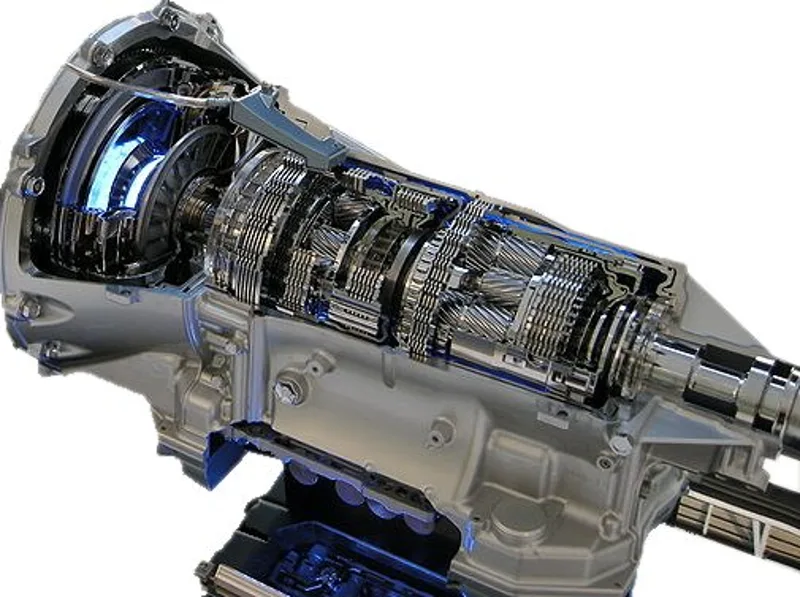
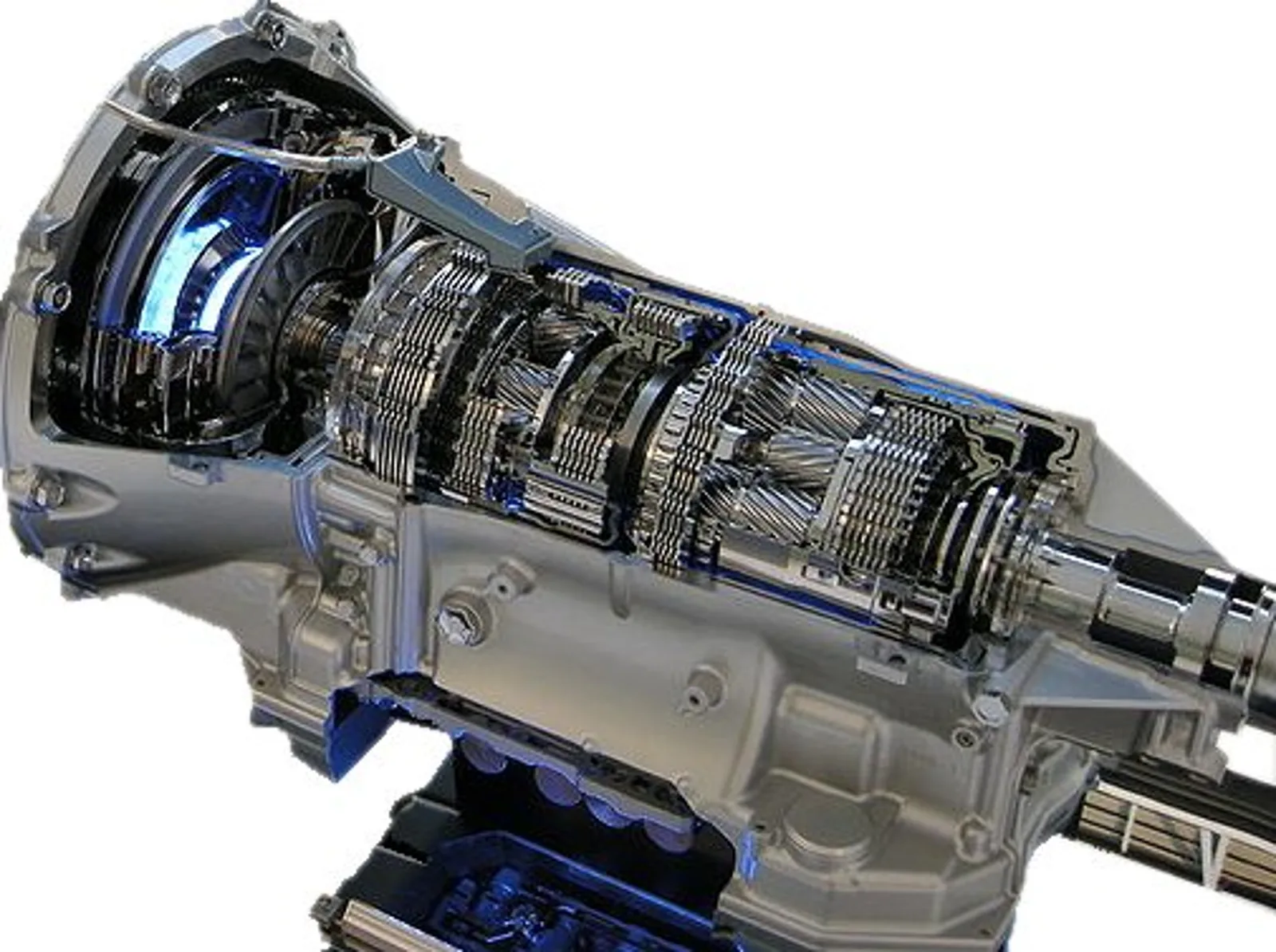
The manual transmission, sometimes called a manual gearbox, stick shift or standard, has a clutch pedal and a hand-operated gear stick. Semi-automatic transmissions are mechanically the same but use automation to work the clutch, while the driver still chooses each gear. Fully automatic designs spread widely in the 1940s, when the hydraulic automatic became common in mass-production cars.
Continuously variable transmissions followed, with the Variomatic in 1958 as the first mass-production example. Automatics with manual shifting appeared in the early 1990s, starting with the Porsche Tiptronic. Computer-controlled single-clutch automated manuals, pioneered by BMW and Ferrari, reached production cars in the mid-1990s, and Alfa Romeo's Selespeed used the same system as those makers. The first mass-production dual-clutch transmission came with the fourth-generation Volkswagen Golf R32 in 2003.
On automatic selectors, the pattern is generally straight, starting with park at the most forward position and running through reverse, neutral and drive, then into the lower gears. Some automatics also carry extra controls that alter the transmission's choices depending on the engine and road speed.
How did lighting and signal controls develop?
Early headlights and signal lamps were fuelled by acetylene or oil. Acetylene was preferred because its flame resisted wind and rain. Acetylene headlights gave a strong green-tinted light and stayed in use through the First World War, even though electric headlights had appeared in 1898, powered by batteries.
Electric lighting only fully replaced acetylene once high-wattage bulbs and stronger car generating systems were developed in the late 1910s. Electric turn signals date back to 1907, and the modern turn signal was patented in 1938. By 2013 most countries required turn signals on all vehicles driven on public roads.
The turn signal is usually operated by a horizontal lever that projects from the steering column. Cars also carry controls for headlamps and fog lamps.
Which instruments do drivers read?
Vehicles usually carry a set of instruments on the dashboard that show driving conditions and the state of the mechanics. The standard gauges are the speedometer, tachometer, odometer, fuel gauge, engine temperature gauge, ammeter and oil pressure gauge. Warning lights supplement them, indicating the selected transmission gear mode, the check engine light and the status of various systems.
Instrument design has moved from analogue dials towards digital readouts. Depending on the vehicle, more specialised displays may show a trip computer, a fuel economy gauge or a battery level. Some instruments sit behind the steering wheel, while others are mounted centrally below the windscreen or integrated into the centre stack above the climate and audio controls.
How were engines started before the starter motor?
Before the starter motor, engines were started by difficult and sometimes dangerous methods, ranging from springs wound by hand to gunpowder charges and detachable cranks. The first electric starter was installed on an Arnold in 1896, one of the first motor cars made in the United Kingdom.
In America, Charles Kettering and Henry Leland filed US patent 1,150,523 for an electric starter in 1911, and 1912 brought a starter to the Cadillac Model Thirty, the first American car so equipped. Before Chrysler's 1949 key-operated combined ignition and starter switch, drivers pressed a button on the floor or dashboard. That style has returned with keyless entry.
Some early Chevrolets placed the starter pedal beside the accelerator, with a second throttle knob on the dashboard, since working both by foot was awkward. The choke valve, ignition timing and spark arrestor were other manual controls that modern cars now handle automatically.
What controls do modern cars add?
Cars once needed manual controls for every part of starting and running the engine. Modern cars have automated most of those tasks, and they also carry controls that have nothing to do with driving. Climate control, satellite navigation, onboard computing, entertainment, wipers and touch displays all compete for the driver's attention.
The layout varies between vehicle types. Motorcycles use a hand lever for the throttle and a pedal for the gear shift. Some trams and light rail vehicles, such as the PCC streetcar, use car-style pedals to control speed. Formula One drivers set many parameters during a race, including brake balance, differential, ignition timing, regenerative braking and the rev limiter, all through controls mounted on the steering wheel.