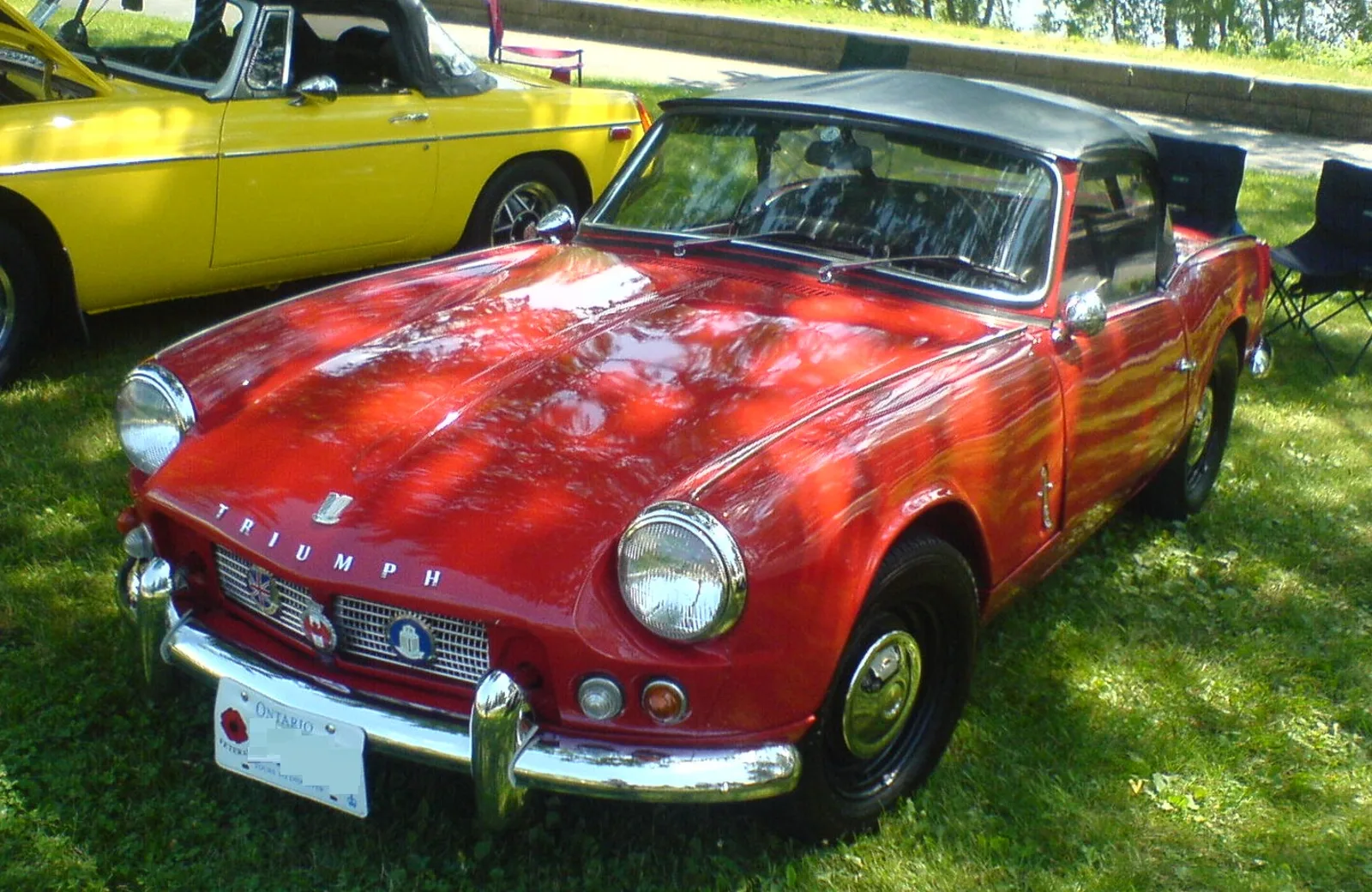
A bicycle importer's trade name became a British car marque, passed through Standard and British Leyland, and now sits with BMW as a dormant badge.
Triumph began in 1885 as a bicycle importer's trade name and later made motorcycles and cars in Coventry. Standard, Leyland and British Leyland each controlled the marque in turn, and the last Triumph car, the Acclaim, was retired in 1984. BMW now holds the trademark, which it has not used for a new car.
The Triumph Motor Company was a British car and motor manufacturer whose roots lay in a bicycle import business founded in 1885. Its cars were built from the 1920s until 1984, passing through the hands of Standard, Leyland and British Leyland along the way. Today the name belongs to BMW, which keeps it alive as a trademark rather than a working car brand.
Where did Triumph begin?
The marque began in 1885, when Siegfried Bettmann of Nuremberg formed S. Bettmann and Co. and began importing bicycles from Europe to sell in London under his own trade name. The name became Triumph in 1886, and Moritz Schulte, a fellow German, joined Bettmann in 1887.
In 1889 the two businessmen began making their own bicycles in Coventry, England. That move from importing to manufacturing gave the business a base in the English city.
A bicycle importer's trade name became a British car marque, then a BMW trademark, and never quite stopped being Triumph.
How did Triumph become a motorcycle maker?
In 1897 the business was renamed the Triumph Cycle Co Ltd, which reflected the name by then used on its products. In 1902 the company began producing Triumph motorcycles at its works on Much Park Street in Coventry, where the early machines used engines bought from another manufacturer.
The business prospered, and before long Triumph was making its own engines. In 1907 it bought the premises of a spinning mill on Priory Street to develop a new factory, which gave the firm the room it needed to grow.
The British Army placed major orders for the 550 cc Model H during the First World War, and Triumph ended the conflict as the country's biggest motorcycle maker, a title it had reached by 1918.
When did Triumph make its first car?
Triumph manufactured its first car in 1923, but the path to it began in 1921. That year Claude Holbrook, the general manager, talked Siegfried Bettmann into taking over the Dawson Car Company's assets and its Clay Lane premises, and into making a car with a 1.4-litre engine.
Holbrook had joined the company in 1919 and was born in 1886, dying in 1979. He was the driving force behind the car programme.
The car was the Triumph 10/20, designed for the company by Lea-Francis. Triumph paid Lea-Francis a royalty on each car sold. Output of this car and its immediate successors stayed moderate.
What was the Triumph Super 7?
The Triumph Super 7 arrived in 1927 and changed the company's fortunes in cars. It sold in large numbers until 1934.
The Super 7 was the model that turned the car programme into a volume product. The renaming of the business followed in 1930.
Why did Triumph rename itself in 1930?
In 1930 the company was renamed Triumph Motor Company. Holbrook judged that a mass-market fight with bigger carmakers was hopeless, so he turned to costly models, introducing the Southern Cross and Gloria.
At first the new cars used engines made by Triumph but designed by Coventry Climax. In 1937 Triumph began producing engines to its own designs, which had been created by Donald Healey, who had become the company's experimental manager in 1934.
The change meant that from 1937 the company built engines to its own designs rather than relying on outside work.
What happened to Triumph's bicycle and motorcycle businesses in 1936?
The company encountered financial problems, and in 1936 its bicycle and motorcycle businesses were sold. The motorcycle side went to Jack Sangster of Ariel and became Triumph Engineering Co Ltd, which left the car company to concentrate on its own work.
The sale reflected how hard the business had become. Triumph could no longer carry all of its interests at once, and the decision to focus on cars made the company's core identity clearer.
Losing the bicycle and motorcycle operations marked the end of an era for the original trade name, which had been built on two wheels and a pedal before it grew into a car maker.
What were the Triumph Dolomite prototypes?
Healey purchased an Alfa Romeo 8C 2300 and used it as the basis for a new car model with an Alfa-inspired straight-eight engine, named the Triumph Dolomite. Three of these cars were made in 1934, and one was raced before being wrecked.
Cars sold as Dolomites from 1937 to 1940 had no link to these prototypes, so the later model should not be confused with the original experiments.
The prototype programme was ambitious for a company of Triumph's size.
How did the Second World War affect Triumph?
In July 1939 the Triumph Motor Company went into receivership, and its works and goodwill were put up for sale. The Thos. W. Ward scrapping company bought Triumph and placed Healey in charge as general manager.
The effects of the Second World War again stopped car production. The Holbrook Lane works were completely destroyed by bombing in 1940, which removed the company's main production site and left little to rebuild from.
The company's recovery depended on a sale to another group, and that sale would define the postwar years. What was left of Triumph was now a name and a few assets rather than a working factory.
How did Standard take over the Triumph name in 1944?
In November 1944 the Standard Motor Company acquired the Triumph name and the leftovers of the old firm. A subsidiary called Triumph Motor Company (1945) Limited was formed, and production moved to Standard's factory at Canley, on the outskirts of Coventry.
Standard had been supplying engines to Jaguar and its predecessor company since 1938, so the new owners already had close ties to the car trade. Their interest in the name was tied to the wider contest over post-war car design.
A dispute between Sir John Black, the managing director, and William Lyons, the head of Jaguar, is part of the story. Black wanted a car to rival the soon-to-be-launched postwar Jaguars, and the Triumph name gave him the means to try.
What cars did Standard-Triumph launch after the war?
The pre-war Triumph models were not revived. In 1946 a new range was announced, starting with the Triumph Roadster. Steel was scarce, so the Roadster was given an aluminium body made from surplus metal left over from aircraft production. The 1800 Town and Country saloon shared that engine and later became the Renown, with styling chosen by Sir John Black. The Mayflower light saloon followed a similar style.
All three carried the globe badge of the pre-war cars. When Sir John was forced to retire, the range was discontinued without a direct replacement, because sheet aluminium had become too expensive for most car makers compared with sheet steel.
Why was the TR2 so important to Triumph?
In the early 1950s the company assigned the Triumph name to sporting cars and the Standard name to saloons. In 1953 the Triumph TR2 was started, and it was the first of the TR series of sports cars that continued until 1981.
The TR2 wore a Standard badge at the front but the Triumph globe on its hubcaps.
The TR range proved so successful that Triumph became a more marketable name than Standard. The sports cars gave the brand a sporting identity that carried through its later models.
How did the Herald and the 2000 arrive?
Standard's small Eight and Ten saloons were due for replacement. Because the TR range had made Triumph a stronger name, the new car arrived in 1959 as the Triumph Herald.
The last Standard car made in the UK was replaced in 1963 by the Triumph 2000.
The Herald and the 2000 took Triumph from sports cars into everyday saloons.
How did Leyland change Triumph?
Standard-Triumph was bought by Leyland Motors Ltd in December 1960. Donald Stokes took over as chairman of the Standard-Triumph division in 1963. Leyland Motor Corporation acquired Rover in 1967, and a 1968 merger with British Motor Holdings created British Leyland Motor Corporation.
Triumph had set up an assembly facility in Speke, Liverpool, in 1960. The plant was designed to produce 100,000 cars per year, but only a maximum of 30,000 cars were ever built there, because it was never fully used for production and mostly served as an assembly plant.
Under Leyland and then British Leyland, the Triumph marque belonged to the Specialist Division, which went by the names Rover Triumph and later Jaguar Rover Triumph. For a brief spell in the mid-1970s the car marques were grouped under the name Leyland Cars.
What problems did Triumph's 1960s and 1970s cars face?
During the 1960s and 1970s Triumph sold a series of Michelotti-styled saloons and sports cars. The Dolomite Sprint was an advanced car, and in 1973 it already had a 16-valve four-cylinder engine.
Many Triumphs of this era gained a reputation for unreliability, particularly the 2.5 PI with its petrol injection. The system had fuel injection problems, and in Australia the summer heat caused petrol in the electric fuel pump to vaporise, which led to frequent malfunctions.
The injection system had proven itself in international competition, but it lacked altitude compensation to adjust the fuel mixture above 3,000 feet (910 m). The Lucas system proved unpopular, and Lucas did not want to develop it further, while Standard-Triumph dealers were reluctant to attend the training courses.
Why did TR7 production move between factories?
The only all-new Triumph model started as a Rover Triumph project was the TR7. It was built at three factories in turn, all of them later closed: Speke, the Leyland-era works in Liverpool, the original Standard site at Canley and finally Rover's Solihull plant.
Lynx, a fastback variant codenamed after an animal, was among the extended TR7-based plans dropped once Speke closed. The TR7 and its eight-cylinder TR8 offshoot both ended when the Solihull car section shut, although that plant kept building Land Rovers.
How did the Triumph name come to an end?
The last Triumph model was the Acclaim, introduced in 1981. It was essentially a rebadged Honda Ballade made under licence at the former Morris works in Cowley, Oxford.
In 1984 the Triumph name vanished as the Acclaim gave way to the Rover 200, a rebadged Honda Civic and Ballade successor. That change was the first phase of a rebranding of the Rover Group, which would see the Austin and Morris brands disappear by the end of the 1980s.
By then the BL car division had become the Austin Rover Group, which also dropped the Morris marque in 1984 along with the Triumph brand.
Who owns the Triumph name today?
BMW holds the trademark, having taken it on with the Rover Group in 1994. When BMW sold Rover it kept the Triumph and Riley names. The Phoenix Consortium, Rover's buyer, wanted Triumph too, but BMW refused, warning that the deal would collapse if Phoenix pressed the point.
The Standard marque was transferred to British Motor Heritage Limited, which still retains it. British Motor Heritage also licenses the Triumph name for spares and servicing of cars already on the road.
That arrangement keeps the name in use for spares and servicing.
Has Triumph ever been revived?
Early in the 2000s, reports suggested BMW might sell a cheaper rear-drive roadster built on the Z4, to take on the Mazda MX-5. It could have carried either the Austin-Healey or the Triumph name, and development took place, although production did not begin.
A 2005 report said BMW's Designworks studio in California suggested using the Triumph badge on the new Mini Roadster. Mini dealers rejected the idea, because they did not want to sell a second legacy brand or add extra showrooms.
In 2011 BMW applied for a European trademark on the Triumph laurel wreath badge, to be used on vehicles and a wide range of merchandise. The application was published in late 2012, and it fuelled further rumours. The BMW Australia communications chief said the brand was there to be rejuvenated if the company chose, but he struggled to see a place for it.
In 2023 the design house Makkina, working with permission from BMW, revealed the Triumph TR25 concept for the brand's 100th anniversary. Based on the BMW i3S, the car paid homage to the TR2 MVC575 Jabbeke of 1953, and its designers said the platform could bring it to production if the opportunity arose.
What do the Triumph badges tell us?
Pre-war Triumphs wore a stylised globe, normally on the radiator grille, and the first three Standard-era models kept it.
In 1947 Standard introduced its own griffin-wing motif, first used on the Vanguard. With the TR2 the griffin reached the bonnet for the first time, while the globe stayed on the hubcaps.
Leyland's corporate badge, based on the spokes of a wheel, appeared on the 1500FWD and next to the Triumph name on the identification labels. The Stag carried a unique grille badge showing a stylised stag, and the last TR7 and Dolomite versions received a badge with the word Triumph inside laurel wreaths, which was also used on the Acclaim.
Which Triumph models shaped the marque?
| Model | Years | Note |
|---|---|---|
| Triumph 10/20 | From 1921 | First car programme, with a 1.4-litre engine designed by Lea-Francis |
| Super 7 | 1927 to 1934 | Sold in large numbers, a volume success |
| Southern Cross and Gloria | From 1930 | Expensive cars introduced after the renaming |
| Dolomite | 1937 to 1940 | Production cars unrelated to the 1934 prototypes |
| TR2 | From 1953 | First of the TR sports cars, produced until 1981 |
| Herald | From 1959 | Replaced the Standard Eight and Ten |
| 2000 | From 1963 | Replaced the last UK-built Standard car |
| Dolomite Sprint | 1973 | Advanced car with a 16-valve four-cylinder engine |
| Acclaim | 1981 to 1984 | Rebadged Honda Ballade, the last Triumph model |
Triumph's history runs from bicycles in Coventry to the last rebadged Honda in 1984, through several changes of ownership. Its name survives today as a trademark.