Founded in 1946 by Soichiro Honda, the company grew from motorbikes into cars, engines, robots and aircraft, and it still leads the world in motorcycle output.
Honda is a Japanese automaker founded in October 1946 by Soichiro Honda and headquartered in Tokyo. Its motorcycle business has been the largest in the world since 1959, and it launched the Acura luxury brand in 1986 before building a long Formula One record.
Honda is a Japanese manufacturer that began with piston rings, moved into motorbikes and went on to build cars, engines and aircraft. Founded by Soichiro Honda, it has led the world in motorcycle output since 1959. Its Civic, its Acura luxury brand and its Formula One record make it one of the most recognisable names in motoring.
When was Honda founded and what did it make first?
Soichiro Honda founded the company in October 1946 after building a business around piston rings. Tokai Seiki, which he had set up in 1937, made piston rings that were supplied to Toyota before the war. The earliest products after the war were improvised motorised bicycles fitted with 50 cc two-stroke engines.
Soichiro had spent time as a mechanic, preparing cars and taking them into races. That hands-on background shaped the company from the start, and the early years were a matter of making do with what was available.
Toyota took a 40% stake in Tokai Seiki during the war, and the two firms stayed linked long afterwards. After the war Soichiro sold the salvageable remains of the company to Toyota for 450,000 yen and used the money to start again.
Honda Motor Co. was incorporated in 1949. Takeo Fujisawa supplied the business and marketing expertise that complemented Soichiro's engineering, and the two worked closely together for many years. The A-Type motorised bicycle was nicknamed Bata Bata after the sound of its engine.
A piston ring workshop that became the world's largest motorcycle maker and then a global car brand.
How did Honda become the world's largest motorcycle maker?
Honda has been the world's largest motorcycle manufacturer since 1959 and reached a production of 500 million motorcycles by May 2025. At its 1982 peak the company made almost three million motorcycles a year. The volume rested on a steady run of popular models and an export push that began in the 1960s.
The company sold 90,000 motorcycles in the United States by the end of 1963. Its advertising helped, and the campaign used the slogan You meet the nicest people on a Honda, which challenged the rebellious image that American motorcycling had at the time.
Honda's market entry became a case study. In 1975 the Boston Consulting Group reported on why the British motorcycle industry had lost out to Japanese rivals. Richard Pascale later described Honda's US entry in 1984 as a story of miscalculation and serendipity rather than a long-term plan.
Gary Hamel and C. K. Prahalad used Honda as an example of core competencies in 1989, arguing that its focus on internal combustion engine technology was the basis of its advantage. That analysis is still taught in business schools.
What were Honda's first cars?
Honda's first production car was the T360 kei truck, which went on sale in August 1963 with a 356 cc straight-four gasoline engine. The S500 sports car followed in October 1963, with chain-driven rear wheels that pointed to the company's motorcycle origins.
The Civic became the most widely known of the early cars. It is the second-longest continuously running Japanese nameplate in North America, after the Toyota Corolla, and it grew steadily larger and more upmarket over its generations.
The redesigned Civic won Motor Trend Car of the Year in 2006, and the Ridgeline won Motor Trend Truck of the Year the same year. That double win was rare, and it helped cement the brand's reputation for sensible engineering.
When did Honda begin building hybrids and fuel-cell cars?
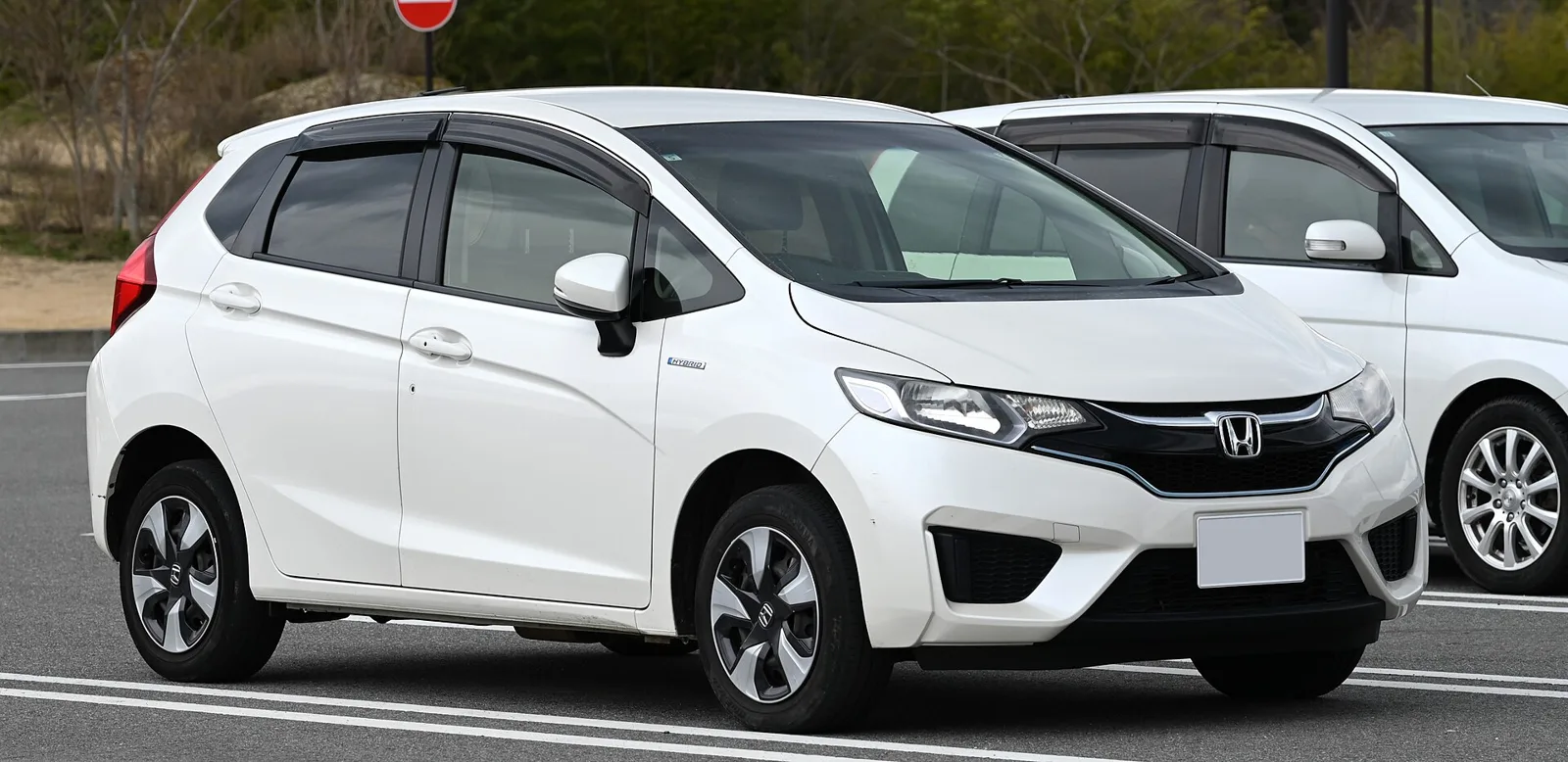
Honda's first hybrid was the 1999 Insight, which was rated at 70 mpg-US on the EPA highway cycle. The Civic followed as a hybrid in 2001, the Accord in 2004, and the Clarity fuel cell car launched in 2008.
The FCX Clarity began assembly-line production on 16 June 2008. Global hybrid sales passed 1 million in September 2012, a milestone that showed how far the company had moved from its early petrol-only range.
The CR-V e:FCEV later added a plug-in hybrid fuel cell system. It carries two hydrogen tanks totalling 4.3 kg and a 17.7 kWh battery, giving the company another route to low-emission driving alongside its pure hybrids.
How have Honda's electric vehicle plans fared?
Honda launched the Honda e in 2020 with a range of 137 mi (220 km), and the e:Ny1 in 2023, with a range of 256 mi (412 km) on its top model. The e:Ny1 was the company's first electric SUV, and it showed the direction Honda intended to take.
The EV programme has since been reshaped by the company's choices about partners and platforms. Honda's hybrid business remains the core of its low-emission strategy while that reshaping takes place.
In March 2026 Honda said it expected up to $15.7B in expenses and losses from reassessing its EV strategy. It also reported a net loss of 423.9 billion yen for the year ending March 2026, which was driven in large part by the cost of that strategy.
The company also cancelled the 0 Saloon, 0 SUV and Acura RSX in March 2026. Earlier, the EV Plus of 1997 had been a limited attempt, with about 276 units sold in the United States before production ended.
What did ASIMO achieve?
ASIMO was released in 2000 and weighs 54 kilograms, standing 130 centimetres tall. It walks at up to 6 km/h (3.7 mph) and was developed within Honda's research and development robotics programme.
Honda also developed the HondaJet HA-420, whose production began in 2012 under its aircraft subsidiary. Honda invested about 5.7% (US$6.8 billion) of its revenues in research and development in 2013, which underlined how much the company spent on new technology across its businesses.
How successful has Honda been in Formula One?
Honda entered Formula One in 1964 and won its first race at the 1965 Mexican Grand Prix. Between 1986 and 1991 it won five consecutive Drivers' Championships, and in 2021 it won the World Drivers' Championship with Max Verstappen at Red Bull Racing.
Honda left Formula One after the 1992 season, in a decision that followed a change of leadership and a fresh focus on costs. It later returned as a power unit supplier, which kept the company close to the sport for years.
Honda returns to Formula One in 2026 as a works team with Aston Martin. That brings the company back to its original role in the sport, building both the engine and the team effort around it.
What has Honda achieved in other forms of racing?
Honda won the Indianapolis 500 for the first time in 2004, and Honda engines powered all 33 cars at the 2010 Indianapolis 500. In sports car racing the company won the 24 Hours of Le Mans in 1995 in the GT2 class, showing its reach beyond single-seater racing.
In motorcycle racing, Honda won its first 500 cc Grand Prix World Championship in 1983 with Freddie Spencer. It has claimed seventeen Motocross World Championships and has taken 227 solo race victories at the Isle of Man TT.
How did Honda's reputation grow abroad?
Honda built its reputation through clever marketing as well as engineering. Its 2003 Cog advertisement took 100 takes to film, and the company became known for humorous campaigns that set it apart from more formal rivals.
The Hondamentalism campaign highlighted the engineers who push engines to their limits, from motorbikes and cars to powerboats and lawnmowers. The message was that the company's racing spirit runs through everything it builds.
How were Honda's Japanese dealerships organised?
Between 1978 and 2006, Honda ran three sales channels in Japan. Verno handled the sportier and better-equipped models, Clio carried the Accord, and Primo sold the smaller cars and kei vehicles.
In March 2006 the three channels merged into one Honda Cars brand, which simplified the dealer structure at home.
What were Honda's finances like in 2018 and 2026?
In the fiscal year 2018 Honda reported earnings of US$9.534 billion on revenue of US$138.250 billion. Its market capitalisation stood at US$50.4 billion in October 2018.
Those figures show a company whose profits once rested on motorcycles and cars alike, and whose scale gave it room to invest heavily in new technology.
By 2026 the company's market capitalisation had fallen to around US$32 billion. The swing reflected the heavy cost of the electric vehicle programme, which the company has been forced to reassess in recent months.
Who leads Honda today?
Toshiaki Mikoshiba has been chairman since April 2019, and Toshihiro Mibe has been president and chief executive since April 2021. Their predecessor, Takahiro Hachigo, led the company until 2021, when the leadership passed to Mibe.
Earlier leaders include Soichiro Honda himself, and Nobuhiko Kawamoto, who shaped the company's product strategy during the 1990s and ended the Formula One programme after the 1992 season.
What happened in the Nissan merger talks?
Honda and Nissan discussed a merger in late 2024, which would have created a much larger group. Talks ended in February 2025 after the two boards voted to stop, and the merger never went ahead.
Analysts watching the talks saw real scale in a combined group, but the two boards concluded that the terms could not be agreed. The collapse left both companies to pursue their own plans.
Growing differences were behind the collapse. Honda's proposal that Nissan become a subsidiary was among the sticking points, and Mitsubishi Motors was also part of the wider talks before they ended.
Honda at a glance
The table below gathers the company's headline figures, from its founding and headquarters to its finances, leadership and return to Formula One. It is a quick reference for the numbers that matter most.
| Specification | Detail |
|---|---|
| Founded | October 1946 by Soichiro Honda |
| Headquarters | Toranomon, Minato, Tokyo |
| Acura launch | March 1986 |
| Largest motorcycle maker | Since 1959 |
| Motorcycle production | 500 million by May 2025 |
| Revenue, fiscal 2018 | US$138.250 billion |
| Market capitalisation | US$50.4 billion (October 2018) |
| Net loss, year to March 2026 | 423.9 billion yen |
| EV expenses and losses | Up to $15.7B (March 2026) |
| Chairman | Toshiaki Mikoshiba (since April 2019) |
| President and CEO | Toshihiro Mibe (since April 2021) |
| Formula One return | 2026, as a works team with Aston Martin |
Frequently asked questions
What is the Honda Super Cub?
The Super Cub is the most produced motor vehicle in history. It sits within a motorcycle business that has produced 500 million motorcycles as of May 2025.
When did Honda enter Formula One?
The first Formula One win came at the 1965 Mexican Grand Prix. The 2026 return is as a works team with Aston Martin.
What is ASIMO?
ASIMO is Honda's humanoid research robot, released in 2000. It weighs 54 kilograms and walks at up to 6 km/h (3.7 mph).
Which was Honda's first hybrid?
The 1999 Insight was Honda's first hybrid. Honda's Civic hybrid followed in 2001, after the Insight had proved the concept.
How many vehicles did Honda recall in 2023?
In December 2023 Honda recalled about 4.5 million vehicles globally, a move that followed earlier recalls for the same type of issue.