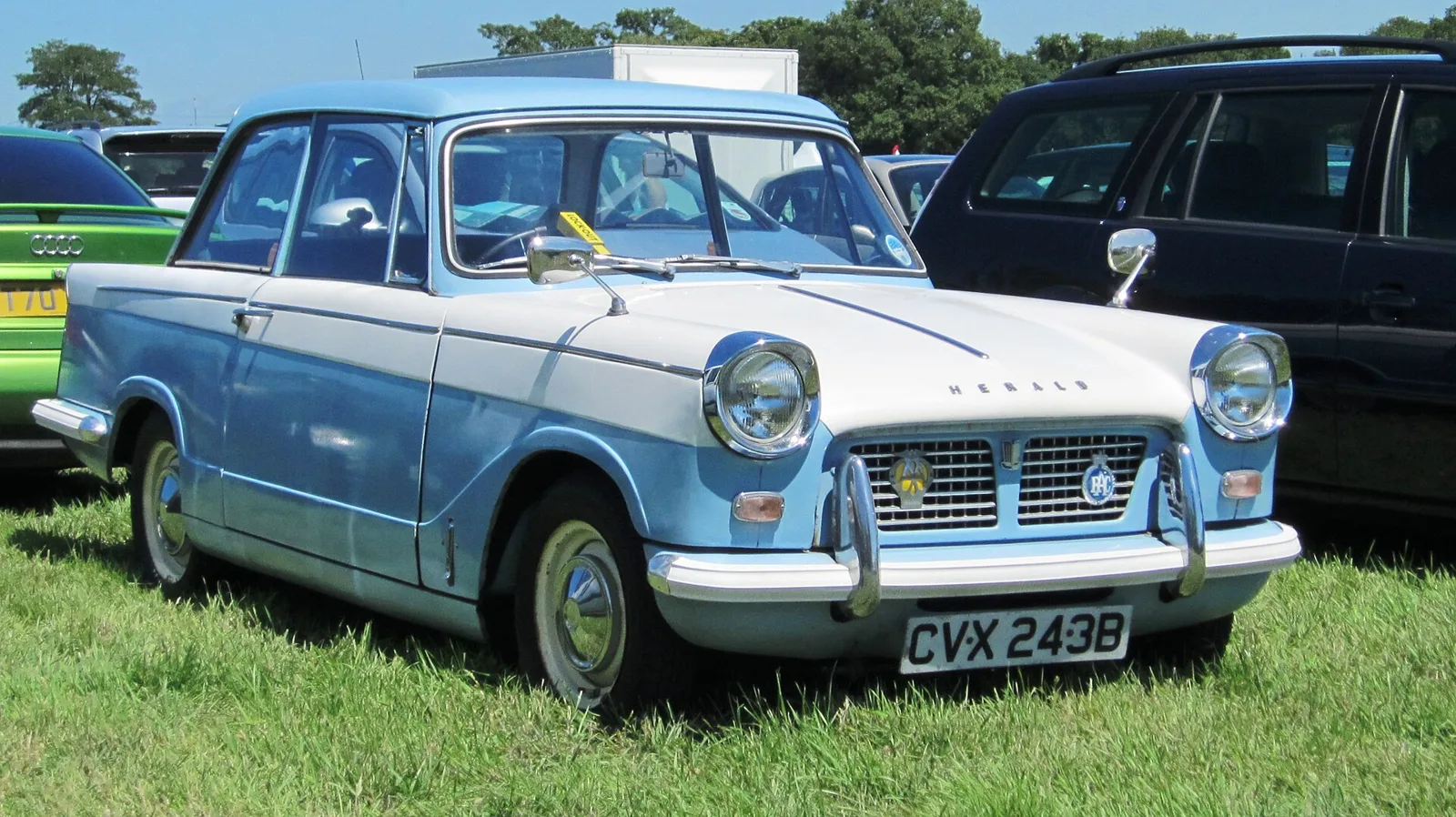
A 1959 Standard-Triumph design that sold well over half a million cars and lived on as the chassis behind the Vitesse, Spitfire and GT6.
The Triumph Herald was a 1959 two-door from Standard-Triumph, styled by Michelotti and offered as saloon, convertible, coupe, estate and van. It began with a 948 cc four, grew to a 1296 cc 13/60 and ended in 1971.
The Triumph Herald was a small two-door car that Standard-Triumph built in Coventry from 1959 until 1971. Its body was styled by Giovanni Michelotti, and it came as a saloon, convertible, coupe, estate and van. Total Herald sales were well over half a million, and the Vitesse, Spitfire and GT6 later used modified Herald chassis.
Where did the Herald come from?
Standard-Triumph began work on the Herald in the late 1950s, when its two-seater sports cars and Standard saloons, powered by 803 cc or 948 cc four-cylinder engines, were due for an update. The Herald name matched the Standard naming scheme of Ensign, Pennant and Standard, which made it look like a Standard model at first.
By 1959 the Triumph name was judged the stronger brand, and the Standard name disappeared from British showrooms after 1963. Chief engineer Harry Webster encouraged the board to commission Giovanni Michelotti, who sketched a two-door saloon with a generous glass area.
Michelotti's saloon gave 93 per cent all-round visibility and carried the razor-edge look that many makers were adopting. Because Standard-Triumph's body suppliers had become part of the British Motor Corporation, which was not especially cooperative, the company chose a separate chassis rather than unitary construction.
A Michelotti body on a separate chassis, bolted together so one design could wear many shapes.
How was the Herald built?
The Herald used a separate chassis, with the body tub bolted on and the whole front end hinged forward for engine access. Each panel, the sills and roof included, could be bolted off, so different body styles could be built on the same chassis. A convertible joined the saloon and coupe in 1960.
The steering was rack and pinion, so the car turned within 25 feet (7.6 m). The front used coil springs and double wishbones, a layout that Lotus, Bill Thomas and Reliant later copied. The rear used one transverse leaf spring fixed to the final drive, with swing axles that offered limited independent springing.
Early saloons had one large speedometer with a fuel gauge on a grey pressed-fibreboard dashboard, and a temperature gauge was an option. The coupe added temperature gauge and a lockable glovebox. Loop-pile carpet and a heater were standard, and extras included twin SU carburettors, leather seats and a wood-veneered dashboard.
What engine did the first Herald have?
The first Herald used a 948 cc OHV four-cylinder engine, closely related to the units in the Standard Eight and Ten. It drove the rear wheels through a four-speed manual gearbox whose top three ratios were synchronised, and single-carburettor cars made 34.5 bhp (26 kW).
Performance was modest. The Motor tested a 1959 saloon at 70.9 mph (114.1 km/h), with 0-60 mph (97 km/h) taking 31.1 seconds, and it returned about 8.2 L/100 km, or 34.5 mpg-imp and 28.7 mpg-US. Reviewers criticised the rear suspension at the limit, but they liked the visibility, light steering and ease of repair.
The launch was staged on 22 April 1959 in the Royal Albert Hall, London. Prototypes covered the Cape Town to Tangiers route in late 1958, and publicity later embellished the account of that journey. Only minor changes separated the prototypes from production cars.
The launch did not bring an immediate rush of orders. The price was a barrier, because the car cost roughly GBP 700 once 45 per cent Purchase Tax was added, and the basic 34.5 bhp model was no better than average for performance.
Why did the Herald 1200 replace the original?
Standard-Triumph hit money problems early in the decade, and Leyland Motors bought control of it in 1961. That brought new resources, and in April 1961 the car returned as the Herald 1200, with an 1147 cc engine rated at 39 bhp (29 kW).
The 1200 added rubber bumper covers, a laminated wooden dashboard and better seats, and quality control was tightened. Twin carburettors were no longer standard, though they stayed on the options list, and the standard unit was a single Solex downdraught carburettor. A three-door estate joined the range a month later, and disc brakes became optional from 1962.
Sales picked up even though the Mini and Ford Anglia were gaining ground. The coupe was dropped in late 1964 because it had become a rival to the Triumph Spitfire, while the 1200 stayed in production until 1970.
What was the Herald 12/50?
The Herald 12/50 was an upmarket two-door saloon built from 1963 to 1967. It used a tuned engine rated at 51 bhp (38 kW), and it had a sliding sunroof in vinyl fabric, front disc brakes from the factory and a fine-barred aluminium grille.
The ordinary 1200 continued alongside it, and its output was later raised to 48 bhp. Australia built a 12/50 of its own, available as both saloon and coupe and sold without Herald badges.
What was the Courier van?
The Courier van replaced the rear side windows of the estate with solid side panels. It was built from 1962 to 1966 and powered by the 1147 cc engine, but poor sales ended it. Production in England finished in mid-1964, while CKD assembly by MCA in Malta continued until late 1965 at least.
How did the Herald 13/60 change the car?
The Herald 13/60 arrived at the London Motor Show in October 1967 with a 1296 cc engine, a Stromberg CD150 carburettor and 61 bhp (45 kW). It also had a restyled front with a bonnet similar to the Vitesse's and a revised interior, although the wooden dashboard stayed.
The larger engine was essentially the unit used in the Triumph 1300 since 1965. The saloon outlived the 1300 that had been designed to replace it, and the 1200 saloon was sold alongside the 13/60 until the end of 1970. Because construction was labour-intensive, the Herald was selling at a loss by the end.
What were the Herald's core specifications?
The table sets out the figures for the original 948 cc car, the 1200, the 12/50 and the 13/60. Power rose from 34.5 bhp (26 kW) on the first car to 61 bhp (45 kW) on the final 13/60, while the rack and pinion steering stayed in place across the range.
| Specification | Detail |
|---|---|
| Introduced | 1959, Standard-Triumph, Coventry |
| Original engine | 948 cc OHV four-cylinder, 34.5 bhp (26 kW) |
| Herald 1200 engine | 1147 cc, 39 bhp (29 kW) |
| Herald 12/50 engine | Tuned unit, 51 bhp (38 kW) |
| Herald 13/60 engine | 1296 cc, 61 bhp (45 kW), Stromberg CD150 carburettor |
| Gearbox | Four-speed manual, synchromesh on top three gears on the 948 cc car |
| Steering | Rack and pinion, 25-foot (7.6 m) turning circle |
| Top speed, 1959 saloon | 70.9 mph (114.1 km/h), as tested by The Motor |
| 0-60 mph, 1959 saloon | 31.1 seconds |
| Fuel economy, 1959 saloon | 8.2 L/100 km; 34.5 mpg-imp; 28.7 mpg-US |
| Launch price | About GBP 700 with 45 per cent Purchase Tax |
| Production ended | 1971 |
How did the Herald sell overseas?
Heralds were assembled in many countries from complete knock-down kits, with the separate chassis used as a jig. The Australian Motor Industries plant built 14,975 units between 1959 and 1966, and the Madras works of Standard Motor Products made the car for India.
In India the car was built as the Standard Herald, with extra four-door saloon and five-door estate versions for the home market. In 1971 a restyled four-door saloon, the Standard Gazel, appeared on the Toledo axle, because the Herald swing-arm was judged unable to cope with Indian roads. The Gazel was discontinued in 1977.
Kits were also put together in South Africa, New Zealand, Ireland and Malta, plus two Peruvian sites. Ducati's Borgo Panigale motorcycle factory in Italy also assembled the 1200 model.
Which cars were built on the Herald?
The Vitesse, Spitfire and GT6 were built on reworked Herald underpinnings, each with bodywork that bolted on. The Bond Equipe was built with Herald chassis and components, and the separate body on a chassis made the Herald a sound starting point for kit cars.
Sussita 12 and 13/60 cars were built in Israel between 1968 and 1975, using the 12/50 and 13/60 engines respectively. The New Zealand T car by Alternative Cars was a fibreglass replica of the MG TF, and about 250 were made. The German-built Amphicar used the same 1147 cc engine as the Herald, although Michelotti did not design it.
Where did the Herald appear in film and television?
The Herald appeared on screen across several decades. In A Man Could Get Killed, released in 1966, Tony Franciosa drove a Herald convertible, and a 1961 convertible met a fiery end in the 1971 film Melody. A Herald also took part in the opening of the closing ceremony at the 2012 London Olympic Games.
On television, In the 1960s drama Heartbeat, a cactus green Herald was the car of Dr Kate Rowan from series 1 to series 5, while Edie drove a red convertible in Last of the Summer Wine. A Herald converted into a sailing boat appeared on Top Gear in 2006 and 2007, driven and sailed by James May.
Other films include Paper Mask, released in 1990, where Paul McGann drove a white 1360 convertible, and Paper Tiger from 1975, in which David Niven escaped terrorists in a battered convertible. Soft Top Hard Shoulder, a 1993 film written by Peter Capaldi, who also starred, featured a blue 13/60 convertible as one of its main features.
Were Herald models sold as toys?
Scale models arrived early. Dinky's No. 189 was the first scale model introduced to coincide with a real car launch, and it was produced from 1959 to 1963. Corgi offered a Herald coupe, Airfix sold a 1/32 bagged kit from 1967, and Hongwell later made a 1/43 model.
Frequently asked questions
How much did the Herald cost when new?
Launch pricing put the car near GBP 700 with its 45 per cent Purchase Tax, which slowed early sales.
How many Heralds were sold?
The saloon, convertible, coupe and estate models together sold well over half a million cars.
When did disc brakes arrive on the Herald?
Disc brakes became an option from 1962, and the 12/50 had front discs as standard equipment.
Which Herald came last?
The 13/60 was the final version. The saloon ended in December 1970, and the convertible and estate followed in May 1971.
Was there a Herald van?
Yes. The Courier was a van derived from the Herald estate, built from 1962 to 1966.