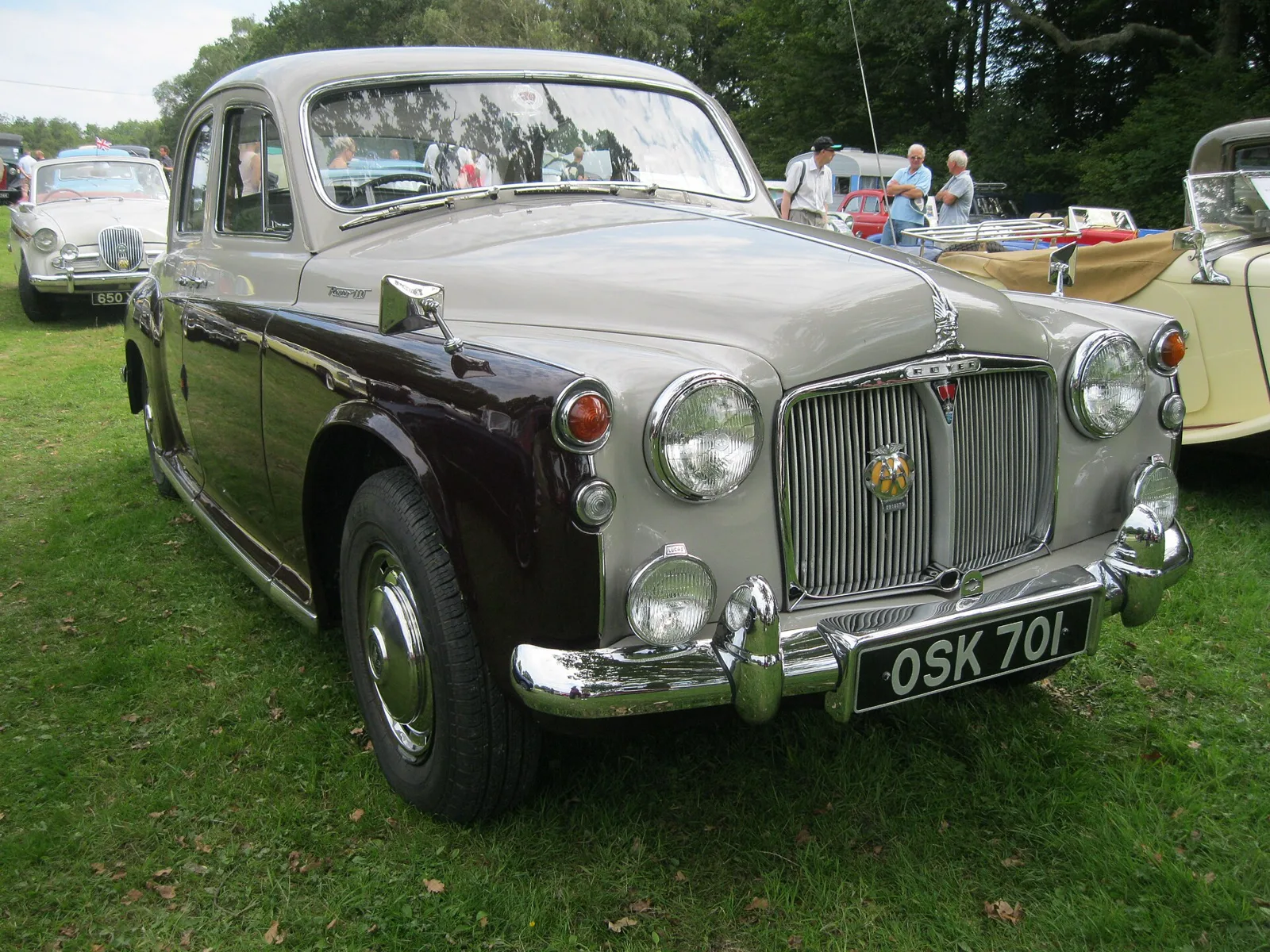
A mid-size luxury saloon family from 1949 to 1964, the P4 covered the Rover 75 to 110 and gave its bodyshell to the company's gas turbine experiments.
Between 1949 and 1964 Gordon Bashford's design gave Rover a range of mid-size luxury saloons, running from the 2.1-litre Rover 75 to the 2.6-litre Rover 110. The larger Rover 3-litre P5 joined the range in September 1958, and the Rover 2000 replaced the whole family.
The Rover P4 was a family of mid-size luxury saloons built by the Rover Company from 1949 until 1964. Designed by Gordon Bashford, the range ran from the six-cylinder Rover 75 up to the Rover 110, and its cars were nicknamed Auntie Rovers. The series also gave its bodyshell to the company's gas turbine experiments.
Where did the Rover P4 come from?
The P4 designation was factory terminology, and owners knew the cars by names such as Rover 75, 60, 90 and later 100 and 95. The P4 replaced the outdated P3 Rover 75 and began production in 1949 with the six-cylinder 2.1-litre car.
The new Rover 75 was announced on 23 September 1949 and first displayed on the opening day of the Earls Court Motor Show, on 28 September 1949. At that point it was the only Rover in production.
Four years later, in 1953, a 2-litre four-cylinder Rover 60 and a 2.6-litre six-cylinder Rover 90 were added. The 60 sat below the 75 and the 90 topped the three-car range, aimed at a wider field of motorists with differing needs for performance and running costs.
A mid-size saloon family that carried Rover from a six-cylinder 75 to the gas turbine age.
What did the Rover 75 look like?
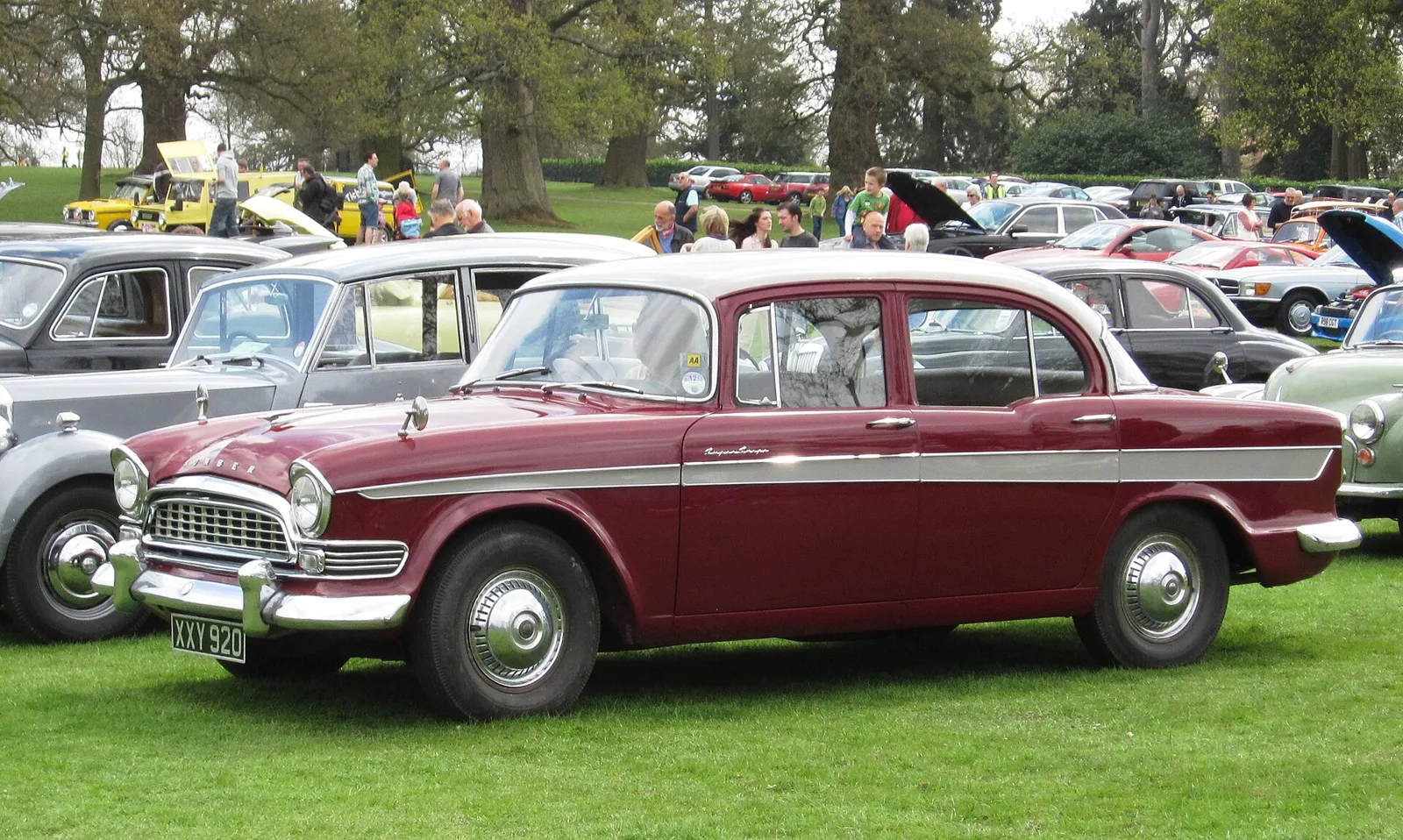
The 75 broke sharply with the P3. The traditional radiator, separate headlamps and external running boards were gone, replaced by a chromium grille, recessed headlamps and a streamlined body that ran the full width of the chassis. A steering column gear lever completed the modern look.
The styling drew on the then controversial 1947 Studebakers. Rover bought two of them, fitted the body of one to a prototype P4 chassis, and produced a development mule known as the Roverbaker. The new car's proportions were different from almost every other new car of the day.
Critics ridiculed the bonnet-like extension at the rear. The driver sat well forward over a relatively short bonnet, while the rear wheels were set back behind the rear seat. Rover had clearly tried to shake off its old image, even if not everyone accepted the result.
The grille carried a single centrally mounted light, known as the Cyclops eye. Most rivals used a pair of lamps, and the Cyclops eye never caught on. It was dropped when a new grille was announced on 23 October 1952.
How did the P4 drive and what was it built from?
The P4 used a separate chassis with independent front suspension on coil springs and a live rear axle on half-elliptical leaf springs. Early cars used a hybrid hydro-mechanical brake system before moving to fully hydraulic brakes in 1950. Front drums gave way to Girling discs in October 1959.
The 75's engine was a 2.1-litre IOE straight six, 2103 cc or 128 cu in, with chromium-plated cylinder bores and an aluminium head that had the induction manifold built in. Twin horizontal carburettors replaced the earlier downdraught pair. The engine grew to 2.2 litres (2230 cc, 136 cu in) in October 1954.
The gear lever began on the steering column and moved to a floor-mounted unit in September 1953. Synchromesh was first fitted only on third and top, and second gained it in 1953. A freewheel clutch, a traditional Rover feature, stayed on cars without overdrive until mid-1959.
The body shells came from Pressed Steel, with alloy doors, boot lid and bonnets in Birmabright, an aluminium and magnesium alloy. Those panels dented easily when not closed carefully, so the final 95 and 110 models used steel instead. The P4 was also one of the last British cars with rear-hinged so-called suicide doors.
How fast was the Rover 75 on the road?
The Motor tested a 75 in 1949 and recorded a top speed of 83.5 mph (134.4 km/h) and 0 to 60 mph (97 km/h) in 21.6 seconds. Economy measured 27.8 mpg imperial (10.2 L/100 km; 23.1 mpg-US). The tested car cost GBP 1106 including taxes, and its turning circle measured 37 feet (11 m).
The 1954 test of the Rover 60 gave 76.0 mph (122.3 km/h) and 26.5 seconds to 60 mph. Fuel use came to 25.8 mpg imperial (10.9 L/100 km; 21.5 mpg-US), and the car cost GBP 1162 with taxes included. The 60 was an economical choice rather than a fast one, and its 60 bhp (45 kW) engine came from the early Land Rover.
What made the Rover 90 the most popular P4?
The Rover 90 was the top model, with a much larger 2.6-litre inline six. It made 90 hp (67 kW) and could reach 90 mph (145 km/h). Its 35,903 sales made it the most popular car of the P4 series before the Rover 100 replaced it in October 1959.
The cast-iron block carried an aluminium head, with a bore of 73.025 mm (2.9 in), a stroke of 105 mm (4.1 in) and a compression ratio of 6.73:1. This was raised to 7.5:1 in 1956, lifting output by 3 horsepower to 93.
The 1956 model arrived in September 1955 with independently adjustable front seats at extra cost. The freewheel was dropped in favour of Laycock de Normanville electric overdrive, and pleats were added to the seats, a treatment that continued on later P4 models.
The Motor tested the Ninety in 1954 and recorded 90.0 mph (144.8 km/h) and 18.9 seconds to 60 mph. The price was GBP 1297 with taxes, and economy was 20.3 mpg imperial (13.9 L/100 km; 16.9 mpg-US). A MotorSport road test in September 1956 found the steering heavy and spongy, and the firm suspension brought column shake and body judder.
Why did the 105R and 105S matter?
On 16 October 1956 Rover introduced the 105R and 105S, which used a high-output version of the 2.6-litre engine with 8.5:1 compression, which took advantage of higher octane fuel. The twin-SU carburettor engine made 108 brake horsepower (81 kW), and the 105R offered an automatic transmission that Rover designed and built itself.
The Roverdrive was a two-speed automatic with overdrive, giving three forward gears. It was the only British-built automatic of its time, as rivals bought units from American makers such as Borg-Warner. The 105S kept a manual gearbox with Laycock de Normanville overdrive and a kick-down control, and it could reach 101 miles per hour (163 km/h).
The Motor tested a 105R de Luxe in 1957 and recorded 93.9 miles per hour (151.1 km/h) and 23.1 seconds to 60 mph, for GBP 1696, including GBP 566 of taxes. The 105R ended in 1958, the manual 105S in 1959, and 10,781 cars were built, two-thirds with the manual option.
What was the four-cylinder Rover 80?
The Rover 80 used a new Land Rover-derived straight-four overhead-valve engine of 2.3 litres (2286 cc, 138 cu in), entirely different from the six-cylinder units in the rest of the range. It produced 80 hp (59 kW) and could top 85 mph (137 km/h). It was announced on 24 October 1959.
The four-cylinder cars were never popular. Just 5,900 were built before production ended after roughly three years, and the Rover 95 took over in September 1962. Overdrive on top gear was standard, and options included a radio, two-tone paint and either a bench or individual front seats.
The Motor tested an 80 in 1961, recording 82.9 mph (133.4 km/h) and 22.4 seconds to 60 mph, while fuel use was 23.5 mpg imperial (12.0 L/100 km; 19.6 mpg-US). The test car cost GBP 1396 with GBP 411 of taxes.
How did the Rover 100, 95 and 110 close the series?
The Rover 100 was announced on 21 October 1959 as the successor to the Rover 90 and 105. It used a seven-bearing 2.6-litre six, a short-stroke version of the P5 3-litre engine, and could reach 100 mph (161 km/h). Production ended in 1962 after 16,521 cars.
The 100 had a luxurious interior with wood and leather accents on classic English car elements. A bench or individual front seats could be ordered, a heater was standard, and top-gear overdrive was standard too. Servo-assisted Girling disc brakes were fitted at the front, with drums kept at the rear.
The Rover 95 and Rover 110 were announced on 27 September 1962 as the final members of the series. The 95 was a regeared 100 with a 3.9:1 final drive, offered at the price level of the four-cylinder 80 it replaced. The 110 had a more powerful engine and overdrive as standard, and both used steel door panels to reduce cost.
Higher octane fuel allowed compression to rise to 8.8:1. The 110, with a Weslake cylinder head, made 123 hp (91 kW), and the 95 made 102 hp (76 kW). The Motor tested a 110 on 30 January 1963 and recorded a mean maximum of 100.0 mph, 15.9 seconds to 60 mph and 20.6 seconds for the standing quarter mile, the fastest P4 the magazine tested.
After a run of some 15 years, the 95 and 110 gave way to the all-new Rover 2000, announced on 9 October 1963. P4 production wound down in May 1964, when a 2.6 litre 95 became the final car.
Did the P4 lead to gas turbine cars?
Yes. The P4 platform was the origin of the JET 1 prototype, which was displayed in Britain and America in 1950. JET 1 was a mid-engined two-seat open tourer built on the P4 bodyshell, and it was subjected to speed tests on the Jabbeke highway in Belgium in 1952.
The original JET 1 is on display in the Science Museum in London. Two further gas turbine prototypes were based on the P4. The four-door T2 carried its turbine under the bonnet at the front, but problems led Rover to abandon that layout and rebuild the car as the T2A, with the turbine over the rear wheels.
Rover P4 models at a glance
| Model | Introduced | Engine | Key figure |
|---|---|---|---|
| Rover 75 | 1949 | 2.1 L (2103 cc, 128 cu in) six | 83.5 mph top speed in 1949 test |
| Rover 60 | 1953 | 2.0 L (1997 cc, 121 cu in) four | 60 bhp (45 kW) |
| Rover 90 | 1953 | 2.6 L (160 cu in) six | 90 hp (67 kW), 93 hp from 1956 |
| Rover 105R | 1956 | 2.6 L six, 8.5:1 compression | 108 brake horsepower (81 kW) |
| Rover 80 | 1959 | 2.3 L (2286 cc, 138 cu in) four | 80 hp (59 kW) |
| Rover 100 | 1959 | 2.6 L (160 cu in) six | 100 mph (161 km/h) top speed |
| Rover 95 | 1962 | 2.6 L (160 cu in) six | 102 hp (76 kW) |
| Rover 110 | 1962 | 2.6 L (160 cu in) six, Weslake head | 123 hp (91 kW) |
.jpg)