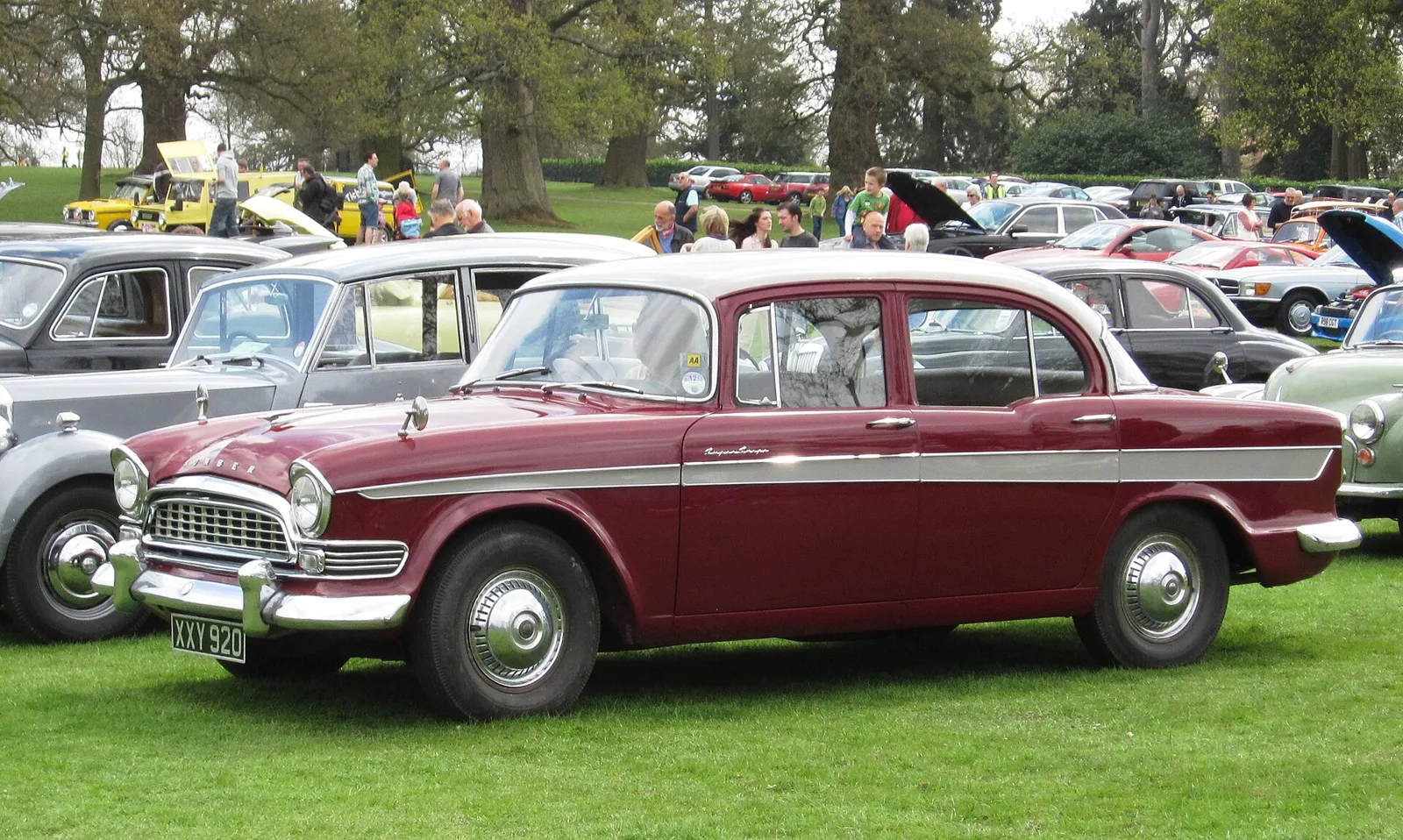
A Rootes Group executive car that began as a pre-war Humber, passed through Mark and Series versions, and ended as a Chrysler-era model.
Britain's Humber Limited produced the Super Snipe from 1938 until 1967. It was a six-cylinder executive car that began before the war, evolved through numbered versions and ended under Chrysler ownership.
The Humber Super Snipe was a British six-cylinder executive car built by Humber Limited from 1938 to 1967. It combined a larger Humber engine with the Snipe chassis, then passed through a long run of Mark and Series versions before the Chrysler era closed its story.
The car was aimed at managers, professionals and officials, and it was relatively affordable for its size and performance. This profile follows its pre-war origins, the post-war Mark cars, the 1958 Series models and the final years under Chrysler.
Where did the Super Snipe come from?
Launched in October 1938, the Super Snipe paired the four-litre six of the bigger Humber Pullman with the Snipe's chassis and body. The Snipe itself normally ran a three-litre engine. The result had a top speed of 79 mph (127 km/h), which was fast for its day.
Its design was contributed to by Delmar Barney Roos, an American engine specialist who had left Studebaker to join Rootes in 1936. The car was similar in appearance and concept to American cars, and it offered good value for money.
A six-cylinder executive car that began as a pre-war Humber and ended as a Chrysler-era model.
How did the Super Snipe serve in the war?
Within a year of its launch the Second World War had broken out in Europe, but the Super Snipe was kept in production as a British military staff car. The same chassis was also used for the Humber Light Reconnaissance Car, an armoured vehicle.
British military users included the Army, the Royal Navy and the RAF. Civilian production resumed in 1946, and the car then evolved through several numbered versions.
What changed in the Mark I and Mark II?
The Mark I was essentially a six-cylinder version of the 1945 Humber Hawk. Its standard engine was a side-valve unit that had first appeared in the Humber Pullman in 1936, and it was rated at 100 bhp at 3400 rpm.
The Mark II was announced in mid-September 1948 and was mostly redesigned in chassis and body. It became a full six-seater with a bench-type front seat, a wider track and variable ratio steering, and the gear lever moved to the steering column.
The Mark II also had headlights fitted into the wings and running boards brought back. Its transverse-spring independent suspension, first used on the Snipe and Pullman in 1935, now had 14 leaves instead of eight. Early examples carried fog and pass lamps, which were dropped in 1949.
The Times tested the new car at the end of 1948. It criticised the spare wheel as difficult to extract and the indirect gears as not as quiet as they might be, but it praised the finish. Tickford built 125 drophead coupes in 1949 and 1950.
What did the Mark III add?
The Mark III followed in August 1950. It was easily identified by spats over the rear wheels, and a Panhard rod was added to the rear suspension. That rod limited sideways movement of the rear wheels and allowed softer springs to be used.
The 1950 car could be told apart from its predecessor by simpler dome-shaped bumpers and rectangular stainless-steel foot-treads on the running boards. The Motor magazine tested one in 1951, recording a maximum of 81.6 mph (131.3 km/h) and a 19.1-second run to 60 mph.
That test also recorded fuel use of 17.7 mpg imperial (16.0 L/100 km; 14.7 mpg-US). The test car cost GBP 1,471 including taxes.
How powerful was the Mark IV?
The Mark IV was announced in mid-October 1952, in the Earls Court Motor Show period. The body shell came from the Hawk Mk IV, stretched by 6 in (152 mm), and the car carried a 4138 cc overhead-valve engine rated at 113 bhp (84 kW). That unit also powered a Rootes Group Commer truck.
Stronger chassis and suspension parts were fitted, which meant they were no longer interchangeable with the Hawk's. Overdrive became an option from 1955, and an automatic gearbox followed in 1956.
A 1953 road test in The Motor found a top speed of 91 mph (146 km/h) and 0-60 mph in 14.7 seconds. Fuel consumption had risen to 15.5 mpg imperial (18.2 L/100 km; 12.9 mpg-US), and the test car cost GBP 1,481 including taxes.
How did the Mk IV perform on long journeys?
Shortly after the car's announcement, Leslie Johnson and Stirling Moss, with two Rootes Group staff, drove a silver-grey Super Snipe from Oslo to Lisbon. Covering fifteen nations took 3 days, 17 hours and 59 minutes.
The journey showed high-speed reliability even in far from ideal conditions. A 1956 test of the automatic Mk IV saloon, reported in The Motor, recorded a mean maximum speed of 97.0 mph and a best of 98.9 mph.
In 1957 The Times described the car as handsome if somewhat dated. It said the two separate front seats were enormous, and that the car represented remarkably fine value for money.
What was the New Super Snipe of 1958?
A new Super Snipe was introduced in October 1958 and first shown at the opening of the Paris Salon de l'Automobile. The designation returned to Super Snipe I, but the variants were now identified by a series number.
The new car used the unitised chassis and body of the four-cylinder Humber Hawk. Its new 2,651 cc six, a 2.6-litre overhead-valve engine based on an Armstrong Siddeley design, produced 112 bhp at 5000 rpm.
The engine was matched to a three-speed manual gearbox, with optional Laycock de Normanville overdrive or a Borg Warner DG automatic. The car was smaller outside but larger inside, and a touring limousine with a glass partition was also offered.
How did the Series II and III change the car?
The Series II entered production in October 1959 with its engine enlarged to 2,965 cc, or 3 litres. Output rose to 129 bhp at 4800 rpm, and Girling 11.5 in (292 mm) front discs replaced the earlier brakes.
A Series II with overdrive and power steering tested at 94.7 mph (152.4 km/h), reached 60 mph in 16.5 seconds and returned 24.6 mpg imperial (11.5 L/100 km; 20.5 mpg-US). The basic car cost GBP 1453, while the tested example came to GBP 1,601 with taxes.
The Series III was announced in October 1960 with four headlights and a revised full-width grille. It was the first British car to fit two pairs of headlamps, and its nose was lengthened by 3.25 inches (83 mm) to take a pulley for optional air conditioning.
The Series III also had redesigned seats that gave more leg space for rear passengers. The Times found the power steering lacked feel, and in direct top gear the car reached 95 mph.
What did the Series IV and V bring?
For the October 1962 Motor Show, the Series IV received minor improvements. Output was rated at 132.5 bhp (99 kW), the rear axle had a higher gear ratio, and the petrol tank grew from 12.5 to 16 gallons.
The Series V arrived in October 1964 with an upper body restyle, a flat roofline and a larger, taller windscreen. Twin Zenith Stromberg 175CD carburettors and a Harry Weslake tuned cylinder head lifted output to 137.5 bhp (102.5 kW). Synchromesh now covered every ratio.
Hydrosteer power steering and metallic paint were optional extras on the Series V. An automatic gearbox was also available, using a Borg Warner Type 35 on the Series Va.
What was the Humber Imperial?
The Humber Imperial was introduced in late 1964. It was meant to rival BMC's Vanden Plas Princess 4-litre R, which had a Rolls-Royce engine, and it shared the Super Snipe's basic specification and performance.
Standard fittings were a vinyl roof, reclining front seats, an automatic gearbox and Hydrosteer steering. Its rear shock absorbers could also be adjusted electrically.
How did Chrysler change the Super Snipe's future?
Series Va production ended in July 1967, when Rootes had come under American Chrysler Corporation control. Chrysler assembled the final large Humbers in Melbourne, Australia.
Plans for a V8 engine, and for a Humber version of the Chrysler 180/2L in the UK, did not materialise. A small number of Chrysler LA 318ci prototypes were nevertheless built.
Where was the Super Snipe built outside Britain?
The Super Snipe was assembled in Australia from 1953, beginning with the Mark IV. From 1956 the car could be bought with automatic transmission there, though that version was dropped soon after.
In New Zealand, Todd Motors put Super Snipes together over several years. Todd was a Rootes and Chrysler importer that later became Mitsubishi New Zealand.
What were the Humber Super Snipe specifications?
| Item | Detail |
|---|---|
| Launch year | 1938, Humber Limited |
| Final production | 1967, Series Va |
| Mark I engine | Side-valve four-litre six, 100 bhp at 3400 rpm |
| Mark IV engine | 4138 cc overhead-valve, 113 bhp (84 kW) |
| Series I engine | 2,651 cc six, 112 bhp at 5000 rpm |
| Series II engine | 2,965 cc, 129 bhp at 4800 rpm |
| Series IV output | 132.5 bhp (99 kW) |
| Series V output | 137.5 bhp (102.5 kW) |
| Mark III top speed (1951) | 81.6 mph (131.3 km/h) |
| Mark IV top speed (1953) | 91 mph (146 km/h) |
| Series II top speed (1960) | 94.7 mph (152.4 km/h) |
_car.JPG)