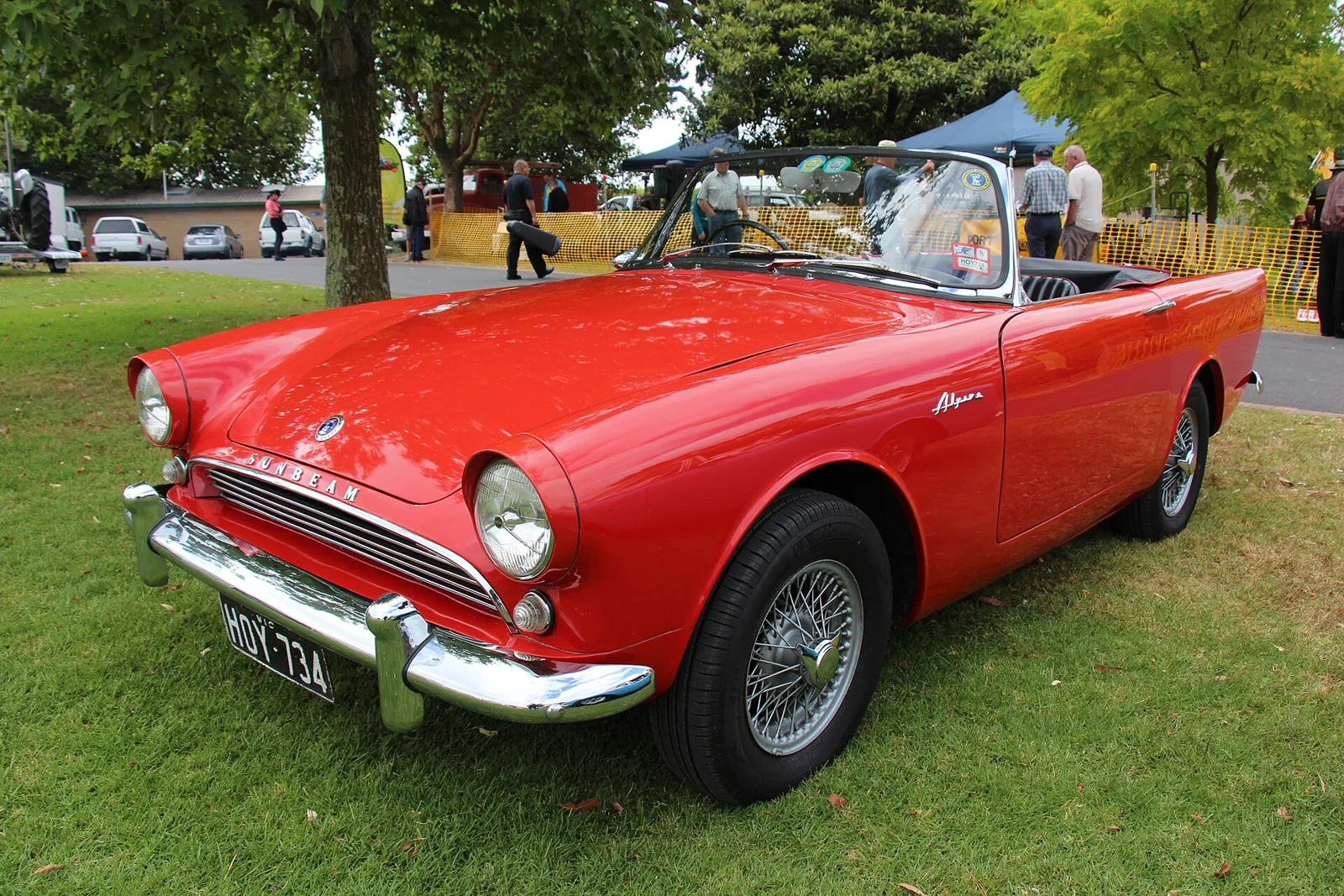
A two-seat roadster that began as a Sunbeam-Talbot rally special, grew through five series and found its way onto cinema screens and into the Bond films.
The Sunbeam Alpine was a two-seater sports roadster and drophead coupe made by the Rootes Group, first from 1953 to 1955, then from 1959 to 1968. It was based on the Sunbeam-Talbot 90 saloon at first, and the name later returned on a fastback coupe built from 1969 to 1975.
The Sunbeam Alpine was a two-seat roadster that Rootes Group built in the fifties and sixties, with a name that later returned on a fastback coupe. It started life as a sporting spin-off from a saloon and grew into a volume car, with around 70,000 built across its series.
Where did the Alpine come from?
The Alpine began in 1952 as a Sunbeam-Talbot drophead coupe, reworked into a rally car by George Hartwell, a dealer in Bournemouth. It was announced in March 1953 and took its name from the marque's success in the Alpine Rally.
The name marked a return of sorts. Rootes had bought Clement-Talbot, and later took over the Sunbeam marque from its receiver in 1935. The 1953 Alpine was the first car from the Sunbeam-Talbot line to carry the Sunbeam name alone since that purchase.
Its first competitive outing came at the July 1953 Coupe des Alpes. The car took the Coupe des Dames, won by Sheila van Damm, and four Coupes des Alpes went to drivers including Stirling Moss and John Fitch, with no marks lost.
The original car was a true open two-seater, with no external door handles and no wind-up windows. Its gear-change lever sat on the column.
A Sunbeam-Talbot saloon's bones under a true open two-seater, which became a rally special, a Bond cameo and a volume roadster.
What engine did the first Alpine use?
The Mark I used a 2,267 cc (138.3 cu in) four-cylinder taken from the saloon, with a raised compression ratio. Because it shared the saloon platform, the Alpine suffered rigidity compromises, which engineers tried to offset with bracing added to the chassis frame.
Gear ratios were revised, and overdrive became standard from 1954.
Rootes fielded six works cars for the 1953 Alpine Rally. They looked much like the production models, but they reputedly carried some 36 modifications, which pushed output to roughly 97.5 bhp.
Special versions were tuned harder. A Mk 1 Special was rated at roughly 97.5 bhp at 4,500 rpm, and the works team cars, tuned by ERA, reached 106 bhp.
How did the Series cars differ?
The Series I began production in 1959 on a modified Hillman Husky floorpan, The engine was 1,494 cc (91.2 cu in) in size. Its running gear came mostly from the Sunbeam Rapier, and front disc brakes replaced the saloon's drums. Overdrive and wire wheels were extras.
The Series I had independent front suspension on coil springs and a live rear axle on semi-elliptic springs. Its Girling brakes used 9.5 in (241 mm) front discs and 9 in (229 mm) rear drums. It also used dual downdraught carburettors, and its wind-up side windows were a first for a British sports car of its time.
Thomas Harrington Ltd built coupe versions after 1959. Following the 1961 Le Mans Index of Efficiency success, Harrington sold replicas badged Harrington Le Mans, which came with a fastback shell and a 104 hp (78 kW) tune. Armstrong Siddeley assembled the cars for Rootes until 1962.
How fast was the Series I?
The Motor tested an open Series I with overdrive in 1959. Top speed was 99.5 mph (160.1 km/h), while 60 mph (97 km/h) came from a standstill in 13.6 seconds. Economy came to 31.4 mpg-imp, which is 9.0 L/100 km or 26.1 mpg-US, and the test car cost 1,031 pounds including tax.
The Series II followed in 1960 with a 1,592 cc (97.1 cu in) unit rated at 80 bhp and revised rear suspension. A hardtop Series II with overdrive was tested by The Motor that year, managing 98.6 mph (158.7 km/h), 13.6 seconds for the same sprint and 31.0 mpg-imp, with 9.1 L/100 km and 25.8 mpg-US as the metric and US figures. That test car cost 1,110 pounds.
How did the Series III and IV differ?
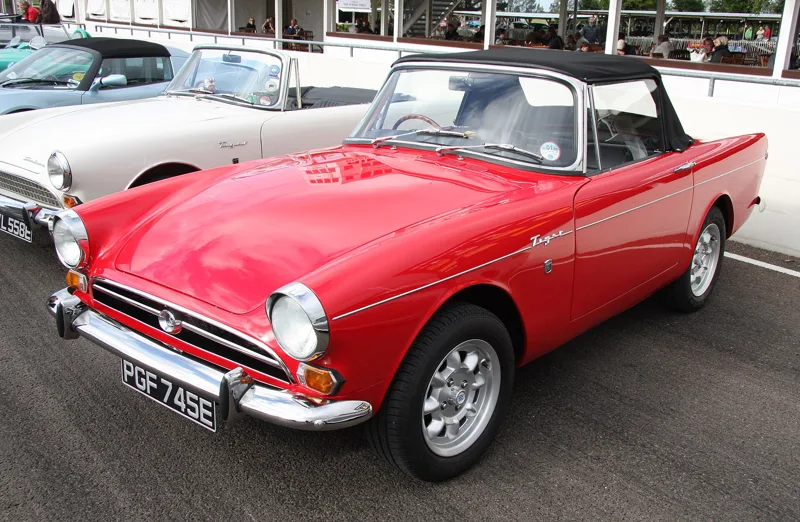
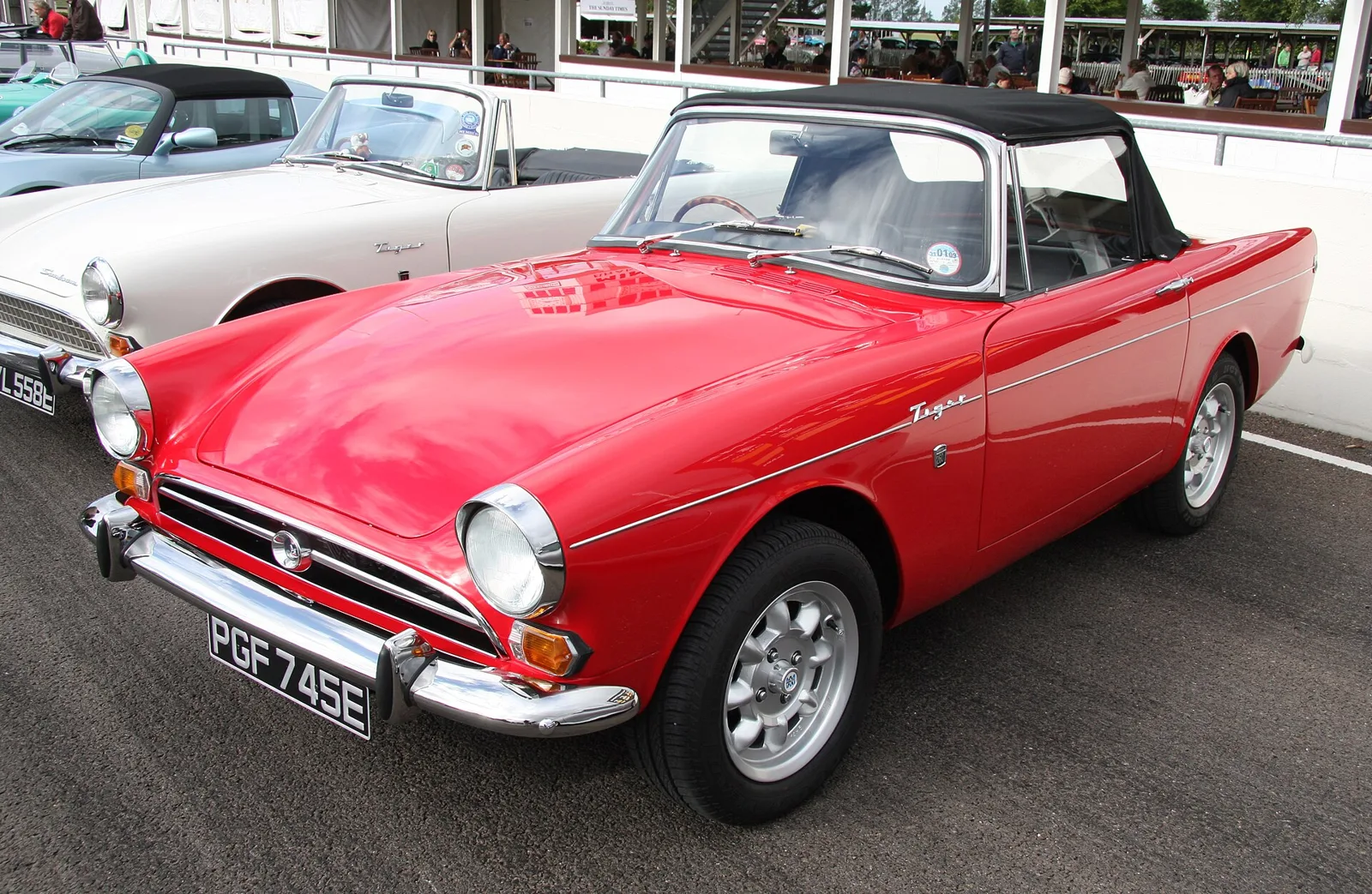
The Series III came in two forms: a GT with a removable hardtop only, and an ST with a fabric roof that stowed behind the small rear seat. It had high fins, tanks in the fins, a vertical spare tyre and chrome bumper guards.
The Series III was built from March 1963 to January 1964. It was a transitional model with a roomier boot, a later hardtop, tube-type rear shocks and improved seats. Its 5,863 units make it the rarest production Alpine.
The Series IV had no lower-output engine, and the convertible and hardtop shared an 82 bhp unit with a single Solex carburettor. Most of the fins were removed, and an automatic option with floor-mounted control did not sell well. Later in 1964 the manual gearbox gained synchromesh on first gear.
What was the final Alpine like?
The last model switched to a 1,725 cc (105.3 cu in) unit with five main bearings, breathed through twin Zenith-Stromberg carburettors and made 93 bhp. The automatic option was dropped, and 19,122 cars were built in this series.
Some export markets claimed 100 PS (99 bhp) SAE for the same engine. The Sunbeam Tiger, a V8 version of the Alpine, was the muscle-car offshoot.
Who designed the Series Alpine?
Kenneth Howes and Jeff Crompton were given a complete redesign in 1956, aimed at a dedicated sports car for the US market. Howes did about 80 percent of the overall design, and he had worked for Studebaker and Ford before joining Rootes.
Before joining Rootes, Howes had spent time at Studebaker's design studio, with Loewy, and at Ford in Detroit. The Series I was the result of that redesign, and the car was built on the Hillman Husky platform rather than the Mk I saloon base.
How many Alpines were built?
Total production was around 70,000 across all series. The Series I built 11,904 cars, the Series II built 19,956, and the Series III built 5,863 units, while the Series IV and Series V accounted for the rest.
The Mk I and Mk III were hand-built at Thrupp and Maberly in Cricklewood, London, from 1953 to 1955, and 1,582 were produced. The split was 961 for the US and Canada, 445 for the UK and 175 for other markets. No Mark II was made.
Survival figures are thin. In 2000 it was estimated that as few as 200 cars were still around. Production stopped shortly after Chrysler took over the Rootes Group.
Did the Alpine race successfully?
Yes. The car did well in both Europe and North America. Vince Tamburo took the 1960 G-Production National Championship in a 1494 cc Series I, and Don Sesslar won the 1964 championship with five wins.
Le Mans gave the car its best-known international moment. A Sunbeam Harrington won the Index of Efficiency at the 1961 race, and the factory prototype registered as XRW 302 was raced by Bernard Unett from 1962 to 1964.
Unett won the Fredy Dixon challenge trophy in 1964, a major prize on the British club circuit then, and later became British Touring Car champion three times in the 1970s. Dan Carmichael won the Central Division title in 1964 and 1965, and he finished second at the American Road Race of Champions in 1967.
Which films and shows used the Alpine?
The Alpine appeared in To Catch a Thief in 1955 with Cary Grant and Grace Kelly, and it turned up in Dr. No in 1962 as one of the first on-screen Bond cars. Its screen career continued through television and film, from Get Smart to Heartbeat.
A sapphire blue Mk I was the car in To Catch a Thief. Decades later the PBS programme History Detectives tested whether a privately owned roadster was the film car. It was found not to be, based on the vehicle identification numbers.
In Dr. No a lake blue Series II roadster was rented and driven by Bond. The car was reportedly lent by a local resident, as no other suitable sports car could be found on the island. The novel gives a Sunbeam Alpine to John Strangways, a secret agent later assassinated.
In Get Carter, Caine's character gets help from the driver of a white 1968 Alpine roadster. In Get Smart the Sunbeam Tiger was the car of choice for Maxwell Smart, while an Alpine dressed to look like the Tiger handled the gadget shots, because the cannon would not fit beneath a V8 bonnet.
Other appearances included Night of the Demon, a 1957 British horror film in which a Mk I appears, and Gambit, where Michael Caine drove an Alpine. Muriel Spark also mentions the car in The Comforters, her 1957 debut novel.
Later appearances were smaller. A crimson Alpine was the status symbol of one character in the 1966 Launder and Gilliat comedy The Great St Trinian's Train Robbery, and Sandra Dee drove a red 1966 Series V convertible in The Dunwich Horror in 1970. A Series V also turns up near the end of the 1982 short A Shocking Accident.
What happened to the Alpine name?
In 1969 Rootes launched a more economical, slightly slower version of the Rapier, badged as the Sunbeam Alpine. It was a fastback whose doors had no pillars, and whose rear side windows opened the car up in the manner of a cabriolet with a hardtop fitted.
In 1976 Chrysler, which by then owned Rootes, put the Alpine name on a UK-market version of the Simca 1307. That car was badged Chrysler Alpine and then Talbot Alpine after Peugeot took over Chrysler Europe in 1978. The name survived until 1984.
Sunbeam Alpine specifications at a glance
| Specification | Detail |
|---|---|
| Body | Two-seater sports roadster and drophead coupe |
| Production | 1953 to 1955 and 1959 to 1968 as a roadster |
| Mk I engine | 2,267 cc (138.3 cu in) four-cylinder; 97.5 bhp in Special form |
| Series I engine | 1,494 cc (91.2 cu in); overdrive optional |
| Series II engine | 1,592 cc (97.1 cu in); 80 bhp |
| Series IV engine | 82 bhp with a single Solex carburettor |
| Series V engine | 1,725 cc (105.3 cu in); 93 bhp |
| Series I top speed | 99.5 mph (160.1 km/h); 0-60 mph in 13.6 seconds |
| Series I fuel use | 31.4 mpg-imp; 26.1 mpg-US |
| Total production | Around 70,000; Mk I and Mk III 1,582 |
.jpg)