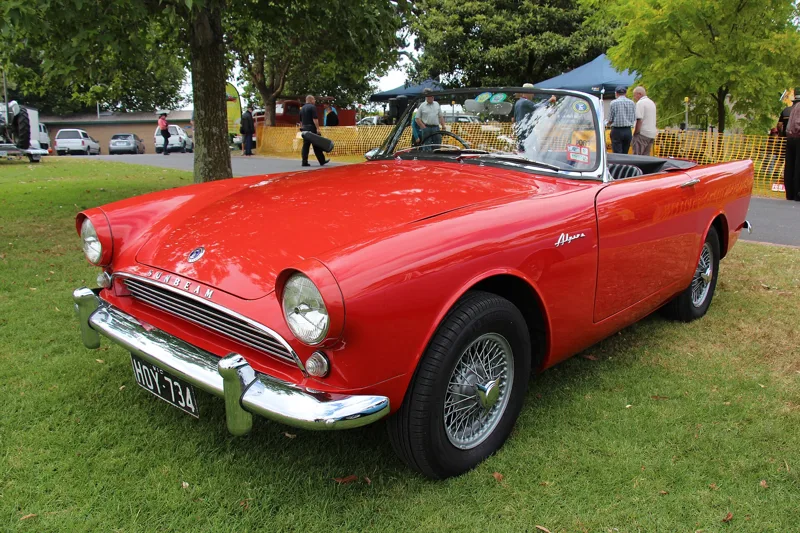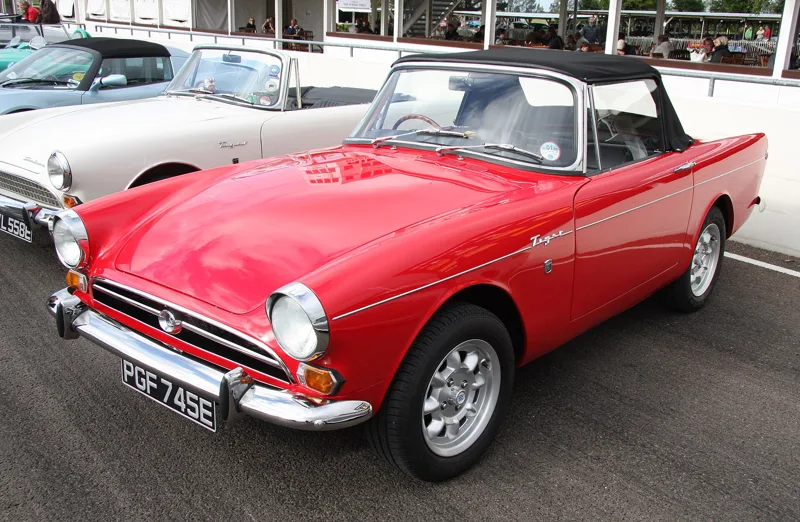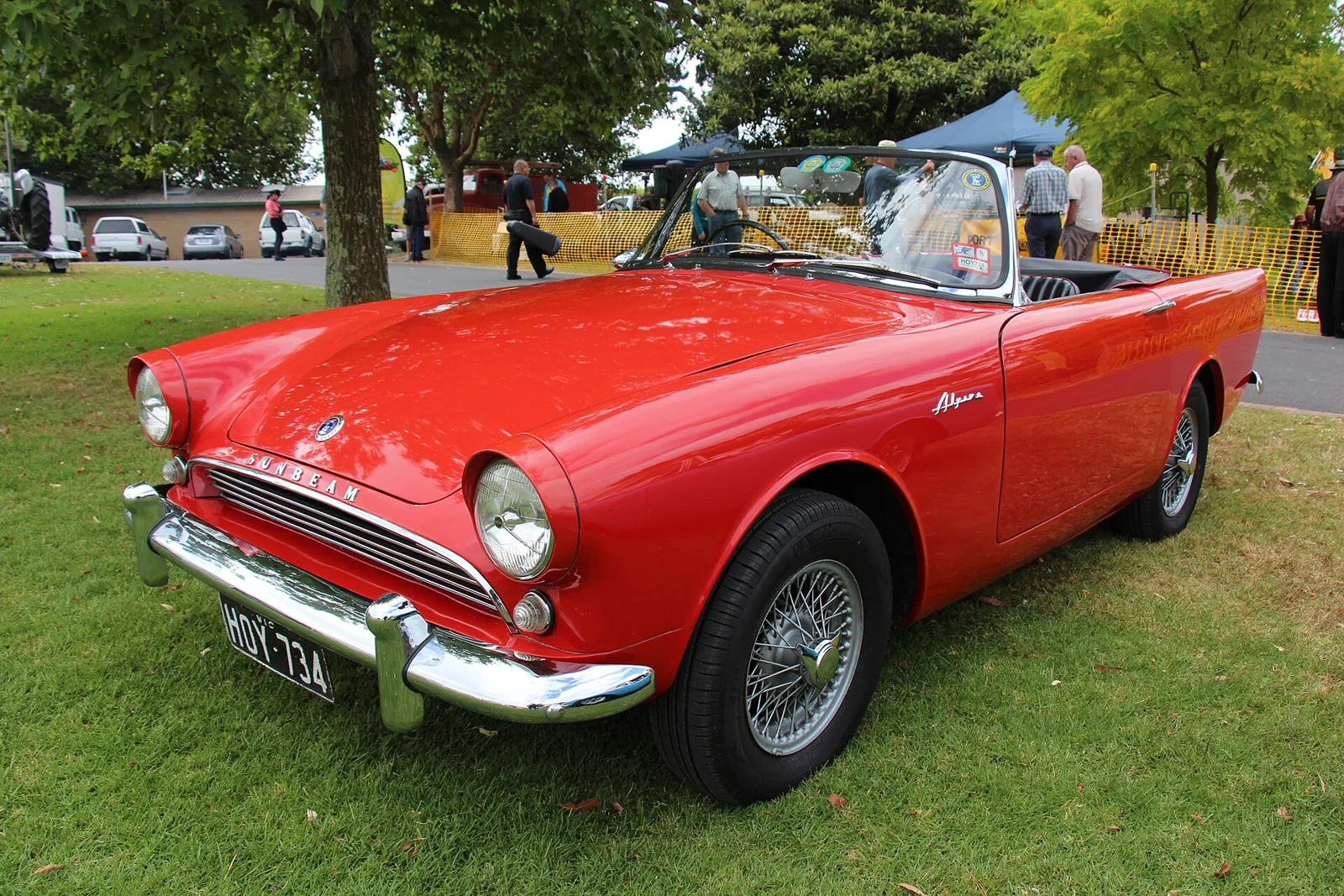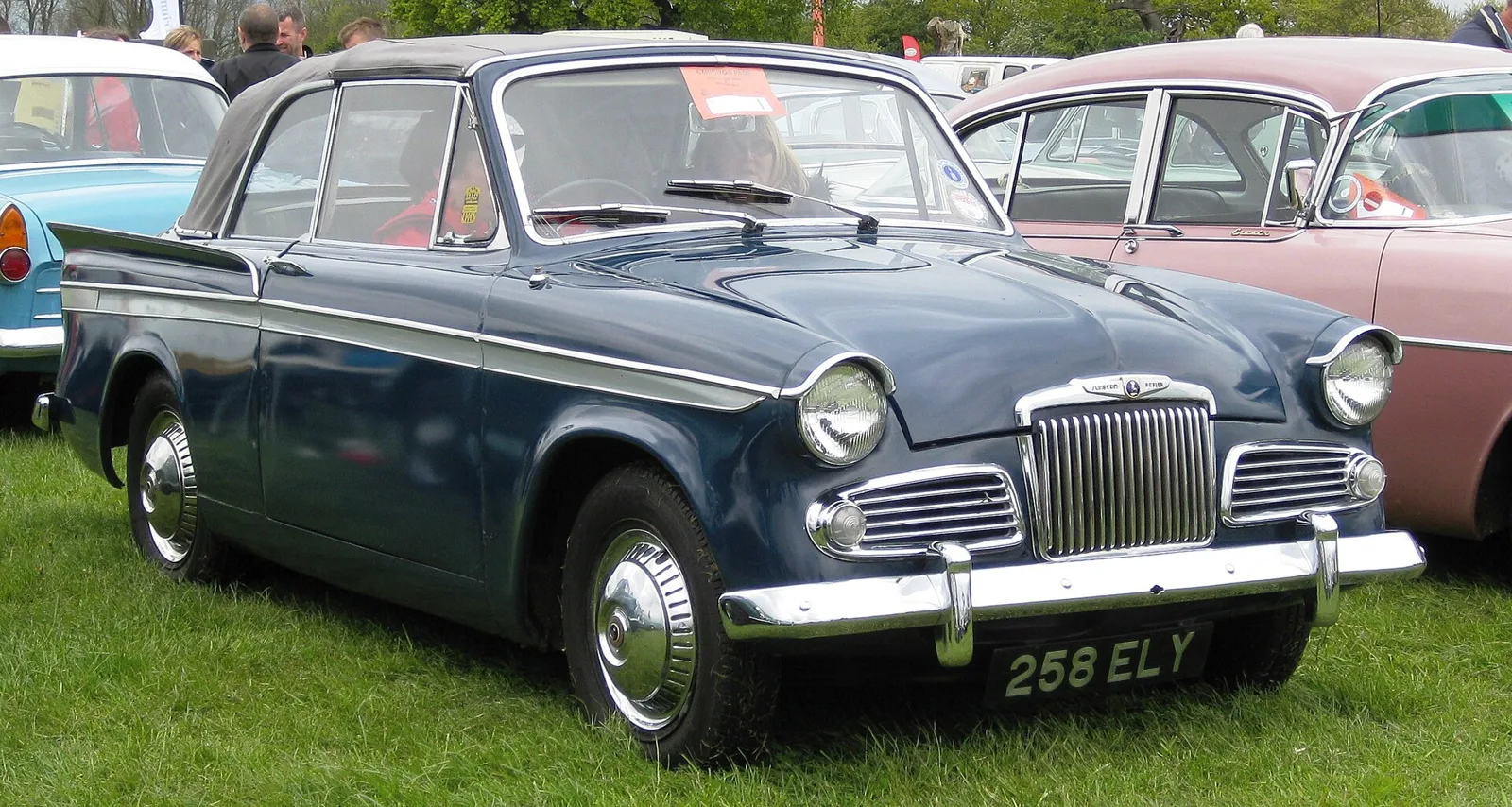
A Raymond Loewy styled hardtop from 1955, a rally-influenced engine story and the 1967 Fastback that kept the name until 1976.
The Sunbeam Rapier was a Rootes Group car built in two generations from 1955 to 1976. The Series I to Series V cars were four-seat, two-door hardtop coupes, and the 1967 Arrow Fastback that followed kept the name. The H120 and Alpine Fastback were the performance and cheaper variants.
The Sunbeam Rapier started life as a four-seat hardtop from the Rootes Group and ended as a fastback coupe sold until 1976. Along the way it passed through five Series versions, a pair of performance variants and a run of engine changes shaped by rallying. Its story shows how a family car's underpinnings became a sporting coupe.
Where did the Rapier come from?
The Rapier was the first of the Audax light cars from the Rootes Group, sold under its Sunbeam marque. It was announced at the London Motor Show in October 1955, while its Hillman Minx and Singer Gazelle counterparts followed in 1956. The car was designed in house, although its look owed much to Raymond Loewy's studio.
The Series I styling was undertaken by Raymond Loewy Associates, and it showed the influence of Loewy's 1953 Studebaker Starliner and the Hawk that followed. Announced for the 1955 show, the car came in two-tone colour schemes typical of the period.
Bodies were built by Pressed Steel and then shipped to Thrupp & Maberly in north London for painting and trim. They went on to the Rootes plant at Ryton-on-Dunsmore near Coventry, where engines, transmissions and running gear were fitted. That complicated arrangement lasted until the Series IV arrived in late 1963.
A Loewy-styled four-seater that grew into a fastback coupe and a performance H120, all from one clean hardtop.
What made the Series I different?
Standard fittings on the Series I were a steering column gear change, two-tone Kangaroo leather trim and overdrive by Laycock de Normanville. In the UK vinyl was an alternative to leather, while some export territories had vinyl as the norm. It was a four-seat, two-door hardtop coupe that stayed in production until the Series II arrived in 1958.
The four-speed transmission had overdrive on third and top, and it was included in the price as a standard feature.
In total, 7,477 units of the first version were produced before the Series II took over.
How much power did the early engines make?
The first engine was a 1,390 cc unit essentially the same as the Hillman Minx's, but with an 8:1 compression ratio instead of 7:1. In that form it produced 47 kW (62.5 bhp) at 5000 rpm. The updated R67 engine, introduced in October 1956, raised output to 50 kW (67.5 bhp).
The change came from rally experience. Rootes replaced the Stromberg carburettor with twin Zenith 36 WIP units on a new inlet manifold. The effect was to cut the 0-60 mph time by almost 1 second and add 3 mph (5 km/h) to the top speed.
The Motor tested a twin-carburettor Series I saloon in 1957. It reached 138 km/h (85.7 mph) and needed 20.9 seconds for the 0-60 mph run, with fuel use of 9.3 L/100 km (30.5 mpg imp; 25.4 mpg-US). The test car cost 1043 pounds including taxes of 348 pounds.
How did the Series II change the Rapier?
The Series II arrived on 6 February 1958, in hardtop and convertible forms. It brought back a traditional Sunbeam radiator grille, a floor gear change and vinyl upholstery in place of leather. Rootes sent nine of the new cars to Monte Carlo so the press could try them.
The engine, called the Rallymaster, grew to 1,494 cc with a higher 8.5:1 compression ratio and larger valves. Output reached 54 kW (73 bhp) at 5,200 rpm. Autocar quoted 146 km/h (91 mph) and 0 to 97 km/h (60 mph) in 20.2 seconds.
The most visible change was a pair of pronounced fins on the rear wings. A broad flash in the roof colour replaced the two-tone body scheme, and the grille was shorter and wider with side grilles beside it. Larger front brakes and a recirculating ball steering box arrived too, both learned from competition.
Series II production reached 15,151 units before the Series III replaced it in 1959.
What did the Series III look like?
The Series III, introduced in September 1959, looked subtly different from its predecessor because many small changes added up. The side grilles gained an extra bar, rising from three to four. The boot lid received an oblong number plate recess, and the side flash moved lower with Rapier script on the rear.
Thinner windscreen pillars and a lower scuttle line gave a 20% increase in windscreen area. Inside, the seats and interior panels were completely redesigned and trimmed in single colour vinyl with contrasting piping.
Burr walnut veneer covered the dashboard, which carried black-faced British Jaeger instruments beneath a padded crash roll. Deep pile carpets appeared in the footwells for the first time, and the steering wheel and switches changed from beige to black plastic.
Mechanically the Series III shared its engine with the Sunbeam Alpine. The 1,494 cc unit gained an eight-port aluminium cylinder head, a sportier camshaft and a power rise to 58 kW (78 bhp) at 5400 rpm. New front disc brakes improved stopping and widened the front track.
A saloon with overdrive tested by The Motor in 1960 reached 147.6 km/h (91.7 mph) with 16.6 seconds needed to reach 60 mph. Fuel use was 9.6 L/100 km (29.5 mpg imp; 24.6 mpg-US), and the test car cost 1045 pounds including taxes.
The Series III totalled 15,368 units before the Series IIIA arrived in April 1961.
What changed with the Series IIIA?
The Series IIIA of 1961 used the 1,592 cc engine from the Sunbeam Alpine, producing 60 kW (80.25 bhp) at 5,100 rpm. Durability improved through a stiffer crankshaft and larger connecting rod bearings. Torque reached 120 N m (88.2 lb ft) at 3,900 rpm.
Visually the Series IIIA matched its predecessor, but it gained a thicker front anti-roll bar that improved roadholding. The clutch got nine pressure springs in place of six, and a fresh-air heater became standard.
The extra durability cost a little pace. Top speed fell to 140 km/h (90 mph), and the 0-60 mph time rose to 19.3 seconds. When production ceased, 17,354 Series IIIA cars had been built, and the hardtop continued until October 1963.
Why did the Series IV arrive with a new look?
The Series IV was a restyle rather than a brand-new car. A fully new design had been prototyped and tested, but Rootes changed direction, and that design became the Humber Sceptre. The existing Series IIIA was reworked to give it a fresh life as a touring saloon.
The biggest visible change was the move to 13-inch (330 mm) road wheels, which replaced the stainless steel wheel trims. A new bonnet lowered the front, and the grille became lower and more square. Alpine headlamp rims were chromed for the Rapier, and the frames came off the side windows.
Inside, the dash stayed walnut veneer, but the glove box moved into it, creating a proper shelf on each side of the car. An adjustable steering column arrived, along with new front seats that adjusted for backrest angle for the first time.
Under the skin, the front suspension switched to sealed-for-life ball joints, and most other joints became sealed or rubber bushed. A brake servo became standard. The twin carburettors gave way to a single twin-choke Solex, raising output to 63 kW (84 bhp) and torque to 123 N m (91 lb ft) at 3,500 rpm.
The Series IV moved to an all-synchromesh gearbox in October 1964. The Motor's April 1964 test recorded 146 km/h (91 mph) and a sprint to 60 mph in 17 seconds. Production ended in 1965 with 9700 units built.
What was the Series V?
The Series V, introduced in September 1965, looked identical to the Series IV but carried 1725 badges on its wings and boot. Beneath, a re-developed engine produced 68 kW (91 hp) at 5,500 rpm. The revision also brought negative earth and an alternator in place of the dynamo.
Rootes gave the engine a new five main bearing crankshaft, making it stronger and smoother, and fitted a twin pipe exhaust so it could breathe more easily. The top speed rose to 153 km/h (95 mph), and the sprint to 60 mph took 14.1 seconds.
The Series V did not sell. Its run ended in June 1967 with 3,759 units built, which made it the rarest of the Series Rapiers. It was effectively a stopgap while the Fastback was readied.
What was the Arrow Fastback?
The Arrow Fastback launched in October 1967 as a four-seat coupe with a sporty image. It sat on the Hillman Hunter Estate chassis, but its superstructure was unique to the Rapier. The car was made until 1976, when it was discontinued without a replacement.
The engine was Rootes' five-bearing 1,725 cc four, tilted slightly to lower the bonnet line like the other Arrow models. With twin Stromberg 150CD carburettors it produced 66 kW (88 hp) at 5200 rpm. The manual gearbox came with overdrive as standard, while a Borg-Warner automatic could be ordered at extra cost.
The maximum was 166 km/h (103 mph), and 60 mph arrived in 12.8 seconds. Production began at Ryton-on-Dunsmore, but from 1969 it moved to Linwood in Scotland, the Hillman Imp works.
In total, 46,204 units were built, including the H120 and Alpine versions. In America, the car went on sale as the Sunbeam Alpine GT.
How did the H120 and the Alpine Fastback differ?
The H120 was the performance Fastback from October 1968, with Holbay Engineering tuning and twin Weber carburettors. The Alpine Fastback arrived in October 1969 as a simpler, cheaper car with a single carburettor and a wooden dashboard. Both were built on the Rapier's body and running gear.
The H120 had a more powerful 1,725 cc engine specially developed by Holbay Engineering. It gave 81 kW (108 hp) gross at 5,200 rpm, helped by a special cylinder head, a high lift camshaft and twin Weber 40DCOE carburettors. Its top speed was 171 km/h (106 mph), and it reached 97 km/h (60 mph) in 11.1 seconds.
Visually the H120 stood apart, with wheels that were wider and Rostyle-pattern, bold side flashes, polished sill covers, a matt black grille and a boot-lid spoiler. H120 badges appeared on the front wings and in the centre of the grille.
The Alpine Fastback used a single Stromberg 150CD carburettor and made 55 kW (74 hp) at 5500 rpm. It cost 1086 pounds in the UK, against 1200 pounds for the Rapier. Maximum speed reached 146 km/h (91 mph), and 60 mph took 14.6 seconds.
The Alpine Fastback was dropped in 1975, a year before the Rapier and H120 ended.
How did the Rapier perform in motorsport?
The Rapier's competition record fed back into the road cars. A Rapier driven by Peter Harper finished fifth in the 1958 Monte Carlo Rally, and rally experience produced the R67 engine upgrade in 1956. Competition thinking also shaped the Series II brakes and steering.
The works Series I rally cars came out of Rootes' competition department, and their modifications shaped the Series II floor gear change.
Rootes later turned its motorsport effort to the Hillman Imp and the Sunbeam Tiger, and the Rapier faded from the competitions department.
Were there scale models of the Rapier?
Yes, several die-cast models were made. Meccano's Dinky Toys No. 166 covered the Series I from 1958 to 1963, Oxford Die Cast produced a 1:76 Series III, and Silas Models made a 1:43 Series IIIa convertible.
The Dinky Toys model was described as approximately O scale, at 1:44.
How many Rapiers were built?
Series production ran from 7,477 Series I cars down to 3,759 Series V cars. The largest runs came from the Series II, III and IIIA, and the full run came to 46,204 units including the H120 and Alpine versions.
The Series II counted 15,151 units, the Series III 15,368, the Series IIIA 17,354 and the Series IV 9700. Those figures show why the Series V is the rarest of the family.
What are the Sunbeam Rapier specifications?
| Specification | Detail |
|---|---|
| Production | 1955 to 1976, Rootes Group, Sunbeam marque |
| Series I engine | 1,390 cc; 47 kW (62.5 bhp) at 5000 rpm |
| Series II engine | 1,494 cc; 54 kW (73 bhp) at 5,200 rpm |
| Series III engine | 1,494 cc; 58 kW (78 bhp) at 5400 rpm |
| Series IIIA engine | 1,592 cc; 60 kW (80.25 bhp) at 5,100 rpm |
| Series IV engine | 1,592 cc; 63 kW (84 bhp; 85 PS) |
| Series V engine | 1725 cc; 68 kW (91 hp) at 5,500 rpm |
| Fastback | 1,725 cc; 66 kW (88 hp) at 5200 rpm; top speed 166 km/h (103 mph) |
| H120 | 81 kW (108 hp) gross at 5,200 rpm; top speed 171 km/h (106 mph) |
| Alpine Fastback | 55 kW (74 hp) at 5500 rpm; 1086 pounds in the UK |
| Wheels | 13-inch (330 mm) road wheels from the Series IV |
| Total production | 46,204 units, including H120 and Alpine versions |