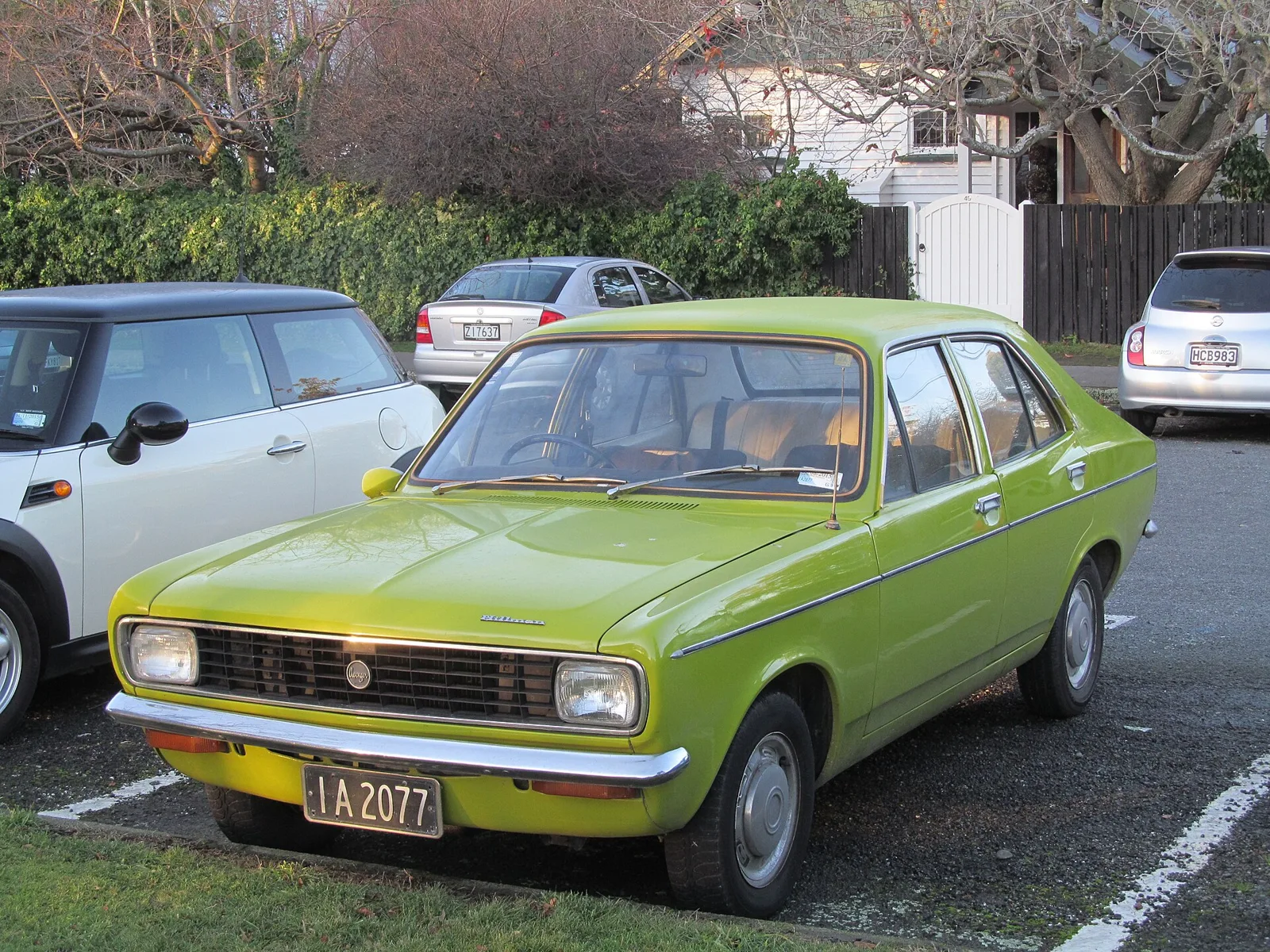
A conventional, economical family car from the Rootes Group that sold under Hillman, Chrysler, Talbot and Plymouth names, found motorsport success and lived on as a Dodge in South America.
The Hillman Avenger was a conventional Rootes Group family car built in the UK from 1970 to 1981. It was sold as a Hillman, Chrysler and Talbot in Britain and as the Plymouth Cricket, Dodge and VW models overseas. About 790,000 examples left the UK lines.
The Hillman Avenger was a small family car that the Rootes Group built in the United Kingdom and sold worldwide between 1970 and 1978. It was offered as a two- or four-door saloon and a five-door estate, with a front engine and rear-wheel drive. Over its life it wore the Hillman, Chrysler and Talbot names in Britain, and it was sold as the Plymouth Cricket and Dodge models in the rest of the world.
What was the Hillman Avenger?
The Avenger was a conventional and economical car, and it was a completely new design rather than a reworked older model. Its saloon had four doors, chair-height seating, a four-link coil rear suspension and a distinctive J-shaped, or hockey stick, taillight.
It became one of the first automobiles to use computer-aided design in engineering its unibody. It also addressed the growing safety requirements of its time, with a rigid passenger compartment, a front crumple zone, strengthened windscreen glass and a heavily padded instrument panel.
A conventional family car that sold under four British and American names and still lives on as a South American Dodge.
How was the Avenger developed?
The project was conceived in 1963. Roy Axe, the design director, received the styling brief in 1965, and engineering began in 1966. The car was first shown to the press in Malta in early 1970 before going on sale.
Production took place at the Rootes plant at Ryton-on-Dunsmore, near Coventry, which had been renovated at a cost of GBP 8M. Bodies and body panels travelled by train from Linwood in Scotland, while powertrains came from Stoke. Manufacturing moved entirely to Linwood in 1976.
Which names did the Avenger carry?
Rootes sold the car from 1970 to 1975 solely under its Hillman brand. After Rootes became part of Chrysler Europe, it was marketed from 1976 to 1978 as the Chrysler Avenger. When Chrysler Europe was sold to PSA Peugeot Citroen, the car became the Talbot Avenger from 1979 to 1981.
The Avenger also spawned badge-engineered variants around the world. These included the Plymouth Cricket in North America, the Dodge 1800 and later Dodge Polara in Brazil, and the VW 1800 built by Volkswagen Argentina.
How did the Avenger's engines work?
The car used a four-cylinder all-iron overhead valve engine in either 1250 or 1500 cc sizes, mounted at the front and driving a coil-sprung live axle at the rear. The engine and transmission were purpose-designed for the Avenger alone, and the press praised its handling and general road competence.
The 1973 upgrade reshaped the range. The 1250 became the 1300 and the 1500 became the 1600, and the three-speed automatic was replaced by a four-speed Borg Warner 45 unit in place of the earlier 35.
What trims did the Avenger offer at launch?
At first the Avenger was offered as a four-door saloon in DL or Super trim, with either the 1250 or 1500 cc engine. A GL trim with the 1500 cc engine sat at the top of the range. The DL had rubber mat flooring and a simple dashboard with a strip speedometer, while the Super added carpets, armrests and twin horns.
The GL brought four round headlights, an internal bonnet release, two-speed wipers, brushed nylon seat trim that had not been used on British cars before, reclining front seats and round instruments. For the first two years only the car's kerbside wing carried an Avenger emblem, as a cost-saving measure.
The front grille was a plastic component 4 ft 6 in (137 cm) wide, which the company claimed was the largest mass-produced plastic part used by a European car at the time. The Avenger competed in the 1970s with the Ford Escort and Vauxhall Viva, and it was a steady seller.
What body styles and trims came later?
The Avenger GT arrived in October 1970 with a twin-carburettor 1500 cc engine and a four-speed manual or three-speed automatic. Its features included twin round headlights, door stripes and dustbin lid wheel covers, a look shared with several Datsuns and Toyotas of the period.
A basic fleet Avenger joined the range in February 1972, followed by the five-door estate in March 1972 in DL and Super trim. The estate used heavy-duty springing and could carry 1,040 lb (470 kg), against 840 lb (380 kg) for the saloon. A two-door saloon was added in March 1973 with all engine and trim levels. In October 1972 the GT had been replaced by the GLS, which had a vinyl roof and Rostyle sports wheels.
In continental Europe the car was first marketed as the Sunbeam, with 1250 and 1500 versions in France that later grew to 1300 and 1600. Several northern markets used the Sunbeam Avenger name.
What was the Avenger Tiger?
The Avenger Tiger was named to recall the Sunbeam Tiger, and it began as a publicity exercise. The Chrysler Competitions Centre, led by Des O'Dell, modified Avenger Super four-door cars, and the Tiger was launched in March 1972. It used the 1500 GT engine with an improved cylinder head, enlarged valves and twin Weber carburettors, giving 92.5 bhp (69 kW) at 6,100 rpm.
Testers timed 0 to 60 mph at 8.9 seconds, with 108 mph (174 km/h) at the top. Those figures beat the Ford Escort Mexico, but fuel consumption was heavy and the Tiger soon earned a reputation for thirst. Around 200 Mark 1 cars were thought to have been built.
The Mark 2 Tiger appeared in October 1972 on the GL bodyshell with four round headlights. It lost the bonnet bulge, gained a matt black bonnet and went on sale at GBP 1,350, with production of around 400. Red Wardance was offered alongside yellow Sundance.
How did the Chrysler facelift change the car?
In September 1976 the Avenger was rebadged as a Chrysler and received a facelift with a new front, a new dashboard and a rear that dropped the hockey stick lamps for a straight light-bar arrangement. Metal plates covered the old light apertures to save the cost of retooling the rear wings, and the fuel cap moved to the right-hand side.
Three trim levels followed, LS, GL (known as Super in some markets) and GLS, with the GLS offered only with a high-compression 1.6 L engine. After the Hillman Imp ended in 1976, Avenger production was moved wholly to Linwood, and Ryton began building the Simca-based Chrysler Alpine and later the Talbot Solara.
What was the Chrysler Sunbeam hatchback?
A hatchback variant appeared in 1977 as the Chrysler Sunbeam. It rode on a cut-down version of the Avenger's floor pan and was aimed at the supermini class. It shared its doors with the two-door Avenger, and it launched with a 928 cc engine derived from the Hillman Imp alongside 1300 and 1600 Avenger units. A sporty Ti version followed quickly with a 1600 engine.
The name revived the Rootes Sunbeam marque, which had been killed off along with the Rapier. In 1979 Chrysler showed the Sunbeam Lotus at the Geneva Motor Show. It was developed with Lotus for rallying, using a 2200 cc Lotus engine, and became the Talbot Sunbeam Lotus when the road cars reached customers after the Peugeot buyout.
How did the Talbot years end?
Chrysler Europe collapsed in 1978 and was taken over by PSA Peugeot Citroen. The Avenger was rebadged as a Talbot, and it stayed on sale beside the hatchback-only Horizon for buyers who still wanted a saloon or estate. It kept the Chrysler Pentastar badge, because Chrysler had retained the rights to the Avenger name.
The Sunbeam had a minor facelift in autumn 1980 with revised headlights and the round Talbot logo on the grille. Production continued until the middle of 1981, when PSA closed the Linwood plant and moved British output to Ryton. The Avenger ended without a direct replacement.
How did the Avenger perform in motorsport?
Despite its conventional underpinnings, the Avenger won in several arenas. It took the 1971 Press-on-Regardless Rally in Plymouth Cricket badging, took the British Group 1 rally title in 1975 and again in 1976, with events held in Northern Ireland, and won the 1976 Heatway Rally of New Zealand. It also won the British Saloon Car Championship on several occasions.
In Argentina the driver Jorge Omar del Rio won the TC2000 in a Dodge 1500 GT-100 in 1980, and he won again in 1981 and 1982.
How many Avengers were built and sold?
When UK output ended in 1981, around 790,000 examples had left the Ryton and Linwood lines. It was among the best-selling British cars of its decade, yet by 2016 only around 260 were reported on the road in Britain.
Chrysler had promised a domestic small car for years, and in the meantime the Cricket was one of the imports it leaned on. The company had lost a record $170 million by 1974.
How did the Plymouth Cricket reach America?
The Ryton plant built a rebadged Avenger for the US and Canadian markets for the 1971 model year, sold as the Plymouth Cricket through Plymouth dealers. It came as a four-door saloon and, from the 1972 model year, a five-door station wagon. The Cricket and the Dodge Colt, sold through Dodge showrooms, were regarded as stopgaps while Chrysler prepared a home-built small car.
The first shipment of 280 Crickets arrived from the UK on 20 November 1970. Showroom sales began on 20 January 1971 at a suggested retail price of $1915, with optional automatic transmission, air conditioning, whitewall tyres and radio. The marketing used a cartoon cricket mascot and the line The Little Car That Can.
Sales were disappointing. Plymouth sold 27,682 Crickets for 1971, and about 41,000 over the two full model years. Consumer Reports did not give the car a good rating, and Car and Driver recorded a roadside breakdown during its December 1970 test. Weak points included the Stromberg fuel system, Lucas electrics and corrosion problems linked to a change in underseal.
Chrysler also created dealer trouble. It withheld the Cricket from the Simca-Rootes dealers, arguing it was not a Rootes product, and a court later found that the company had to supply those dealers. Chrysler then dissolved the Simca-Rootes Division and sold its captive imports only through Plymouth dealers.
What happened to the Cricket after 1972?
With sales slow and rivals strong, the cost of re-engineering the Cricket for 1974 US safety, bumper and emissions rules looked unjustifiable. The model faded out once Plymouth dealers cleared their last 1972 stock early in 1973, just before the fuel crisis lifted demand for economical cars. Some cars sold as 1973 models still carried 1972 vehicle identification numbers.
How was the Avenger built in Argentina?
The Avenger was built in Argentina between 1971 and 1990. It started as the Dodge 1500 four-door sedan built by Chrysler Fevre Argentina, which began production in August 1971. Volkswagen acquired the operation in 1980 and produced the car as the Volkswagen 1500 from 1982, before a joint venture with Autolatina.
Argentine sporting versions included the GT90 in 1974 and the GT100 with the 1.8 engine in 1975. The GT-100 that followed in 1977 produced 105 bhp (78 kW). Production ended in 1990 when the car was replaced by the Volkswagen Gacel and Senda. A total of 262,668 units were sold in its almost 20-year life, and it was popular with taxi drivers.
How did the Avenger appear in Brazil and New Zealand?
In Brazil the car was built from 1973 to 1981 as a two-door saloon sold first as the Dodge 1800. It had a unique front end with a four-headlamp grille and conventional tail lights. In 1975 it became the first car converted to run on alcohol under a programme to use surplus sugar cane.
In New Zealand Todd Motors sold the Avenger from 1970 to 1980, and the car was assembled from CKD kits. A sporty TC model arrived in 1971, and the Avenger Alpine replaced it in 1973. Todd Motors built 26,500 examples locally and imported 2,000 fully built, and the last New Zealand cars were assembled in November 1980.
What is the Avenger's legacy?
The Hillman Avenger shows how a single design could be sold under many badges across a changing industry. Its engineering was conventional, but its unibody work, safety features and rally results gave it a place in British motoring. Its survival in Argentina, Brazil and New Zealand shows how far the car travelled.
The Avenger name also outlived the car. Chrysler kept the trademark, and it was used again on the Dodge Avenger from 2007 to 2014.
.jpg)