From a Madison Square Garden debut and a Mayflower logo to Barracuda muscle, K-cars, Voyager minivans and a 2001 farewell, the Plymouth story tracks Chrysler's fortunes.
Plymouth was a Chrysler brand launched in 1928 to compete in the low-priced market against Chevrolet and Ford. It peaked at 973,000 cars in 1973, built the K-cars and Voyager minivan, and was withdrawn after the 2001 model year. It sold cars for 73 years before the brand was withdrawn.
Plymouth was a brand of cars built by the Chrysler Corporation and later DaimlerChrysler. It was launched in 1928 to challenge Chevrolet and Ford in the low-priced market, grew into a high-volume seller and was withdrawn after the 2001 model year. Its story runs from Depression-era survival and muscle cars to the K-car and minivan years.
Where did Plymouth come from?
Madison Square Garden hosted the debut on 7 July 1928. It was Chrysler's first entry in the low-priced field that Chevrolet and Ford had long dominated, although its early prices sat above those of its rivals, and it offered standard internal expanding hydraulic brakes that the other two did not provide.
Early cars were sold only through Chrysler dealerships, and the 4-door, 5-passenger Touring Sedan was listed at US$695. The badge showed the Mayflower sailing toward Plymouth Rock, but the name itself came from Plymouth binder twine, a product of a Plymouth company that farmers trusted. Joe Frazer chose the name for that reason.
The car's lineage ran back to the Maxwell. Walter P. Chrysler took control of the troubled Maxwell-Chalmers company in the early 1920s, inherited the Maxwell with it, and later reworked it into a lower-priced companion to his six-cylinder Chrysler. For 1926 the Maxwell became the four-cylinder Chrysler Model 52, and in 1928 it became the Chrysler-Plymouth Model Q.
A low-priced brand that carried Chrysler through the Depression and later built Barracudas, K-cars and Voyagers.
How did Plymouth get through the Depression?
Plymouth was meant for the bottom of a booming market, but during the Great Depression it did something more important for its parent. Its sales held up when many other carmakers failed, and by 1931 the brand had climbed to third in sales among all cars.
From 1930 Plymouths were sold through all three Chrysler divisions, and the 1931 Model PA introduced floating power, which Plymouth promoted as eight-cylinder smoothness with four-cylinder economy. The company then tried to catch Ford, Chevrolet and Pontiac on cylinder count, and it built the 1933 PC with a 190 cu in flathead six.
The PC did not sell well. Chrysler cut its wheelbase from 112 to 107 inches, and by April 1933 the car was reworked on the Dodge DP chassis with a 112-inch wheelbase and renamed PD. The PC was also exported to Sweden, Denmark, the United Kingdom and Australia, where it was sold in Britain as the Chrysler Kew.
What were the 1950s Plymouths like?
The 1950s brought a string of firsts. The 1954 Plymouth offered an optional torque converter, PowerFlite, paired with a three-speed transmission. On March 25, 1954, Chrysler showed a turbine-powered car, which was an experimental unit fitted to a standard 1954 Belvedere two-door hardtop.
The 1955 redesign by Chrysler stylist Virgil Exner was a sensation, and sales rose 52% over 1954. The car also gained the brand's first modern overhead-valve V8, which displaced 241 cu in. In 1956 the Fury arrived as a halo model with a 303 cu in V8 producing 240 hp.
Exner's Forward Look came in 1957 under the tagline Suddenly, it's 1960, and the year's total reached 726,009, roughly 200,000 above 1956. The 1957 and 1958 cars, however, suffered from poor materials, uneven build quality and weak corrosion protection, and they were rust-prone enough to damage Chrysler's reputation.
How did Plymouth become a muscle-car brand?
Sales faltered in the early 1960s, but the brand stayed profitable. The Valiant compact became a Plymouth in 1961, and the 1962 downsizing misjudged what buyers wanted, since Chevrolet kept its large cars. By 1965 the Fury had moved to the C-body platform, and the Savoy line was dropped.
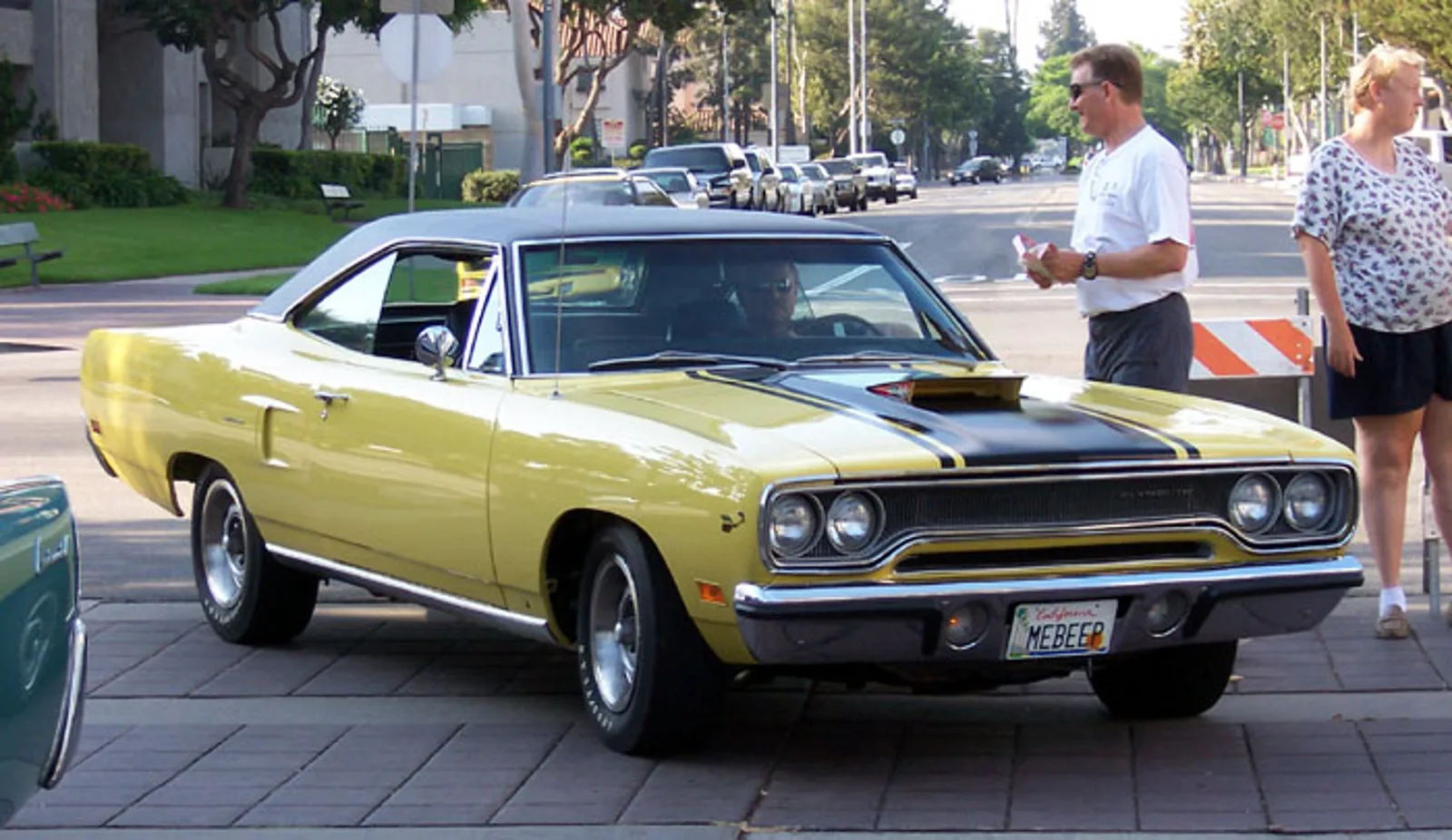
The sporty era began with the 1964 Barracuda fastback, which was based on the Valiant and was offered with the Slant Six or a 273 cu in V8. In 1966 the Sport Fury carried a 383 cu in V8, and in 1967 the Belvedere GTX offered Super Commando 440 or Hemi 426 engines.
The 1968 Road Runner was a stripped-down Belvedere coupe built with drag racing in mind, with a bench seat, minimal trim and a floor-mounted four-speed on offer with Chrysler's big-block engines. Under the Rapid Transit System banner, Plymouth sold the Valiant Duster 340, the Sport Fury GT, the Road Runner, the Barracuda and the GTX.
Racing reinforced the image. Richard Petty drove for Plymouth in NASCAR, Dan Gurney raced a Cuda for All American Racers in Trans Am events, and Sox and Martin, a leading drag team of the period, ran only Plymouths after 1964.
What were the 1970 Barracudas and their engines?
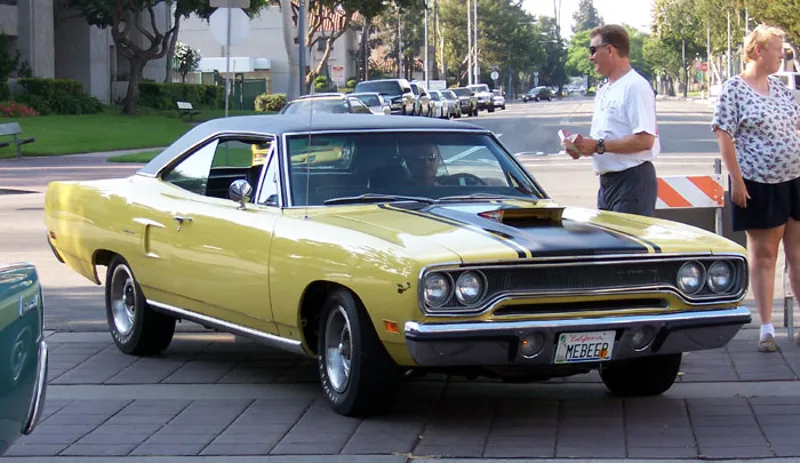
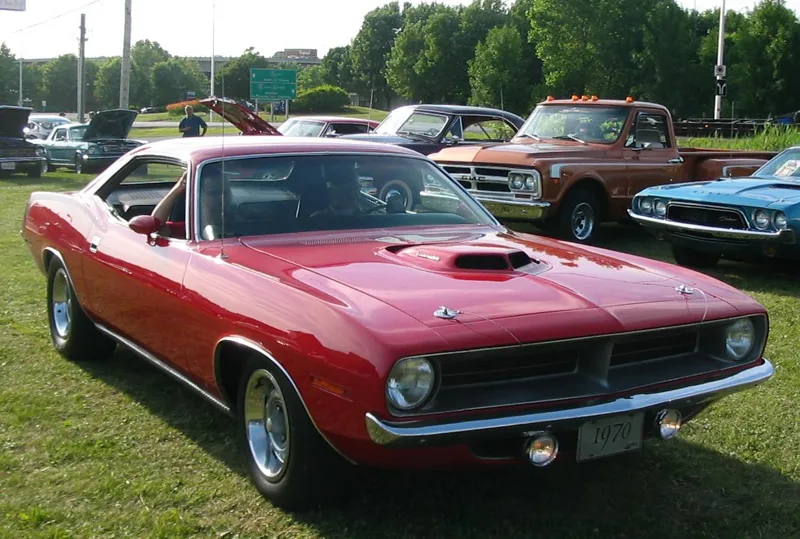
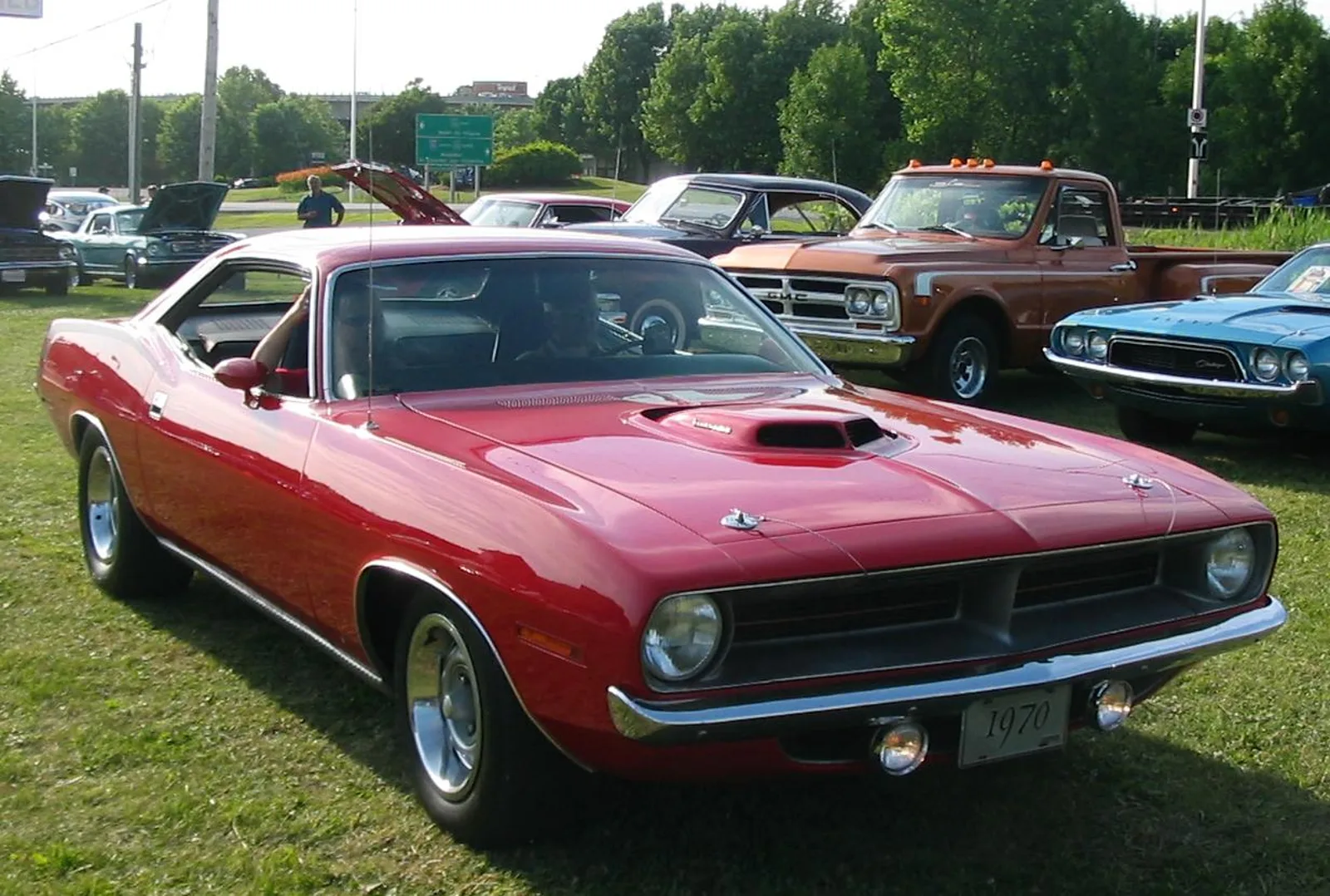
The 1970 Barracuda was redesigned on a shorter, wider version of Chrysler's B platform, the E-body. The new car shared its platform with the Dodge Challenger, although no exterior sheet metal was common between the two, and the Challenger had a wheelbase 2 inches longer than the Barracuda.
For 1970 the Barracuda range had three versions: the base Barracuda, the luxury Gran Coupe and the sporty 'Cuda. The 383-4V was rated at 335 hp, the 340-4V at 275 hp, the 440-4V at 375 hp, the 440-6V at 390 hp and the 426-8V Hemi at 425 hp, all in SAE gross figures.
The lower-end Barracuda Coupe carried a Slant Six as its base engine. Other packages included decal sets, hood changes and unusual high-impact colours, which gave the range plenty of individuality.
Why did the 1970s hurt Plymouth?
By the 1970s emissions and safety rules, soaring fuel prices and an economic downturn had cut demand for muscle cars. Big-block options were withdrawn, engines were detuned year after year, and bumpers and side-impact beams added weight. Insurance surcharges on performance cars discouraged many buyers.
Barracuda output stopped on April 1, 1974, a decade to the day from its start. The compact line had its own replacement. The Volare launched in 1976 with transverse torsion bars and a slightly larger body, and it was an immediate sales success, though quality problems hurt it and sales fell badly by 1980.
Chrysler judged that front-wheel drive, four-cylinder power and rack-and-pinion steering would be standard in the 1980s, so it introduced the Horizon in 1978 on a Simca platform. The Horizon sold well until a critical Consumer Reports review questioned its handling, and Plymouth kept building it until 1987.
What were the K-cars?
The K-cars were Chrysler's first front-wheel-drive mass-market family, and they set the template for much of the company's later range. The Plymouth Reliant and Dodge Aries arrived for the 1981 model year, with the Reliant available as a two-door coupe, a four-door saloon or a wagon, in base, Custom and SE trims.
Under the bonnet the Reliant had a 2.2-litre four-cylinder SOHC unit, and a Mitsubishi 2.6-litre was optional. Both cars sold over 150,000 units each in 1981, and the Reliant and Aries shared Motor Trend's Car of the Year award for that year. Chrysler marketed the car as able to seat six Americans.
The Reliant replaced the Volare and Road Runner, and the Aries replaced the Dodge Aspen. The K-cars were built at Newark in Delaware, Detroit in Michigan and Toluca in Mexico, and they sold for nine years, with a total of more than a million Reliant units.
How did the minivan and small cars sell?
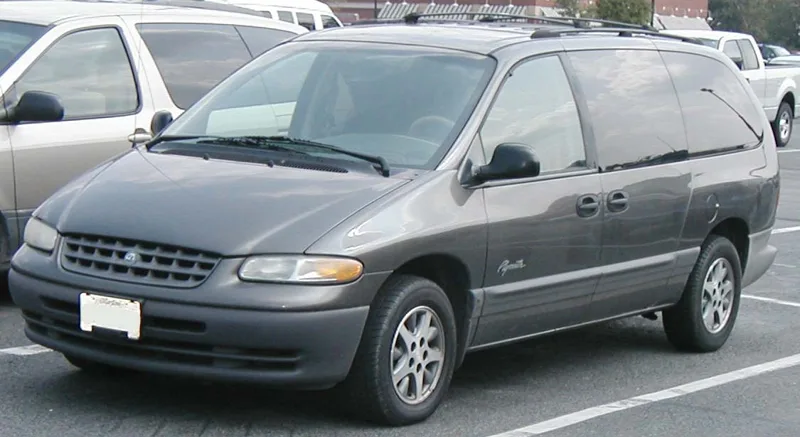
Chrysler's minivan arrived in 1984 as the Plymouth Voyager, built on the S platform derived from the K-car. It shared parts with the K-cars, including the Reliant's instrument cluster and dashboard controls, and its low floor gave it an easy step-in height.
The Voyager was on Car and Driver's Ten Best list for 1985, although its sales were usually under half of the Dodge Caravan's. Grand Voyager, an extended wheelbase version, followed in May 1987, and the Voyager was credited with being among the first mass-produced vehicles with built-in cup holders. Early television advertising starred the magician Doug Henning.
The Sundance arrived in 1987 as a compact P-body hatchback, with an RS model offering a turbocharged 2.2 L I4 from 1988. The AA-body Acclaim followed in 1989 as the replacement for the Reliant. Most buyers chose the base car, which made up close to 85 percent of sales, and it was marketed as a mainstream variant beside the Dodge Spirit and the luxury Chrysler LeBaron.
Why did the Plymouth brand end?
In the 1990s the brand's identity had faded, since its cars shared features and prices with sister marques Dodge and Eagle. Chrysler tried to restore Plymouth as its entry-level brand, but sales kept falling and the line narrowed, reaching just three models in 1995.
The Prowler arrived as a fourth model in 1997, and the Breeze mid-size sedan had been introduced in 1996. Production had peaked at 973,000 cars in 1973, but after 1990 Plymouth rarely built more than 200,000 cars a year, and in 1993 the model year produced 159,775 Plymouth cars.
DaimlerChrysler announced the end of the brand on November 3, 1999, and the final Plymouth model year was 2001. The Neon, the last new model sold under the marque, was built at Belvidere, with 38,657 produced for the model year, and the final car was assembled on June 28, 2001. The PT Cruiser debuted under the Chrysler badge, while the Prowler and Voyager were folded into Chrysler too.
What are the key Plymouth figures?
| Item | Detail |
|---|---|
| Launch | July 7, 1928, Madison Square Garden |
| Early price | US$695 for the 4-door Touring Sedan |
| 1939 output | 417,528 vehicles, including 5,967 convertible coupes |
| 1955 sales change | Up 52% over 1954 after the Exner redesign |
| 1957 total | 726,009 cars |
| Peak output | 973,000 cars in 1973 |
| K-cars, 1981 | Over 150,000 Reliant and Aries units each |
| 1997 output | 178,807 Plymouth cars |
| 2000 output | 108,546 Plymouth cars |
| Final Neon | 28 June 2001, Belvidere |