How Plymouth's Voyager went from a passenger van to one of the first minivans sold in North America, across three generations and the end of the brand.
The Plymouth Voyager was a Plymouth passenger van from 1974 to 1983 and a front-drive minivan from 1984 to 2000, across three generations. Its engines ranged from a 2.2 L four-cylinder to a 3.8 L V6, and the Plymouth brand closed during the 2000 model year.
The Plymouth Voyager began in 1974 as a full-size passenger van and was reborn in 1984 as one of the first minivans sold in North America. Across three minivan generations it remained part of Plymouth's range until the brand closed during the 2000 model year. The name has since returned under Chrysler, and then again in 2020.
Where did the Plymouth Voyager come from?
Plymouth's first own-brand light trucks since 1942 included the Voyager, a passenger van from 1974. It was the Plymouth counterpart of the Dodge Sportsman, and its name later moved to a far smaller vehicle, a front-drive minivan introduced for 1984.
For the 1974 model year, Plymouth debuted light trucks under its own name for the first time since 1942. The Voyager arrived alongside the Trail Duster SUV, which was derived from the Dodge Ramcharger. Unlike Dodge, Plymouth marketed the Voyager only as a passenger van.
Seating depended on body length, with the model line offered for up to 15 passengers. An extended-body version, derived from the Dodge MaxiWagon, was longer again. The Voyager was refreshed through the late 1970s, with a redesigned B-pillar and wraparound rear corner windows on extended vans for 1978, and a taller, longer hoodline and larger grille for 1979.
Plymouth Voyagers were fitted with four headlamps as standard, a detail that set them apart from their Dodge counterparts. Plymouth discontinued the full-size van after the 1983 model year, moving the nameplate to the new 1984 minivan.
A van that became a minivan, then a Chrysler, and then a name that came back for one more generation.
How did Chrysler create the minivan that became the Voyager?
Chrysler began its small van work in the early 1970s, after Ford had explored smaller garageable vans. A project that began in 1977 became the modern minivan, with a front-wheel drive chassis based first on the Dodge Omni and then on a larger design, launched a few months ahead of Renault's Espace in Europe.
Ford and Chrysler both began work on lower, passenger-focused vans in the early 1970s. Ford's 1973 Carousel prototype used the Ford Club Wagon as its starting point and was restyled and lowered before the project was cancelled during 1974. At Chrysler, the small van designed by Dodge Truck Engineering was shelved for lack of funds.
Development started at the end of 1977. Lee Iacocca and Hal Sperlich joined Chrysler in 1978 after leaving Ford, and the van grew in size because the Omni chassis proved too small for the powertrain. The T-115 small van program was funded through a large portion of Chrysler's federal loan guarantees.
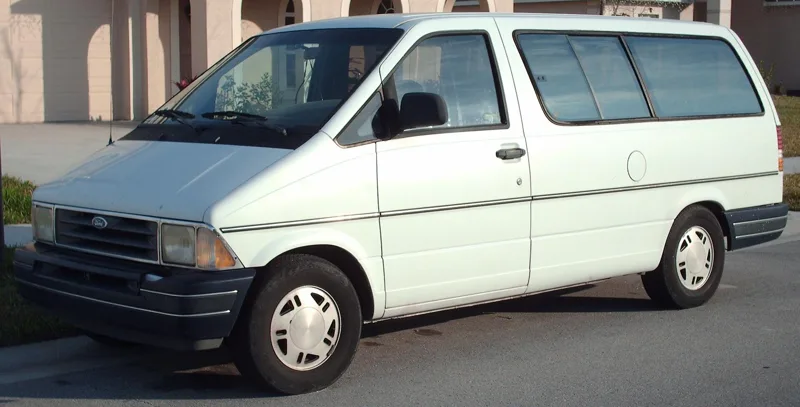
The Chrysler minivans launched a few months before the Renault Espace, which was the first MPV in Europe. Chevrolet, GMC and Ford followed with the Astro, the Safari and the Aerostar, and together they created the modern minivan segment in the United States.
What did the first-generation Voyager minivan offer?
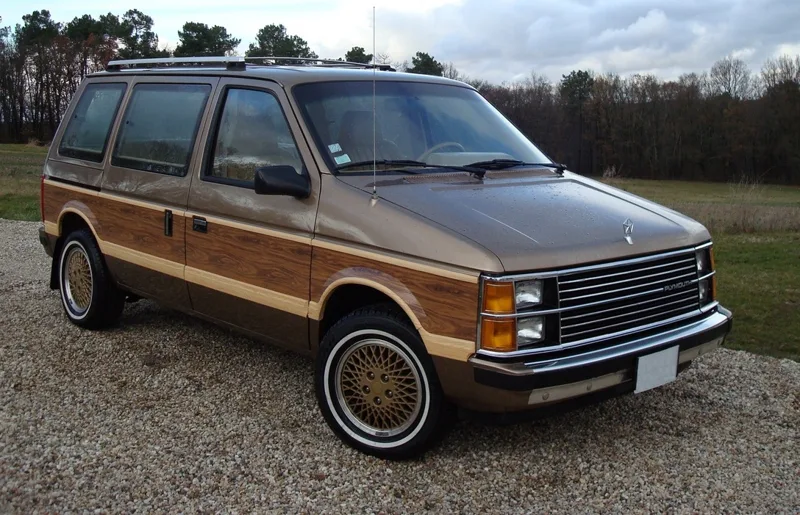
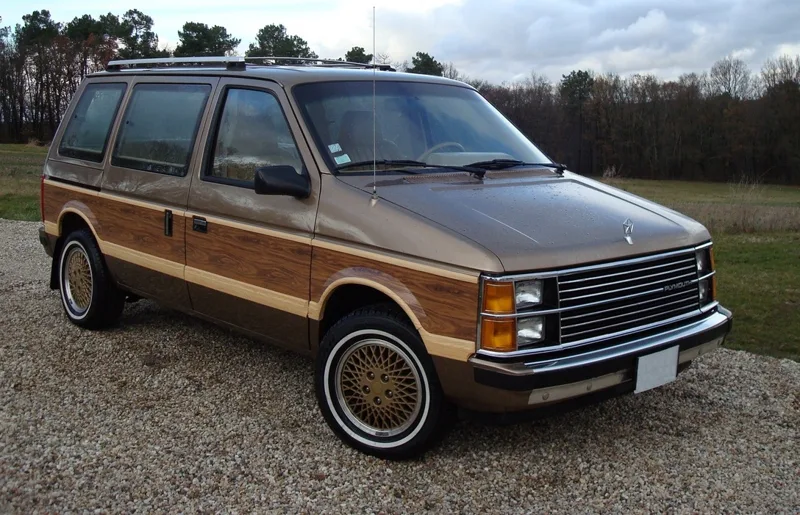
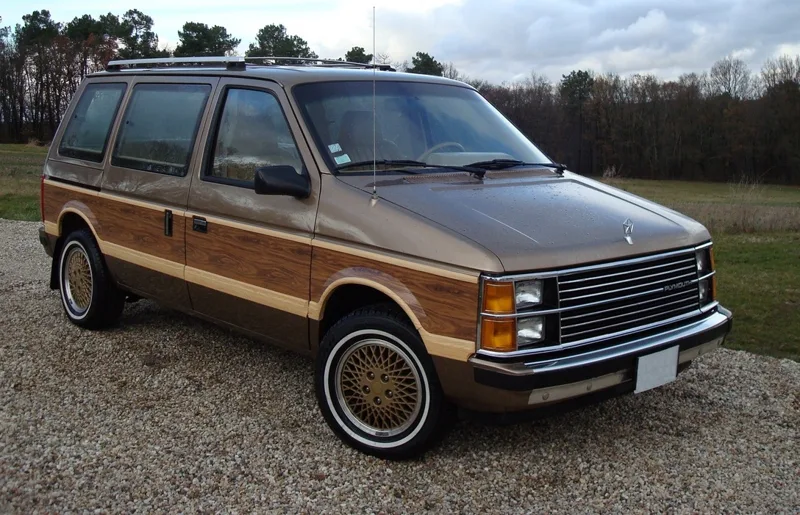
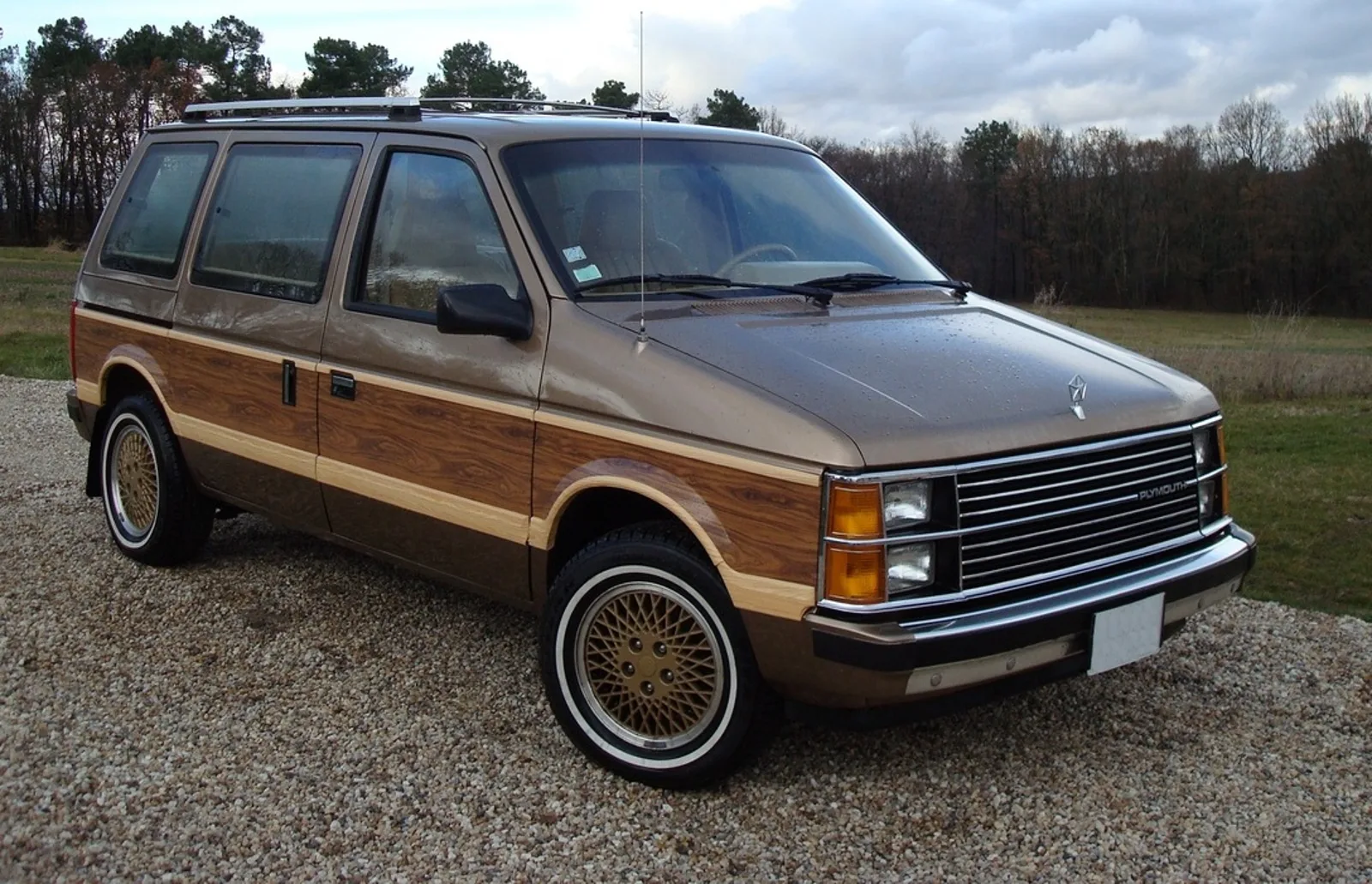
The 1984 Voyager was built on a front-wheel drive chassis shared with the Dodge Caravan, and it was sold in base, SE and LE trims. It could seat five, six or seven passengers, and eight in 1985 only, which made the seating layout the main draw.
The first Voyager had a passenger-side sliding door and a single-piece liftgate at the back. Its front-wheel drive layout gave it a much lower floor than the full-size van it replaced, and it was similar in length to the Aries and Reliant station wagons, though several inches wider.
Five-passenger seating was standard on every trim, with seven-passenger seating an option on SE and LE models. The rear benches could be removed independently, and the Magic Camper option let the rear seat fold flat into a bed for 1985 and 1986. A tent attached magnetically to the side of the van, giving access through the sliding door.
For 1987 the six- and eight-passenger options were withdrawn, and the Grand Voyager arrived with a longer wheelbase for SE and LE trims. Leather seats appeared on LE models that year, and the flagship two-tone LX trim followed in 1989.
Safety equipment was basic. Front occupants had three-point seat belts, rear passengers had lap belts, and airbags or ABS were not available. The Voyager and Caravan are considered among the earliest mass-produced vehicles with dedicated cup holders outside the glovebox.
Advertising was memorable. Magician Doug Henning promoted the Magic Wagon in the original 1984 commercials, Tina Turner featured in 1989, and Celine Dion appeared in Canadian commercials in 1990.
What engines did the Voyager use across its generations?
Early Voyagers used a 2.2 L four-cylinder rated at 72 kW (96 hp), with a Mitsubishi 2.6 L option. By 1998 the top engine was a 3.8 L V6 with 134 kW (180 hp), while the turbocharged 2.5 L made 112 kW (150 hp) in 1989 and 1990.
At launch the Voyager's low power-to-weight ratio was not much of a concern. Its main rivals, the Toyota Van and the Volkswagen Vanagon, offered similar performance, so buyers did not expect a quick minivan.
In mid-1987 the base 2.2 L was replaced by a fuel-injected 2.5 L four rated at 75 kW (100 hp). The Mitsubishi four gave way to a fuel-injected 3.0 L V6 with 101 kW (136 hp) in March of that year, and a turbocharged 2.5 L arrived in 1989 before being dropped at the end of 1990.
Inline-four engines could be paired with a three-speed TorqueFlite automatic or a five-speed manual. The V6 engines used the hydraulically operated TorqueFlite until the computer-controlled Ultradrive 4-speed arrived in 1989, which gave much better economy and responsiveness.
| Years | Engine | Power | Torque |
|---|---|---|---|
| 1984-1987 | 2.2 L K I4 | 72 kW (96 hp) | 161 Nm (119 lb ft) |
| 1984-1987 | 2.6 L Mitsubishi G54B I4 | 78 kW (104 hp) | 193 Nm (142 lb ft) |
| Mid-1987 to 1990 | 2.5 L K I4 | 75 kW (100 hp) | 183 Nm (135 lb ft) |
| Mid-1987 to 1988 | 3.0 L Mitsubishi 6G72 V6 | 101 kW (136 hp) | 228 Nm (168 lb ft) |
| 1989-1990 | 2.5 L Turbo I4 | 112 kW (150 hp) | 244 Nm (180 lb ft) |
| 1989-1990 | 3.0 L Mitsubishi 6G72 V6 | 106 kW (142 hp) | 235 Nm (173 lb ft) |
| 1990 | 3.3 L EGA V6 | 112 kW (150 hp) | 244 Nm (180 lb ft) |
| 1991-1995 | 2.5 L K I4 | 75 kW (100 hp) | 183 Nm (135 lb ft) |
| 1994-1995 | 3.3 L EGA V6 | 121 kW (162 hp) | 263 Nm (194 lb ft) |
| 1994-1995 | 3.8 L EGH V6 | 121 kW (162 hp) | 289 Nm (213 lb ft) |
| 1996-2000 | 2.4 L EDZ I4 | 112 kW (150 hp) | 226 Nm (167 lb ft) |
| 1996-2000 | 3.3 L EGA V6 | 118 kW (158 hp) | 275 Nm (203 lb ft) |
| 1998-1999 | 3.8 L EGH V6 | 134 kW (180 hp) | 325 Nm (240 lb ft) |
What changed in the second-generation Voyager?
The second generation arrived for 1991 with new sheet metal on the AS platform, which was still derived from the K platform. It built on the Quad Command seating introduced in 1990, added a driver's side airbag in 1991 and dual front airbags in 1993, and became the first minivan to meet the 1998 US federal safety standards in 1993.
Trim levels carried over from the first generation, with base, SE, LE and LX models for 1991. The LX was a sport-luxury van with alloy wheels, fog lamps and a wide range of power features. The Sport Wagon package, from 1993 to 1995, added grey bumpers and mouldings, while the Rallye package for 1995 replaced the LX with two-tone lower-body paint and silver aluminium wheels.
Quad Command replaced the middle bench with two individual buckets and a centre aisle that gave access to the rear bench. The Voyager was a rebadged twin of the Dodge Caravan, and only its badging and minor cosmetics set the two apart. The Chrysler Town and Country shared the Voyager's headlamps and taillights.
The 1994 update brought new bumpers, a redesigned dashboard with a passenger-side airbag and side door-guard beams. Those changes allowed the Voyager to meet all passenger car safety requirements through 1998. A 162 hp (121 kW) 3.8 L V6 became an option on top-of-the-line Grand Voyager LE models, and a 10th Anniversary Edition was offered on SE models.
What was the third-generation Voyager, from 1996 to 2000?
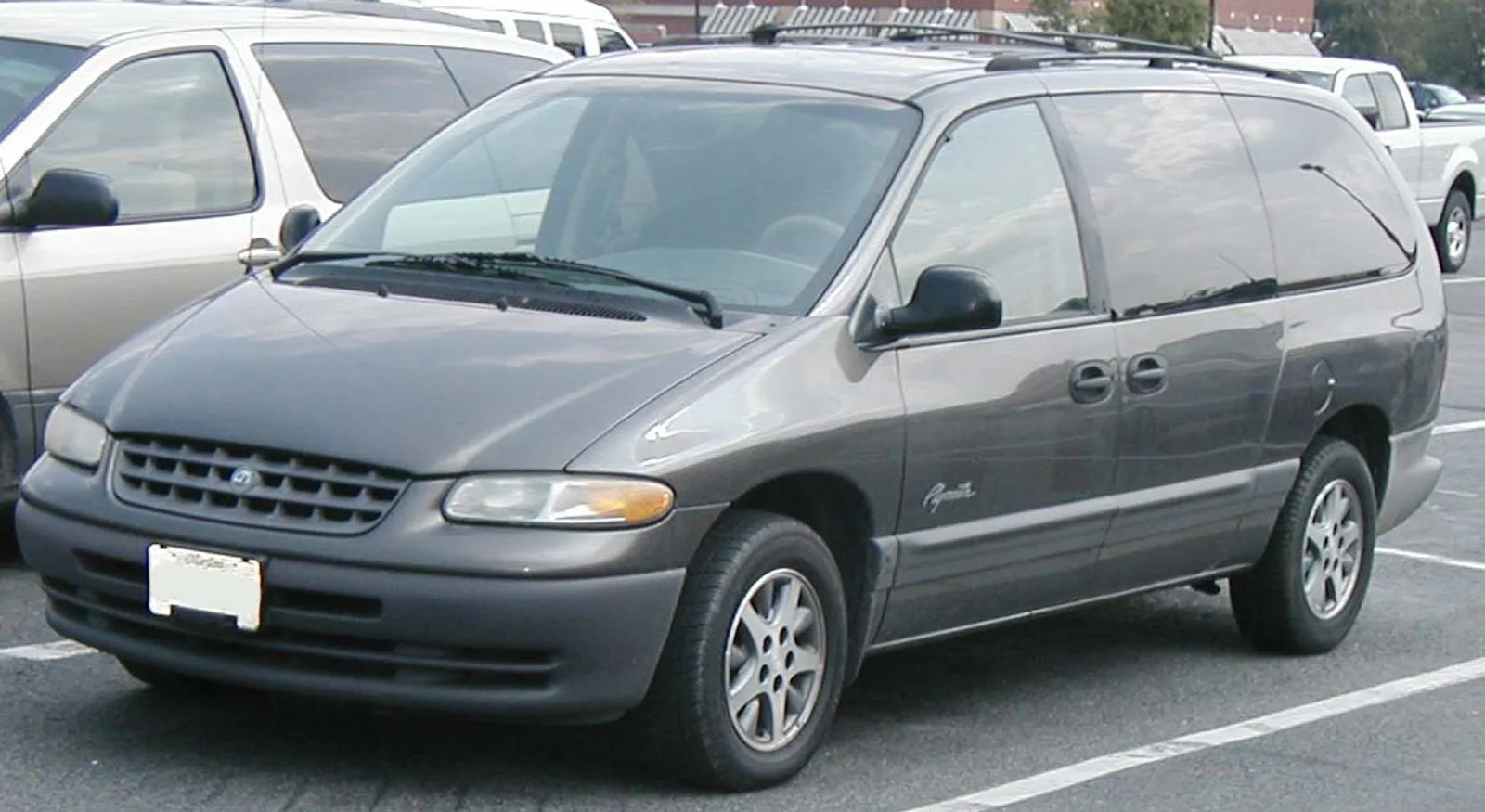
The 1996 Voyager was redesigned from the ground up on Chrysler's NS platform, adopting cab-forward design and a driver's-side sliding door, a first for a minivan. It was marketed as the entry-level Chrysler minivan and used 'Easy-Out Roller Seats' that could be moved with ease.
The shared bodyshell with the Dodge Caravan hid significant differences in trim and content. The Voyager used matte gray bumpers on every trim and a dark gray egg-crate grille, and it was never offered with automatic headlights, fog lights, a power driver's seat or auto-dimming mirrors. That kept it as the entry-level choice.
The Easy-Out seats latched to floor-mounted strikers. When released, eight rollers lifted each seat so it could be rolled fore and aft, and ergonomic levers released the latches without tools. The seatbacks also folded forward, and the bench stanchions were moved inboard to make the frames lighter.
The base engine became a 2.4 L four-cylinder producing 112 kW (150 hp). The 3.3 L V6 produced 118 kW (158 hp), and the 3.8 L V6 made 124 kW (166 hp) in 1996 and 1997 before rising to 134 kW (180 hp) for 1998 and 1999. Canadian vans from 1999 had a 3.0 L V6 as standard equipment.
The Rallye option package arrived on SE models in 1996 and was renamed Expresso for 1998. Expresso added new wheel covers on steel wheels, a standard CD player and a body-coloured grille. Air conditioning became standard on SE models in 1999.
How did the Voyager end with the Plymouth brand?
The Voyager ended as a Plymouth in 2000, when Chrysler closed the brand during that model year. Chrysler kept the nameplate for a short-wheelbase minivan, which was dropped in the US and Canada for 2004, and the name returned for 2020 production.
In 2000 the Voyager was sold under both Chrysler and Plymouth badges while the brand wound down. Air conditioning became standard on all models, while power windows and power locks were standard on SE models only. Dealers could also fit a rear-seat video entertainment system, and the 2000 packages added only unique fender badges.
After the 2001 arrival of the RS-generation minivans, the Chrysler Voyager carried a winged Chrysler emblem above a black plastic grille. It was the lowest-trim Chrysler minivan in North America, and Chrysler discontinued it in the United States and Canada for 2004. The model stayed in Mexico through 2007, and exports continued until 2016.
The nameplate returned for 2020 production, slotted below the Chrysler Pacifica and in effect replacing the Dodge Grand Caravan.
How did the Voyager fare in crash tests and reviews?
The twin Dodge Grand Caravan was rated Marginal in an Insurance Institute for Highway Safety offset test, while the NHTSA gave it four stars for the driver and front passenger in a frontal impact. Car and Driver put the Voyager on its Ten Best list for 1985, 1996 and 1997.
The IIHS rating applied to the 1996 to 2000 Grand Caravan, which shares its structure with the Voyager and Grand Voyager. Structure and restraints were graded Acceptable, but foot injuries were very high in the test.
In the NHTSA side-impact test, the driver scored five stars and the rear occupant three. The same test also produced a fuel leak that could cause a fire hazard.