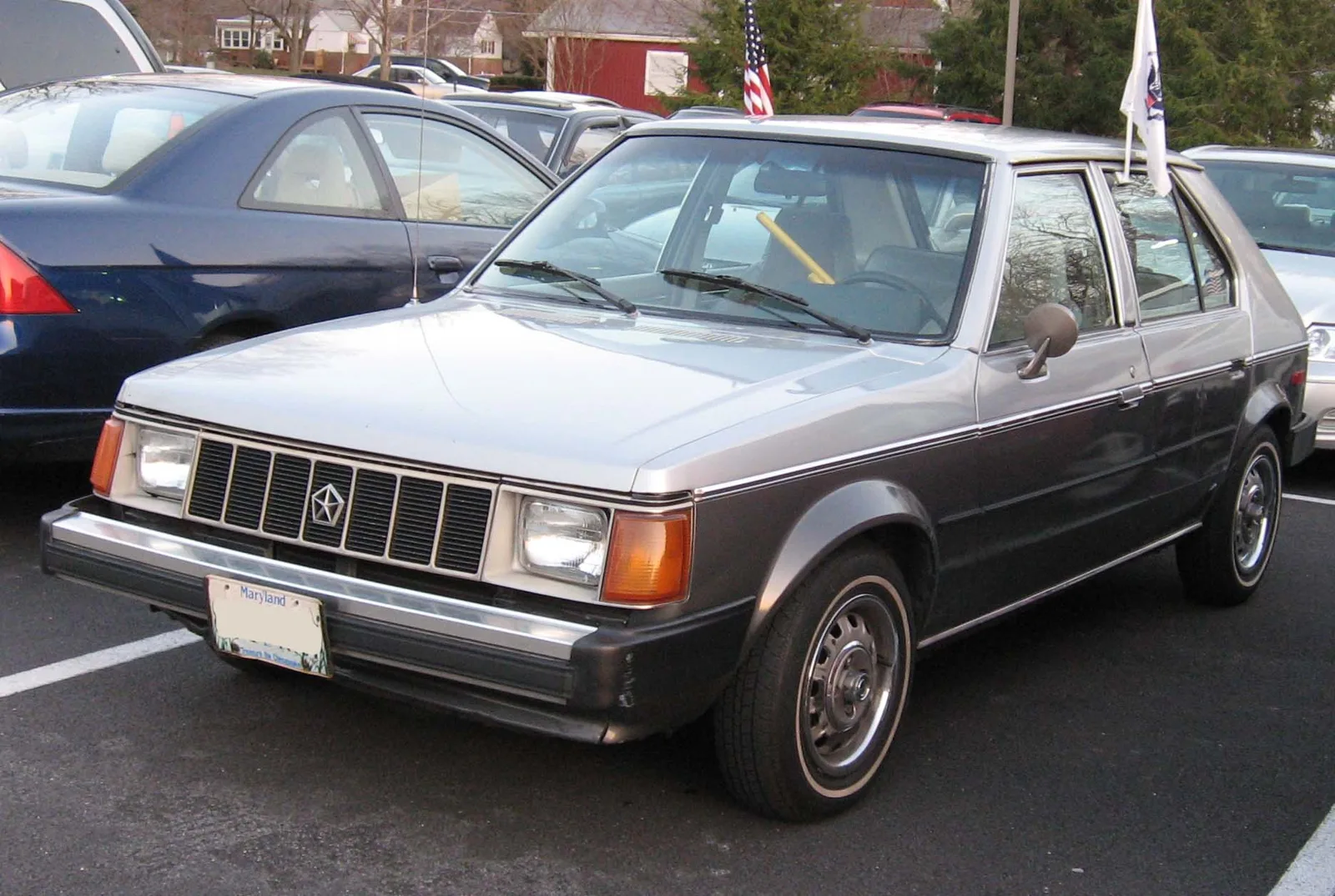
A five-door subcompact from Chrysler's L platform, sold as the Plymouth Horizon too, that brought front-wheel drive to American showrooms and sold for a dozen years.
The Dodge Omni was a front-wheel-drive five-door hatchback that Chrysler built from 1978 to 1990. It was also sold as the Plymouth Horizon, used a transverse four-cylinder engine and helped the company build a case for government support.
The Dodge Omni was a subcompact hatchback that Chrysler Corporation built from the 1978 to the 1990 model years. It was sold as the Plymouth Horizon as well, and it was the first front-wheel-drive Chrysler and the first front-wheel-drive American car to reach showrooms. Its success in the first years gave the company evidence that it could build fuel-efficient cars, which helped its case for government support.
What was the Dodge Omni?
The Dodge Omni was a five-door hatchback built on Chrysler's L platform, with a transverse four-cylinder engine driving the front wheels. Plymouth sold the same car as the Horizon, and the two models were nearly identical apart from grilles, taillamps and badging. Chrysler sold the line for thirteen model years in North America, from 1978 to 1990.
Its 99.2-inch wheelbase was shared with the European Chrysler Horizon that gave the platform its name, although Chrysler made substantial suspension changes for the American car.
A front-wheel-drive hatchback that arrived when Chrysler needed it most and carried the company's small-car hopes into the 1980s.
Why did Chrysler need a small car?
Chrysler needed a small car because it had no competitive subcompact in the mid-1970s, while rivals such as the Chevrolet Vega, Ford Pinto and AMC Gremlin were already on sale. For most of the early 1970s the company promised a domestic small car under a project called R-429, and then kept delaying it.
The company first tried to fill the gap through European partners. It raised its stake in Simca to 77 percent in 1963 and took control of the Rootes Group by mid-1964, marketing Simca and Rootes models through a new Simca-Rootes Division formed in 1966. The results were poor, and in late 1969 Chrysler moved those products into its Chrysler-Plymouth division.
Chrysler also used captive imports to fill the lower end of its range. The Plymouth Cricket was a rebadged Hillman Avenger from the United Kingdom, sold between 1971 and 1973, while the Mitsubishi-built Colt was sold by Dodge dealers. Both were regarded as stop-gap measures, and the Cricket in particular failed to win buyers.
How was the L platform developed?
The L platform was developed through Chrysler Europe, which had its own small-car programme. Chairman Lynn A. Townsend initially doubted that subcompacts would appeal to American buyers, but in 1974 he sent an American management team to Chrysler Europe to find a suitable design. That team rejected a front-wheel-drive compact, codenamed C6, as unsuitable for the US, which was later built in Europe as the Chrysler Alpine.
Chrysler Europe then approved a shorter-wheelbase subcompact, codenamed C2, that would use a range of engines around 1.3 litres. Development of the American version began in 1975, after Townsend had retired. American designers considered a coupe body but kept the five-door hatchback, which followed the European look of the Volkswagen Golf.
The project used early computer-aided design. It was the first programme in which CAD drawings were passed electronically, by satellite, between the two sides of the Atlantic. Chrysler also bought nearly 100 Volkswagen Rabbits in the United States so its engineers could reverse engineer them.
How did the Omni come to market?
The Omni reached production at the end of 1977, with the Horizon nameplate used by Chrysler Europe as well. Chrysler had trailed its American rivals to the market by eight years, but it had front-wheel drive and transverse engines in its favour. The Omni and Horizon launched at a price of $2,500, and rivals such as the Gremlin, Pinto and Vega arrived in 1981 and 1982.
The sale of Chrysler Europe to PSA Peugeot Citroen in August 1978 ended further design work on the C2 project. Peugeot phased out the Chrysler name in Europe in favour of the Talbot marque, and the Horizon continued in production with little change until 1987. Chrysler Corporation kept the design rights to its American version and carried on building it in Illinois.
Why did the Omni matter to Chrysler's rescue?
The Omni mattered because Chrysler was on the brink of bankruptcy when it arrived, and the car was evidence that the company was building small, efficient cars that could compete with imports. Its early sales were disappointing, since 1978 was a strong year for larger cars, yet the car was an important argument when the company asked for federal help.
The Omni and Horizon became Chrysler's best-selling model line for the three years before the K-cars arrived. The company's government-backed funding was secured in 1979, and the loans of $1.5 billion ($6.65 billion in 2025) allowed Chrysler to finish the K-car programme and its minivans, two of its most profitable lines of the 1980s.
What engines did the Omni use?
The Omni's first engine was a 1.7-litre four sourced from Volkswagen in the United States, with a Chrysler-designed intake manifold. It produced 75 hp (56 kW; 76 PS) at launch, with 90 lb-ft (122 N-m) of torque, and was paired with a four-speed manual or a three-speed automatic. A California version with an air pump made 70 hp (52 kW).
Power climbed to 77 hp (57 kW) in 1979, then dropped to 68 hp (51 kW) and 83 lb-ft (113 N-m) of torque in 1980, when the engine was offered in all fifty states. From 1981 the 2.2-litre K-car engine became an upmarket alternative, starting at 84 hp (63 kW) and rising to 93 hp (69 kW) in 1986.
For 1983 Chrysler added a Peugeot-supplied 1.6-litre Simca unit with 62 hp (46 kW) as a new base engine, linked to a manual gearbox and no air conditioning. That engine was dropped for 1987, when the 2.2 became the standard engine. The 2.2 received fuel injection in 1988, adding three horsepower. Chrysler had also planned a PSA 1.9-litre diesel for 1984 and a 1.8-litre four for 1985, but neither reached North American production.
How were the body and chassis built?
The L platform used a 99.2-inch wheelbase and front MacPherson struts, while the rear had a semi-independent twist-beam layout with coil springs. Front brakes were power-assisted discs, rear brakes were drums, and steering was rack and pinion. Chrysler changed the suspension for the American market compared with the European Horizon, which used front torsion bars.
The body was far less shared than the names suggested. American regulations required sealed-beam headlamps and 5-mph bumpers, and the body stampings differed between the two markets. On the American car the rear door windows do not roll down fully, which was a cost-saving compromise compared with the European model.
How did the Omni change over its life?
The Omni was produced almost unchanged across its run, with the most visible revisions arriving in 1984, 1987 and 1990. Each update added detail changes rather than a new design.
- 1981 and 1982: the Miser version appeared with an overdrive manual, aimed at fuel economy.
- 1984: chrome trim gave way to black trim, the dashboard was redesigned and a Rallye dashboard with full instrumentation became an option. The five-speed manual became standard.
- 1987: all cars received an instrument panel with tachometer, oil pressure and voltmeter gauges, and the America version arrived.
- 1990: larger mirrors borrowed from the M-body sedans replaced the round units, and a driver-side airbag and rear-seat outboard shoulder belts were added to meet passive-restraint rules.
Which trim levels did the Omni offer?
The Omni was sold across a single trim level for most of its life, unlike many Chrysler models. The Miser for 1981 and 1982 was lightly equipped, and the SE Sport Edition arrived for 1984 with two-tone exterior paint.
The America trim arrived in 1987 to compete with low-priced imports such as the Yugo and the Hyundai Excel. Options were reduced to air conditioning and a radio, the paint and colour choices were cut and the price dropped from $6,209 to $5,499. Chrysler said the car included $684 of added equipment at no cost, and the break-even point for the America was 170,000 cars.
Where was the Omni built?
From 1977 to 1987 Chrysler built the Omni and Horizon at its Belvidere Assembly Plant in Illinois, which also made the rest of the L-body range. In 1985 Chrysler agreed with American Motors Corporation to build M-body vehicles at AMC's Kenosha, Wisconsin plant, and in 1987 the Omni and Horizon were added to that contract.
Chrysler ended production at the AMC Kenosha facilities at the end of December 1988, moving Omni and Horizon production to its Jefferson Avenue facility in Detroit, Michigan. In total about 2.5 million vehicles were produced, and the Plymouth Horizon was the final Plymouth model to outsell its Dodge counterpart.
Which variants came from the Omni?
The L chassis supported several derivatives. The Omni 024 and Plymouth Horizon TC3 three-door hatchbacks arrived in 1979 on a shortened 96.6-inch wheelbase. For 1982 they were renamed the Dodge Charger and Plymouth Turismo, and a 2.2 high-output engine produced the Shelby Charger.
The Dodge Rampage followed in 1982 as a coupe utility pickup and the first front-wheel-drive American pickup, with a 104.2-inch wheelbase and a leaf-sprung rear axle. The Plymouth Scamp was its twin in 1983. Carroll Shelby modified the Omni into the GLH, which stood for Goes Like Hell, from 1984 to 1986. That car used a 110 hp (82 kW) 2.2-litre, and for 1985 and 1986 an optional turbo, the GLH-T, produced 146 hp (109 kW).
Shelby Automobiles bought the final 500 GLH-T cars from 1986 and converted them into GLHS models, which were modified in California and sold as Shelbys. They used the turbo engine with an intercooler and a larger turbocharger, and their upgraded suspension used adjustable Koni struts. The final 1000 Shelby Chargers were built as GLHS cars with a 175 hp (130 kW) 2.2-litre Turbo II.
How did the press treat the Omni?
The Omni was well received at launch. Motor Trend named it its Car of the Year for 1978, and the Chrysler Horizon won European Car of the Year for 1979. In the same period Chrysler's success with the car helped it through a difficult period.
Not every review was positive. Consumer Reports said the car lost control in hard manoeuvres, and the claim received wide coverage, including a piece in Time magazine. Other automotive media found no problems and argued that the test did not reflect real-world driving. Chrysler responded by adding a steering damper and a lighter steering wheel.
Dodge Omni specifications
| Specification | Detail |
|---|---|
| Built by | Chrysler Corporation, sold as the Plymouth Horizon in the same years |
| Model years | 1978 to 1990 |
| Body | Five-door hatchback; three-door coupes and pickups as variants |
| Platform | Chrysler L platform, 99.2-inch wheelbase |
| Launch engine | 1.7-litre four from Volkswagen, 75 hp (56 kW; 76 PS) |
| K-car engine | 2.2-litre, 84 hp (63 kW) at launch, 93 hp (69 kW) from 1986 |
| Transmission | Four or five-speed manual; three-speed automatic |
| Front suspension | MacPherson struts |
| Rear suspension | Semi-independent twist-beam, coil springs |
| Assembly | Belvidere Illinois, AMC Kenosha Wisconsin, Jefferson Avenue Detroit |
| Production | About 2.5 million vehicles |
| Performance variants | GLH 110 hp (82 kW); GLH-T 146 hp (109 kW); GLHS 175 hp (130 kW) |