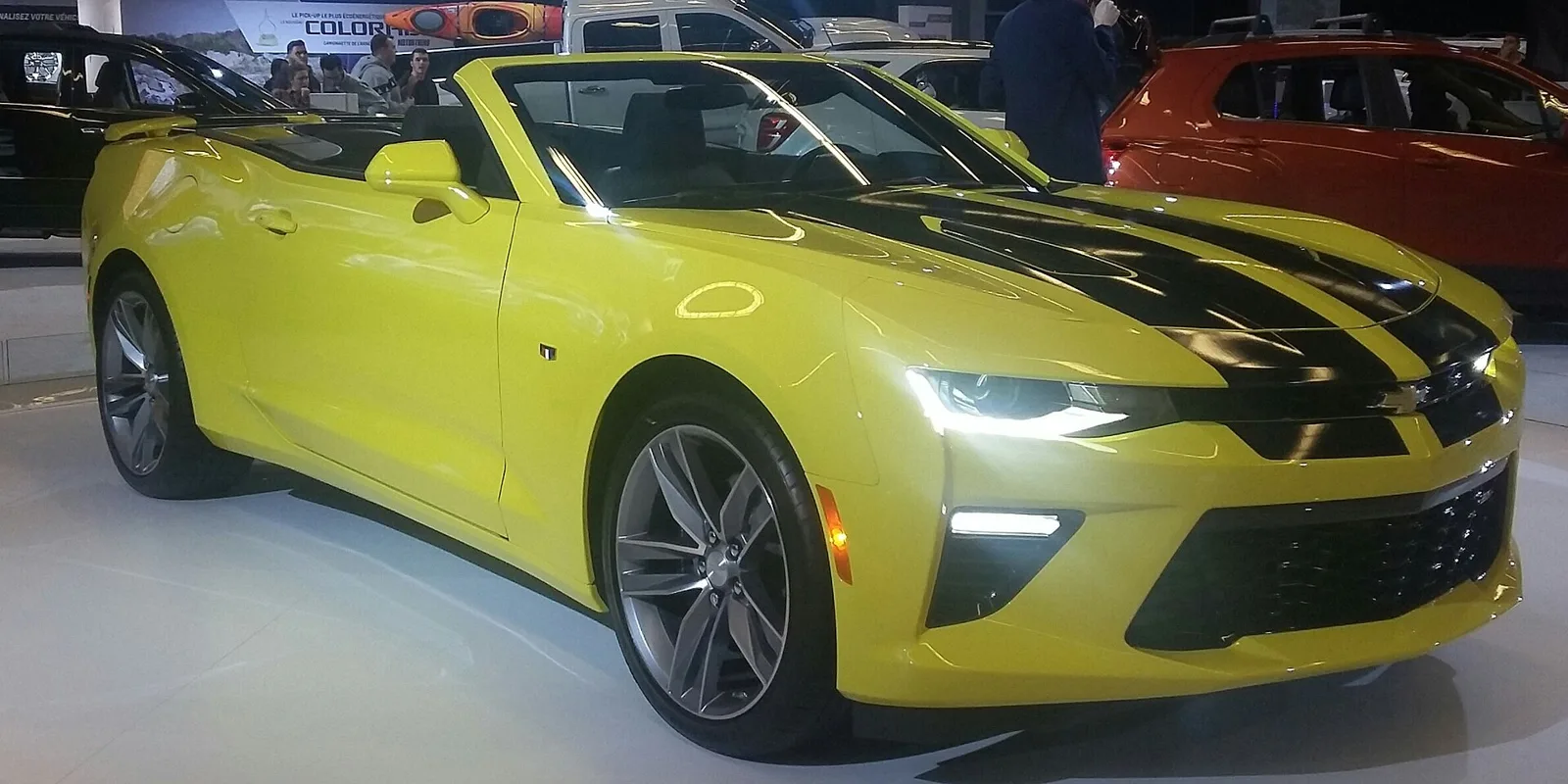
From a Swiss racing driver's name over a Flint, Michigan workshop to the small-block V8 and the Volt, Chevrolet has spent over a century as General Motors' everyman marque.
Chevrolet is General Motors' mainstream automobile division, founded on 3 November 1911 by racing driver Louis Chevrolet, his brother Arthur, and William C. Durant in Flint, Michigan. It became GM's volume leader, producing the long-running small-block V8 and models from the Corvette to the Volt.
Chevrolet is General Motors' mainstream, high-volume brand, built from a racing driver's name in 1911 into the division that made the small-block V8 and sold more cars in America than Ford by the end of the 1920s.
What is Chevrolet?
Chevrolet is the automobile division General Motors uses to sell mainstream vehicles, from subcompact cars to medium-duty commercial trucks, positioned below the premium Buick and GMC lines and the luxury Cadillac division.
The name carries enough weight that it is sometimes used as informal shorthand for General Motors itself, or even for a shared GM engine such as the LS1, which enthusiasts still often call by a variant of the small-block name its Chevrolet ancestor made famous. Many GM vehicles across brands share underlying platforms, but it is Chevrolet that carries the company's broadest, most accessible range worldwide, sitting in GM's own internal hierarchy below Buick and GMC and well below the luxury Cadillac name.
Nobody, not even Chevrolet itself, has ever definitively settled where that bowtie on the hood actually came from.
How did Chevrolet start?
The Chevrolet Motor Car Company was founded on 3 November 1911 and formally incorporated on 8 November, based in Flint, Michigan. Its founders were Swiss-born racing driver and engineer Louis Chevrolet, his brother Arthur, and ousted General Motors man William C. Durant.
Durant had been pushed out of his senior role at the very company he founded in 1908, having previously run Buick Motor Company and, before that, the Flint Wagon Works. While at Buick he had hired Louis Chevrolet to race its cars in promotional events, and when Durant needed a new venture, he leaned directly on that racer's growing reputation to anchor his next company. The first factory stood at Wilcox and Kearsley Street in Flint, and the plan worked almost too well: Durant used the new company's rising fortunes to engineer a reverse takeover, buying back control of General Motors and returning as its president in 1918, at which point Chevrolet itself was folded into GM as a division.
Where does the bowtie logo come from?
Chevrolet first used its bowtie emblem in 1914, on the H-series and L-series models, but its origin is still disputed. One account holds that Durant copied it from wallpaper he had once seen in a French hotel room.
A rival theory, advanced by historian Ken Kaufmann, traces the shape to an advertisement for a coal company called Coalettes, which ran in the Atlanta Constitution on 12 November 1911, barely a week after Chevrolet itself was founded. A third camp insists it is simply a stylised Swiss cross, a quiet nod to Louis Chevrolet's homeland. For decades the colour varied by vehicle type: passenger models typically wore it in blue, trucks carried a gold version, and anything with a performance package got a version outlined in red. That changed in 2004, when Chevrolet settled on one gold bowtie across the entire range, a tidy-up that also helped separate its look at a glance from Ford's blue oval badge and Dodge's long-running red branding.
What made the small-block V8 so important?
Chevrolet's small-block V8 debuted in 1955 and has stayed in continuous production ever since, making it the longest-running mass-produced engine design in the world, even though modern versions share almost no interchangeable parts with the original.
That longevity rests on how adaptable the basic layout proved to be. Over seven decades the small-block absorbed one upgrade after another: iron gave way to aluminium in the block and heads, ignition and fuelling moved under full electronic control, and injection shifted to a sequential, port-by-port setup, all while still tracing its lineage back to an overhead-valve design Chevrolet had used from its earliest days, itself derived from a patented Buick layout judged more efficient than the flathead engines rivals were still selling. The same basic engineering had already given Chevrolet an edge once before: its 1929 'Stovebolt' overhead-valve inline six beat Ford's flathead four on the showroom floor, years before the V8 existed at all. The modern small-block family spans displacements from 4.3 to 9.4 litres and factory outputs from 111 hp (83 kW) to 994 hp (741 kW), and the same basic platform has also powered cars badged Pontiac, Oldsmobile, Buick, Hummer, Opel and Holden.
Chevrolet's small-block V8, in numbers
Few single engine families have stretched across as many decades, displacements and output figures as Chevrolet's small-block, which is easiest to take in as a straight comparison.
| Measure | Figure |
|---|---|
| Debut year | 1955 |
| Displacement range | 4.3 to 9.4 litres |
| Factory power range | 111 hp (83 kW) to 994 hp (741 kW) |
| 1957 Ramjet fuel injection price | $484 ($5,548 today) |
| Other brands using the platform | Pontiac, Oldsmobile, Buick, Hummer, Opel, Holden |
That 1957 figure is worth pausing on: Rochester's Ramjet mechanical fuel injection, offered on the Corvette and the Bel Air that year, cost $484 at the time, equivalent to roughly $5,548 today, for a feature that would not become commonplace for another three decades.
How did Chevrolet become America's best-selling car?
Chevrolet's rise to the top of the US sales chart was deliberate strategy, not accident. GM president Alfred Sloan coined the maxim 'a car for every purse and purpose' and picked Chevrolet specifically to be the volume leader aimed squarely at Henry Ford's Model T.
It worked: by 1929, Chevrolet had passed Ford to become America's top-selling car outright, led by the Chevrolet International, and alongside Ford and the newly formed Plymouth it became one of the so-called 'Low-priced three' that dominated mainstream American motoring for decades. The brand's momentum only grew from there; by 1963, roughly one of every ten new cars bought anywhere in the country carried a Chevrolet badge. The Impala and Bel Air led that 1950s and 1960s charge, while the 1953 Corvette, a fibreglass-bodied two-seat sports car, gave the brand a halo model that had nothing to do with volume at all.
Did Chevrolet almost get cancelled in its early years?
Yes. A 1921 General Motors management review actually recommended shutting the Chevrolet division down entirely. Alfred Sloan personally overruled that recommendation, and William Knudsen, a former Ford production man, was brought in soon after as Vice President of Operations to turn performance around instead.
That near-miss landed just as Chevrolet's own footprint was still taking shape. By 1919 the division ran assembly plants not just in Flint but in Tarrytown, New York; Norwood, Ohio; St Louis, Missouri; Oakland, California; Fort Worth, Texas; and Oshawa, Ontario, and that same year General Motors began rebadging its GMC-brand commercial trucks as Chevrolets, sharing chassis with the passenger-car range. Chevrolet's own corporate address moved too, from an office at 57th Street and Broadway in New York to the General Motors Building in Detroit that April. Four years later, in 1925, a repurposed export-boxing plant in Bloomfield, New Jersey, began crating knock-down kits of Chevrolet and sister-brand cars for shipment overseas by rail. None of that expansion stopped Chevrolet from briefly trying an eight-cylinder engine of its own decades before the small-block arrived: the 1918 Series D offered a V8 in roadster and tourer form, only for weak sales to kill it off within a single year.
Did Chevrolet ever sell outside North America?
Yes, extensively. Chevrolet-badged vehicles have sold in most automotive markets worldwide, including a 2005 European relaunch built on rebadged cars from GM Daewoo of South Korea, sold under the line 'Daewoo has grown up enough to become Chevrolet'.
That European push was meant to position Chevrolet as GM's mainstream value brand while Opel and Vauxhall moved upmarket, but GM reversed course in late 2013 and withdrew Chevrolet from most of Europe from 2016 onward, keeping only the Camaro and Corvette on sale there. Chevrolet still continued selling across the CIS states, including Russia. In Oceania, the brand returned in 2018 after a 50-year absence, distributed first through Holden Special Vehicles with the Camaro and Silverado, before General Motors Specialty Vehicles took over Oceania sales in 2021, beginning with the Silverado pickup.
Which Chevrolet models defined each era?
Chevrolet's model history reads less like one single plan and more like a running record of postwar American taste, decade by decade, model by model. The 1960 Corvair introduced a rear-mounted, air-cooled engine to the compact-car boom, while the Impala, Chevelle, Monte Carlo, Nova and Camaro carried the brand through the 1960s and early 1970s as some of the country's best-selling nameplates, with the economical Nova's platform underpinning the original Camaro itself.
As cheaper imports began winning over American buyers in the 1970s and 1980s, Chevrolet answered with the Vega and the internationally engineered Chevette, both effectively gone by the mid-1980s, and then with rebadged Japanese models entirely: the Suzuki-built Sprint and the Isuzu-built Spectrum, aimed squarely at the Toyota Corolla and Honda Civic. The Citation became the division's first compact front-wheel-drive car, followed by the Cavalier and Celebrity, while a 1990s partnership with Toyota produced the Geo Prizm alongside the domestically built Corsica. The Lumina served the mid-size family-sedan boom, and the Venture minivan, Trailblazer and Traverse SUVs rounded out the range as tastes shifted again. The Impala nameplate itself returned in 2000 as a mid-size front-wheel-drive sedan and ran until 2020, its final 2014-2020 generation growing into a genuinely full-size car.
How did the 2008 financial crisis change Chevrolet?
The 2008 financial crisis forced General Motors into bankruptcy and killed off entire GM brands, including Pontiac and Saturn, while Chevrolet absorbed survivors such as the Captiva into its own lineup as GM refocused on fuel-efficient products.
That refocus produced the Chevrolet Volt, a plug-in hybrid launched in late 2010 and sold in Europe as the Opel and Vauxhall Ampera. In 2012 alone it collected three separate honours: North American Car of the Year, the European equivalent, and the World Green Car title. Sales matched the acclaim: Chevrolet moved 31,400 Volts that year, enough to lead the world in plug-in electric sales, while the Ampera took a 21.5% share of Europe's entire plug-in segment on 5,268 units sold. Combined Volt and Ampera deliveries worldwide passed the 100,000 mark by October 2015, and US Volt sales alone reached that same figure in July 2016, a run that still leaves the nameplate trailing only the Nissan Leaf and Tesla Model S on the all-time plug-in sales chart.
Nobody, not even Chevrolet itself, has ever definitively settled where that bowtie on the hood actually came from.
From a Flint street corner to a GM Building boardroom, Chevrolet's path has rarely been a straight line, shaped by a founder's ouster, a logo nobody can fully agree on, and a V8 that refuses to retire. Few car companies have reinvented their showroom lineup as many times while keeping the same bowtie on the hood. A division a 1921 memo nearly wrote off has since outlasted Pontiac and Saturn within its own parent company, still selling under the badge Louis Chevrolet's own name first gave it back in 1911.
.jpg)