The founder of Ford Motor Company built the Model T and popularised the moving assembly line, and his public record includes antisemitic publishing that historians still examine.
Henry Ford founded the Ford Motor Company in 1903 and built the Model T, which debuted in 1908 at $825. He popularised the moving assembly line and the $5 day, and his later career included a newspaper and political record that historians still examine.
Henry Ford was the founder of the Ford Motor Company and one of the most influential figures in the history of the car. He is credited with making automobiles affordable for middle-class Americans through a system that came to be known as Fordism. His record also includes a public role in antisemitic publishing, which historians still examine alongside his industrial achievements.
Who was Henry Ford?
Henry Ford was born on 30 July 1863 on a farm in Greenfield Township, Michigan, and died on 7 April 1947 at the age of 83. He founded the Ford Motor Company in 1903, and in 1911 he was awarded a patent for the transmission mechanism used in the Model T. He was among the early advocates of the five-day working week.
Ford spent much of his life pursuing a single idea: that a well-made, cheap car could be sold to ordinary families in large numbers. The Model T was the clearest expression of that idea, and the methods used to build it changed manufacturing well beyond the car industry.
A farm boy who learned watch repair built the Model T and the assembly line, and his newspaper and politics remain part of the same story.
What were Henry Ford's early years like?
Schooling ended with eighth grade at a one-room school, and he later studied bookkeeping at a commercial college. His father gave him a pocket watch at 12, and by 15 he had dismantled and reassembled the timepieces of friends and neighbours dozens of times, which earned him a reputation as a watch repairman.
Ford saw his first automobile as a boy. In 1875, aged 12, he witnessed a Nichols and Shepard road engine, which he later called the first automobile other than horse-drawn that he had ever seen. He left home at the age of 16 to work as an apprentice machinist in Detroit, and he later returned to the family farm, where he became adept at running a portable steam engine.
Through the later 1880s he repaired and built engines, and he took a job with a division of Edison Electric in the 1890s. He married Clara Jane Bryant on 11 April 1888, and the couple had one child, Edsel Ford, born in 1893.
How did Ford's first car come about?
Ford completed a two-cylinder, four horsepower motor car in 1892 and drove it for about 1,000 miles over the following years. In 1896 he completed the Ford Quadricycle, which he test-drove on 4 June. He then built a second car, completing it in 1898, and he went on to build three in his home workshop.
Thomas Edison encouraged his experiments after the two met at a meeting of Edison executives in 1896. Ford left the Edison company to found the Detroit Automobile Company on 5 August 1899, but the cars it produced were of lower quality and higher price than he wanted, and the company was dissolved in January of 1901.
How was the Ford Motor Company founded?
With help from C. Harold Wills, Ford built a 26-horsepower car that won a race in October 1901, and the Henry Ford Company was formed on 30 November 1901. Ford left that company in 1902 after a disagreement, and it was renamed the Cadillac Automobile Company. He then teamed up with Alexander Malcomson to form Ford and Malcomson, Limited.
The partnership was reincorporated as the Ford Motor Company on 16 June 1903, with $28,000 of capital. Investors included the Dodge brothers, who had supplied parts, and James Couzens, who later became prominent in the company. The new firm proved its worth on the ice of Lake St. Clair, where Ford drove a mile in 39.4 seconds, at 91.3 mph.
Barney Oldfield then took the car around the country, which made the brand known across the United States. Ford was also one of the early backers of the Indianapolis 500.
Why did the Model T change the industry?
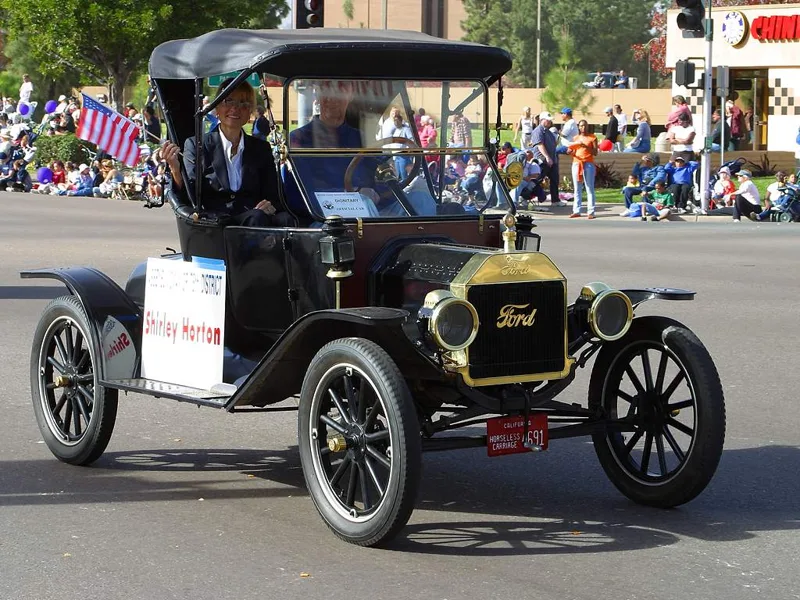
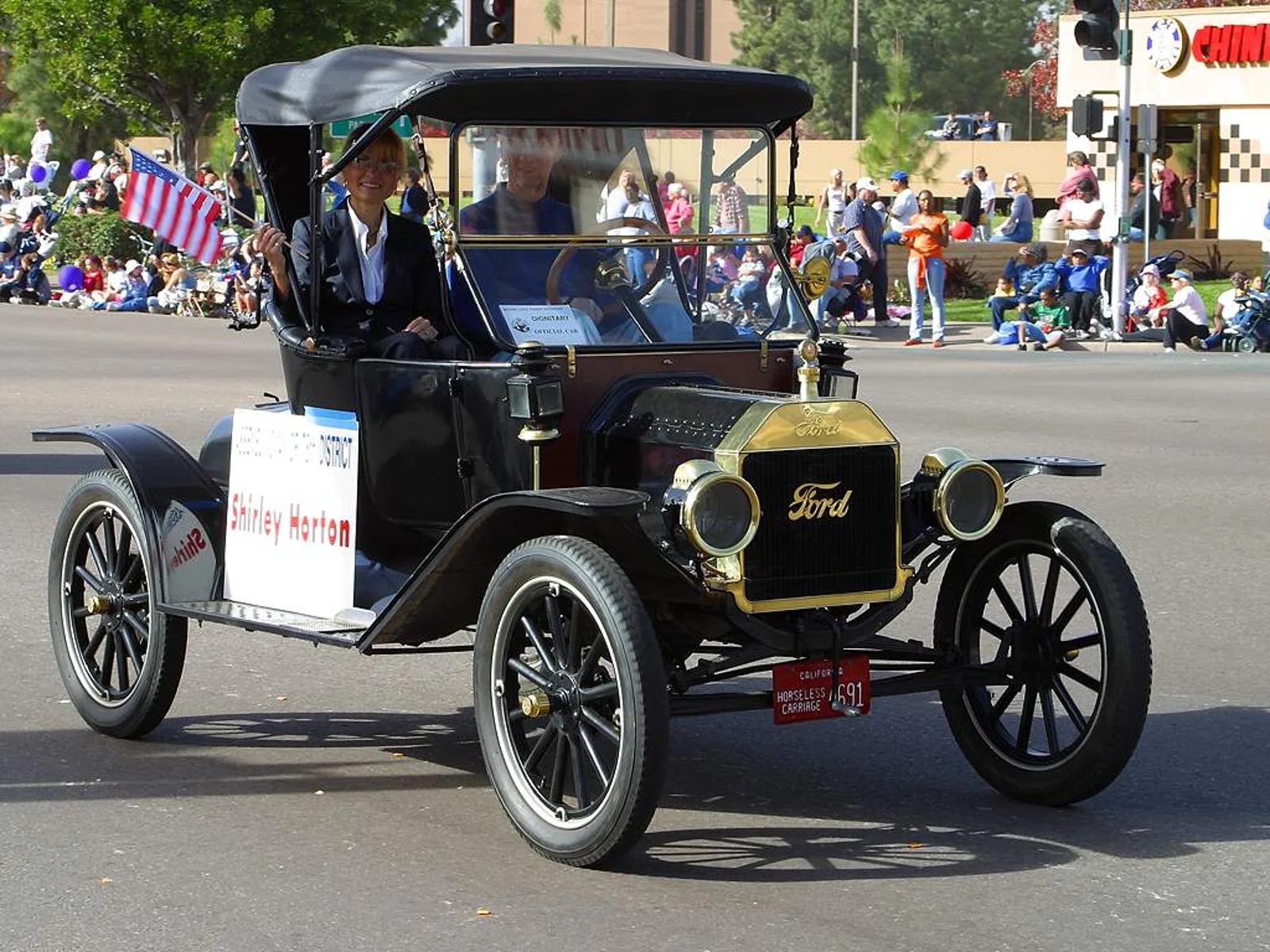
The Model T debuted on 1 October 1908 and was priced at $825 in its first year, falling each year afterwards. Its steering wheel was on the left, which other companies soon copied. The engine and transmission were fully enclosed, and the four cylinders were cast in a single block.
Ford's dealer network made the car common across North America. Sales passed 250,000 in 1914, and by 1916 the basic touring car cost $360 and sold 472,000 units in that year. Half of the cars on American roads were Model Ts by 1918.
In 1913 Ford introduced moving assembly belts into his plants, which enabled a large increase in output. Historians note that the concept was developed by several employees, including Clarence Avery, Peter E. Martin, Charles E. Sorensen and C. Harold Wills, rather than by Ford alone. Production continued until 1927, and the final total was 15,007,034, a record that stood for 45 years.
What was the $5 day?
On 5 January 1914 Ford announced a $5 daily wage, raising the minimum for qualifying male workers from $2.34. It more than doubled the rate for most of his workers, and it reduced the heavy turnover that had forced some departments to hire 300 men a year to fill 100 slots.
Profit-sharing came with conditions. Workers had to have been at the company for six months and live in a manner that Ford's Social Department approved. The department used 50 investigators and staff to monitor standards, a practice Ford later described in the past tense as he moved away from its most intrusive elements.
On 1 May 1926 the factory workers switched to a five-day, 40-hour week, with office staff following in August. Ford argued that leisure time was good for business, because workers would buy and use more goods.
How did Ford's company develop after the Model T?
General Motors had become the leading American manufacturer by the mid-1920s, and Ford was slow to respond. He eventually approved a successor, the Model A, which went on sale in December 1927 and was built through 1931 in a total output of more than four million. Ford then adopted an annual model change, similar to the system pioneered by General Motors.
The company also made a series of other moves. Ford bought Lincoln Motor Company in 1922, and Edsel Ford pushed the company into the upscale market. Mercury was launched in 1939 at Edsel's insistence. In 1932 Ford introduced the flathead V8, the first low-priced eight-cylinder engine, which gave the company a reputation for performance.
The Ford Trimotor, nicknamed the Tin Goose, first flew on 11 June 1926. It was the first successful American passenger airliner, and 199 were built before the aviation division closed in 1933.
| Year | Event |
|---|---|
| 1863 | Born on a farm in Greenfield Township, Michigan |
| 1892 | Completes a two-cylinder, four horsepower motor car |
| 1896 | Completes the Quadricycle |
| 1903 | Ford Motor Company incorporated on 16 June |
| 1908 | Model T debuts on 1 October |
| 1914 | $5 daily wage announced |
| 1927 | Model A launched in December |
| 1932 | Flathead V8 introduced |
| 1941 | Groundbreaking at Willow Run near Detroit |
| 1945 | Control passes to grandson Henry Ford II |
| 1947 | Dies on 7 April, aged 83 |
How did Willow Run contribute to the war effort?
Responding to a call for a "Great Arsenal of Democracy", Ford directed the company to build a large aircraft plant at Willow Run near Detroit. Ground was broken in the spring of 1941, parts for the B-24 began arriving on the line in May 1942, and the first complete aircraft followed in October 1942.
At its peak in 1944 the plant produced 650 B-24s a month. Ford built 9,000 B-24s at Willow Run, which was half of the 18,000 B-24s produced during the war.
The company's success at Willow Run contrasted with the tensions in its management during the same years. Ford's health was failing, and his subordinates were making many of the decisions in his name.
Why did Ford become involved in politics?
In 1915 Ford funded a Peace Ship to Europe, which carried about 170 other peace activists. The venture had no government support, and Ford left the ship as soon as it reached Sweden. He believed that industrial efficiency would discourage war, and his company became a major supplier of weapons during the First World War, including Liberty engines.
In 1918 Woodrow Wilson encouraged Ford to run for the US Senate in Michigan to help build support for the League of Nations. Ford lost narrowly, by about 7,000 votes in a statewide vote of more than 400,000, to Truman Newberry.
In 1919 Ford sued the Chicago Tribune for libel after it called him an anarchist. The jury awarded him six cents, although he had asked for $1 million. Ford later opposed US entry into the Second World War and resigned from the executive board of the America First Committee when his involvement proved too controversial.
What was the Dearborn Independent?
In 1918 Ford bought his hometown newspaper, the Dearborn Independent. Beginning in 1920, the paper ran a series of antisemitic articles across 91 issues, claiming a Jewish conspiracy was affecting America. Ford later bound the articles into four volumes entitled The International Jew, which sold more than 500,000 copies and was distributed in the United States and Europe.
The Independent had around 700,000 readers, and every Ford dealership was required to carry it. Its articles were denounced by the Anti-Defamation League, and a libel suit by the farm cooperative organiser Aaron Sapiro led Ford to close the paper in December 1927. Ford sent a public letter of apology to the ADL that year, although later accounts disputed how far he was personally involved, and he never formally recanted his views.
The International Jew was published in Germany by Theodor Fritsch, and Hitler's autobiography later named Ford as the one American it mentions favourably. In July 1938, on Ford's 75th birthday, the German consul in Cleveland presented him with the Grand Cross of the German Eagle, and the distribution of The International Jew was halted in 1942 through legal action by Ford.
How did Ford's later years unfold?
Edsel Ford died of cancer in 1943, aged 49, and Henry Ford nominally resumed control. A series of strokes had weakened him, and a handful of senior executives, including Charles Sorensen and Harry Bennett, made many of the decisions in his name. Ford forced Sorensen out in 1944, and the company was losing over $10 million a month during his final term.
Clara Ford and Edsel's widow Eleanor confronted him in 1945 and demanded he cede control to his grandson, Henry Ford II, who fired Harry Bennett as one of his first acts. Ford retired completely in September 1945.
He died on 7 April 1947 at his Fair Lane estate in Dearborn, from a cerebral hemorrhage. Public viewing took place at Greenfield Village, and funeral services were held at the Cathedral Church of St. Paul.
How is Henry Ford remembered?
Ford was inducted into the Automotive Hall of Fame in 1946, and the Automobile Manufacturers Association honoured him during its Golden Jubilee the same year. He held 161 US patents, and the Franklin Institute awarded him its Elliott Cresson Medal in 1928.
His museum work also survives. Ford began collecting historic structures and objects for a themed village, which became Greenfield Village in Dearborn. The museum, opened in 1929 as the Edison Institute, is still open today.
Ford appears in fiction and film, from E. L. Doctorow's Ragtime to the 2020 HBO miniseries, and he remains a central figure in histories of the American automobile.
Frequently asked questions
Did Henry Ford invent the car?
No. Ford built automobiles and developed the Model T, while the wider car industry grew from many inventors and firms. His contribution was in making cars cheap and building them with moving assembly.
How much did the Model T cost?
The Model T was priced at $825 when it debuted in 1908, and the price fell each year. By 1916 the basic touring car sold for $360.
Why did Ford pay $5 a day?
Ford's $5 wage, announced in January 1914, reduced turnover and attracted skilled workers. It also came with conditions tied to the Social Department's oversight of employees' private lives.
What is the record on Ford's antisemitism?
Ford owned the Dearborn Independent, which ran antisemitic articles in 1920 onwards, and The International Jew was published in four volumes. He apologised in 1927, but later statements disputed his role, and historians continue to examine the record.