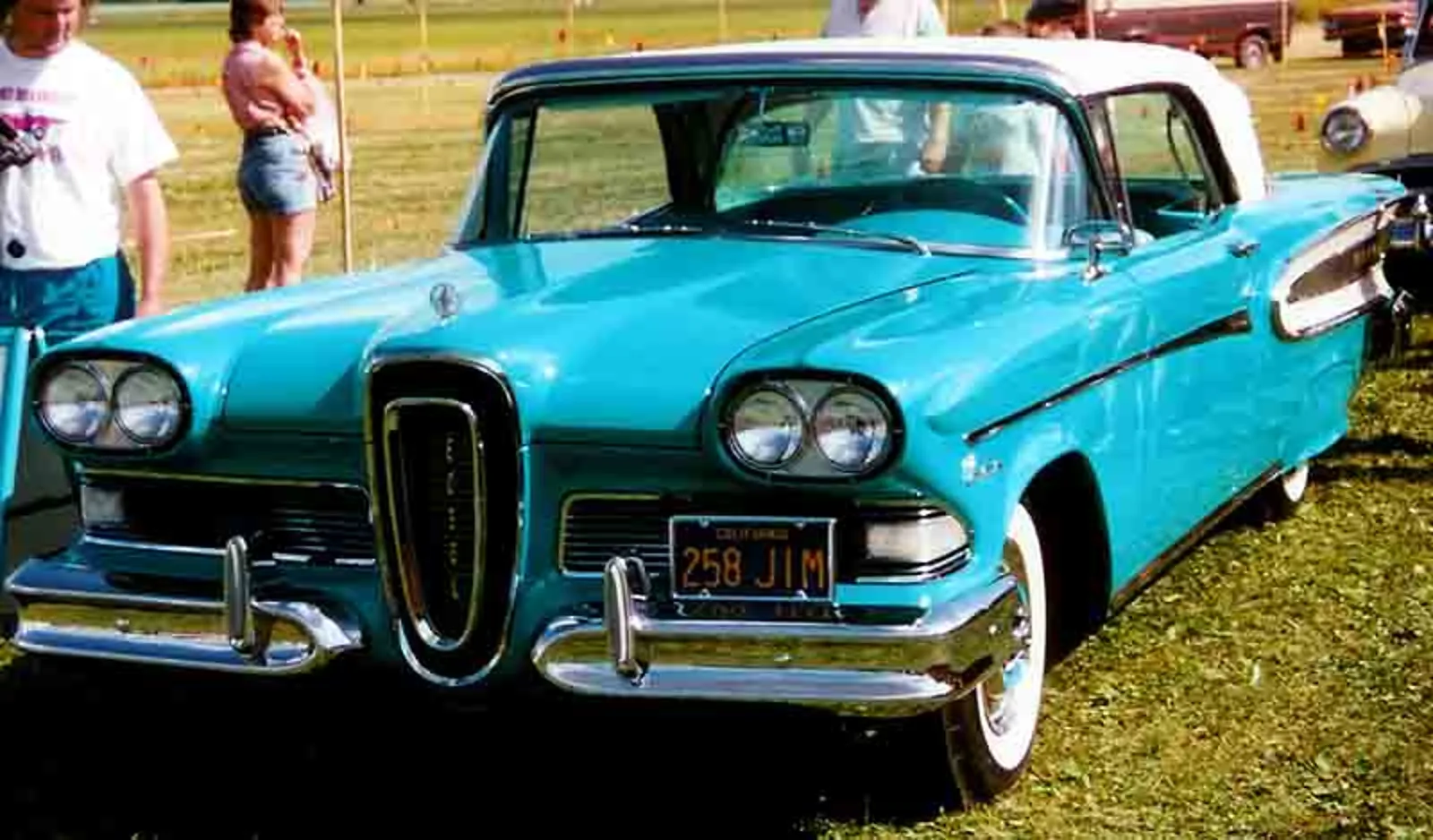
Built to give Ford a fourth brand, the Edsel lasted three model years, sold about 116,000 cars and left a lasting lesson in how to launch a product.
Edsel was a Ford brand sold in the United States for the 1958 to 1960 model years, named after Edsel Ford. Positioned in the medium-price range against Oldsmobile, Buick and Pontiac, it was discontinued in November 1959 after heavy losses. Its vertical grille and early reliability problems made it a byword for commercial failure.
Edsel was a Ford Motor Company brand sold for the 1958 to 1960 model years. Ford created it to win buyers from Chrysler and General Motors, but the launch became one of the best-known commercial failures in American car history. The programme lost a large sum and was dropped in late 1959.
What was the Edsel and why did Ford build it?
Ford created the Edsel to give the company a fourth brand that could draw buyers from Chrysler and General Motors. It was established as an expansion of the Lincoln-Mercury Division, which was re-christened the Mercury-Edsel-Lincoln Division, and it shared its price range with Mercury.
Edsel was the first new brand an American automaker had introduced since Mercury arrived in 1939 and Continental in 1956. Continental had been absorbed by Lincoln for the 1957 season, leaving Edsel to compete with Buick, Oldsmobile, Pontiac, Dodge and DeSoto.
Ford's new management had compared its roster with those of General Motors and Chrysler. It concluded that Lincoln was competing with Oldsmobile, Buick and DeSoto rather than with Cadillac, so the company set out to move Lincoln upmarket and fill the medium-price slot with a new line.
Ford had become a publicly traded corporation on 17 January 1956, which meant the family no longer owned it outright. The company could now respond to market trends, after the seller's market of the postwar years had passed.
Ford built a careful plan and a publicity campaign, but it never tested whether buyers wanted what it had made.
How was the Edsel name chosen?
The project began in 1955 under the code name E car. Ford later chose the name Edsel after a long debate, and Henry Ford II objected strongly to using it. The advertising firm Foote, Cone and Belding produced a report citing more than 6,000 possible names, which the company judged far too many.
With Henry Ford II away from a board session, Ernest Breech directed that Edsel be used for the E car. Management bypassed Henry Ford II and picked a name with strong ties to the company founder, a habit shared by Buick, Oldsmobile, Dodge and Chrysler.
Early favourites Citation, Corsair, Pacer and Ranger were ultimately used on the Edsel sedan lines, and each later appeared elsewhere in the American car industry. The company also asked the public, with staff standing outside movie theatres to poll audiences.
The poet Marianne Moore was unofficially invited to contribute ideas. Her suggestions included Utopian Turtletop, Pastelogram and Mongoose Civique, but they were never formally adopted and were meant only to stir creative thought.
When did the Edsel reach showrooms?
Edsels were introduced on E Day, 4 September 1957, after a large publicity campaign. A television special, The Edsel Show, followed on 13 October, but the promotion could not offset the poor first reaction to the car's styling and unconventional build. Ford's stock slipped the day after launch.
On 5 September 1957, the press described the new car as a reborn LaSalle, a General Motors brand first sold in 1927. For months Ford had told the industry that its market research showed great demand for the car.
Ford insisted that it had built an entirely new kind of car, yet The cars used engineering and bodywork common to other Fords. The similarities were apparent as soon as people saw the cars in person, and that undercut the message the company had been sending.
What did the 1958 Edsel offer?
The 1958 model year introduced a seven-model line of four sedans and three station wagons. The lower-trim pair used Fairlane-based bodies, while the higher-trim Corsair and Citation borrowed Mercury Monterey bodies. Several features were considered innovative for the price segment.
Edsel used a rotating dome for its speedometer, and the dashboard carried warning lights for low oil, a set parking brake and engine overheating, in line with aircraft practice. A speed warning appeared on the speedometer when the driver exceeded a preset limit.
The most ambitious feature was the Teletouch push-button automatic shifter, which was mounted in the steering wheel hub. A standard column shifter was offered as a delete option.
From the Ford Lifeguard package came optional belts, a steering wheel with a deep rim, double-latched doors and childproof locks on the rear doors. The model line was also among the first to offer remote-operated trunk opening and self-adjusting brakes.
Why was the horsecollar grille controversial?
The vertical grille, which critics compared to a horse collar, was the most memorable and most criticised feature of the Edsel. Assistant stylist Bob Jones is credited with suggesting the vertical motif, but the design changed under objections from engineers and pressure from Ernest Breech.
Roy Brown, the original chief designer, had envisioned a slender, delicate opening in the centre. Engineers feared cooling problems and vetoed it, and a ring design was proposed instead. Breech then wanted the grille taller and wider, which produced the horsecollar shape.
A popular joke said the front end made Edsels look like an Oldsmobile sucking a lemon. After the 1959 revision the vertical grille was still present but de-emphasised, and it was dropped for 1960 when the front end came to resemble Ford's own models.
The 1958 station wagons had reversed, boomerang-shaped taillights, which at a distance pointed the wrong way when the indicator flashed. Corporate management would not allow any sheet metal to change, so only the lamps and trim could be altered.
How did the 1959 and 1960 Edsels differ?
For 1959 Ford repositioned Edsel in the lower price field and dropped the Citation and Pacer, with the Corsair becoming the flagship. The sedans moved to a 120-inch wheelbase, two inches longer than Ford's. For 1960 the line was cut to the Ranger and the Villager wagon.
Ford's general sales manager said Edsel was lowered in price to sit alongside many Chevrolet, Plymouth and Ford models. The Roundup and Bermuda wagons were removed, so the Villager, which sold far better than the other two together, stood alone.
The 1959 Corsair used a 70/30 split bench seat, which was a forerunner of the 50/50 lounge seats later offered in the 1967 Ford LTD. The Teletouch controls were discontinued because of reliability problems, and the climate control and padded dashboard returned.
Ford introduced the Galaxie as a higher-trim Fairlane 500 in mid-1959, and no Edsel equivalent was offered. That left the Edsel with less appeal as a medium-price car, and the brand had few options to distinguish itself.
The 1960 Edsel was largely a Ford in a different suit. It had a full-width front bumper for the first time, and its four oblong vertical taillamps set it apart from the Fords. The Ranger hardtop with four doors had no Ford counterpart, and the 1960 cars were built between October 15 and November 19, 1959.
How well did the Edsel sell?
Edsel sold 63,110 cars in the United States and 4,935 in Canada in its first model year. Sales fell to 44,891 in the United States in 1959, and total sales from September 1957 to November 1959 were about 116,000, less than half the company's projected break-even point.
Although the figures fell short of forecasts, the first-year launch was the second biggest for a new brand, behind only the DeSoto of 1929. The strong start did not hold, and sales fell again in 1959.
Edsel built 118,287 cars in total, including 7,440 at Oakville, Ontario. Output was weak by the standards of the American industry, particularly when spread across only three model years.
Was the pricing the real mistake?
Ford priced Edsels inside Mercury's market segment, which left buyers confused about where the car fitted. The least expensive Ranger was within $74 of the most expensive Ford sedan and $63 less than Mercury's base Medalist. Launch prices ran from $2,484 to $3,766, or $27,033 to $40,985 in 2025 dollars.
The Pacer and Corsair were more expensive than the Mercury models that were meant to sit above them. Only the Citation hardtop sedan was priced to compete with Mercury's mid-range Montclair Turnpike Cruiser, which made the lineup hard to follow.
Buyers struggled to see whether Edsel was a step above Mercury or a step below it. After launch the cars did not live up to their publicity, even with self-adjusting rear brakes and automatic lubrication, and many buyers left dealerships after seeing the base price.
Ford had invested $400 million in development, advertising and launch before testing whether the market wanted the car. It never ran a test market for the vehicles or their styling, and the cars were shipped to dealers under wraps and stayed that way on the lots.
Why did Edsel fail in the market?
Historians have offered several explanations, including styling, poor workmanship and weak internal backing for the car inside Ford. The launch also coincided with a recession that began in late 1957, and the medium-price market was shrinking fast as buyers turned to cheaper cars.
Pontiac, Oldsmobile, Buick, Dodge and DeSoto were established names, and Mercury also competed for the same buyers. As a new make, Edsel had no brand loyalty to draw on.
The medium-price segment had changed sharply. Three makes, Pontiac, Buick and Dodge, moved two million units combined in 1955, but by the autumn of 1957 independent makers in the field were drifting towards insolvency. Packard acquired Studebaker and stopped the Packard badge after 1958.
Buyers were also turning to economy cars. Volkswagen Beetles were selling at more than 50,000 a year in the United States from 1957 onward. Edsels needed premium fuel, and their city mileage was weak.
Ford's Falcon, introduced in 1959, sold more than 400,000 units in its first year. Ford's investment in plant capacity and tooling for Edsels helped make the later success of the Falcon possible, which is one of the ironies of the story.
By 1965 the medium-price market had recovered, and Ford had the right car in the Galaxie 500 LTD. The Galaxie's success prompted Chevrolet to offer the Caprice, an upscale option on the Impala, in mid-1965.
What reliability problems did Edsels have?
Edsels shared basic technology with other Ford cars, but the 1958 models suffered from reliability problems linked to weak quality control and confusion over parts. Ford never built a dedicated factory for Edsel, so the cars were assembled alongside Mercurys and Fords.
Assembly workers had to change tools and parts bins whenever an Edsel came down the line, and they were expected to keep their hourly quotas for Fords and Mercurys. Many cars left the line unfinished, and some parts went into the trunks with instructions for dealers, which some dealers never fitted.
The March 1958 issue of Popular Mechanics said 16% of owners had build-quality problems, including bad welds and failed power steering. The magazine's own test car had a badly leaking trunk in rain and an odometer that showed fewer miles than had been driven.
The Teletouch controls were fragile. The buttons sat in the steering wheel hub where the horn was, so some drivers shifted gears when they meant to sound the horn. Its control wires ran close to the exhaust manifold and could fail.
The 410-cubic-inch E-475 engine had perfectly flat cylinder heads without distinct combustion chambers. Mechanics were wary of it, although Chevrolet's 348-cubic-inch W engine, introduced in 1958, used a similar approach.
How did Robert McNamara shape Edsel's fate?
Robert McNamara was one of the ten Ford Whiz Kids. He opposed separate divisions for Continental, Lincoln, Mercury and Edsel, and he moved to consolidate Lincoln, Mercury and Edsel into one division. He also ended the Continental as a separate make in 1958.
McNamara cut the Edsel advertising budget for 1959, and for 1960 he virtually eliminated it. He then convinced Henry Ford II and the rest of management that Edsel was doomed and should end production before it drained the company.
By 1960 Edsels were little more than Fords with different trim. McNamara had little use for the brands outside the Ford marque, which he considered the core of the business.
During the 1964 presidential campaign, Barry Goldwater blamed McNamara, then Secretary of Defense, for the Edsel's failure. Ernest Breech, a former Ford executive vice president, wrote that McNamara had no part in designing the car, and McNamara later had copies of that letter sent to the press whenever the charge came up.
McNamara quit Ford after being appointed Secretary of Defense under John F. Kennedy, and he later oversaw the escalation of US military presence in Vietnam. The Ho Chi Minh Museum in Hanoi displays an Edsel crashing through a wall, a symbolic reference to the war.
How did the Edsel programme end?
Ford announced the end of the Edsel programme on 19 November 1959. Production of 2,846 model year 1960 cars continued until late November, and the company had already sunk a large sum into the brand by then.
After the announcement, used Edsel values fell by as much as $400, and some dealers renegotiated newspaper advertising while others dropped the name entirely. Ford offered owners coupons worth $300 to $400 toward new Ford products and issued credits to dealers for unsold stock.
Estimates of the loss range from over $250 million, or $2.72 billion in 2025 dollars, to $350 million, or $2.9 billion in 2024 dollars. Sales over the whole run came to about 116,000, against 118,287 cars built.
What did the Edsel leave behind?
The Edsel's failure had longer-term effects. Ford invested more than $100 million in compact cars through the 1960s, and the Edsel programme gave the company a lesson in how not to launch a car. Some of the Edsel's engineering reappeared in later products.
The Comet compact was planned for the 1960 model year, sharing a body with the Falcon, and it was sold by Lincoln-Mercury without divisional branding. It was stretched to a 114-inch wheelbase and adopted the oblong taillamps and key styling from the Edsel. Lincoln-Mercury sold more 1960 Comets than the entire Edsel line sold across its three years.
The Mercury Meteor, introduced for 1961, began life as a design for the 1961 Edsel Ranger, and its base trim kept the oblong taillamps derived from the Edsel. For 1962 the full-size Meteor was discontinued and the name moved to an intermediate car.
The Edsel's vertical grille drew a near-universal negative response from buyers and critics, yet later makers including Pontiac, Jaguar, Subaru, Lancia, Alfa Romeo and Saab used narrow vertical grilles with more success. Features such as self-adjusting brakes and childproof rear door locks are now standard or optional on many cars.
Which Edsel models were sold?
| Model | Years | Note |
|---|---|---|
| Edsel Ranger | 1958 to 1960 | Lower-trim sedan, the only sedan line in 1960 |
| Edsel Pacer | 1958 to 1959 | Lower-trim sedan on Fairlane bodies, dropped for 1959 |
| Edsel Corsair | 1958 to 1960 | Higher-trim sedan and hardtop, the flagship in 1959 |
| Edsel Citation | 1958 to 1959 | Top-trim hardtop on Mercury Monterey bodies |
| Edsel Roundup | 1958 | Two-door station wagon, dropped for 1959 |
| Edsel Villager | 1958 to 1960 | Four-door station wagon, sole wagon from 1959 |
| Edsel Bermuda | 1958 | Wood-trimmed station wagon, dropped for 1959 |
The Edsel story is a case study in launching a product on expectation rather than evidence. Ford built a careful plan, a dealer network and a publicity campaign, but it never tested whether buyers wanted what it had made.
The name became shorthand for any product that is promised as the perfect answer and then fails in the market. Few cars have carried so much weight in the way the industry talks about risk.