Walter Chrysler's mid-price make, the Airflow setback, the Forward Look tailfins and the decisions that ended the brand in November 1960.
DeSoto was a mid-priced American brand of Chrysler Corporation, launched for the 1929 model year and named after the Spanish explorer Hernando de Soto. Its sales were hit by recession and rival models, and Chrysler announced its end in November 1960.
DeSoto was an American car brand that Chrysler Corporation built and sold from 1928 until the 1961 model year. It was a mid-price make that competed with Pontiac, Studebaker, Hudson and Willys. The brand carried more than two million cars and trucks in North American markets. Its story shows how a brand can be squeezed by its own sister divisions as well as by outside rivals.
Who founded DeSoto and when?
Walter Chrysler founded the DeSoto marque on 4 August 1928. It was designed to compete in the mid-price class with Pontiac, Studebaker, Hudson and Willys, and it debuted for the 1929 model year as a lower-priced sibling to the Chrysler products of its day.
Within the Chrysler line, DeSoto sat below Dodge in the early years, while Plymouth was added in 1928 as the entry-level product. Shortly after DeSoto arrived, Chrysler completed its purchase of Dodge Brothers, which gave the group two mid-priced makes to manage at once.
Chrysler hoped to benefit from the reputation Dodge had built when Horace Elgin Dodge and John Francis Dodge ran the company. DeSoto was priced below Dodge models, which gave the two makes a clear price order.
Walter Chrysler's mid-price brand, from a record first year in 1929 to a last car in November 1960.
Where did the DeSoto name come from?
The name honours Hernando de Soto, a Spanish explorer who travelled far into the interior of what is now the southern United States, through Florida, Georgia, Alabama and Mississippi. He was the first documented European to cross the Mississippi River, and the DeSoto logo showed a stylised image of him.
The explorer's image appeared on the logo, which tied the marque's identity directly to his story. The name was a deliberate choice by Chrysler rather than a borrowed badge from a rival firm.
Was there an earlier De Soto company?
Yes. The De Soto Motor Car Company was formed in Auburn, Indiana, in November 1912 as a subsidiary of the Zimmerman Manufacturing Company. It started with $20,000 and offered two models, before the Auburn Automobile Company bought the business. Its history is separate from the Chrysler-founded marque of 1928.
The Zimmerman firm had been founded in 1886 as a maker of horse buggies. It moved into automobile production in 1908 with a line of high wheel cars, and between 1912 and 1916 it also built light high wheel trucks. Around the time it was bought by the Auburn Automobile Company, it switched to conventional cars and trucks.
The earlier company's first range included the De Soto Six, a rebadged Zimmerman listed at $2,185 ($71,178 in 2025 dollars). Its equipment included electric lights, and a buyer who declined the compressed-air starter received a credit of $100.
In 1914 the line gained a two-cylinder, two-passenger cyclecar listed at $385 ($12,375 in 2025 dollars). A 1915 scheme would have shifted production to Fort Wayne and renamed the firm Motorette, but deaths in the Zimmerman family changed the plan, and the business was sold to the Auburn company.
How well did DeSoto sell at launch?
DeSoto's first year was a strong one. The brand built 81,065 single-model DeSoto Sixes in 1929, a first-year record in the United States that stood for 31 years until the 1960 Ford Falcon eclipsed it. Sales then remained healthy through the Depression years.
By 1932 DeSoto was selling around 25,000 units, roughly level with Dodge, and the brand was doing its job as a mid-price Chrysler. Those numbers were close to Dodge's own.
The arrangement changed in 1933, when Chrysler reversed the market positions of DeSoto and Dodge. The aim was to boost Dodge sales, and DeSoto moved above Dodge in the line-up, which set up the design trouble that followed.
Why did the 1934 Airflow bodies hurt DeSoto?
DeSoto received Chrysler's streamlined Airflow bodies for 1934, mounted on a shorter wheelbase. Buyers largely rejected the design, which was unpopular with consumers.
Chrysler still had more traditional models to fall back on, so the damage to the group was limited. DeSoto had no such cushion, and it was hobbled by the Airflow design until the 1935 Airstream arrived.
Why is the 1942 DeSoto remembered for its headlights?
The 1942 DeSoto had powered pop-up headlights, the first North American mass-production vehicle to offer them. The Cord 810 had used hand-cranked, hidden headlamps on its dashboard in the 1936 model year, but the DeSoto system was driven by power and was marketed as Air-Foil lights.
The advertising line was that the lamps stayed 'Out of Sight Except at Night'. The feature belonged to the 1942 models, because the 1946 cars dropped it.
How did DeSoto return after World War II?
After wartime restrictions ended, DeSoto reissued its 1942 models as 1946 cars without the pop-up headlights, and with fender contours running into the doors. The Deluxe and Custom names stayed until 1952, when the Firedome arrived with a 276 cu in (4.5-litre) Hemi V-8.
That engine was first used in the French luxury performance car, the Facel Vega. In 1953 the six-cylinder cars were renamed Powermaster, while the V-8 car kept the Firedome name, and the Deluxe and Custom labels disappeared for good.
Which DeSoto models defined the 1950s?
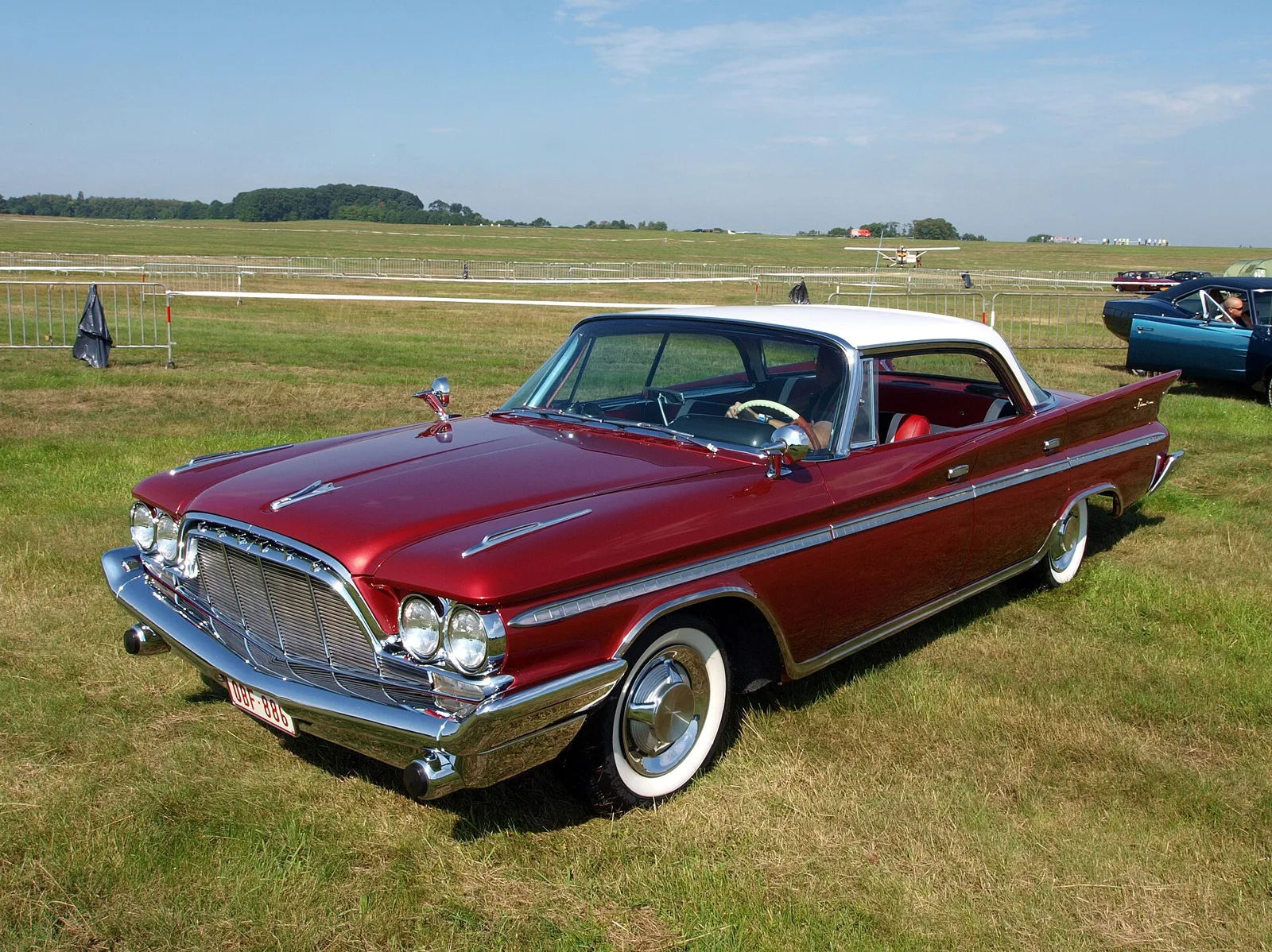
The core DeSoto names of the 1950s were the Firesweep, the Firedome and the Fireflite. The Adventurer sat at the top as a high-performance hardtop, introduced for 1956 and offered as a convertible from 1957. The Forward Look redesign of 1955 gave the whole range its new look.
Virgil Exner styled the 1955 cars along with the rest of the Chrysler line, and those DeSotos sold well through the 1956 model year. The Adventurer was the halo sub-series of the 126-inch cars, and it became a full-range model in 1960.
The 1957 cars used two platforms. The Firesweep sat on the 122-inch Dodge wheelbase and took Dodge front fenders, while the Firedome and Fireflite, along with the Adventurer, used the 126-inch chassis shared with Chrysler. In the usual three-year model block, later years were differentiated by trim, bumpers, grilles, taillights, colours and interior changes.
Did a DeSoto pace the Indianapolis 500?
Yes. In 1956 a DeSoto served as the pace car at the Indianapolis 500, the only time the marque held that role. That same year, Exner's soaring tailfins with triple taillights drew buyers in record numbers.
Buyers responded strongly to the 1956 update, and the Indianapolis appearance put the brand in front of a national audience that season.
DeSotos also raced in NASCAR's Grand National series during the 1950s, which was the brand's motorsport activity in that decade.
Why did DeSoto sales fall after 1957?
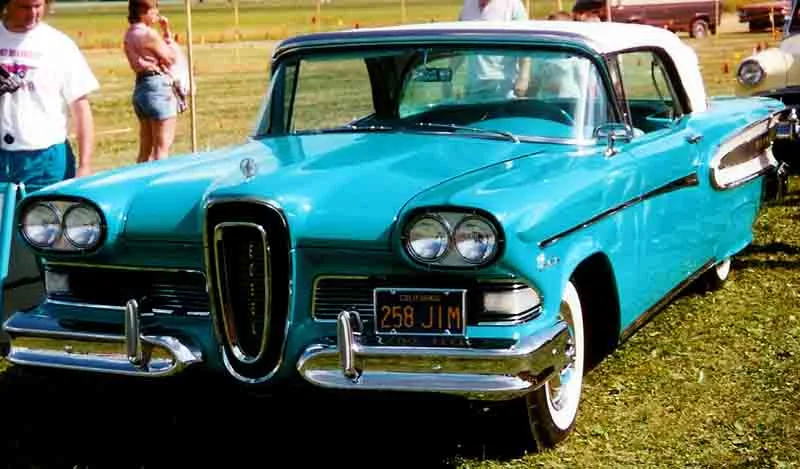
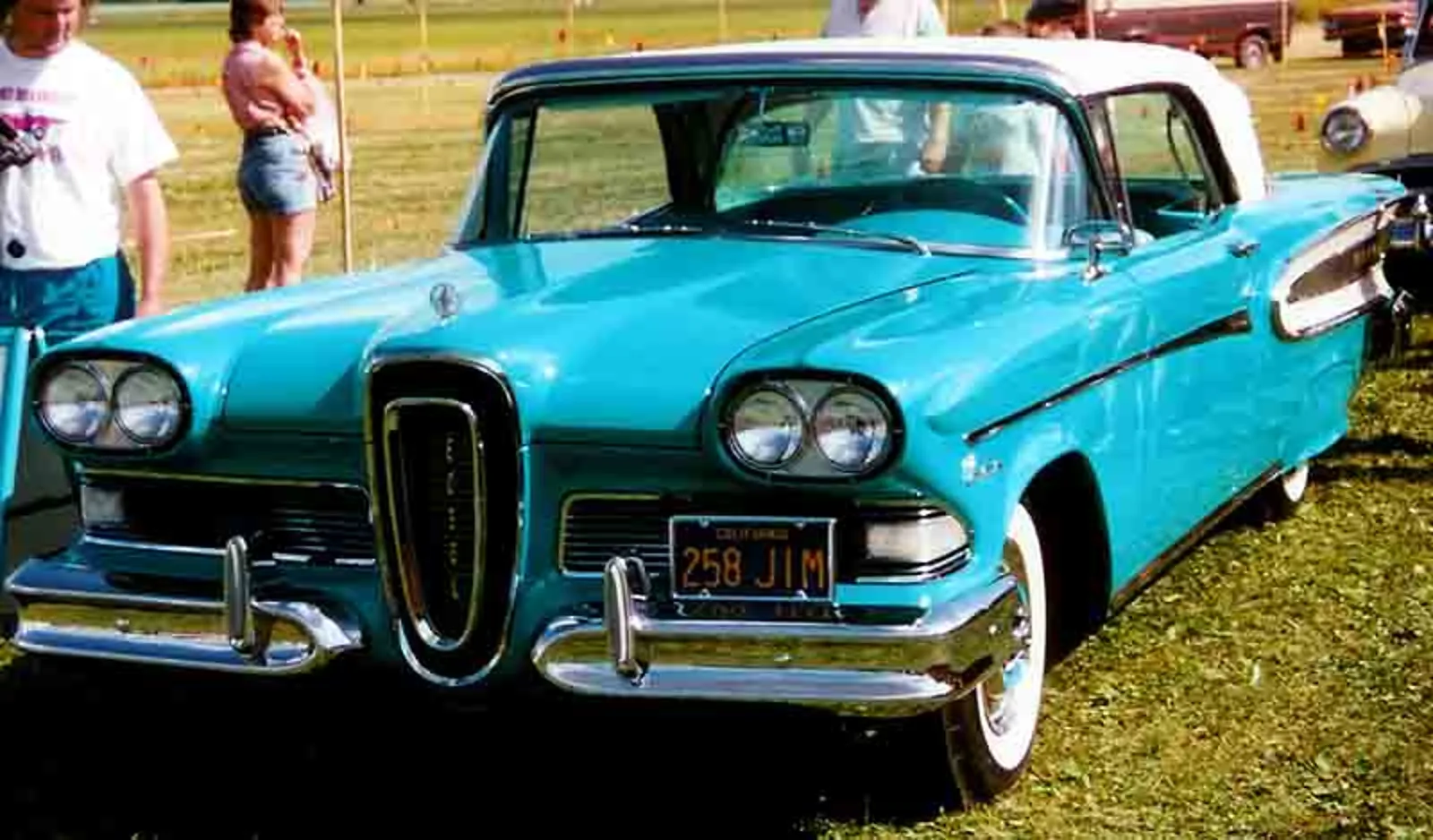
A 1958 recession hit mid-priced makes across the board, and DeSoto sales were 60% lower than in 1957, the brand's worst year since 1938. Ford added pressure by introducing its Edsel brand for the 1958 model year, and sales kept sliding in 1959 and 1960. The 1960 figures were 40% below the already low 1959 level.
Talk that the brand would soon be dropped did little to help. The 1959 and 1960 models were very close to the concurrent Chrysler cars, which made it harder to argue for a separate DeSoto. 1960 was also the last year DeSoto sold in Canada.
How did Chrysler's brand strategy weaken DeSoto?
Chrysler ran five marques in the 1950s, Plymouth, Dodge, DeSoto, Chrysler and Imperial, and let each division chase markets that overlapped with its sister divisions. Dodge moved upmarket with the Custom Royal, and the 1957 Firesweep put DeSoto in direct competition with it. Imperial became a separate make in 1955, pushing Chrysler downward and squeezing DeSoto's middle ground.
The Dodge Dart, introduced in 1960, was advertised against the entry-level offerings of Chevrolet, Ford and Plymouth. Its sales gains came largely at Plymouth's expense, and Plymouth fell out of third place in the market, regaining it only in 1971 and 1974 before its own demise in 2001.
Dealers added to the problem. After the war many Chrysler dealers carried two or more makes, and when Plymouth was being spun off into standalone dealerships, most chose to become higher-volume Plymouth outlets rather than keep the slower-selling DeSoto. DeSoto also had no new compact model in 1960, when GM, Ford, Dodge and Plymouth all did.
When and why was DeSoto discontinued?
Chrysler announced the end of DeSoto on 18 November 1960, 47 days after the 1961 models were introduced. Falling sales, a crowded mid-price segment and the new entry-level Newport all played a part. The final car came off the line on 30 November.
The decision was not without cost. Chrysler's warehouses held several million dollars' worth of 1961 DeSoto parts, so production was pushed up to use the stock. Dealers who had been forced to take DeSotos under their franchise agreements received no compensation for unsold cars, and shipments continued through December, many sold at a loss.
Once the parts stock ran out, the few outstanding customer orders still open were filled with Chrysler Windsors. The Newport sold more than 45,000 units in its first year, and in 1962 Dodge introduced the DeSoto-sized Custom 880 to close the gap.
What did the final 1961 DeSoto look like?
The 1961 DeSoto dropped its series names and used the shorter Chrysler Windsor wheelbase. It came with a two-tier grille, revised taillights, and only two-door and four-door hardtops, trimmed in a way similar to the 1960 Fireflite. The car sold 3,034 units in total.
The marque lost its series designations entirely, a move that recalled the final Packard lineup. The car closed out a passenger car run that had begun with the 1929 model year.
Did DeSoto build trucks?
Yes. Chrysler introduced DeSoto trucks in 1937 to give Dodge and Fargo commercial vehicles made in America more overseas sales outlets. The badge was applied on and off to Dodge trucks in several countries, including Argentina, Australia, Spain, Turkey and Britain.
The Argentine Chrysler subsidiary built D-100 and D-400 trucks with the DeSoto name from 1960 to 1965. Chrysler ended its international truck operations in 1970, but the DeSoto and Fargo names continued on trucks made by Askam in Turkey. Chrysler sold its share in that venture to its Turkish partners in 1978.
How did DeSoto advertise on television?
DeSoto sponsored the television game show You Bet Your Life from 1950 to 1958. Host Groucho Marx urged viewers to visit a DeSoto dealer, and a DeSoto logo could be seen behind the action. Between 1955 and 1957 the brand also used a revised Cole Porter song.
The Cole Porter song It's De-Lovely was used with the composer's permission, and its lyrics were revised so the song ended on the brand name.
What is the DeSoto legacy today?
The legacy rests on a record first year, the Hemi-powered Firedome, the tailfin cars and the brand's place in Chrysler history. Its replacements were the Newport and the Dodge Custom 880, which closed the price gap that DeSoto left behind.
The wider lesson is about brand discipline. DeSoto was not beaten by a single bad car. It was squeezed by a parent that let its own divisions compete for the same buyers, and then by a recession and a rival's new brand.
Key dates in the DeSoto story
| Year | Event |
|---|---|
| 1912 | De Soto Motor Car Company formed in Auburn, Indiana, in November |
| 1928 | Walter Chrysler founds the DeSoto marque on 4 August |
| 1929 | Launch year; 81,065 single-model DeSoto Sixes built |
| 1932 | Sales of around 25,000 units, roughly level with Dodge |
| 1934 | Airflow bodies on a shorter wheelbase |
| 1935 | Airstream replaces the Airflow |
| 1937 | DeSoto truck brand introduced for overseas outlets |
| 1942 | Powered pop-up headlights |
| 1952 | Firedome with a 276 cu in (4.5-litre) Hemi V-8 |
| 1956 | Pace car at the Indianapolis 500; record sales year |
| 1958 | Sales 60% lower than in 1957 |
| 1960 | Discontinuation announced on 18 November; last car on 30 November |
| 1961 | Final model year; 3,034 units sold |