A Detroit maker founded with a goal of cars under US$1,000 that pioneered step-down bodies, won NASCAR with the Hornet and was folded into American Motors in 1954.
The Hudson Motor Car Company was a Detroit carmaker that made Hudson and other brands from 1909 until 1954. It built step-down bodies, won NASCAR titles with the Hornet six and merged with Nash-Kelvinator in 1954 to form American Motors.
The Hudson Motor Car Company was an American carmaker based in Detroit, Michigan, which built Hudson and other branded vehicles from 1909 until 1954. It sold cars in the United States and abroad, and its unusual step-down design, Hornet racing record and engineering firsts make it a favourite of enthusiasts. In 1954 it merged with Nash-Kelvinator to form American Motors Corporation, and the Hudson name was marketed for the last time in 1957.
Where did the Hudson Motor Car Company start?
A group of Detroit businesspeople set up the company, several of them with experience in the young motor industry. The name came from Joseph L. Hudson, a department store entrepreneur who founded Hudson's department store. He supplied the initial capital and allowed the firm to bear his name, and he was named chairman.
Eight Detroit businessmen incorporated the company on 20 February 1909, with about $90,000 of primary capital. The aim was to produce a car that would sell for less than US$1,000. Roy D. Chapin Sr., who had worked with Ransom E. Olds, was one of the lead car men, while Howard E. Coffin, an engineer, and the purchasing agent Fred Bezner also helped to shape the firm.
Advertising drew about 4,000 potential customers who sent $25 deposits. The firm rented an empty plant at Mack Avenue and Beaufait Street on Detroit's East Side, a building dating from 1906 that had been built for the Aerocar Company.
Founded in Detroit with a sub-$1,000 goal, Hudson built step-down cars, dominated NASCAR with the Hornet and then vanished into AMC.
How did Hudson's first car sell?
The first car was driven out of the small factory on 3 July 1909. The Hudson Twenty ranked among the earliest budget cars sold in America, and it sold well, with 4,508 delivered in the first year. That was the best first-year production in the history of the industry at that point, and it placed the new company 17th among makers, at a time when hundreds of brands were on sale.
Rising sales soon forced a move. The company built a new plant on a 22-acre (8.9 ha) site at Jefferson and Conner Avenues in Detroit's Fairview district, across from the Chalmers Automobile plant. Designed by the industrial architect Albert Kahn, it covered 223,500 square feet (20,760 m2) and opened on 29 October 1910.
How big did Hudson grow before the 1929 peak?
Production in 1911 rose to 6,486 cars. By 1913 there were 47 engineers working on vehicle development, and for 1914 the American-market Hudsons switched to left-hand drive. The company's growth was steady, and by the late 1920s it was one of the biggest names in the country.
At its peak in 1929, Hudson and Essex together produced a combined 300,000 cars in a single year, with contributions from the company's factories in Belgium and England. A factory in Brentford, London, had been built in 1925. That year Hudson was the third largest US carmaker, after Ford and Chevrolet. Trucks were a much smaller side line, with 719 sold in 1938 and 409 in 1939.
Why did Hudson build its own bodies?
Early Hudson bodies came from outside suppliers. Fisher Body built them until General Motors bought the coachbuilder in 1919, and from 1923 the Massachusetts firm Biddle and Smart supplied all Hudson bodies. The contract was so large that Biddle and Smart bought up many smaller local coachbuilders to meet the demand, and its peak came in 1926 with 41,000 bodies delivered to Hudson.
Because it could not stamp steel, Biddle and Smart made its bodies from aluminium. On 1 July 1926 Hudson completed a US$10 million body plant of its own, which allowed it to build all-steel closed bodies for both the Hudson and Essex models. Biddle and Smart saw its Hudson work fall by 60 per cent, and the contract was ended in 1930. Briggs and Murray were brought in to supplement production.
What engineering firsts did Hudson claim?
Hudson claimed a long list of firsts for the industry. Its cars had dual brakes, and dashboard oil-pressure and generator warning lights. The Super Six straight-six of 1916 used the first balanced crankshaft, which let the engine run at higher speeds while staying smooth. Before that, Hudson had designed engines that Continental Motors built. Most Hudsons until 1957 used straight-six engines.
The dual brake system included a secondary mechanical emergency brake that acted on the rear wheels when the pedal travelled beyond the reach of the main system. A mechanical parking brake was also fitted. Transmissions ran in an oil bath with a cork clutch, which was as durable as it was smooth.
How did Essex and Terraplane fit into the range?
Hudson launched the Essex line in 1919 as a budget brand to compete with Ford and Chevrolet, while the Hudson brand competed with Oldsmobile and Studebaker. Briggs introduced a closed coach body for the Essex in 1922, and it cost only $300 more than the open touring car. Within three years Hudson had cut prices so that the 1925 Essex touring and coach cost the same.
The Essex name was phased out in 1932 for the Terraplane. The new line launched on 21 July 1932 with a promotional christening by Amelia Earhart. The Terraplane became the Hudson 112 in 1938. In Canada, Canada Top and Body built Hudsons at Tilbury, Ontario, and in England the Terraplane was still advertised in 1938.
What was the Hudson Eight?
For the 1930 model year Hudson introduced a flathead inline eight, with the block and crankcase cast as one unit and two cylinder heads. It displaced 218.8 cu in (3.6 L) and produced 80 hp (60 kW; 81 PS) at 3,600 rpm. The five-main-bearing crankshaft had eight counterweights, an industry first, and the eight replaced the Super Six in the Hudson line while the Super Six stayed in the Essex.
Hudson also took part in motor sport. At the 1931 Indianapolis 500, Buddy Marr's Hudson Special finished tenth after completing 200 laps.
What changed in the 1936 to 1942 cars?
In 1936 Hudson revamped its cars with a suspension it called radial safety control, or rhythmic ride. The live front axle was held by two steel bars as well as leaf springs, which allowed longer, softer springs and kept bumps and braking from pushing the car off line. Hudson claimed a 145 cu ft (4.1 m3) interior, against 121 cu ft (3.4 m3) for the largest rival cars, and an optional bulging trunk lid for 21 cu ft (0.59 m3) of luggage.
The 1939 models adopted a column-mounted gearshift, which freed front-seat space, and Hudson became the first maker to use foam rubber in its seats. For 1940 it added coil spring independent front suspension and true center-point steering on all models. The 1941 cars had longer bodies with 5.5 inches added for more legroom, and wheelbases of 116, 121 and 128 inches.
In 1942 Hudson answered General Motors' Hydramatic with Drive-Master, a vacuum-operated system that offered three modes, from full manual shifting to fully automatic. Adding an automatic overdrive turned it into Super-Matic. The system worked well but needed a large and complicated mechanism under the hood.
Who was Hudson's female designer?
Hudson hired Elizabeth Ann Thatcher in 1939 for a female perspective on design, making her one of America's first female automotive designers. She contributed exterior trim with side lighting, the interior instrument panel and interior fabrics to the 1941 Hudson. She left in 1941 when she married Joe Oros, a Cadillac designer, who later headed the design team at Ford that created the Mustang.
How did Hudson contribute to the Second World War?
At the government's request Hudson stopped car production from 1942 until 1945. It built aircraft parts, naval engines and anti-aircraft guns, and its Invader engine powered many of the landing craft used on D-Day on 6 June 1944. The company also had an aircraft division that made ailerons for a large eastern airplane builder.
On 22 May 1941 Hudson won a contract for the Oerlikon 20 mm cannon, and its engineers converted the original Swiss drawings to American production standards. It built 33,201 of them for the US Navy. Hudson ranked 83rd among US corporations by the value of its wartime military production contracts.
Why did the Fisher brothers try to buy Hudson?
The Fisher Body Company was by then part of General Motors, and the Fisher brothers had planned a takeover of Hudson before the war. Their engineer Roscoe C. (Rod) Hoffman built several rear-engine prototypes for possible production as Hudsons, and one was built in secret in 1935.
The war paused those plans, but after brothers Fred and Charles retired from GM in 1944 they revived them. Hudson's main stockholder was Queen Wilhelmina of the Netherlands, who used an intermediary to signal that she was willing to sell. Hudson's share price jumped on the news, but the Fisher tender offer fell short of the market value and the deal failed.
What did step-down bodies mean?
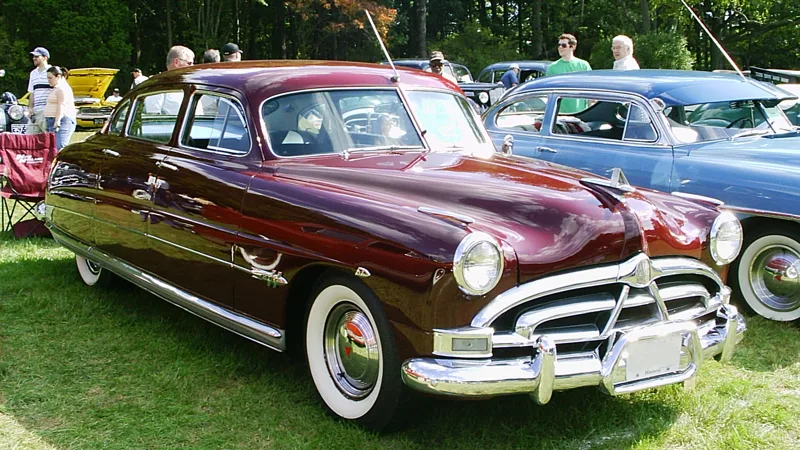
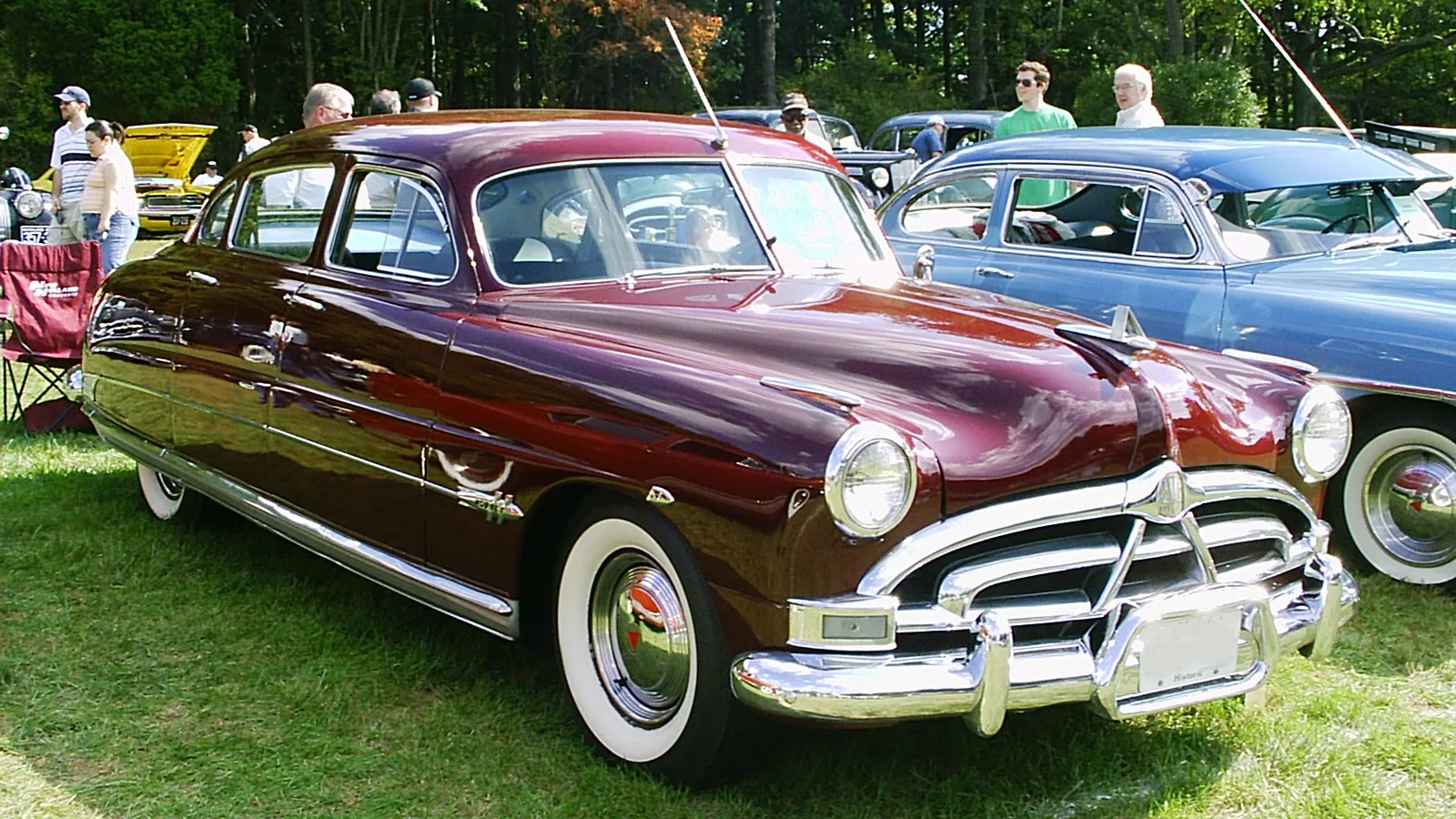
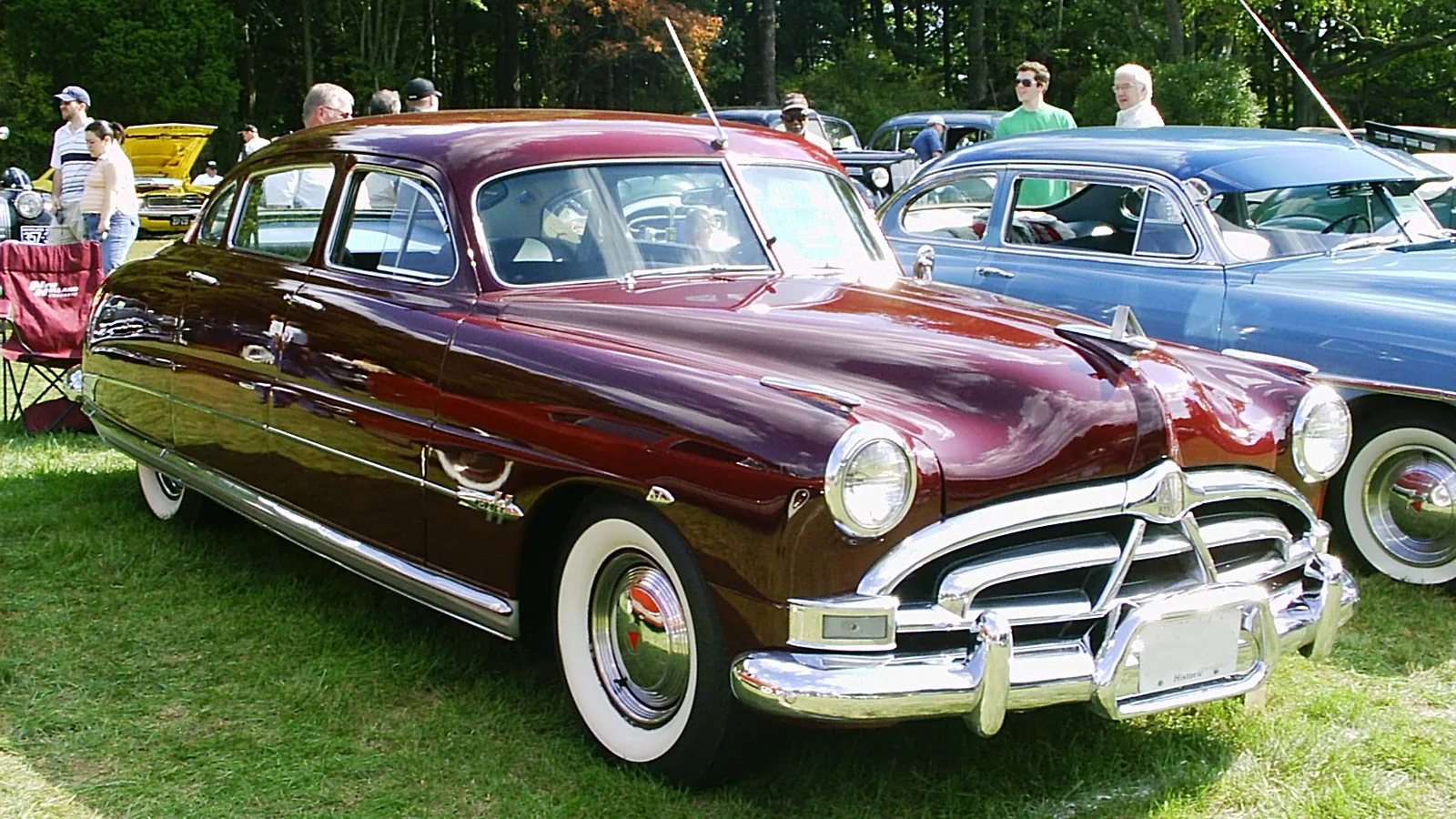
In 1948 Hudson launched its step-down bodies, which were used through the 1954 model year. The passenger compartment sat down inside the perimeter of the frame, so riders stepped down onto a floor surrounded by the frame. The result was a safer and more comfortable car, and a lower centre of gravity gave it good handling.
Almost all US automakers later adopted the same approach. Richard Langworth, an automotive author, described the step-down models as the greatest cars of their era in his writing for Consumer Guide and Collectible Automobile.
How did the Hornet win NASCAR titles?
For 1951 the six-cylinder engine received a new block with thicker walls and other improvements that raised horsepower by almost 18 per cent and torque by 28.5 per cent. The GM-supplied four-speed Hydramatic became optional on the Hornet and Commodore Custom models.
Hudson's light, strong bodies and high-torque six made the 1951 to 1954 Hornet a dominant NASCAR car, and it won the championship in four straight seasons from 1951 to 1954. Herb Thomas won the 1951 and 1954 Southern 500s, and Dick Rathmann won the 1952 race. Hudsons also did well in AAA Contest Board races, with Marshall Teague winning the 1952 AAA Stock Car Championship and Frank Mundy taking the 1953 title.
The marketing campaign Win on Sunday, Sell on Monday tried to turn that success into sales, but it did little to affect showroom traffic.
Why did Hudson's sales collapse in the early 1950s?
Smaller makers struggled against the Big Three as the post-war market became a buyer's market. Ford and General Motors fought a sales war in 1953 and 1954, leaving little business for independents. The Big Three changed styling every year, while smaller makers could only afford gradual changes, and Hudson's unit-body construction was difficult and costly to change.
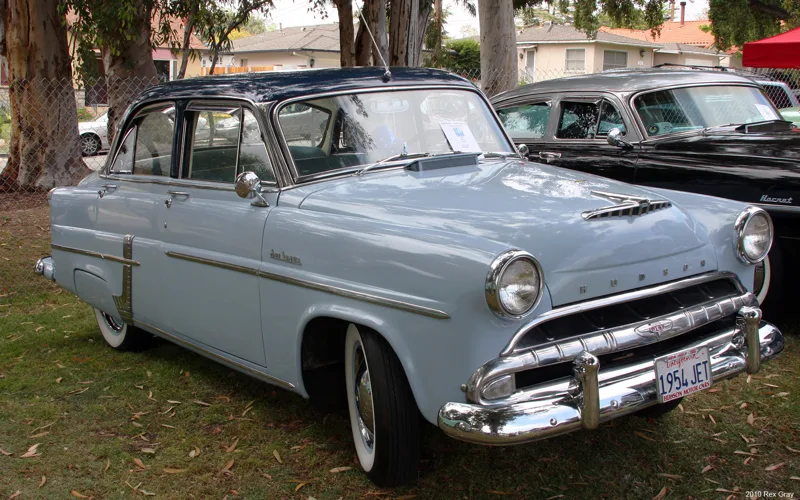
Sales dropped annually from 1951 through 1954, and military orders tied to the Korean War were all that kept the firm afloat. In 1953 the company posted a $10,411,060 deficit, against a 1952 profit of $8,307,847. The compact Jet, priced above the full-size Big Three cars, failed to attract buyers in its second year.
How did the 1954 merger with Nash come about?
Hudson's chief executive, A.E. Barit, talked to George W. Mason, the head of Nash-Kelvinator, which made Nash and Rambler cars. Mason wanted to combine four independent makers, Nash, Hudson, Packard and Studebaker, into one firm able to challenge the Big Three, and he had raised the idea with Packard as early as 1946. An agreement was reached on 14 January 1954.
On 1 May 1954 Hudson officially merged with Nash-Kelvinator to create American Motors Corporation. Hudson's Detroit factory ended passenger car production at the end of the 1954 model year and was converted to military work for the Korean War. The next three years of Hudson production took place at the former Nash plant in Kenosha, Wisconsin, mostly building rebadged Nash cars.
Mason died on 8 October 1954, and his successor, George W. Romney, later retired the Nash and Hudson brands at the end of 1957. The last Hudson came off the Kenosha line on 25 June 1957.
What did the Hudson V8 and V-Line cars look like?
The 1955 Hudsons shared a body shell with the Nash Ambassador, but they kept a unique front cowl, the traditional Hudson dashboard and the Triple Safe Brakes. They also used the Nash Weather Eye heating and ventilation system, with a cheaper Freon air conditioning unit from Harrison Radiator. The 1955 car brought the first Hudson V8, a Packard-designed 320 cu in (5.2 L) unit producing 208 hp (155 kW). Packard's Ultramatic automatic cost an extra $494.
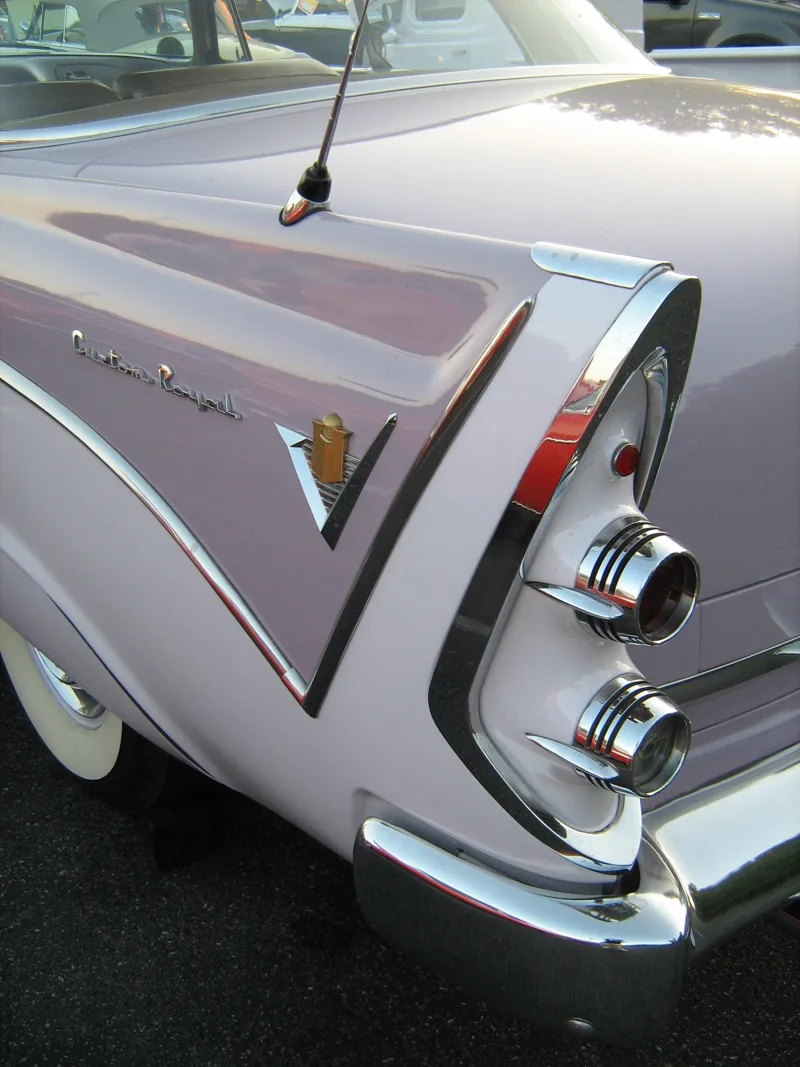
For 1956 Richard Arbib styled the senior Hudsons with the polarising V-Line motif, which echoed the triangular corporate logo. The 308 cu in Hornet Six remained available with the Twin-H Power option, which was discontinued at the end of that year. Sales for the brand fell below the 1955 figures, and former president A.E. Barit resigned from the AMC board in protest at the likely end of the marque.
How did Hudson sell overseas?
Hudson, Essex and Terraplane cars were exported as complete cars or built locally from knock-down kits. In 1928 Hudson shipped 50,587 vehicles overseas, or 17.9 per cent of its production. In March 1929 it exported 44,295 cars in that month alone, and the first quarter of 1929 reached an all-time high of 108,298.
In Australia, McGhie Motor Company of Brisbane imported Hudsons in 1913, and Dalgety of Sydney became the distributor in 1915. Neal's Motors of Port Melbourne began assembly in 1927 and celebrated its 30,000th car in June 1937. In New Zealand, Dominion Motors of Wellington began trading in 1912. Hudson also assembled cars in Berlin-Spandau in the 1920s, and in South Africa National Motor Assemblers built AMC Ramblers until 1967.
In Britain Hudsons arrived in 1911, and a Brentford factory on the Great West Road opened in 1927. The Hudson factory helped create the nearby area known as the Golden Mile, and the Chiswick roundabout became known as Hudson's Corner.
What is Hudson's legacy today?
American Motors revived the Hornet name for its 1970 compact cars. Chrysler, which later bought AMC, revisited the name at Dodge, and the Hornet returned for 2023 as a model derived from the Alfa Romeo Tonale.
Miller Motors in Ypsilanti, Michigan, is usually cited as the last Hudson dealership, and the site now forms part of a heritage museum. In Shipshewana, Indiana, the Hostetler collection of restored Hudsons, begun by inventor Eldon Hostetler, closed in 2018.
Hudson key milestones
| Year | Milestone |
|---|---|
| 1909 | Incorporated 20 February; first car 3 July; 4,508 sold in year one |
| 1910 | Jefferson Avenue plant opens on 29 October |
| 1919 | Essex line introduced; General Motors buys Fisher Body |
| 1926 | US$10 million body plant completed on 1 July |
| 1929 | Hudson and Essex produce 300,000 cars combined |
| 1930 | Hudson Eight, 218.8 cu in flathead inline eight |
| 1932 | Terraplane launched on 21 July |
| 1942 | Drive-Master system introduced; car production halted until 1945 |
| 1948 | Step-down bodies introduced |
| 1954 | Merger with Nash-Kelvinator on 1 May |
| 1955 | First Hudson V8, 320 cu in, 208 hp (155 kW) |
| 1957 | Last Hudson built on 25 June |