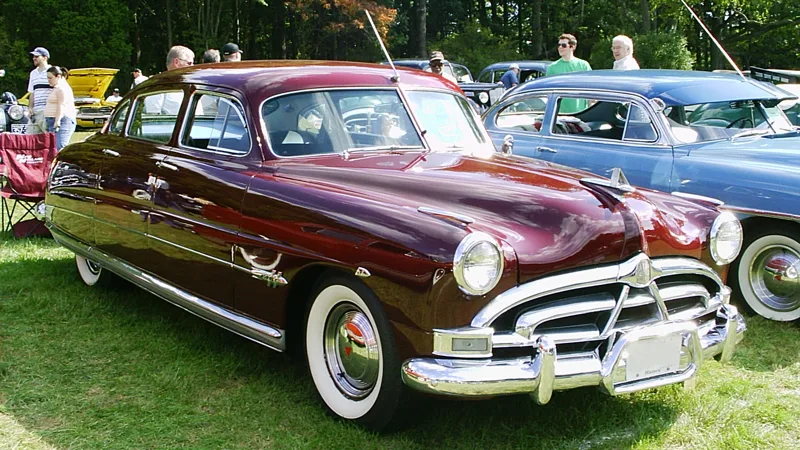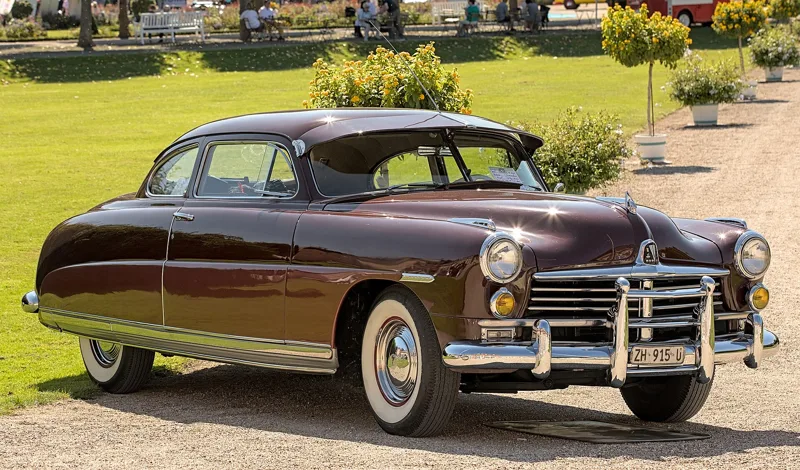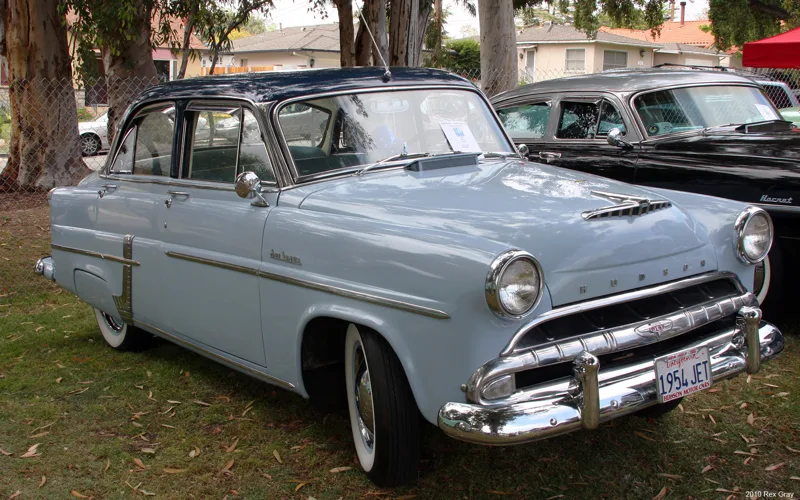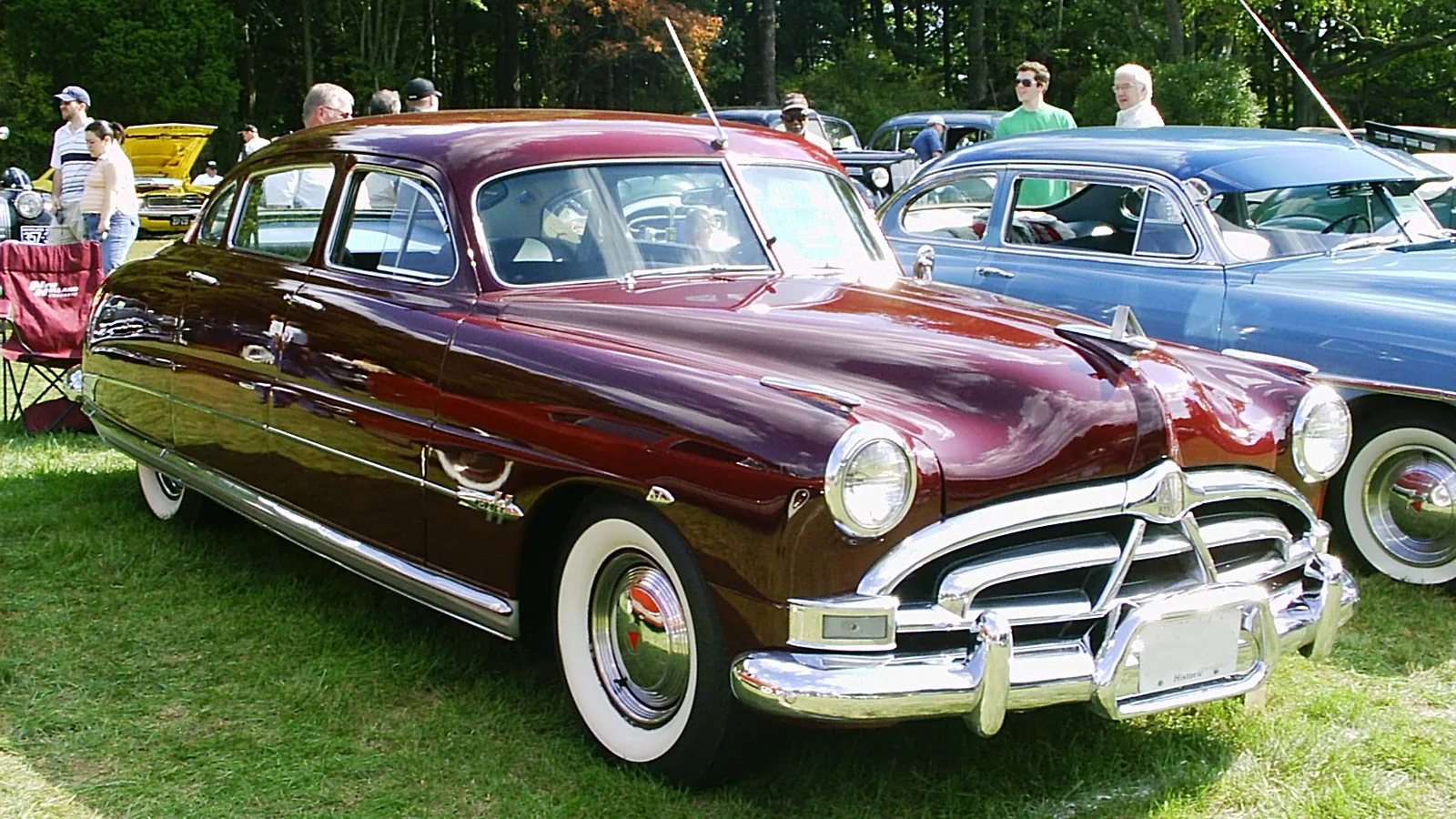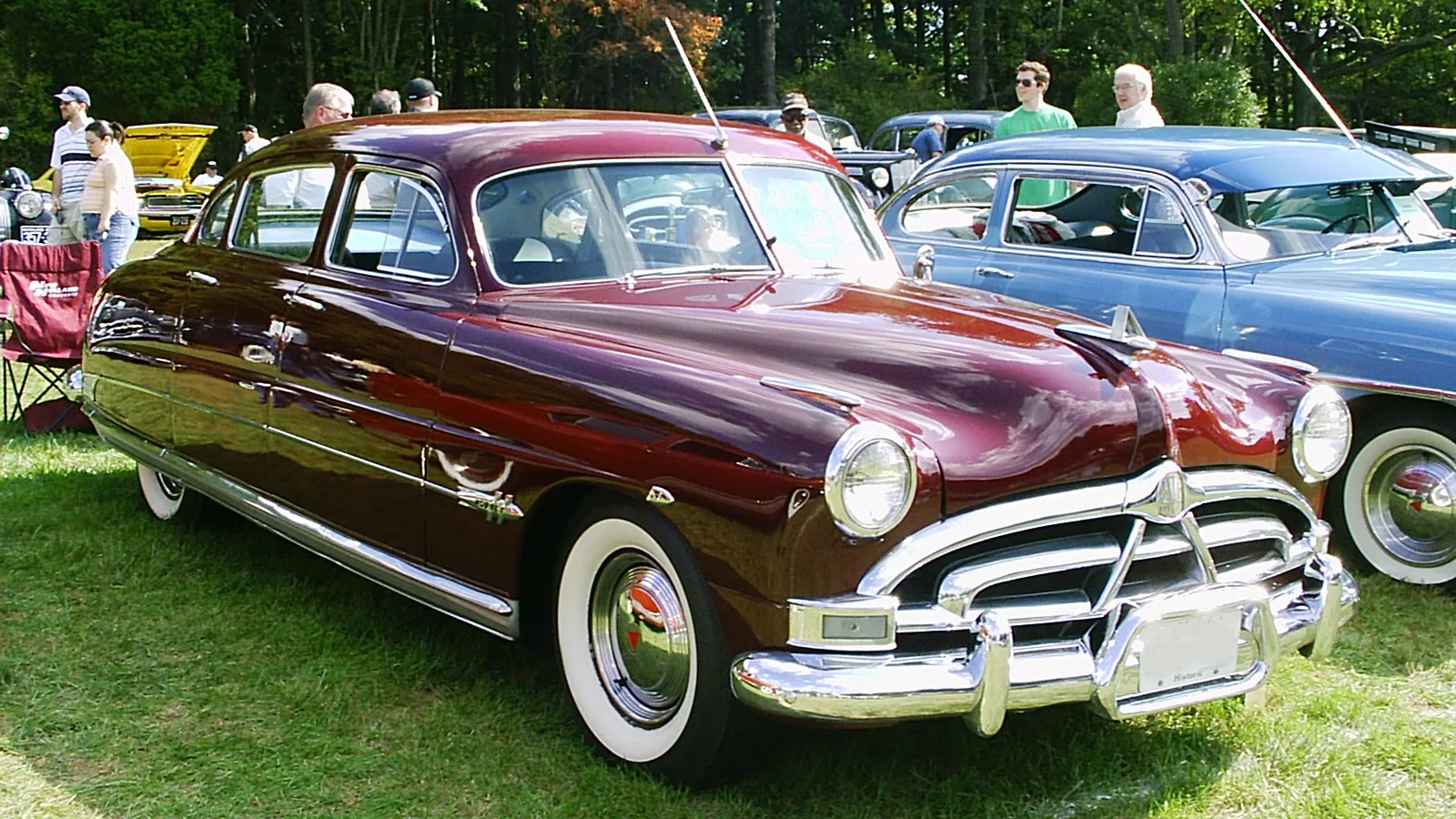
From 1951 to 1954 the Hudson Hornet combined a low, dropped-floor body with a high-compression six, and its race record in the early 1950s made it one of the most famous American cars of its era.
The Hudson Hornet was a full-size Detroit car sold from 1951 to 1954, built on Hudson's step-down design. Its 308 cu in straight-six and dominant NASCAR record in the early 1950s made it one of the most famous American cars of its time.
The Hudson Hornet was a full-size car that Hudson Motor Car Company built in Detroit from the 1951 to 1954 model years. Its low, step-down body and straight-six engine made it a serious contender on the racetrack, and the nameplate carried on under American Motors until 1957.
Where did the Hudson Hornet come from?
The Hornet arrived for 1951 and rested on Hudson's step-down design, which had first appeared on the 1948 Commodore. The floor pan sat down between the chassis rails rather than on top of them, so passengers stepped down into the car, and the body was carried on a frame that later became known as a perimeter frame.
That layout gave the car a lower centre of gravity than most rivals. The low chassis helped the car handle well and gave its six passengers a plush ride, while the nearly enclosed rear wheels added to a sleek look.
Buyers in 1951 could pick a coupe, a sedan, a convertible or a hardtop with no centre pillar. Hudson set the Hornet's prices alongside the Commodore Eight, a band of $2,543 to $3,099, which kept it in the mainstream.
A low, step-down full-size car that won more stock car races than any rival in the early 1950s.
How did the Hornet's engine work?
The first Hornets used Hudson's H-145 straight-six, a development of the earlier 262 cu in Super Six that Hudson bored and stroked to 308 cu in. It was an L-head design, and at that displacement it was the largest six-cylinder engine in a mass-production car at the time, with a high-chromium-alloy block.
A factory option called Twin H-Power added twin one-barrel Carter carburettors and improved fuel distribution. It appeared in mid-1951 as a dealer-installed upgrade costing $85.60, which was about $1,062 in 2025, and in the twin-carburettor form the engine produced 145 hp at 3800 rpm and 275 lb ft of torque.
| Year | Engine | Power | Notes |
|---|---|---|---|
| 1951 | H-145 six, 308 cu in | Standard output, Twin H-Power as an option | Dealer-fitted twin carburettors |
| 1952 | H-145 six, 308 cu in | 145 hp at 3800 rpm | Twin H-Power standard, 7.2 to 1 compression |
| 1954 | 308 cu in six | 170 hp with Twin-H-Power | 7-X option raised output above 210 hp |
| 1955 | Packard V8, 320 cu in | 208 bhp | Ultramatic transmission available |
| 1957 | AMC V8, 327 cu in | 255 hp | Four-barrel carburettor and dual exhausts |
Tuners could coax far more from the six. Marshall Teague said he could get 112 miles per hour from a stock Hornet, and Hudson's engineers offered severe-usage parts that were thinly disguised racing equipment.
What made the Hornet handle so well?
The step-down chassis gave the Hornet a handling advantage on the dirt and on the few paved tracks of the 1950s. Its low mass helped it corner on the rough circuits of that period, which mattered greatly to racers. The body wrapped around a frame engineered for stiffness, and the car was over-designed in the Hudson tradition.
Hudson engineers also paid attention to comfort. The car carried an electric clock as standard, and the Weather Eye heating and ventilation system was rated highly for its efficiency. An optional air conditioner cost $395, about half what competitors charged for similar systems.
What changed in the 1952 and 1953 Hornets?
The 1952 model year made the Twin H-Power engine standard, with dual single-barrel carburettors and a dual-intake manifold. The engine was rated at 145 hp, and its compression ratio was 7.2 to 1. An aluminium head came at no extra cost, and an iron-alloy head with 6.7 or 7.2 to 1 ratios was also offered.
Production in 1952 totalled 35,921 cars, including about 2,160 hardtops and 360 convertibles. The Hornet had become nearly unbeatable on the track, but sales began to slide because the car's modern unibody was costly to update each year.
The 1953 cars got a fresh grille and a hood air scoop that did nothing functional, and four body styles were on offer. Production that year fell to 27,208, of which around 910 were Hollywood hardtops, and an eight-tube radio cost $100 extra.
How did the 1954 redesign look?
For 1954 the Hornet received a major redesign with squarer lines that matched the compact Hudson Jet of 1953. The step-down frame made the work difficult, because it wrapped around the passenger compartment, and the car's new one-piece curved windscreen replaced the earlier two-piece unit.
The hood scoop became functional and fed cold air to the carburettors. The side fender chrome, a squared-off rear end and redesigned taillamps gave the car a more modern look, and the interior received a new dashboard and instrument cluster.
The refreshed Brougham convertible was the sole open-top Hudson, yet critics considered its $3,288 price steep for a six-cylinder car. A total of 540 convertibles were built, and the 1954 Hornet's production of all body styles came to 24,833.
A Grosse Pointe owner and major Hudson stockholder, Harold Du Charme, customised a 1954 two-door hardtop. He chopped the roof by 2.5 inches (64 mm), channelled the body and added twin hood scoops, Lincoln taillights and a continental kit.
Why did Hudson merge with Nash?
Hudson's financial difficulties overshadowed the Hornet's redesign. Negotiations with Nash-Kelvinator led to a merger that formed American Motors Corporation. Hudson's board approved the deal on 14 January 1954, shareholders ratified it on 24 March 1954, and the new company was formed on 1 May 1954.
Hudson car production moved to Nash's plant in Kenosha, Wisconsin. For a time the two dealer networks carried on separately, although all Hudson output was concentrated in the Nash works. The last Detroit-built Hudson was completed on 30 October 1954, and the step-down platform was retired. The 1954 Hornet had come too late to boost sales, so the merger was the end of an independent era.
How did the Hornet dominate NASCAR?
Hudson was the first automaker to take an interest in stock car racing, and the Hornet dominated the sport in the early 1950s. In the 1952 AAA season, Marshall Teague ended up 1000 points clear of his nearest rival and took 12 of the 13 races on the calendar.
Tim Flock, Frank Mundy, Al Keller, Dick Rathmann and Herb Thomas collected 27 NASCAR wins that year, all in Hudsons. Across the season Hudson recorded 48 first places and 23 second places, and Teague's stock Hornet, which he called the Fabulous Hudson Hornet, took 14 wins on the AAA circuit.
Across the Grand National events, Hudson took 27 of 34 in 1952, then 22 of 37 in 1953 and 17 of 37 in 1954. The original Fabulous Hudson Hornet has been restored and is displayed at the Ypsilanti Automotive Heritage Museum, a building that was once the Miller Motors dealership, the last Hudson dealer in the world.
How did the Hornet's racing record affect the brand?
Racing success did not translate into sales. The Hornet's unibody meant that updating the body was expensive, and rivals with body-on-frame designs could change their styling every year. The Automobile Manufacturers Association then banned factory-supported racing from 1957, and that ended the brand's racing role.
Production of the Hudson Hornet stopped on 25 June 1957. The Hudson name was dropped, and all American Motors cars were sold as Ramblers. The final Hornets were 4,108 cars, made up of 3,359 sedans and 749 Hollywood hardtops.
How did the second-generation Hornet differ?
The second-generation Hornet was built by American Motors on the Nash platform, using Nash Statesman and Ambassador components. Hudson styling themes were applied to the badge-engineered cars, which were credited to Pinin Farina, Edmund Anderson and Frank Spring, while the straight six remained available.
The 1955 model was AMC's first all-new car and was conservatively styled. The Hornet shared its styling with the new Wasp, but it used a longer wheelbase. It rode on a 121.25 in (3,080 mm) wheelbase, and a 320 cu in Packard V8 with 208 bhp was available for the first time with the Ultramatic automatic transmission. Automotive writer Floyd Clymer judged the Hudson the safest American-built car, citing its welded body and its braking.
In 1956 the designer Richard Arbib gave the Hornet its V-Line styling, with a tri-tone paint option and a V theme in the trim. The year's sales dropped to 8,152, with 6,512 of them sedans. The 1957 Hornet used a 327 cu in V8 rated at 255 hp, and total production that year was just 4,108 cars.
Where was the Hornet sold abroad?
Hudson's foreign reach was wide. Hudson Motors of Canada began assembling cars in Tilbury, Ontario in 1932. After the war, CHATCO Steel Products resumed assembly there in 1950, but the Tilbury operations closed in 1954, and Toronto took over the work after the merger. New Zealand imported Hudsons from 1912 and assembled them from kits from 1919, while the Hornet was built there from 1954 by VW Motors. Motor Assemblies Limited of Christchurch had assembled Hudson and other makes from 1935 until Standard-Triumph bought it in 1954.
South African assembly used Canadian kits to build right-hand-drive cars, and Britain had a plant from 1927 that made Hudson and Essex models. Australia received the Hornet from 1955.
Why are first-generation Hornets so collectable?
The first generation is treasured for its NASCAR history. Enthusiast groups keep that history alive, and the Hudson-Essex-Terraplane Club and the AMC Rambler Club both work to preserve and restore the cars. Comedian Jay Leno put the 1951 to 1954 models on his list of the most collectible American cars, while Richard Langworth described the Hornet as the postwar Hudson people still remember best.
Club coupes, the body used by the race-winning drivers, have climbed steeply in value, and several restored cars have passed $75K. The convertibles have also gained value, and a restored 1953 example sold for $150,000 in 2013.
Steve McQueen once owned a green 1953 sedan with the Twin-H engine, and A. E. Barit had a 1951 Hornet turned into a limousine by Derham. The car also reached a wider audience through the Disney and Pixar film Cars, where a 1951 Hornet named Doc Hudson was voiced by Paul Newman.