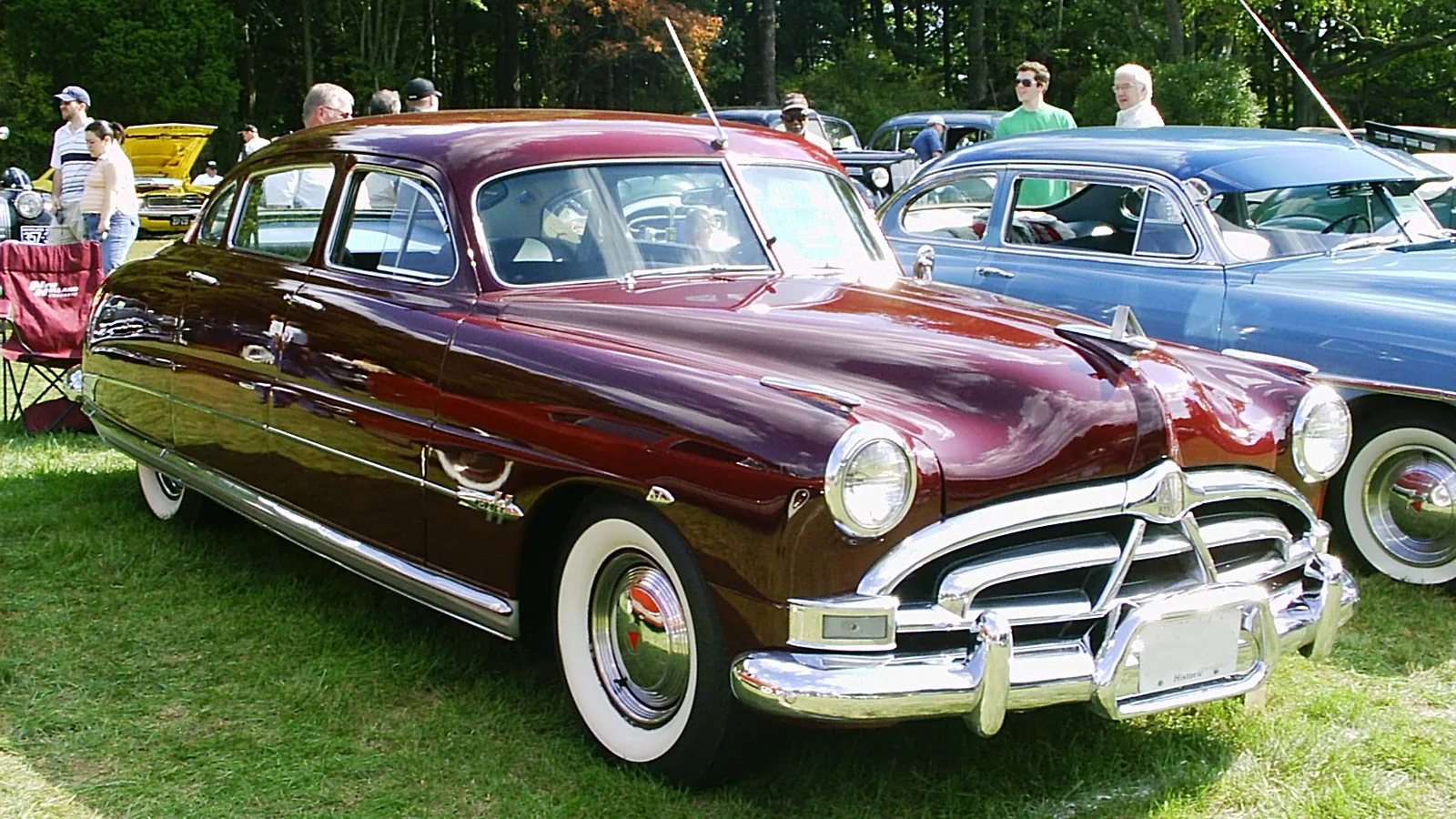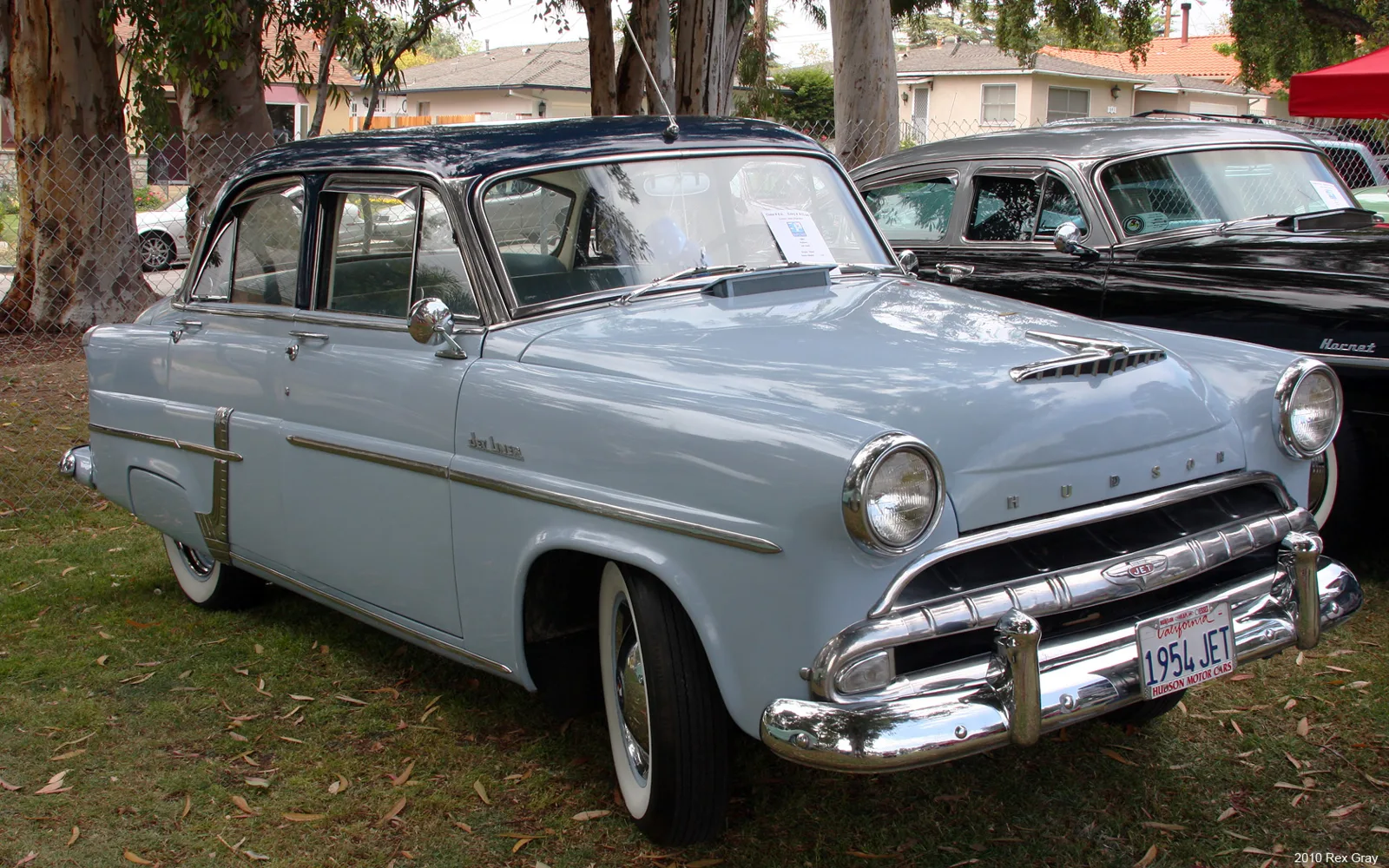
Hudson's 1953 compact, a welded unibody with a flathead six, and the car that helped push the firm into the Nash merger.
The Hudson Jet was a Detroit-built compact from the 1953 and 1954 model years, with a welded unibody and a 202 cu in six. Its development costs helped push Hudson into merging with Nash, creating American Motors. The Italia coupe built on its platform was a sleek two-seater.
The Hudson Jet was a compact car that the Hudson Motor Car Company built in Detroit for the 1953 and 1954 model years. Its development and tooling costs became one of the forces behind Hudson's merger with Nash, which created American Motors Corporation in 1954.
What was the Hudson Jet?
The Hudson Jet was a compact car built by the Hudson Motor Car Company of Detroit during the 1953 and 1954 model years. It was Hudson's answer to the popular Nash Rambler, and its development and marketing costs helped lead to a merger with Nash in 1954.
The Jet was introduced in the middle of the 1953 model year, after an unveiling in December 1952 at the Hotel Astor in New York City. It came as two- and four-door sedans in Standard or Super-Jet trim, and it was the only new nameplate among the domestic automakers that year.
The car competed with the Henry J, the Nash Rambler and the Willys Aero. It was shorter than the Henry J and the Willys Aero, and it was the narrowest and tallest of the four, which gave it a boxy look.
A compact built to save Hudson that instead hastened its merger with Nash.
Why did Hudson build a compact?
Hudson built a compact because the Rambler and Henry J had shown there was a market that the Big Three ignored. Nash launched the Rambler in April 1950 and Kaiser the Henry J in September 1950, and together they sold more than 150,000 units by 1951.
Those sales amounted to 3% of the total US market, which was enough to show that the small-car segment had potential. Hudson had limited money, so it could not refresh its full-size cars or develop a V8, which was becoming popular.
Development was shaped by the Fiat 1400 sedan of 1950, which provided inspiration for the new small Hudson. Early clay models carried the name Bee, in keeping with the Wasp and Hornet names the company already used.
How was the Jet styled?
The Jet's styling was shaped by Hudson president A.E. Barit, who was 63 years old in 1953, and by Chicago dealer Jim Moran. Barit overruled the stylists on full-size features, such as chair-high seating and a tall greenhouse.
Barit insisted that the compact offer full-size car amenities. Designers tried to make a lower, wider and sleeker small car, but he would not give up the seating height or the roofline that let passengers wear hats. He also gave the rear a high fender and a small round taillight to imitate the Oldsmobile.
Moran's Chicago dealership became Hudson's number one sales outlet, accounting for about 5% of production. Moran liked the 1952 Ford's wraparound rear window and roofline, and Barit ordered a similar design, so the Jet closely mimicked the larger 1952 Ford in many respects.
Hudson could not foresee the sharp fall in compact sales between 1952 and 1954, when three competing makes were in the market. The company could produce only a little over 20,000 units for the 1953 model year, which exposed how fragile the project was.
The Jet's bodies were built as Monobuilt units by the Murray Corporation of America in Detroit. Murray agreed to amortise the tooling costs over the production run, which reduced Hudson's upfront investment, but the agreement pushed up the prices Hudson had to charge.
What engine and transmission did the Jet use?
The Jet used a 202 cu in (3.3 L) inline L-head six with output of 104 hp (78 kW; 105 PS) at 4000 rpm, and torque of 158 lb-ft (214 N-m) arriving at 1600 rpm. A three-speed manual was standard, and a four-speed Hydramatic from General Motors became the first fully automatic gearbox Hudson had offered.
Hudson's engineers built the Jet on a welded unibody, which they considered roomy, solid and good for performance, fuel economy and low maintenance costs. Early Studebaker body development mules suffered damage because the engine produced so much torque.
The six was re-engineered from Hudson's 1932 3x4.5 254 cu in (4.2 L) eight, with two cylinders removed and a longer stroke for full-pressure lubrication. It kept a flathead design when the rest of the industry was moving to overhead valves, and it used a forged steel crankshaft.
The optional Twin-H power version used two single-barrel downdraft carburettors, an aluminium cylinder head and 8.0:1 compression to make 114 hp (85 kW; 116 PS). That was more than the standard engines of the Ford, Chevrolet or Plymouth lines.
The overdrive option engaged when the driver briefly eased off the throttle above 22 mph (35 km/h), and it disengaged below 18 mph (29 km/h). Pulling the control knob locked out the overdrive and allowed freewheeling on steep grades or slippery roads.
Was the Jet a good car on the road?
Kiplinger's Personal Finance said the Jet had much to recommend it, with riding qualities that matched more expensive models and good visibility. Its optional power gave it more horsepower than the standard engines of the regular-sized Fords, Chevrolets and Plymouths.
The car was also well appointed. The standard list ran from a heater and theft-proof locks to defroster vents, dual horns and a lit ignition switch, items that were often optional on rival makes.
The heater point is telling, since even the high-priced Cadillac counted a passenger compartment heater as an option in 1953, at a cost of $199.
Price was the drawback. The 1953 base model was $1,858, against $1,734 for a Ford full-size car, and the equivalent Chevrolet was only $1,613.
How did the Jet sell?
The Jet sold 21,143 cars in the United States for the 1953 model year and 14,224 units for 1954, but the cost of developing and tooling it was an estimated $10 to 16 million. The sales were not enough to cover that outlay, and the losses weighed heavily on Hudson.
Hudson also tried marketing gimmicks, including the Tea Cup Test. Dealers attached a glass cylinder and valves to test cars, so a salesman could show how far the Jet travelled on a teacup of gasoline. The idea failed to show the car's economy.
The 1954 model year added a luxury Jet-Liner, which made the Jet a three-series line. It had chrome trim around the windows and body side, gravel shields and colour-keyed vinyl interiors with foam rubber seat cushions. The two-door Family Club Sedan arrived on 12 April 1954. It was $216 cheaper than the base sedan, with a plainer grille and a spartan interior.
One Jet-Liner convertible was built as an experiment, and it was bought by Hudson's sales manager, Virgil Boyd.
What happened when Hudson merged with Nash?
The estimated $10 to 16 million cost of the Jet put Hudson in a precarious position. A.E. Barit persuaded the board that a merger into Nash-Kelvinator offered the best protection for shareholders, and the new American Motors Corporation focused on smaller cars.
When the merger was completed, Barit took his seat on the American Motors board in 1954, and the Jet was the first Hudson model discontinued. The company concentrated on the Nash Rambler, and Hudson dealers were given badge-engineered Ramblers and the Metropolitan to sell under the Hudson name.
The Jet's costs and the falling sales of the senior Hudson line had forced the merger, and the independent carmaker never recovered its position.
How did the Jet perform in racing?
The Jet took part in the 1953 Carrera Panamericana, a road race described as the world's greatest. Malcolm Eckart finished 53rd and Enrique Paredes 42nd out of the 182 cars that started, and Francisco Ramirez finished eighth in the Turismo Especial class.
In drag racing, an Ike Smith-prepared Jet with a Twin H 308 cu in (5.0 L) engine ran consistently in the low 14-second bracket. The engine made 170 hp (127 kW; 172 PS), and the firewall needed modification because the larger engine was not available from the factory.
The National Hot Rod Association made an exception to its rules for the firewall change. Hudson was the only make fully committed to stock car racing at the time, and NASCAR founder Bill France Sr. and Grand National champion Tim Flock took part in the Jet's launch event.
Why is the Jet remembered as a failure?
Automobile historian Richard M. Langworth called the Jet the car that torpedoed Hudson. Its styling was described as bland, its engineering conventional, and its price higher than that of a full-size Chevrolet, Ford or Plymouth.
The Jet was not the only cause of decline. Steel prices, labour costs and the sales war between Ford and Chevrolet also hurt smaller independents such as Packard, Studebaker and Willys.
Hudson lost money on the Jet at a time when its senior line was also falling, which made a merger the only route for shareholders.
What was the Hudson Italia?
The Italia was a two-passenger coupe that used the Jet platform, designed by Frank Spring and built with a body by Carrozzeria Touring of Milano. It used the Jet's standard six engine, carried over without change.
Barit had wanted a more conventional car, but Spring's design was different from the Jet. The Italia is arguably one of the most uniquely designed American sports cars of the 1950s, and its sleek body set it apart from the sedan it was based on.
A four-door prototype built by Carrozzeria Touring was unofficially called the Hornet Italia, although it carried no name badges.
What are the Hudson Jet specifications?
| Specification | Detail |
|---|---|
| Model years | 1953 and 1954 |
| Body styles | Two- and four-door sedan; Standard and Super-Jet trims in 1953; Jet-Liner and Family Club Sedan in 1954 |
| Standard engine | 202 cu in (3.3 L) inline six; 104 hp (78 kW; 105 PS) peak output at 4000 rpm |
| Torque | 158 lb-ft (214 N-m) at 1600 rpm |
| Twin-H option | 114 hp (85 kW; 116 PS), 8.0:1 compression |
| Transmission | Three-speed manual with overdrive option; four-speed Hydramatic option |
| Overdrive engagement | Above 22 mph (35 km/h); disengages below 18 mph (29 km/h) |
| Base price, 1953 | $1,858 |
| Production | 21,143 for 1953; 14,224 for 1954 |
| Development cost estimate | $10 to 16 million |
| Drag engine | 308 cu in (5.0 L), 170 hp (127 kW; 172 PS) |