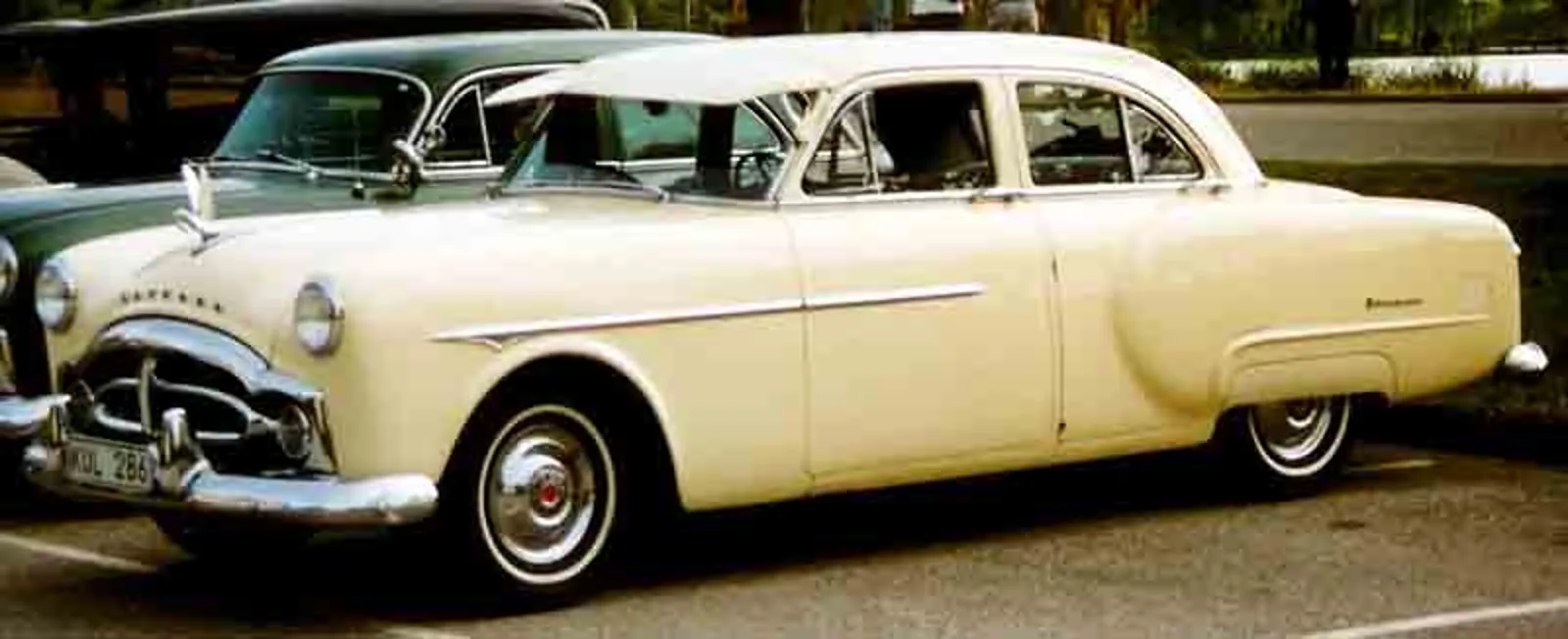
A Warren, Ohio workshop became one of America's most prized luxury makers, then struggled through postwar styling, a rushed Studebaker merger and a final 1958 model year.
Packard was an American luxury carmaker first built in Warren, Ohio, in 1899 and based in Detroit from 1902. It was one of the Three Ps before the war, merged with Studebaker in 1954 and was retired in 1959. Its cars were prized among America's wealthiest buyers before the war.
Packard was an American luxury carmaker that began in 1899 and ended its own line in 1958. It built its reputation in Detroit before the Second World War as one of the Three Ps, which also included Peerless and Pierce-Arrow. After the war it fought to stay independent, merged with Studebaker and was retired in 1959.
Where did Packard begin?
The business was started in Warren, Ohio, by James Ward Packard, with his sibling William and a partner, George Lewis Weiss. Roughly 400 Packard automobiles were built in that workshop between 1899 and 1903, and the first car was completed on November 6, 1899.
The story goes that James Packard was unhappy with the Winton cars that Weiss had a stake in. He raised complaints with Alexander Winton and proposed changes, which Winton brushed aside by telling him to build his own car. Packard took the advice literally.
The company's direction changed when Henry Bourne Joy, from one of Detroit's long-established wealthy families, bought a Packard and admired its dependability. Joy brought in backers such as Truman Handy Newberry and Russell Alger Jr., both prominent local figures. In 1902, on October 2, the group reorganised the former New York and Ohio Automobile Company, giving it the Packard name, with James Packard in the president's chair.
The company then moved to Detroit, and Joy became general manager. Packard set its prices from $2,600, well above low-cost rivals, and it won a wealthy following at home and abroad that put it up against Mercedes-Benz, Isotta Fraschini, Renault and Rolls-Royce.
A Detroit luxury marque that carried the Three Ps name into the Depression and died in a rushed Studebaker deal.
What was the Detroit plant like?
The East Grand Boulevard works covered 3,500,000 sq ft on more than 40 acres. Albert Kahn Associates designed it, and building #10, which opened in 1906, was an early automotive factory built with reinforced concrete.
Its craftsmen practised over 80 trades, and the site later sat close to the General Motors Detroit/Hamtramck plant, which had once been a Dodge factory. The dilapidated works stood for years despite repeated fires, and demolition began in September 2022.
Kahn was also responsible for the Packard test site in Shelby Township, Michigan, which became part of the company's engineering network. The site's roughly forty-acre plant base reflected how much ground the company was prepared to hold.
How did Packard become a luxury benchmark?
Packard was regarded as among the Three Ps of American motoring, along with Pierce-Arrow of Buffalo and Peerless of Cleveland. For most of its history it was led by James Alvan Macauley, who also held the presidency of the National Automobile Manufacturers Association. He later entered the Automobile Hall of Fame.
Macauley is credited with the advertising line Ask the Man Who Owns One. He pushed Packard toward being the leading designer and producer of luxury cars in the United States, and the marque sold in 61 countries. Gross income reached $21,889,000 in 1928.
The engineering on offer grew with the image. The Packard Six appeared in 1913 as a senior luxury platform, and the Twin Six followed in 1916. The Goddess of Speed hood ornament arrived in 1925 and soon decorated every model, while a Cormorant or Swan emblem came in the 1930s.
Packard also ran trucks. In summer 1912 a lorry carrying three tons covered the route from New York to San Francisco, running from July 8 until August 24. That same year the company kept service depots in 104 cities. Packard cars were also being made in Canada by 1931.
How did Packard get through the Depression?
Entering the 1930s, Packard tried to outrun the Depression by offering more opulent and expensive cars and by spreading its range across several price points. The Twin Six, designed under chief engineer Jesse G. Vincent, arrived in 1932 at prices from US$3,650 and was renamed the Packard Twelve in 1933.
For 1932 only, Packard also offered a Light Eight listed at $1,750 at the base, well under the Standard Eight. Packard's other advantage was a single production line, with interchangeable parts across the models, which kept costs down while rivals struggled.
Packard had also adopted a series system for model changes in 1923, borrowing the planned obsolescence idea from GM. By 1930 cars were part of the Seventh Series, and by 1942 the company had reached the Twentieth Series, with the Thirteenth skipped because of superstition about the number.
The major step was the 120. Introduced in 1935 as Packard's first car under $1000, it was built in a separate factory, and sales more than tripled in its first year. The 120 used modern mass-production methods, while the Senior models relied on hand labour, and by 1936 the cheaper Junior cars outnumbered the Seniors by more than ten to one.
Packard also built cars in Windsor, Ontario, from 1931 until 1939, partly to benefit from Imperial Preference and to make right-hand-drive cars for export. Peak output came in 1937, when just over 2,500 cars were completed.
What did the late 1930s bring?
In 1937 Packard added the 115C, powered by a six-cylinder engine, and the Packard Six priced at around $1200 arrived for the 1938 recession. The move broadened the badge's appeal, but it also made Packard look less exclusive, which later hurt its reputation for the finest American luxury cars.
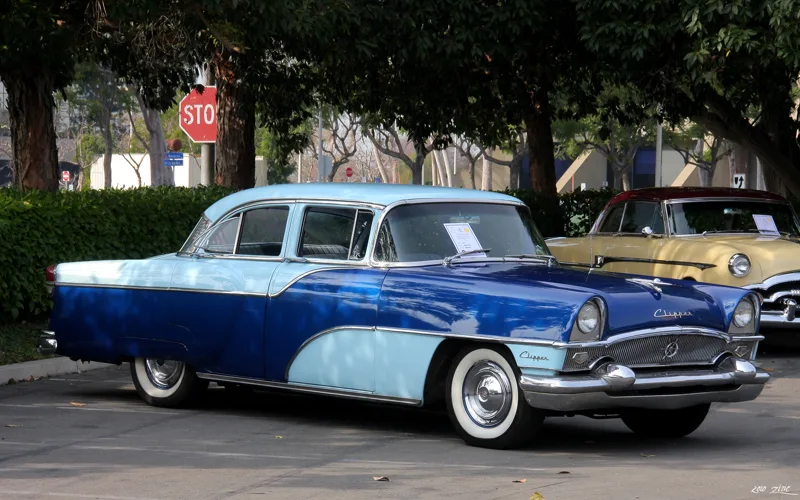
In 1939 Packard introduced Econo-Drive, an overdrive that cut engine speed by 27.8% and could be engaged at any speed above 30 mph. The 1941 Clipper followed as a four-door on a 127 in wheelbase, with a version of the 120's straight-eight.
How did Packard contribute to the war?
In 1942 Packard moved to full war production. It built the V-1650, a Merlin engine licensed from Rolls-Royce, which powered the P-51 Mustang fighter that GIs jokingly called the Cadillac of the Skies. Packard built 55,523 of the engines under that contract.
Large V-12 marine units went into American PT boats, three to a vessel, and British patrol craft also received some. By the time fighting ended in Europe, the company had turned out more than 55,000 combat engines.
Sales in 1944 reached $455,118,600, and by May 6, 1945 the backlog of war orders stood at $568 million. Packard finished the war in strong financial shape, but its management decisions would soon show their cost.
Why did Packard struggle after the war?
Packard resumed civilian production in late 1945, relabelling its 1942 models as 1946 cars. Only the Clipper tooling was ready, so the Senior series was delayed, and some believed the Senior dies had been left to rust.
The Clipper looked old as envelope bodies arrived from Studebaker and Kaiser-Frazer. Packard then pushed a bathtub-style body, which some critics nicknamed the pregnant elephant. Test driver Tom McCahill called it a goat in print. The company sold 2,000 vehicles in 1948 and 116,000 of the 1949 models.
Cadillac had a sleeker body and a new OHV V8 in 1949, which made Packard's inline engines look dated. Packard's Ultramatic, its self-developed automatic, arrived on top models in 1949 and on all models from 1950. It did not match GM's Hydramatic for smoothness, and the money spent on it delayed a modern V8. Sales fell to 42,000 cars for the 1950 model year. Packard had not sold enough cars to pay for the tooling of its 1941 design, which left little room for change.
Leadership problems compounded the trouble. In 1951 Hugh Ferry became president, and he made clear he would serve only until a permanent head was found. The board's average age was 67, and James Nance was recruited from the appliance maker Hotpoint, at 52 he was over ten years younger than the company's youngest executive.
What were the 1951 to 1953 Packards?
The 1951 Packards were redesigned by John Reinhart, with a high-waisted, squarer profile, a one-piece windshield, a full-width grille and blunt guideline fenders. The Mayfair became Packard's first two-door hardtop, and the Patrician 400 took over from the Custom Eight as the premium car.
The redesigned line sold nearly 101,000 cars, though the planned 356 cu in engine for the Patrician was dropped in favour of a de-bored 327 cu in unit. Packard also introduced a Station Sedan that sold 3,864 examples over three years.
Nance declared that Packard would stop making mid-priced cars and focus on luxury, and he unveiled the Caribbean convertible for 1953, with only 750 built. Its build quality slipped as morale fell, and overall sales dropped that year.
Why did Packard merge with Studebaker?
In the early 1950s the independent makers consolidated against the Big Three. Nash-Hudson became American Motors, and George W. Mason of Nash hoped to bring Packard in as well. An accord had AMC purchasing Packard's Ultramatic transmissions and V8s, but the wider plan stalled.
Packard then bought the failing Studebaker Corporation as of October 1, 1954, forming Studebaker-Packard. Nance refused to merge with AMC unless he took the top job, and Mason died on October 8, 1954. Studebaker's finances were far weaker than Packard's, and the rush to close left little time for checks. Afterwards it was obvious that Studebaker's problems put Packard's survival at risk.
The 1954 Packard lineup was largely unchanged, with the Clipper making up most output. Total production for the year was 89,796. The new model that Nance wanted was delayed to 1955.
Dick Teague designed the 1955 line, and it was well received. It had a new suspension with torsion bars, and a new overhead-valve V8 of 352 cu in replaced the straight-eight. Sales climbed back to 55,000 units, but the rest of the company was in trouble.
Body supply was another problem. Packard had outsourced bodies to Briggs Manufacturing since 1941, and Chrysler bought Briggs after the founder's death and ended supply. Packard then moved into a former Briggs plant on Connor Avenue, which caused quality problems and a fall in sales for 1956. John Z. DeLorean was one of the talented people who left the company during this period.
What happened to Packard after 1955?
In 1956 the Clipper was spun off as its own make, while the Senior Packards carried the Patrician, Four Hundred and Caribbean names. The V8 grew to 374 cu in, producing 310 hp in the Caribbean. Reliability problems with the automatic and electrical systems damaged the brand's image further.
The last fully Packard-designed car, a Patrician four-door sedan, left the Conner Avenue line on June 25, 1956. The large Packard was then effectively abandoned, since there was no money to retool for the advanced models that had been planned.
For 1957 the Clipper was a Studebaker President-based car with a supercharged 289 cu in Studebaker V8 producing 275 hp. It sold slowly, and critics called the new models Packardbakers. A dealer network that had already shrunk could not hold on, even with heavy discounts.
The 1958 cars were sold simply as Packard. The Hawk drew on the Studebaker Golden Hawk, and the bodies used fibreglass parts grafted to Studebaker shells. Sales were only 2,622 for the model year. July 16, 1958 saw the final Packard leave the line, and the make was retired in 1959.
What concept cars did Packard build?
During the 1950s Packard built several dream cars to keep the marque alive. The 1952 Pan American led to the production Caribbean, the Balboa hardtop of 1953 had a reverse-slanted rear window, and the Panther followed in 1954 and 1955.
The Predictor was the last show car, styled by Dick Teague to follow the lines of the planned 1957 cars, and it survives in South Bend. The Astral debuted in South Bend, at the Art Centre there, on January 12, 1958, and later appeared at Geneva that March, although no working prototype was ever built.
Packard also made ten Request models, based on the 1955 Four Hundred, and only four were sold from the showroom floor. The engineering mule Black Bess was a 1957 test car that was later destroyed.
What are the key Packard figures?
| Item | Detail |
|---|---|
| First car | November 6, 1899, Warren, Ohio |
| Renamed | Packard Motor Car Company, October 2, 1902 |
| Detroit plant | 3,500,000 sq ft on over 40 acres |
| Gross income | $21,889,000 in 1928 |
| Twin Six price | From US$3,650 in 1932 |
| Windsor best year | 1937, just over 2,500 cars |
| Combat engines | Over 55,000 by the end of the war |
| Postwar low | 42,000 cars for the 1950 model year |
| Studebaker purchase | October 1, 1954 |
| Last Packard | July 16, 1958, South Bend |