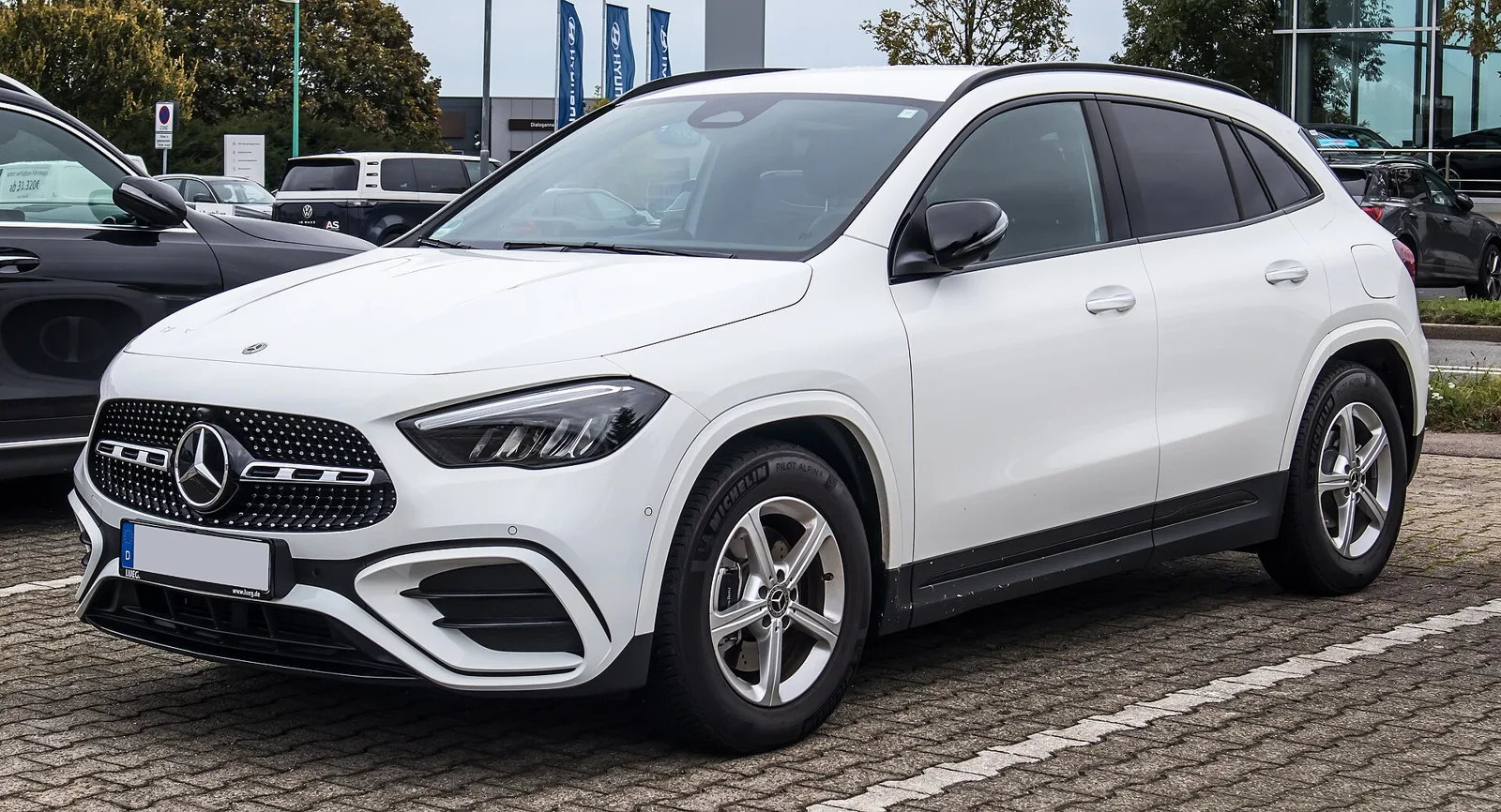
From the 1886 Benz Patent-Motorwagen to the world's largest premium brand, the full arc of Mercedes-Benz.
Mercedes-Benz was formally created on 28 June 1926, when Benz & Cie and Daimler-Motoren-Gesellschaft merged into Daimler-Benz. Its roots run back to 1886 and the Benz Patent-Motorwagen, the first internal combustion car. Today it is based in Stuttgart and ranks as the world's largest premium brand.
The merger of Benz & Cie with Daimler-Motoren-Gesellschaft produced Daimler-Benz on 28 June 1926, the date Mercedes-Benz came into existence. Tracing its origins to 1886, the company points to the Benz Patent-Motorwagen, the earliest internal combustion car. Stuttgart serves as its present headquarters, and it holds the position of the largest premium brand worldwide.
Where did Mercedes-Benz come from?
The story begins with two rival inventors whose workshops lay in the same corner of southwest Germany. In Mannheim, Carl Benz constructed a three-wheeled motor carriage, while in 1886 Gottlieb Daimler and Wilhelm Maybach fitted a petrol engine to a stagecoach. Neither man realised he was laying the foundations of half of the most famous car company on earth.
Benz's Patent-Motorwagen was financed by Bertha Benz's dowry in January 1886, and she later proved its worth by driving it on the world's first long-distance motor journey. By 1894 Benz had the Velo in production, a small four-wheeler that became one of the earliest series-built cars. Daimler and Maybach, meanwhile, were experimenting with engines for boats, airships and trams as well as road vehicles.
The name itself arrived from an unlikely source. Emil Jellinek, a wealthy Austro-Hungarian businessman and Daimler agent, raced under the pseudonym 'Monsieur Mercedes' at Nice in 1899, borrowing the name of his daughter Mercedes. He registered the Mercedes trademark in 1902 and demanded that DMG build him a faster, lower, more powerful car. The result was the 1901 Mercedes 35 hp, widely regarded as the first modern automobile and the car that gave the marque its name.
The 35 hp was not just a faster carriage. Its pressed-steel chassis, honeycomb radiator and low centre of gravity set a template that every carmaker would follow. DMG re-registered Mercedes worldwide as a protected trademark in 1901, and the brand was on its way.
By 2018 Mercedes-Benz was the world's largest premium vehicle brand by sales volume, shifting 2.31 million passenger cars that year.
How did the merger create Mercedes-Benz?
Through the 1920s, Benz and DMG competed fiercely in a collapsing German economy. Neither could survive alone, and on 28 June 1926 they merged to form Daimler-Benz. The first vehicles carrying the Mercedes-Benz name rolled out that same year, combining the three-pointed star of Daimler with the laurel wreath of Benz.
Ferdinand Porsche, then Daimler-Benz's chief engineer, led the design of the early merged range. The 1920s and 1930s produced some of the most powerful cars in Europe, including the supercharged SS and SSK sports cars, whose names carried no number at all, and the massive 770 Grosser Mercedes favoured by heads of state. One 770, fitted with custom bulletproof windshields for Adolf Hitler, survives in the War Museum in Ottawa, Ontario; most others were sold at auction to private buyers after the war.
The company's past is deeply marked by the Nazi era. Daimler-Benz began moving into armaments manufacturing in 1937, producing the LG3000 truck alongside the DB600 and DB601 aircraft engines, while a concealed factory in woodland at Genshagen, 10 km to the south of Berlin, had been established in 1936. Car output had mostly ceased by 1942. Of the 63,610 people it employed in 1944, many were detainees, prisoners of war or forced labourers, and compensation of $12 million was eventually made by the firm to the families of those labourers.
What do the letters and numbers on a Mercedes mean?
Up to 1994, the names Mercedes gave its cars told you both the engine size and the type of body. Take the 300E: the 3.0 indicated a 3.0-litre engine, while the E stood for petrol injection. Insiders found this arrangement sensible, yet outsiders often found it baffling, and on occasion the figure in the name failed to correspond to the engine actually fitted, giving rise to several well-known discrepancies.
The suffix letters carry specific meanings. D stands for diesel, E for petrol fuel injection (and later for electric or plug-in hybrid), K for Kompressor supercharging, and T for the Touring estate body. G denotes the Gelandewagen off-roader and, later, the SUV family including GLA, GLC, GLE, GLK and GLS. L can mean Leicht (lightweight) or Lang (long-wheelbase), R stands for Rennen (racing) as in the 300SLR, and S is short for Sonderklasse, the special class reserved for the flagship saloons. C marks a coupe or cabriolet, as in CL and CLK, and in the 1950s lower-case b, c and d indicated trim levels.
Some suffixes broke the rule. SLK and CLK used K for Kurz, meaning short, rather than Kompressor, and the 190-class numeric designation simply marked the entry-level position in the range. In 1994 Mercedes reorganised everything into 'classes' with up to three letters, giving us the C-, E-, S-, M- and G-Class families that still shape the line-up today.
What does 4MATIC mean on a Mercedes-Benz?
4MATIC is Mercedes-Benz's designation for all-wheel drive, a system that sends power to all four wheels for traction in poor conditions. It has appeared across the range, from saloons to SUVs, and is now a defining feature of the brand's winter-friendly reputation.
Other engineering badges followed a similar logic. CDI stands for Common-rail Direct Injection, the diesel technology that transformed the company's oil-burners in the 1990s. CGI is Charged Gasoline Injection, a direct petrol injection system. BlueTEC adds selective catalytic reduction exhaust after-treatment to diesels, while BlueEFFICIENCY bundles fuel economy features such as direct injection, start-stop and aerodynamic tweaks. NGT denotes natural gas fuelling, and Hybrid covers petrol- or diesel-electric powertrains. Turbo badging has been used only on the A-, B-, E- and GLK-Class, while AMG Line brings sports car luxuries to interior or engine specification.
How did Mercedes-Benz pioneer alternative propulsion?
For Mercedes-Benz, electrification has been a matter of engineering rather than one of marketing. The 2007 Frankfurt motor show served as the venue where the firm displayed seven hybrid vehicles, among them the F700 concept, whose hybrid-electric drivetrain was mated to a DiesOtto engine blending the combustion principles of diesel and petrol.
At the 2009 North American International Auto Show, held two years on, Mercedes-Benz displayed three BlueZERO concepts. Each used a distinct form of propulsion: one ran purely on battery power, another on a fuel cell, and the third combined a petrol engine with an electric motor. That same year, the Vision S500 PHEV concept promised 19 miles (31 km) of electric-only driving and produced 74 grams of CO2 per kilometre under the New European Driving Cycle - figures that stood out at the time.
Work on hydrogen power proceeded at the same time. Using the B-Class as its basis, the F-Cell delivered a 250-mile range and proved that hydrogen was viable within a production-style body. What was learned from these trials went straight into the EQ line of EVs, which today is sold next to the combustion-engine models.
What is the Mercedes-AMG connection?
What started in the 1960s as a separate tuning firm, AMG, was taken over by Mercedes-Benz in 1999, which then held most of its shares. These days the performance range-toppers are its work, spanning the A45 hot hatch through to the GT coupe, while each engine is put together by hand by one technician, whose signature goes on the plaque.
Positioned higher than AMG is Mercedes-Maybach, the marque's ultra-luxury arm brought back during the 2010s, offering upgraded takes on the S-Class and GLS such as the S600 and GLS 600. These cars target customers seeking a chauffeured Mercedes featuring a tailored cabin, taking on Bentley and Rolls-Royce head-to-head.
The company has also experimented with smaller and more affordable marques. Smart was Daimler's city-car brand, and Denza was a joint venture with China's BYD that Mercedes exited by 2024. Beijing Benz, a joint venture with BAIC, handles Chinese production, while Mercedes-Benz Vietnam, a partnership with SAMCO, assembles cars in CKD form.
Which Mercedes-Benz models are the landmarks?
Certain cars define the marque's reputation. The 300SL Gullwing of the 1950s brought fuel injection and a spaceframe to the road. The 600 Pullman of the 1960s carried heads of state and popes. The W123 estate and W126 S-Class built the 'indestructible' reputation that lasted until the mid-1990s.
The SLR McLaren, a 2000s supercar born of the Formula 1 partnership, remains one of the most dramatic cars ever to wear the star. A 1955 Mercedes-Benz SLR sold for $142 million (135 million) in 2022, the highest price ever paid for a car at auction. The X-Class pickup, built from 2017 to 2020 on Nissan Navara underpinnings, was a rare misstep, a badge-engineered truck that never convinced the brand's core buyers.
| Landmark model | Era | Significance |
|---|---|---|
| Benz Patent-Motorwagen | 1886 | First internal combustion car |
| Mercedes 35 hp | 1901 | First modern automobile, gave the marque its name |
| 770 Grosser Mercedes | 1930s | State limousine, favoured by Hitler |
| 300SL Gullwing | 1950s | Fuel injection and spaceframe road car |
| 600 Pullman Guard | 1960s | Armoured limousine for diplomats |
| SLR McLaren | 2000s | F1-derived supercar |
| X-Class | 2017-2020 | Nissan-based pickup |
How has Mercedes-Benz performed in the market?
By 2018 Mercedes-Benz was the world's largest premium vehicle brand by sales volume, shifting 2.31 million passenger cars that year. That position was built on a broad range, from compact A-Class hatchbacks to the S-Class limousine and the G-Class off-roader, plus a commercial vehicle operation that has been part of the business since the early days.
Corporate structure has changed with the times. Mercedes-Benz AG, based in Stuttgart, Baden-Wurttemberg, became a subsidiary of Mercedes-Benz Group when the company was established in 2019. From November 2019 heavy commercial vehicles were managed by Daimler Truck, and that business separated from Mercedes-Benz Group at the end of 2021, leaving the car and van operation to focus on luxury vehicles and light commercial vehicles.
The path has not always been even. A braking defect linked to severe corrosion led the firm in 2022 to call back close to a million cars produced from 2004 to 2015. That same year, a 1955 SLR changed hands for $142 million (135 million), showing that the marque's past has become a financial asset in its own right.
Is Mercedes-Benz still the best or nothing?
Since the merged firm's earliest years, 'The Best or Nothing' has served as its motto, and it still expresses what the brand aims for. For a long stretch, the engineering lived up to that promise: prior to the mid-1990s, Mercedes owners reached for words like 'tanks' and 'indestructible', while the W123 and W126 lines became known for surviving for decades.
That reputation slipped in the late 1990s and early 2000s, when J.D. Power surveys showed a downturn in quality and reliability. The company responded. In the 2007 Initial Quality Study it jumped dramatically from 25th to 5th, and in 2008 it improved to 4th, taking a Platinum Plant Quality Award for its Sindelfingen factory. By 2011 it ranked above average in both US and UK J.D. Power studies, and a 2014 iSeeCars.com analysis found it had the lowest recall rate among its competitors.
Mercedes-Benz ranks among the automotive world's most familiar names and its oldest survivors, and it is given credit for mechanical and electronic firsts, plus safety equipment, that competing marques went on to fit themselves. Combustion, hybrid, battery-electric and fuel-cell powertrains all feature in its line-up, while its performance and luxury divisions extend its coverage from the small hatchback up to the armour-plated limousine used by diplomats. More than a hundred years after it was registered, the three-pointed star retains its meaning.
_%E2%80%93_f_12102024.jpg)