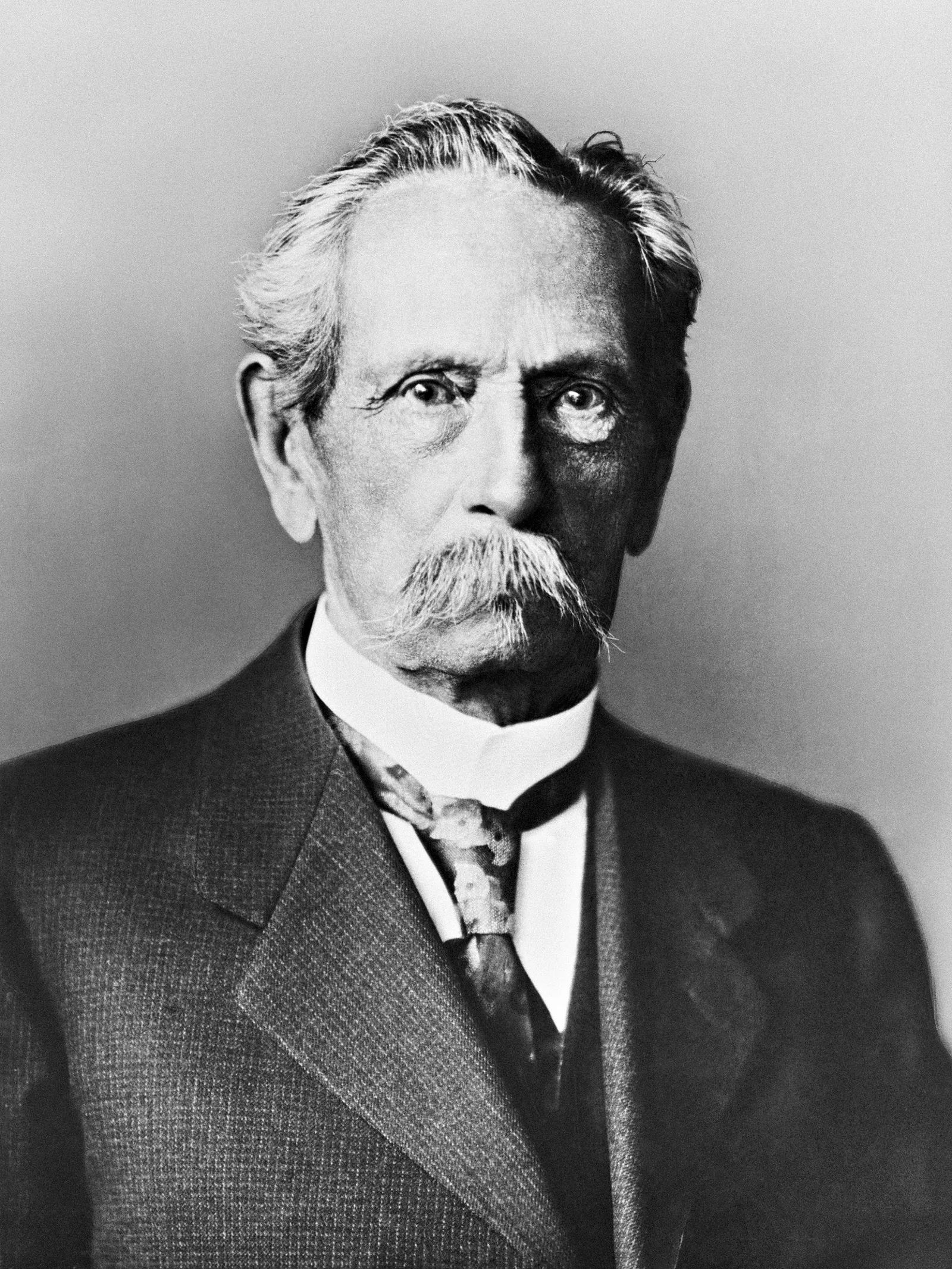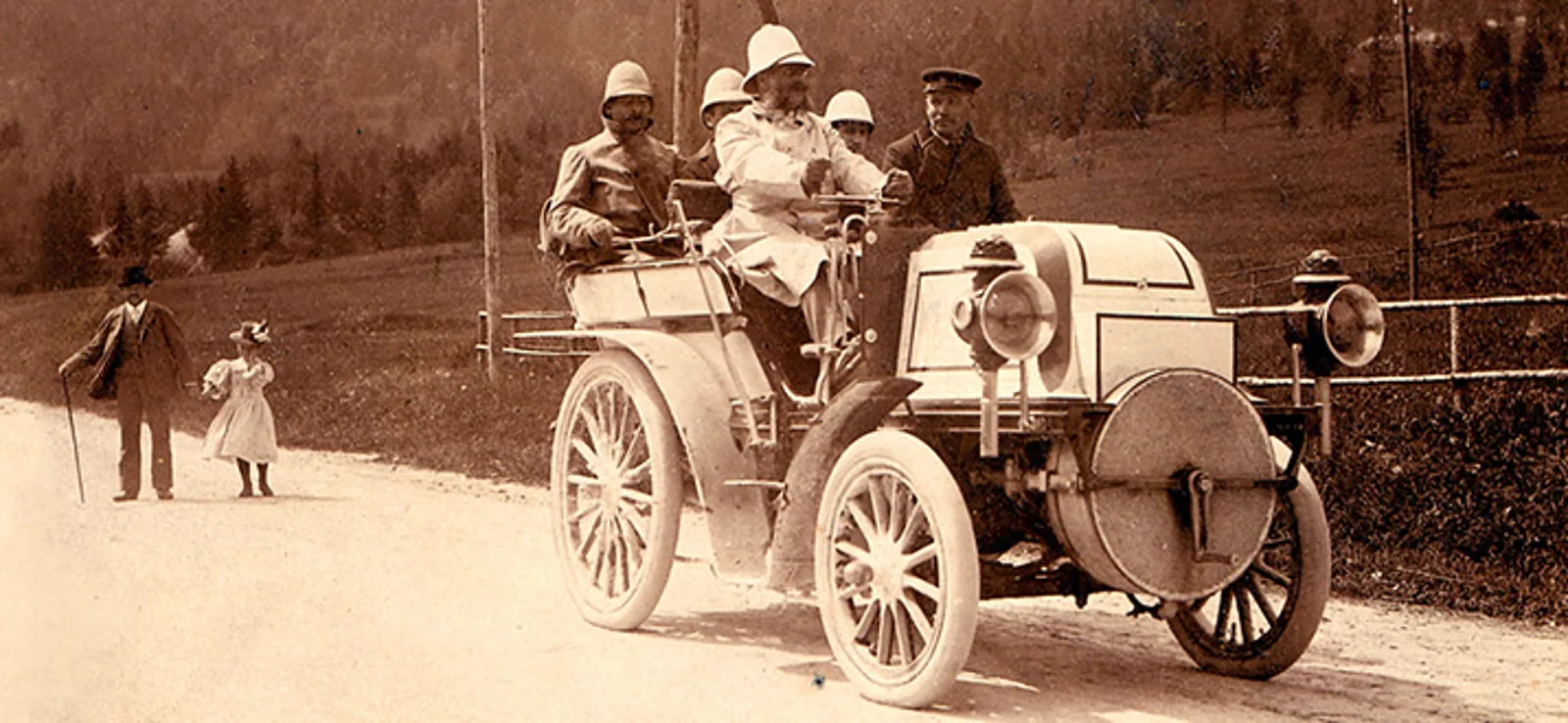
From a 1890 engine business in Cannstatt to the Mercedes 60 and the 1926 merger with Benz, the company behind the Mercedes name.
Daimler-Motoren-Gesellschaft, or DMG, was a German engineering firm founded in 1890 by Gottlieb Daimler and Wilhelm Maybach. It later became an automaker, and its 1902 Mercedes gave the brand its name. DMG merged with Benz and Cie in 1926, and the business is now the Mercedes-Benz Group.
Daimler-Motoren-Gesellschaft, usually shortened to DMG, was a German engineering company that later became an automaker. It operated from 1890 until 1926, and its Mercedes models gave the company the trademark that still defines the brand. The 1926 merger with Benz and Cie produced Daimler-Benz, the forerunner of today's Mercedes-Benz Group.
When was Daimler-Motoren-Gesellschaft founded and why?
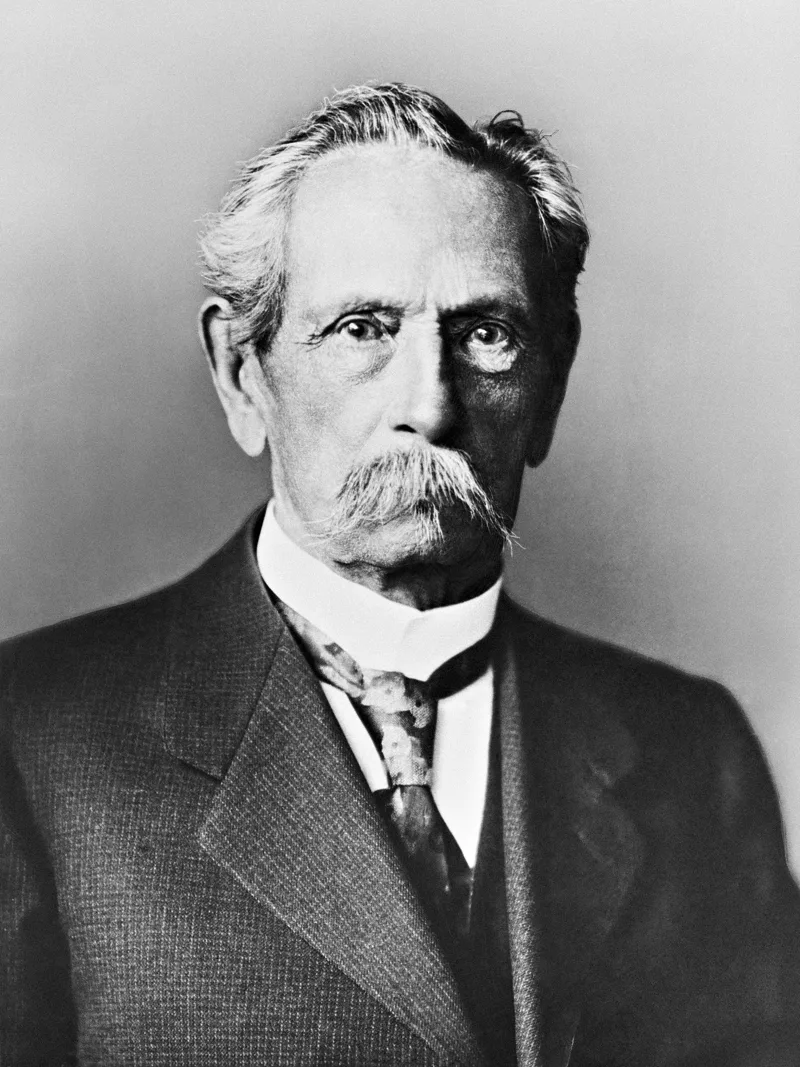
Gottlieb Daimler and Wilhelm Maybach founded Daimler-Motoren-Gesellschaft in 1890 as an engine business. It was set up to build small, high-speed engines based on the stationary engine technology the pair had developed. The business was converted into a public corporation in the same year after financial problems.
The two men had both left Nikolaus Otto's Deutz engine works by 1882. DMG grew out of their independent businesses, which were already developing the four-stroke petrol engine and the carburetor that would later power the automobile. The new company aimed to make internal combustion engines for use on land, on water and in the air.
Financing came from industrialists Max von Duttenhofer and Wilhelm Lorenz, both munitions manufacturers, together with banker Kilian von Steiner. Their investment turned a private workshop into a public company. Some historians describe the arrangement as a devil's pact, because the two inventors were never comfortable with the new arrangement.
A small engine firm built on a three-pointed star became the company that gave the Mercedes name to the world.
Where was DMG's first factory?
DMG's first works stood on Seelberg Hill at Cannstatt, bought by Daimler on 5 July 1887 for 30,200 Goldmark. The 2,903 square meters site had previously been a precious metal foundry owned by Zeitler and Missel. Engines made there powered the Neckar motorboat, and the company sold licences so that others could build its designs.
Cannstatt is now Bad Cannstatt, a district of Stuttgart, and the Seelberg site grew into a hub for the fast-developing car industry. The licences, however, did not always produce much profit. Sales were not high enough, and the income from licences was too small to support a sound business.
Why did Daimler and Maybach return to the company?
The financiers initially expanded the stationary engine business rather than car production, and they even considered a merger with Otto's Deutz AG. Daimler's friend Frederick Simms persuaded them to take Gottlieb Daimler and Wilhelm Maybach back into the faltering company in early 1896.
Daimler and Maybach had left DMG for a short period because they wanted to keep pushing car manufacture. Their return had been made possible by a payment: Simms arranged for DMG to receive 17,100 pounds on condition that it took Gottlieb Daimler back, and a contract of reassociation was signed on 1 November 1895.
Daimler was appointed General Inspector, Maybach became chief Technical Director, and Simms became a director.
Which engines did DMG build before the car?
The Phoenix engine was the company's main product before the Mercedes arrived. Maybach designed an inline two-cylinder unit in 1892 with a new carburetor, and in 1894 Gottlieb Daimler, his son Paul and Maybach produced a four-cylinder version. It powered cars, trucks and boats until the Mercedes of 1902 took over.
The 1894 engine placed four cylinders vertically and in parallel, a layout described as a first for an automobile engine. It also had camshaft-operated exhaust valves, a spray-nozzle carburetor that Maybach had patented in 1893, and improvements to the belt drive.
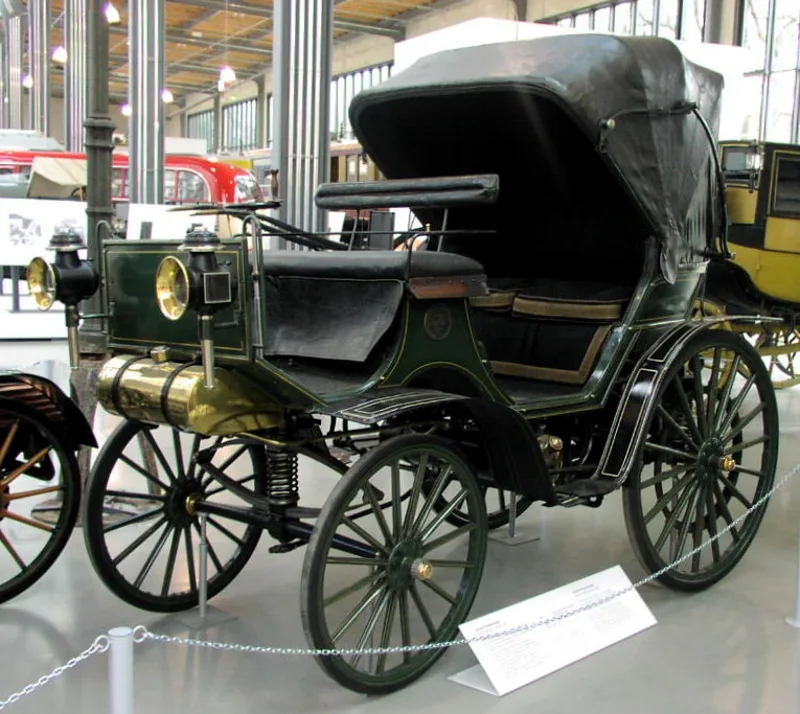
The first Daimler car appeared in 1892, a singularly plain model. It was followed in 1895 by a two-cylinder vis a vis and in 1897 by DMG's first front-engined car, a four-seat open tourer powered by a Phoenix engine. The first DMG automobile sale took place in August 1892, to the Sultan of Morocco.
Commercial vehicles also used the Phoenix engine. The first DMG truck, with a payload of 1.5 tons, was sold to London's British Motor Syndicate on 1 October 1896. Its rear-mounted engine produced 4 hp (3 kW) at 700 rpm, and by 1898 a 5-ton truck with a front-mounted engine was on show at the first Paris Motor Show.
Why were motorboats so important to DMG?
The Neckar motorboat was built by Daimler and Maybach in 1886 and tested on the local river. It was 4.5 meters long and reached 11 km/h (6 knots), and it became DMG's first commercial success. Poor road conditions in Germany helped the boat sell, and motorboats remained one of the financiers' main interests.
Motorboat demand led directly to the Berlin-Marienfelde works, opened on 2 October 1902 and at first limited to motorboat and marine engines. The works later expanded into trucks in 1905 and fire trucks in 1907, and the district became a centre of the automobile industry as other businesses moved in.
How did the Mercedes name come about?
The Mercedes name came from Emil Jellinek, an Austrian merchant who commissioned race cars from DMG and insisted that the engine carry the Daimler-Mercedes name. The car that became known as the Mercedes 35 hp was designed by Wilhelm Maybach to Jellinek's order in 1902, and it was built from a 1900 engine.
Jellinek competed as a driver and painted 'Mercedes' on the cars he raced, after his ten-year-old daughter. The word is Spanish for godsend, and the name stuck. He wanted a larger and wider car with a lower centre of gravity, a true automobile rather than an engine mounted in a carriage body.
Jellinek promised to buy 36 units for 550,000 Goldmark if he could be the sole concessionaire in Austria-Hungary, France, Belgium and the United States.
In June 1902 DMG had already given up the Daimler trademark for France to Panhard and Levassor. The company therefore decided to name all its cars Mercedes after the engine, and it began production of the Mercedes series. Demand was so strong that DMG was soon working at full capacity.
How did the Mercedes 60 change DMG?
The 1902 Mercedes 60 combined touring and racing ability and was capable of 120 km/h (75 mph). It became the most famous early model and the top-status car to own. Its success helped push the number of DMG employees from 821 in 1903 to 2,200 in 1904.
Other manufacturers copied the design, among them Berliet, Rochet-Schneider, Martini, Ariel, Star and Fiat. Production capacity was extended to Untertuerkheim, and the Mercedes trademark was officially adopted as the company's car brand in the same period.
Expansion continued from 1906 to 1913. New in-house capacity reduced the company's reliance on external suppliers, and increased mechanisation lifted annual productivity from 0.7 cars per worker to 10. In 1911 DMG shares were listed on the Stuttgart stock exchange.
Where were the Untertuerkheim and Marienfelde works?
Untertuerkheim became DMG's headquarters on 17 May 1904, after a fire had destroyed the Cannstatt factory. Berlin-Marienfelde had opened on 2 October 1902 for motorboat and marine engines, and it later added trucks. Both sites grew into major production centres for the company.
Untertuerkheim was chosen because it sat close to the Neckar river and the Stuttgart-Ulm railway. The local mayor, Eduard Fiechtner, sold 185,000 square meters of land at a low price and arranged a railroad extension with its own station, plus power from the Neckar hydro-electric plant built in 1900.
Work on a new Art Nouveau building with a jagged roof started in December 1903, and the administration moved in on 29 May 1904. An additional 220,000 square meters was acquired in 1913, and the site was extended again between 1915 and 1918.
By the 1920s Untertuerkheim had nearly every production process on one site, from foundries to final car assembly. The DMG design department moved there in 1925, which concentrated the company's engineering and manufacturing in one place.
What happened in the 1903 Cannstatt fire?
On the night of 10 June 1903 a great fire destroyed the original Seelberg-Cannstatt plant. All the machinery and 93 finished Mercedes cars were lost, which was a quarter of the year's production, along with a small museum that held Daimler and Maybach's first motorcycle, the Reitwagen.
The displaced workers received emergency pay and extra bread rations. Neighbouring businesses lent workshops so that production could continue, and the Untertuerkheim plant was brought forward to take up the work.
DMG created a relief fund, one of the earliest worker insurance schemes, and began building separate blocks in all its plants. The whole operation moved to Untertuerkheim in 1904, and the last unit built at Seelberg rolled out in the first weeks of 1905.
How did DMG license its designs abroad?
DMG licensed its engine designs in several countries, including France, the United States and Britain. Edouard Sarazin opened early talks in France, and after Daimler's death his widow closed the deal with help from Emile Levassor and Rene Panhard, who sold their first engine in 1887.
Armand Peugeot fitted vehicles with Panhard and Levassor engines and bought the Daimler licence from them. Peugeot focused on the German market with some success. In October 1891 Panhard and Levassor marketed a complete car with the engine mounted over the front axle, rear-wheel drive by side chains and a front radiator.
Historians often describe the motor car as a German invention that France developed commercially, partly through publicity from racing. Karl Benz had received the first patent for an automobile he had built in 1885, and the idea was taken up eagerly in France.
In 1888 Gottlieb Daimler formed a partnership with the German-born piano maker William Steinway in New York. The partners built stationary and marine engines, and from 1892 they also built cars as close copies of the German design. Steinway's business was sold after his death in 1896.
Frederick Simms had obtained British and British Empire rights to the Daimler patents in 1890. He formed the Daimler Motor Syndicate Limited in 1893, and in early 1896 a London promoter floated The Daimler Motor Company Limited, with a factory in a disused cotton mill in Coventry.
What became of the British Daimler company?
In 1910 the Daimler Motor Company kept its separate identity but merged ownership with BSA, a munitions maker, and began producing military vehicles. It also dropped the word motor from its name. The business then produced premium vehicles for more than 65 years.
Its cars were distinguished by finned, exposed radiators and later by scalloped radiator shells. Until the early 1950s the saying was that the aristocracy bought Daimlers and the nouveau riche bought Rolls-Royce, which shows how the marque was seen at the top end of the market.
In 1960 the business was sold to Jaguar, which soon engaged in badge-engineering, so that Jaguar and Daimler cars could often be told apart only by the grille and name badge. The name later moved through British Leyland, returned with an independent Jaguar and then passed to Ford.
Why does the three-pointed star matter?
The three-pointed star stood for land, water and air, the three arenas in which Daimler's engines were used. The DMG board accepted it as the company's trademark in June 1909, and the three-pointed star debuted on the cars in 1910. In 1937 the familiar symbol was registered by Daimler-Benz as a three-dimensional star inside a circle.
Daimler had marked his residence with the star in the 1870s, writing that one day it would shine over the company's factories. Paul and Adolf Daimler, Gottlieb's sons, suggested the symbol in the 1900s, once the Mercedes had proved its worth and DMG still lacked a trademark.
In 1916 the star was surrounded by a circle with four additional stars, bearing either the Mercedes name or the name of the factory. A four-pointed star was registered in 1909 as well, and it later became the emblem of a German aerospace firm in the 1980s.
How did the First World War and the 1920s crisis affect DMG?
During the First World War the Sindelfingen factory opened in autumn 1915 to build military vehicles, aircraft engines and complete aircraft. After the conflict the Versailles settlement limited the plant to automobile bodies, and the German car industry struggled through a long period of weak demand.
Cars were taxed as luxury items and the country suffered a petrol shortage, which made the crisis worse. DMG produced only 1,020 units in 1923, against 1,382 made by Benz and Cie in Mannheim, and an average car cost 25 million marks. Strikes and inflation pushed the company to the limit.
DMG turned to Mercedes bicycles and typewriters, and it even issued its own emergency money to survive. The company had tripled its capital to 100 million shares in 1920, and it moved its headquarters to Berlin in 1922 during the same turbulent years.
How did DMG and Benz merge in 1926?
Benz and Cie proposed a merger in 1919, but DMG formally rejected it in December of that year. As the crisis worsened the two struggling firms met again in 1924 and signed an agreement of mutual interest, which was valid until 2000. They standardised design, production, purchasing, sales and advertising, while keeping their separate brands.
On 28 June 1926 DMG and Benz and Cie merged into Daimler-Benz AG, with its headquarters at the Untertuerkheim factory. Because the Daimler name could not be used on every product, the cars were branded Mercedes-Benz, honouring the company's most successful model and the surname of Karl Benz.
The new trademark combined a three-pointed star with the laurels from Karl Benz's logo, labelled Mercedes-Benz. In 1927 unit sales tripled to 7,918, and diesel truck production was launched in the same year.
What were the Simplex and Knight Mercedes?
The Mercedes Simplex ran from 1902 to 1909, and its name meant that the car was easy to drive. The Mercedes Knight of 1910 to 1924 used a sleeve-valve engine developed by Coventry Daimler from the design of Charles Yale Knight. All the models in the range were priced according to their horsepower rating.
The Knight used a sleeve-valve layout, a different engineering approach from the rest of the Mercedes range, and it gave the company a second model line.
In 1921 DMG presented the supercharged Kompressor engine, which was successful in private hands and on the racetrack. The supercharger added to the range's performance credentials.
How did racing shape DMG's cars?
In the early years car races were used as advertising, and DMG and Benz, their great rival, put their best cars on the track. Daimler cars beat Benz until 1908, when a Benz achieved the land speed record, and in the following years the two brands were roughly equal.
The 1914 Paris race was a major event, with 37 cars from six manufacturers in six countries. To beat the favourite Peugeot team, DMG turned to a large engine of aircraft type designed by Paul Daimler and Fritz Nallinger. The automobile department built it, and the airship department carried out the testing.
That engine produced 105 hp (78 kW) at 3100 rpm, at a time when no Mercedes had exceeded 1,500 rpm. It had four steel cylinders, sixteen valves, an aluminum crankcase, a single camshaft and a displacement of 4,483 cc.
The Mercedes name also won major show competitions in Russia, even after the war and the socialist revolution. The company had built its Russian business early, supplying stationary and marine engines there in 1890, opening a Moscow dealership in 1910 and becoming a purveyor to the Russian Royal Court from 1912.
Did DMG build airships and aircraft?
Daimler built the engine for the first petrol-fuelled airship in 1888. From 1899 to 1907 DMG supplied Maybach-designed engines to Zeppelin. Wilhelm Maybach then quit DMG in 1909 and, with his son Karl, founded their own enterprise in Wurttemberg, where they took over the engine supply.
During the First World War, from 1915, the Sindelfingen works turned out a large volume of aircraft and aircraft engines. The company designed a range of aircraft, including the D.I, G.I, L11 and L14, and the airframe work continued until the Versailles settlement prohibited it.
What were DMG's names over time?
The company traded as Daimler-Motoren-Gesellschaft from 1890 until the 1926 merger with Benz and Cie. The name then became Daimler-Benz, and it changed again in 1998 when a merger with Chrysler Corporation created DaimlerChrysler. The table below sets out each name change through to the present day.
| Year | Name | Context |
|---|---|---|
| 1890 | Daimler-Motoren-Gesellschaft | Founded by Gottlieb Daimler and Wilhelm Maybach |
| 1926 | Daimler-Benz AG | Merger with Benz and Cie, Mercedes-Benz trademark adopted |
| 1998 | DaimlerChrysler | Merger with Chrysler Corporation |
| 2007 | Daimler AG | Renamed when Chrysler was sold |
| 2022 | Mercedes-Benz Group | Current name |
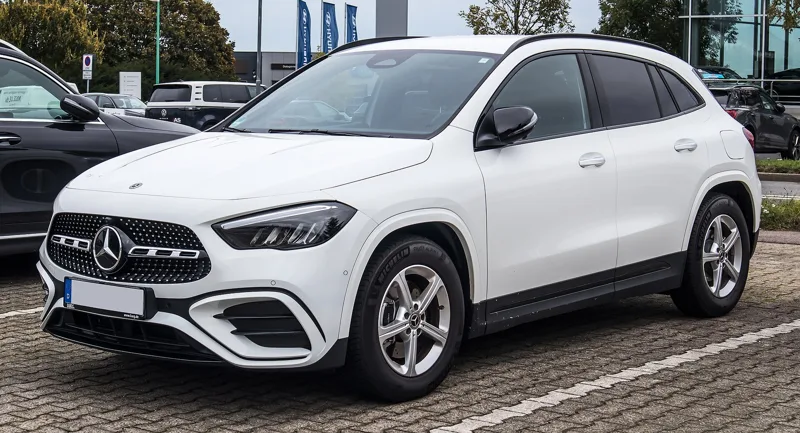
The Mercedes name that began with a 1902 car is therefore the thread running through every later name. The company that began as a small engine firm in Cannstatt became one of the best-known automotive names in the world, and its three-pointed star remains its emblem.