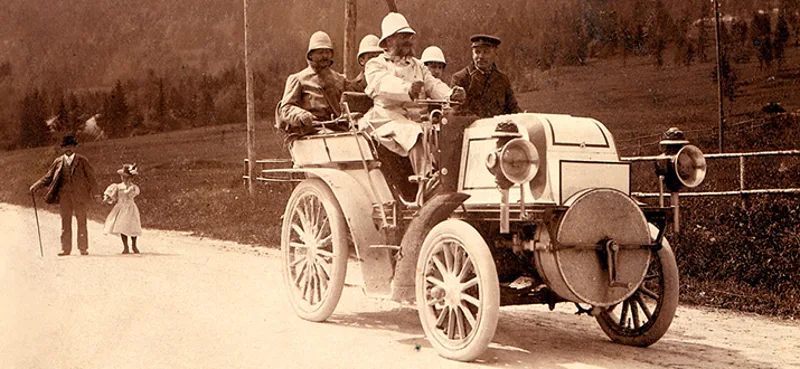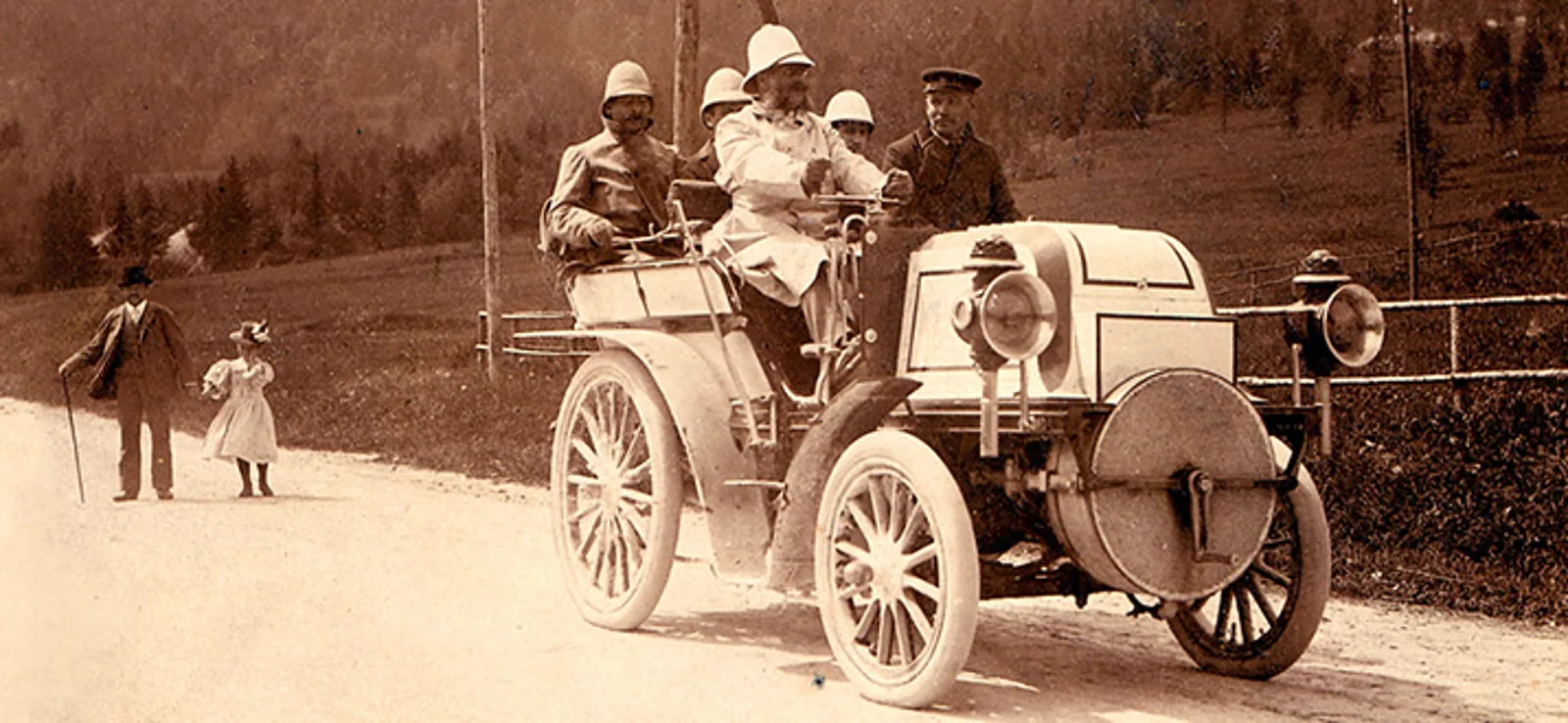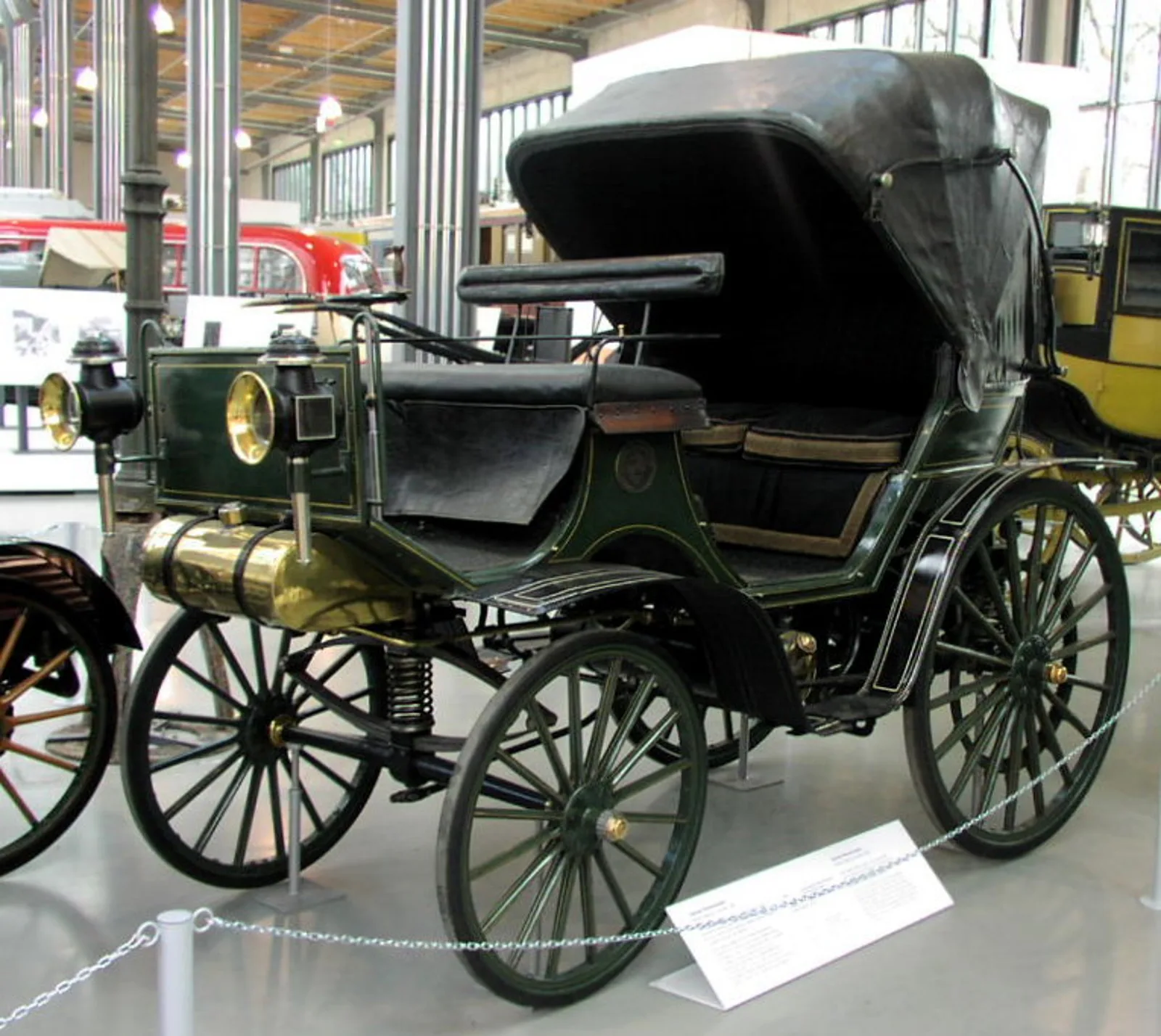
A belt-driven carriage car from 1895, with a two-cylinder Phoenix engine at the rear, that also gave rise to a goods vehicle and a taxi business.
Built by Gottlieb Daimler and Wilhelm Maybach and unveiled in 1895, the Riemenwagen used a two-cylinder Phoenix engine at the rear and a four-speed belt drive. From it came the first motorised taxi and the first engined goods vehicle, which is why it is remembered for its spin-offs.
The Daimler Riemenwagen was a carriage-type car that Gottlieb Daimler and Wilhelm Maybach introduced in 1895. Its two-cylinder Phoenix engine sat at the rear and sent power to the back wheels through a belt. Its lasting significance lies less in engineering than in the taxi and truck business that grew out of it.
Who built the Daimler Riemenwagen, and when?
Gottlieb Daimler and Wilhelm Maybach designed the Riemenwagen in 1895, and the name is German for a Daimler car with belt drive. The groundwork came earlier, when Maybach rented a conservatory at the former Hermann hotel in Cannstatt in October 1892 and set to work with twelve workers and five apprentices.
Maybach's effort produced the Phoenix, a power unit with two cylinders standing side by side in a cast block, with a camshaft that controlled the exhaust valves. It ran on petroleum products. In September he filed patents for a flywheel cooling system and a belt transmission, both developed after he had left the Daimler-Motoren-Gesellschaft (DMG).
The Riemenwagen grew out of that hotel work. It was a carriage-type car with the engine at the back and a four-speed belt drive to the rear wheels. Maybach also gave it a new carburettor with a spray nozzle, the ancestor of the modern carburettor.
A belt-driven car from 1895 that gave the world its first motorised taxi and its first engined goods vehicle.
When did the Riemenwagen first go on show?
The Riemenwagen was unveiled in November 1895 at the Daimler-Motoren-Gesellschaft factory, once both German engineers had returned to management posts in the company. Several models were built with different Phoenix engines, and about 150 cars were made under the official name Daimler Motorkutsche.
The range ran from a 750 cc (45.8 cu in) version with outputs of 2, 3, 4 and 6 horsepower up to a 2.2-litre (134 cu in) unit. Most of the cars carried the 4 horsepower engine.
In 1895, the year of its premiere, the Riemenwagen joined a parade in Eastbourne, East Sussex, England.
How much power did the Riemenwagen make?
The Riemenwagen produced between 2 and 8 horsepower, depending on the version fitted. Most cars carried 4 horsepower units, while the largest engine, a 2.2-litre (134 cu in) unit, produced 7.5 to 8 horsepower (5.5 to 5.9 kW) in its top form.
Engine development did not stop with the first cars. In July 1898, Otto Salzer tested an 8 horsepower car fitted with a low-voltage Bosch magneto during a five-day run through the Austrian Alps. Lessons from that trip changed the engine, and the hot-tube ignition typical of DMG engines disappeared from the design.
Why is the Riemenwagen called the first motorised taxi?
Friedrich Greiner, a Stuttgart goods operator, ordered a Victoria model with a landau body and a taximeter on 26 June 1896. The car was delivered in May 1897, and Greiner's business became the first motorised taxi operation in the world.
The first motorised taxi reached Stuttgart's streets in early summer 1897, after police gave permission in June. The taxi had a heated rear compartment and a rear roof section that opened in good weather. On request customers could also have the whole upper body, with roof and doors, removed, turning the taxi into an open car.
Greiner had to invest heavily. The car cost 5,530 Deutsche Mark (DM), and he also paid a rental fee for the taximeter. The investment paid off, because a single car could cover about 70 km in a day, far more than a horse-drawn carriage. Passengers liked the novelty, and by 1899 Greiner had seven Riemenwagen cars on his books.
The idea then spread quickly. After 1899 companies opened in the large cities of Europe, and taxi firms running Daimler cars appeared in Paris, London and Vienna. The press split between enthusiasm and criticism, since motorised taxis often caused accidents and frightened horses. Driving lessons were proposed for cab drivers, and many former horse-drawn drivers took them to retrain.
Did Daimler recommend the Riemenwagen for taxi work?
Yes, as early as 1896. Daimler had specifically recommended a motorised carriage with a four-speed belt drive and a vertical two-cylinder engine for taxi use. Yet nobody had dared to put a car invented only ten years earlier into service as a taxi. Greiner's firm was the first to try it.
People saw the ride as clever and quick, and a trip in one promised real excitement. Because passengers were so interested, the operator put more money into extra vehicles.
Berlin customers could ride the new cabs along Friedrichstrasse, and in Hamburg the first motorised taxis lined up along Jungfernstieg. A certain buzz grew around the new service, and the media joined in.
How did Emil Jellinek's car link Daimler to Mercedes?
Emil Jellinek, an Austro-Hungarian consul and motor racing enthusiast, came to know the Daimler-Motoren-Gesellschaft through this model. In October 1897 he received a 6 horsepower Riemenwagen with a double phaeton body, and he is best known as co-creator of one of the first modern cars, the Mercedes 35 PS.
The Riemenwagen was the same model on which Daimler and Maybach had tested an electric ignition system. Karl Benz, their main competitor, had used electric ignition on his cars from the very start.
The delivery therefore put a Daimler car in the hands of a man who is known as co-creator of the Mercedes 35 PS.
How did the first engined goods vehicle come about?
In 1896 the Riemenwagen design gave rise to the Daimler Lastwagen, the first goods vehicle in the world with an internal combustion engine. It was a converted horse cart with a two-cylinder engine of 4 horsepower at the rear, and it carried a large sign reading Daimler-Motoren-Gesellschaft Cannstatt.
Suspension mattered because roads were poor and the engine was sensitive to vibration. The chassis carried full-elliptic leaf springs fitted across the car at the front and spiral springs behind, and the wooden wheels carried iron tyres. Fuel for the engine was petrol, then available solely from chemists.
The truck also had an early planetary axle, a feature that became a hallmark of vehicles in its class and is still needed on modern commercial vehicles. Belt drive turned a shaft with gears at both ends, and each gear meshed with internal teeth on a ring gear fixed to the driving wheel.
Why did the truck struggle to sell in Germany?
Early goods vehicles met strong scepticism from German industry, where every manufacturer's product had to earn money. Gottlieb Daimler's first truck was not a success in Germany, but interested buyers were found in England, and the repeal of the Red Flag Act in 1896 helped the cause.
Public resistance was even stronger than the car had faced. High society welcomed passenger cars, but a truck had to justify itself on profit. Steam-powered vehicles had long been at work in many English industries. The old law had required a man with a red flag, and at night a red lantern, to go ahead of any self-propelled vehicle at no less than 55 metres.
In the late 1890s a motorised lorry able to carry 1,500 kg (3,307 lb) was entered as order No. 81 in the Daimler-Motoren-Gesellschaft order book. Daimler offered four truck models from September 1896, with engines from four to ten horsepower and payloads from 1,500 kg (3,307 lb) to 5,000 kg (11,023 lb).
Maybach and Daimler later reworked the layout, shifting the engine and gearbox forward under the driver's seat. Even so, the belt system was only partly up to heavy loads.
The 1897 redesign went further. The engine moved to the very front, ahead of the steered axle, and the truck gained a four-speed gearbox and a full-length propeller shaft. A Bosch low-voltage magneto replaced the old hot-tube ignition, the engine grew to 2.2 litres (134 cu in), and the radiator became tubular.
Daimler tested the revised truck at a brickworks in Heidenheim, where daily work exposed weak points that went back to the factory for correction. He then showed the improved version at the 1898 World Exhibition in Paris, where it drew some interest.
Interest in goods vehicles stayed weak. Europe considered combustion engines suited to passenger cars, while steam and electric power seemed more fitting for commercial work. Surviving order books record nine orders for the 5-tonne versions, and seven of those trucks delivered beer for breweries.
How did Daimler pitch the truck against the working horse?
At the autumn 1897 agricultural show in Wurttemberg, Gottlieb Daimler announced his motorised truck and placed it in the same row as traditional draught animals. He also handed out brochures listing the jobs a truck could do just as a working horse could.
The brochures made one point a horse could never match. The truck was not subject to illness, thirst, hunger or wilful behaviour, and the pitch leaned hard on that difference.
How was the Daimler Phoenix different from the Riemenwagen?
The Daimler Phoenix kept a refined version of the Phoenix engine but moved to a more modern front-engined layout than the rear-engined Riemenwagen. It took over gradually from 1897, so the two cars overlapped for a time.
The change of layout was the main visible difference. The Riemenwagen kept its engine at the back, with the belt drive running to the rear wheels, while the Phoenix put the engine at the front.
When did the Riemenwagen end production?
From 1897 the Riemenwagen was gradually replaced by the Daimler Phoenix, which used a refined version of the same engine. Manufacture of the original car was fully halted in 1899, by which time the Phoenix had taken its place.
The model did not decisively change automotive technology beyond its engine. That engine kept developing and was licensed in France, where it helped popularise and develop the motor industry. The car's lasting place in history rests on the taxi and the truck it inspired.
What were the Daimler Riemenwagen specifications?
| Specification | Detail |
|---|---|
| Engine | Two-cylinder Phoenix with a cast block and camshaft-operated exhaust valves |
| Output | 2 to 8 horsepower, depending on version |
| Displacement | 750 cc (45.8 cu in) to 2.2-litre (134 cu in) |
| Largest engine output | 7.5 to 8 horsepower (5.5 to 5.9 kW) |
| Transmission | Belt drive with four speeds |
| Units built | About 150 |
| Premiere | November 1895 |
| Production completed | 1899 |
| Successor | Daimler Phoenix |
| Truck payload | 1,500 kg (3,307 lb) to 5,000 kg (11,023 lb) |