Walter Chrysler's brand grew from the remains of the Maxwell company into a luxury name with Airflow streamlining, big V8 power and a minivan-only lineup today.
Chrysler is an American brand founded in 1925 by Walter Chrysler from the Maxwell Motor Company's remains. Its best-known models include the Airflow, the 300 and the Pacifica. As of model year 2026 the brand sells only the Pacifica and Voyager minivans, part of Stellantis North America.
Chrysler is an American automaker founded in 1925 by Walter Chrysler, who built the company from what remained of the Maxwell Motor Company. The brand leaned toward luxury as the wider Chrysler Corporation grew, and it went on to produce landmark cars such as the Airflow, the 1951 V8 and the 300. Today it is a division of Stellantis North America whose only current models are minivans.
Who founded Chrysler and where did it start?
Walter Chrysler founded the brand in 1925, drawing on what was left of the Maxwell Motor Company. The first Chrysler cars were unveiled at the New York Automobile Show on 5 January 1924, a year before the corporation itself was created. Maxwell Motors launched them with a high-compression six-cylinder engine, and their 32,000 first-year sales showed that buyers wanted the design.
The early cars carried features that were uncommon in medium-priced automobiles, including a replaceable oil filter, a carburettor air cleaner and four-wheel hydraulic brakes. That combination gave the new brand a strong start, and it did not wait long to widen the range.
Chrysler introduced the Chrysler 70 in 1926, a name that reflected its ability to reach 70 mph. By 1927 the line had four models: the Chrysler 50, 60, 70 and Imperial 80. That year the company held fourth place in sales, with 192,082 units delivered.
In 1928 Chrysler put $23 million into expanding its plants. That investment came while the company was still building out its line, and the 1930s brought a run of technical firsts.
From Airflow streamlining to a minivan-only lineup, Chrysler's story is one of bold ideas and long reinventions.
Why did the 1934 Airflow matter?
The Chrysler Airflow of 1934 combined a welded Unibody with a body shaped in a wind tunnel. Chrysler also offered the Plymouth-based Airstream Six from 1935 as an economical, conventional alternative. Production of the streamlined car was largely wound down by 1937, when only 4,600 C-17 Airflows were built.
The Airflow was presented as a revolutionary design, and its welded body structure and wind-tunnel shape were central to that claim. The same year, the Chrysler 6 gained an independent front coil spring suspension and vent windows that rolled down with the side glass.
The 1936 model year brought a larger luggage compartment, a new roof and a new adjustable front seat to the Airflow. In 1937 the Chrysler Six and Chrysler Eight were renamed the Royal and Imperial, and they gained rubber body mounts that isolated road vibration.
What did Chrysler's 1951 V8 offer?
Chrysler introduced its first overhead-valve, high-compression V8 in 1951. It displaced 331 cubic inches and was rated at 180 bhp, which gave it 20 more horsepower than the new-for-1949 Cadillac V8. It was the only American V8 with hemispherical combustion chambers, a feature that set it apart from rival designs.
The engine went on to win Mexican road races, and after that success Chrysler raised its output to 250 bhp by 1955. That combination of strong power and competition results makes it one of the most significant engines in the company's history.
Mexican road racing remains the clearest competition record linked to Chrysler's early V8. The 1955 300 later carried a Hemi V8 of its own, which kept that name at the centre of the brand's performance story.
What was the Chrysler 300?
The 1955 Chrysler 300 was a luxury sport coupe based on the New Yorker hardtop, with a 300 bhp Hemi V8 and a PowerFlite two-speed automatic as its only gearbox. Its name stressed horsepower, and later models carried a letter for each year, from 300-B in 1956 to 300-L in 1965.
Chrysler had no small sporty car to match the Corvette or the Thunderbird, so it turned a large luxury hardtop into a performance model instead. The car borrowed its grille from the Imperial and its side trim from the less adorned Windsor, and the marketing emphasised the engine's horsepower.
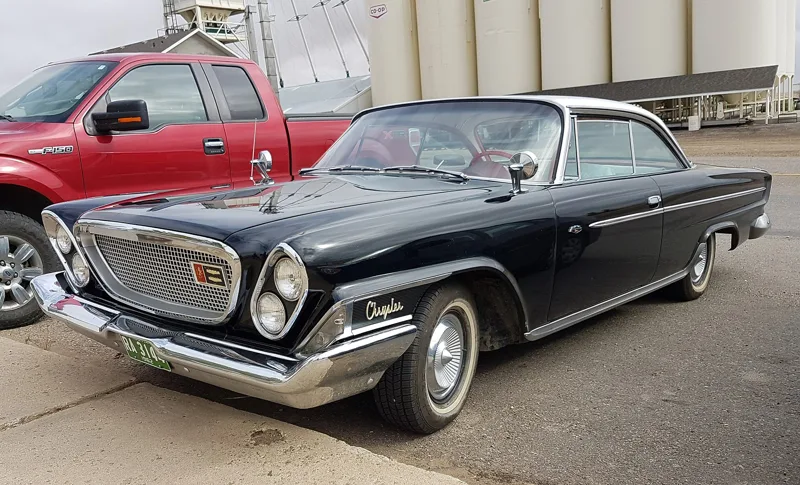
The 300 continued as a high-performance coupe through 1965, adding a new letter each year. A non-letter 300 appeared in 1962 at a lower price, with downgraded standard equipment.
Who shaped Chrysler's styling in the 1950s and 1960s?
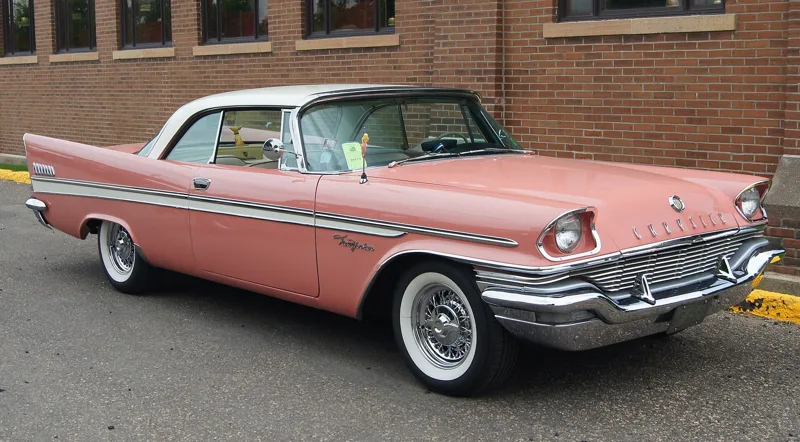
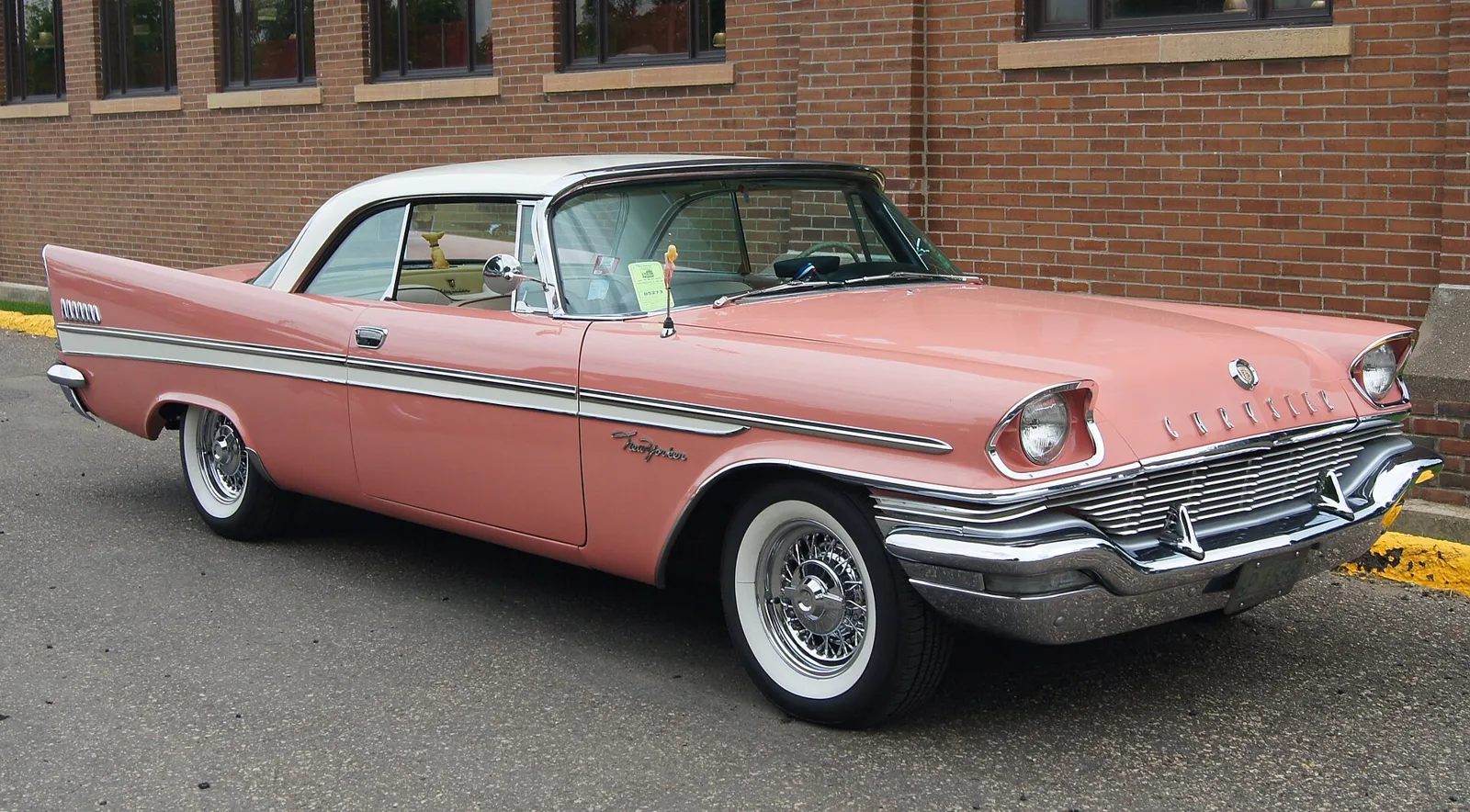
Virgil Exner's 1955 restyle lifted Chrysler sales sharply, and his 1957 cars with sloping front ends and high tailfins pushed the trend further. Quality control slipped as those designs reached the market quickly, and sales fell in 1958 and 1959. Elwood Engel, who had moved from Ford, took charge of styling once Exner left by 1962.
The 1957 cars also introduced Torsion-Aire front suspension, a torsion bar system for the front wheels only. Chrysler adopted it two years after Packard had fitted Torsion-Level suspension to both ends of its cars.
Engel's influence was visible by 1963, when the Chrysler range looked trimmer and boxier. The Newport replaced the DeSoto lines, while the Windsor and Saratoga series also gave way, and the New Yorker stayed as the luxury model.
By 1965 the Chrysler line had a thoroughly modern unit body, slab-sided panels and engines up to 413 cubic inches. Optional glass-covered headlamps retracted when the lights were switched on, a detail that gave the cars a distinctive face.
What was the Chrysler Turbine Car?
The Chrysler Turbine Car was an experimental two-door hardtop coupe with a turbine engine, built from 1963 to 1964. Italian design studio Carrozzeria Ghia built the bodywork, and Chrysler completed final assembly in Detroit. A total of 55 Turbine Cars were manufactured, and the project never produced a model for sale.
The Turbine Car is better understood as an engineering experiment than as a sales product. In 1963 the brand also sponsored The Chrysler Theatre, an anthology series with Bob Hope as its spokesperson, in the same period as the car itself.
The project absorbed a significant amount of investment, and that spending later figured in the company's decisions in the mid-1970s. The next section shows how that financial pressure led to the Cordoba.
How well did the Cordoba sell?
The Cordoba arrived for the 1975 model year as an upscale personal luxury car that replaced the 300. Over 150,000 were sold that year, a strong figure in an otherwise weak year for the company. Sales reached 165,000 in 1976 and just under 140,000 in 1977, which compared well with the somewhat cheaper Dodge Charger SE.
The Cordoba was first planned as a Plymouth, and the names Mirada, Premier and Sebring were linked to the project. Mirada, Premier and Sebring later appeared on other Chrysler, Dodge and Eagle vehicles, while only the Dodge Mirada ended up related to the Cordoba itself.
Losses on the full-size C-body models after the 1973 oil crisis, together with the Turbine investment, led executives to seek higher profits by selling the car under the upscale Chrysler badge rather than as a Plymouth.
Interiors were richer than those of the Dodge Charger SE. A velour cloth bench seat and a folding armrest were standard, while Corinthian leather bucket seats and a centre console with floor shifter were available at extra cost.
What did the K-car LeBaron change in 1982?
In 1982 the LeBaron moved to Chrysler's front-wheel-drive K platform, where it became the brand's lowest-priced offering. An open-top version arrived in early 1982, the first factory-built open-topped domestic vehicle since the 1976 Cadillac Eldorado, and a Town and Country wagon joined the range.
A station wagon called the Town and Country joined the sedan and coupe. A Town and Country convertible followed from 1983 to 1986, with simulated wood paneling that recalled the original Town and Country. Only 1,105 were built, and the car was part of the Mark Cross option package in its later years.
The R-body line was discontinued in 1982, and the New Yorker name moved to the smaller M-body line. The Fifth Avenue package was still offered at $1,244, with a vinyl roof with a distinctive look, electroluminescent opera lamps and a rear end borrowed from the Dodge Diplomat.
How did the Fifth Avenue become a model of its own?
From 1984 the New Yorker Fifth Avenue was sold simply as the Fifth Avenue. Those cars used a 318 cu in (5.2 L) V8 with 140 hp (104 kW) in most states and 170 hp (127 kW) in California, mated to the well-known Torqueflite three-speed automatic.
Production moved from Windsor, Ontario to St. Louis, Missouri, and later to the former American Motors plant in Kenosha, Wisconsin, which Chrysler bought in 1987. Output peaked at 118,000 cars for 1986, and the Fifth Avenue stood out as Chrysler's lone traditional rear-wheel-drive sedan.
The Fifth Avenue also sold far better than its Dodge Diplomat and Plymouth Gran Fury siblings, and a larger share of its buyers were private customers despite its higher price.
Which 1990s Chrysler models mattered most?
The 1990s brought back the Imperial as a Chrysler model rather than a separate marque, along with the LH-platform Concorde, New Yorker and LHS sedans. The Concorde debuted as a 1993 model with a base price of US$18,341, while the LHS offered a 3.5L V6 with 214 hp (160 kW) and standard leather seats.
The 1990 Imperial started with a 3.3L V6 producing 147 hp (110 kW) and 185 lb-ft (251 N-m) of torque. For 1991 the larger 3.8L V6 arrived, with 150 hp (112 kW) and 215 lb-ft at 2750 rpm, and an automatic transmission was standard with both engines.
The Imperial sat above the New Yorker Fifth Avenue, with a more wedge-shaped nose and rounder rear edges. Its rivals included the Cadillac Sedan de Ville and Fleetwood and the full-size Oldsmobile and Buick models of the day.
The LH cars shared a 2,870 mm (113.0 in) wheelbase. The LHS became the division's top model from the 1994 model year, with bucket leather seats where the New Yorker had a bench, and a floor console that the New Yorker lacked.
The New Yorker was dropped after the 1996 model year, and the LHS took over its role with an alternative seating layout. In 1995 the Sebring coupe replaced the LeBaron coupe, and the JA-platform Cirrus took over from the LeBaron sedan.
In 1999 the 300M sedan arrived alongside a redesigned LHS. The 300M had originally been planned as the next Eagle Vision, but the Eagle brand was discontinued in 1998, so it became a Chrysler.
How did Chrysler become known for minivans?
Chrysler brought back the Town and Country nameplate in 1989 for a luxury version of the Dodge Grand Caravan and Plymouth Grand Voyager, starting with the 1990 model year. That name ran until the Pacifica returned as a new minivan for the 2017 model year. Today the Pacifica and Voyager are the only models in the range.
In 2000 the Voyager and Grand Voyager were repositioned as Chrysler models as the Plymouth brand was phased out. By 2004 every Chrysler minivan was sold under the Town and Country name.
The Pacifica name returned in 2017 on a new minivan, replacing the Town and Country, Voyager and Grand Voyager. The Voyager survives as the sister vehicle of the Pacifica, and the two make up the whole current range.
What did the 2000s add to the Chrysler range?
The 2000s brought the retro PT Cruiser in 2001, the Pacifica crossover in 2004 and the Aspen SUV in 2007. The LX-platform Chrysler 300 arrived in 2005 as the brand's first rear-wheel-drive sedan since 1989, and it also brought back a V8 option for a Chrysler sedan.
The 300 replaced both the 300M and the Concorde. Chrysler also offered a two-seat Crossfire coupe and convertible from 2004 to 2008, alongside the Sebring coupe, which ran through 2005.
The Prowler roadster, previously a Plymouth model, joined the range in 2001, and a Sebring sedan replaced the discontinued Cirrus the same year. The Pacifica crossover was discontinued in 2008, while the Aspen SUV ended in 2009.
What did the Fiat Chrysler era bring?
Chrysler Corporation began working with Fiat, and the two companies merged in 2014 to form Fiat Chrysler Automobiles. FCA set a long-term goal of reviving Chrysler as a full luxury brand to compete with Cadillac, but those plans did not come to fruition during the decade.
In 2011 the winged emblem lost its blue ribbon centre, which had dated from the 1930s, in favour of a blue-backed Chrysler nameplate. The same year the 300 was restyled and the Sebring was rebranded as the Chrysler 200.
In May 2014 FCA said Chrysler would become a mainstream brand with premium features. A redesigned 200 arrived for 2015 but was dropped in 2017 as the company shifted its focus toward SUVs and minivans.
Quality remained a weak point. Consumer Reports and J.D. Power rated the brand's quality and customer satisfaction below average, although Strategic Vision named Chrysler an overall winner in 2015 for strong customer appeal.
What is Chrysler's lineup and plan now?
The model year 2026 lineup consists of the Pacifica minivan and its sister Voyager. Stellantis has promised a relaunch, and an electric crossover SUV was expected by 2025, previewed by the Airflow concept. The brand plans to be fully electric by 2028.
In early 2023 the lineup was thin, with the Pacifica and the 300 sedan the only models offered. Stellantis chief executive Carlos Tavares said in March 2023 that the brand would be relaunched with new models, and the 300 was discontinued in December 2023. The 300 had last been redesigned in 2010.
Looking further ahead, the North American lineup for 2030 is expected to include the Pacifica, a model called Airflow, and the Arrow and Arrow Cross.
Who led Chrysler over the years?
Walter Chrysler led the company from 1925 to 1935, and Lee Iacocca held the top job from 1978 to 1991. Sergio Marchionne ran the brand from 2009 to 2018, while Matt McAlear has led it since 2026. The table below lists every leader in order, with the years each one held the post.
| Leader | Years |
|---|---|
| Walter Chrysler | 1925 to 1935 |
| K.T. Keller | 1935 to 1950 |
| Lester Lum 'Tex' Colbert | 1950 to 1961 |
| Lynn Townsend | 1961 to 1975 |
| John J. Ricardo | 1975 to 1978 |
| Lee Iacocca | 1978 to 1991 |
| Robert Eaton | 1992 to 1996 |
| Thomas Stalkamp | 1997 to 1999 |
| Dieter Zetsche | 2000 to 2005 |
| Tom LaSorda | 2006 to 2009 |
| Sergio Marchionne | 2009 to 2018 |
| Mike Manley | 2018 to 2021 |
| Chris Feuell | 2021 to 2026 |
| Matt McAlear | 2026 to present |
Turnover was frequent after 2000, with most leaders serving only a few years each. The direction of the brand shifted with each change, and the luxury revival promised in the Fiat Chrysler years never reached the showroom.