A turbine-powered hardtop built by Chrysler and Ghia in 1963 and 1964, lent to 203 drivers, then mostly destroyed, and the programme that never reached production.
Built by Chrysler from 1963 to 1964 with bodies from Ghia, the Turbine Car was a gas-turbine hardtop. Fifty of its 55 cars were loaned to drivers for a long-term trial, and most of the fleet was later destroyed, so only nine survive today.
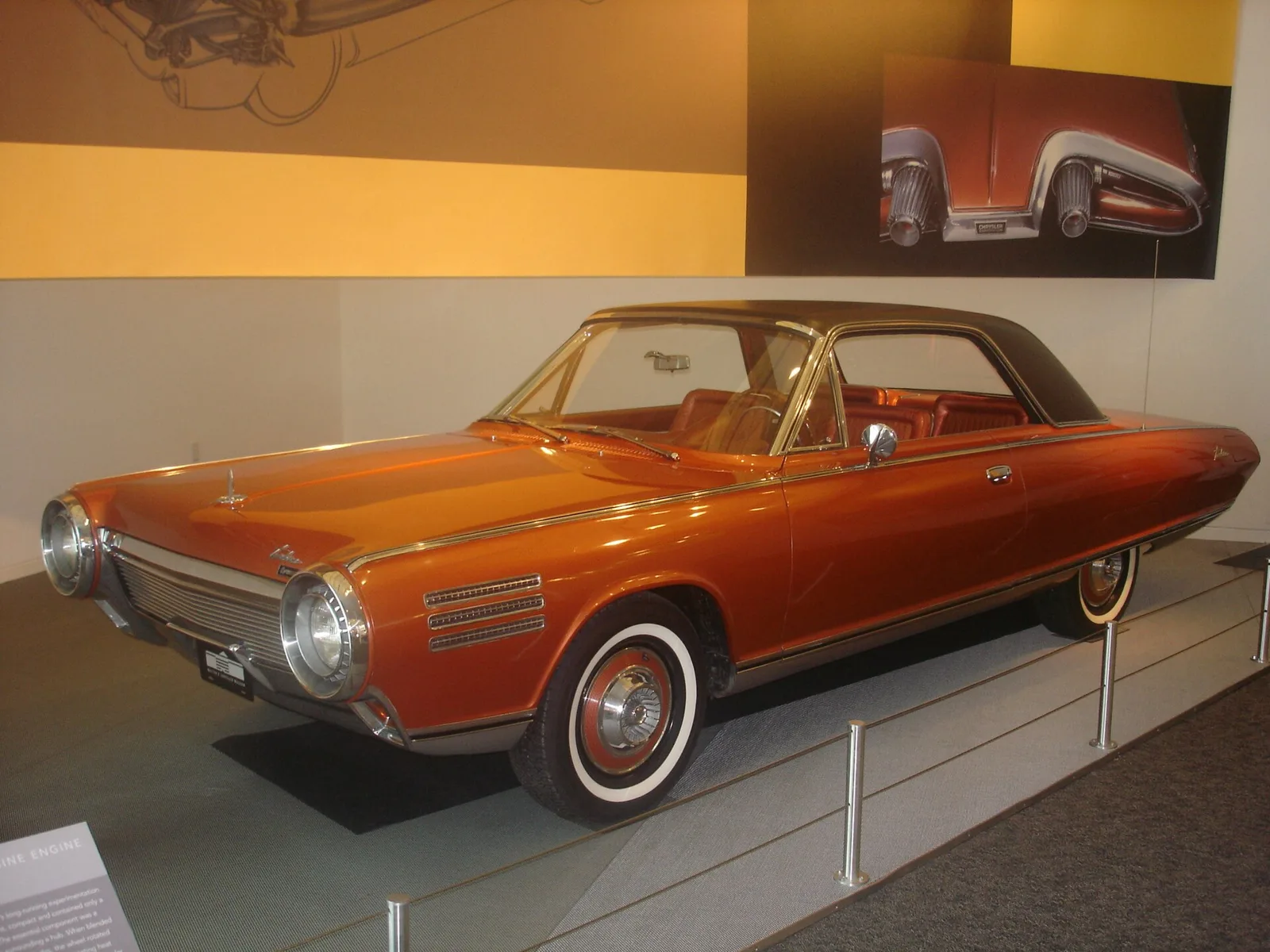
The Chrysler Turbine Car was an experimental two-door hardtop coupe that Chrysler built from 1963 to 1964. Italian studio Ghia shaped its bodies by hand, and Chrysler completed the final assembly in Detroit. Only 55 cars were made, and 50 of them went to members of the public for a long-term trial.
How did Chrysler's turbine programme begin?
Chrysler started researching turbine engines for aircraft in the late 1930s, and executive engineer George Huebner led much of the work. After the Second World War the team turned its attention to cars, and by 1954 it had fitted a turbine to a stock Plymouth Belvedere.
The appeal was practical. A turbine has fewer moving parts than a piston engine and can run on a wide range of fuels, and the team set out to turn those advantages into a usable car.
The team unveiled the Belvedere at its Chelsea Proving Grounds in Michigan on 16 June 1954, in front of more than 500 reporters. Chrysler said its turbine had 20% fewer parts than a comparable piston engine and weighed 200 pounds (91 kg) less.
Each new generation went further. In 1956 a Plymouth covered 3,020 miles (4,860 km) from New York to Los Angeles in four days, shadowed by a 14-person convoy of mechanics. The car needed only two minor repairs on the trip, and neither involved the engine.
By 1959 a Plymouth had averaged 19.4 mpg-US (12.1 L/100 km) on a trip from Detroit to Woodbridge, New Jersey. That was a clear improvement on the 13 mpg-US (18 L/100 km) of the first-generation car on its coast-to-coast run.
Chrysler then took its turbine fleet on a tour of dealers across North America, Europe and Mexico. By February 1962 the tour had visited 90 cities and given rides to almost 14,000 people, which convinced the company to plan a public trial.
Chrysler announced a limited run of 50 to 75 cars that would be loaned to the public at no cost. Lynn Townsend had become Chrysler's president in 1961, and the programme went ahead in late 1963.
A turbine-powered coupe that was lent to the public for a trial, then mostly destroyed, and that became one of the most unusual programmes in American motoring.
What engine powered the Turbine Car?
The Turbine Car used the A-831, Chrysler's fourth-generation turbine engine. It produced 130 bhp (97 kW) at 36,000 rpm, weighed 410 lb (186 kg) and needed no antifreeze, radiator, connecting rods or crankshaft.
Twin regenerators, one on each side of the gasifier, replaced the single heat exchanger of the earlier CR2A. The change trimmed 40 pounds (18 kg) from the engine. The turbine could run on diesel, unleaded gasoline, kerosene and JP-4 jet fuel, although leaded gasoline left damaging deposits.
The engine's fuel flexibility became a talking point. Mexico's president, Adolfo Lopez Mateos, once ran one of the cars on tequila, a test Chrysler's engineers had confirmed was workable. The engine started properly in very cold weather, down to -20 F (-29 C). Compared with piston engines, turbines generally needed less maintenance and lasted longer, and the team regarded those qualities as the real reward of the design.
| Specification | Detail |
|---|---|
| Engine | A-831 gas turbine, fourth generation |
| Power | 130 bhp (97 kW) at 36,000 rpm |
| Stall torque | 425 lb-ft (576 N m) |
| Engine weight | 410 lb (186 kg) |
| Compressor | Pressure ratio of 4:1 at 80% efficiency |
| Top turbine speed | 60,000 rpm at 120 mph (193 km/h) |
| 0-60 mph (97 km/h) | About 12 seconds in the first car |
| Cars built | 55, including five prototypes |
The turbine's exotic materials and strict tolerances made it very expensive to build. Chrysler never disclosed the actual cost of an engine, and the engines were much more expensive to produce than piston engines.
How was the car designed and built?
Ghia was no stranger to Chrysler work. The Italian studio had already built several concept cars for the company, including the Imperial limousines and the Norseman, so the turbine bodies were a familiar kind of task.
Chrysler's own studios styled the car under Elwood Engel, who had earlier worked at Ford. Ghia built the bodies in Italy, and the nearly finished cars were shipped to Detroit for the final stages, which included the turbine, the transmission, the wiring and the interior fittings.
Because of its resemblance to the Ford Thunderbird, the car is sometimes called the Englebird. Huebner said the design was also intended to compete with the Chevrolet Corvette. The paint was called turbine bronze, and the interior used bronze leather, deep-pile carpet and brushed aluminium.
Cost was a serious issue. Building one car may have cost $55,000, equivalent to $571,000 in 2025, and the bodies alone may have cost about $20,000, or $208,000 in 2025.
The first five cars were completed in early 1962 as prototypes. Each one was slightly different in colour, upholstery and roof material. Early problems included sluggish acceleration, which was partly blamed on the heavy hand-built bodies, and a vibration traced to the tyre treads, which stood out because the turbine itself ran so smoothly.
The 50 production cars, built between October 1963 and October 1964, were identical. They had independent front suspension with coil springs, leaf springs at the rear and power-assisted drum brakes at all four wheels. The dashboard carried a speedometer, a tachometer that reads to 46,000 rpm and a pyrometer that reads to 1,700 F (930 C), which measures the hottest part of the engine.
What was the user programme?
From October 1963 to January 1966 Chrysler lent 50 cars to members of the public for three months each, with the drivers paying only for fuel. Some 203 drivers in 133 cities covered more than 1 million miles (1.6 million km) in the cars.
The programme exposed a clear list of problems. Starting was difficult at high altitude, and the eight-step starting procedure damaged some engines when drivers got it wrong. Acceleration was unimpressive, fuel economy was below par and noise was a frequent complaint.
Drivers also found real strengths. They praised the smooth, vibration-free running, the low maintenance needs and the easy starting in different conditions. Downtime fell from 4% at the beginning of the trial to 1% by the end, which showed how durable the engines were.
The turbine's jet-like sound split opinion. About 60% of the people involved liked it, while about 20% of their fellow users did not. Two cars gave visitors rides during the 1964 New York World's Fair, and a third toured the world. The cars carried warning labels against leaded gasoline, and many drivers used diesel or home heating oil instead.
Participants were given the cars for three months at no charge, apart from fuel, and gave Chrysler in-depth interviews within two weeks of returning them. The users were 180 men and 23 women, aged between 21 and 70. Some 60% of them already owned a Chrysler.
Why were most of the cars destroyed?
Chrysler destroyed 46 cars after the programme and its public displays. Forty-five of them ended up burned and crushed at a scrapyard south of Detroit, and the last one was destroyed at the Chelsea site.
Many people have claimed the cars were scrapped to dodge a duty on the Ghia bodies, which were shipped from Italy. Author Steve Lehto has described that idea as largely discredited, and he argues that public relations concerns played a bigger role.
Those concerns included the difficulty of keeping the cars running and the fear that owners would swap the turbines for piston engines. A Chrysler executive said at the time that research was the main objective and the company did not want turbines turning up on used-car lots.
The decision followed the industry's practice of not selling prototypes or non-production cars to the public. General Motors later took a similar step with its EV1 electric car, which it withdrew from service and mostly destroyed in 2003.
How did the turbine programme come to an end?
Chrysler's turbine programme ended in 1979. The engines never met government emissions rules, their fuel economy lagged behind piston engines and the seventh-generation engine was dropped as a condition of a government loan guarantee that year.
The turbine effort was not confined to Chrysler. In 1971 the Williams Research Corporation kept working on a turbine design, supported by a grant from the federal air pollution control agency.
After the user trial, Chrysler kept developing turbines through the late 1960s and into the 1970s, producing fifth- and sixth-generation engines. An Environmental Protection Agency contract worth $6.4 million supported the work, but the turbines still failed to satisfy the emissions tests.
An October 1967 Department of Commerce report concluded that the turbine was unsuited to automobiles. Even so, compact versions of the engine were still being fitted to Dodge Aspen models in the mid-1970s before the programme closed.
Which Turbine Cars survive today?
Nine Turbine Cars survive. Chrysler initially kept three, and two of those remain in the company's hands. Six are on display in museums, and one is owned by a private collector, comedian and television host Jay Leno, who bought it in 2009.
The museum cars can be seen at the Detroit Historical Museum, the Henry Ford Museum in Dearborn, the National Museum of Transportation, the Petersen in Los Angeles and the Smithsonian in Washington, D.C. Most had their fan assemblies removed so the engines could not run, although the car at the National Museum of Transportation was later restored to running order.
Chrysler has displayed one of its own cars at the Walter P. Chrysler Museum in Auburn Hills, Michigan, which has since closed. The Detroit Historical Museum lent its car to the Gilmore Car Museum in 2005.
The sixth car on display belongs to the Stahls Automotive Collection in Chesterfield, Michigan, which bought it at auction in March 2021. It had earlier been owned by the Harrah Collection in Reno and by Domino's Pizza founder Tom Monaghan.
One Turbine Car also appeared in the 1964 film The Lively Set. It was painted white with blue racing stripes, the only car in the series that was not painted turbine bronze.