A front-drive K-car that stood for Chrysler's downsizing, revived the American open car and left a Town & Country convertible that collectors now seek.
The Chrysler LeBaron of 1982 to 1988 was the second LeBaron generation, a front-drive K-car with 2.2 to 2.6-litre four-cylinder engines. Its LeBaron Convertible revived the American open car, and Chrysler also offered a Town and Country estate and a GTS hatchback.
The Chrysler LeBaron of the 1982 to 1988 model years was a mid-size car built on Chrysler's front-wheel-drive K platform. Its open version, the LeBaron Convertible, was the first series-built American convertible since 1976, and it started a fresh trend among US mid-size models. The car is regarded as a central symbol of Chrysler's downsizing.
Why did Chrysler downsize the LeBaron?
Rising raw material prices after the oil crises, together with statutory fuel consumption limits, pushed every US maker towards smaller and lighter cars from the late 1970s. Chrysler, financially weakened, pursued that change more consistently than its rivals and tied it to a broad platform strategy built on the K platform, introduced in 1980.
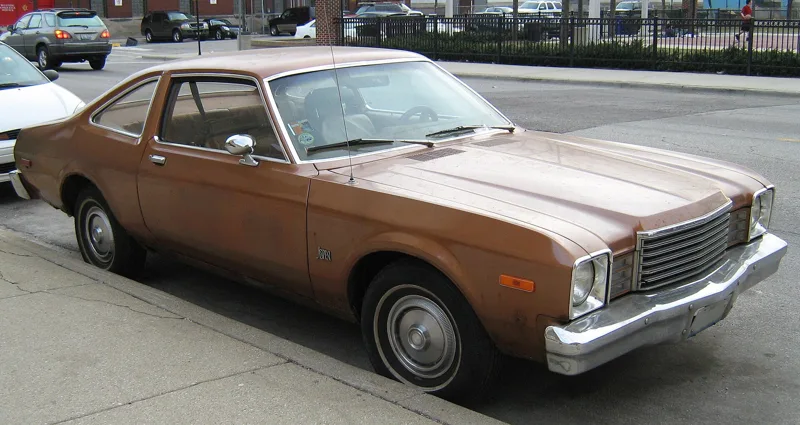
The K platform was designed for cars under 5 metres (16.4 ft) overall, and Chrysler leaned on it for nearly all of its vehicles for a decade. The first K cars, the mid-size Dodge Aries and Plymouth Reliant, took the place of larger rear-drive models such as the Dodge Aspen and Plymouth Volare. In 1982 Chrysler's core brand followed with its own version of the Aries and Reliant, and the LeBaron name moved down to a much smaller class of car.
The LeBaron's front and rear overhangs were slightly longer than those of the Aries and Reliant, which earned it the unofficial name Super-K. Compared with the rear-drive first generation, its wheelbase was 320 mm (12.6 in) shorter, its overall length 660 mm (26 in) less and its weight 400 kg (882 lb) lower.
A K-car that stood for downsizing and then revived the American convertible.
Model history and variants
The LeBaron range began for the 1977 model year as the shortest Chrysler up to that point, and it aimed at the luxury mid-size segment against the Cadillac Seville and Lincoln Versailles. The rear-drive first generation stayed in the range until 1981. In 1983 two longer-wheelbase versions joined it: a simpler E Class, which lasted two years, and the better-equipped New Yorker, which was sold until 1988.
For model year 1987 Chrysler gave the coupe and convertible new bodies, while the four-door notchback saloon and the estate kept their former shape for two more years. The E Class was a simpler car that shared technology and partly interchangeable body parts with the LeBaron.
Body and interior
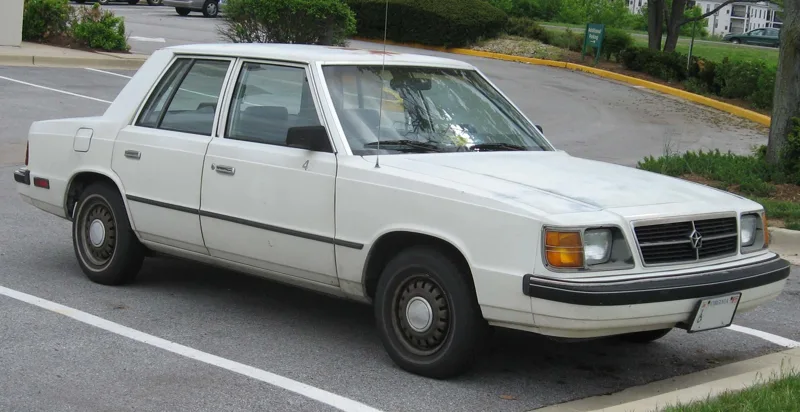
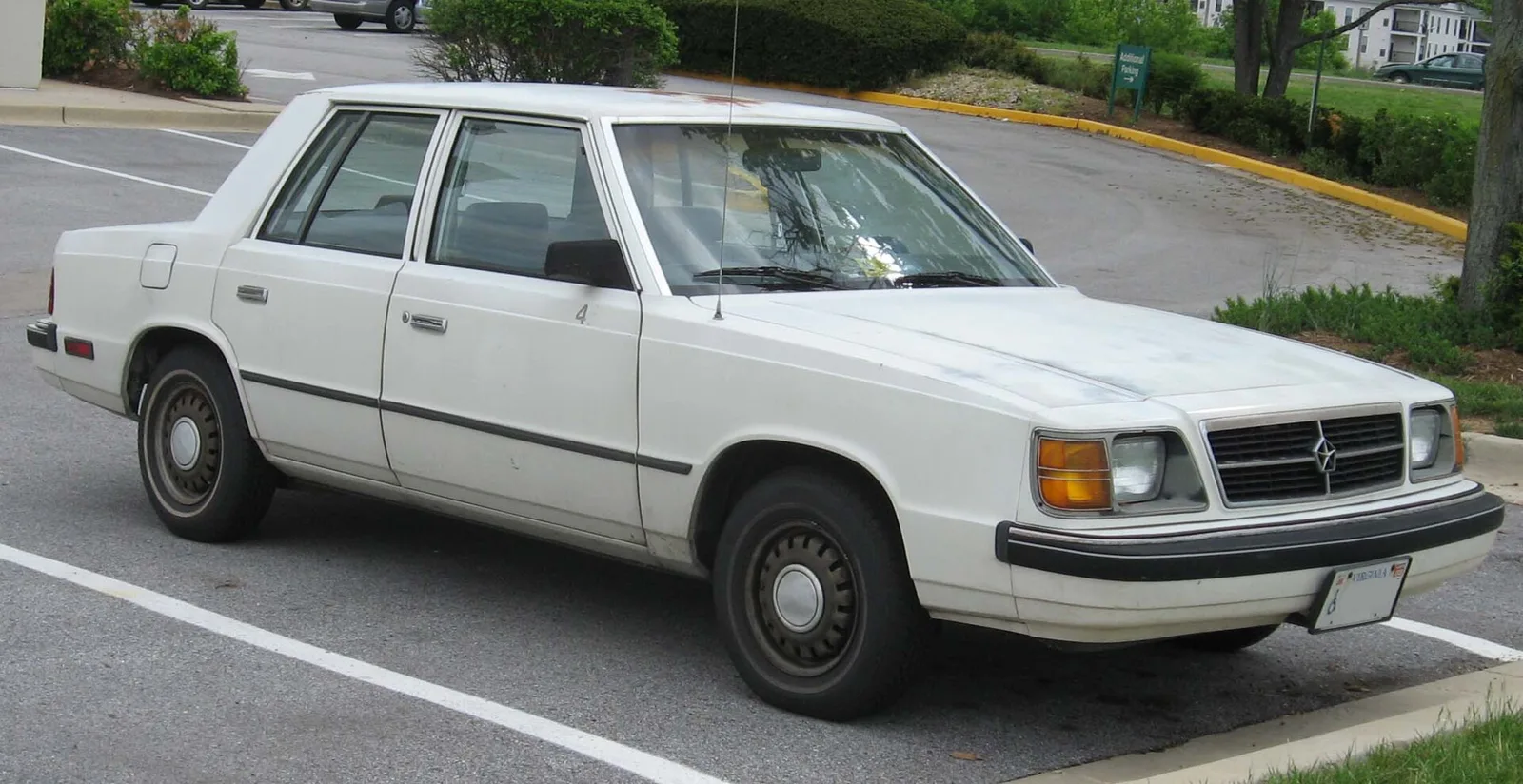
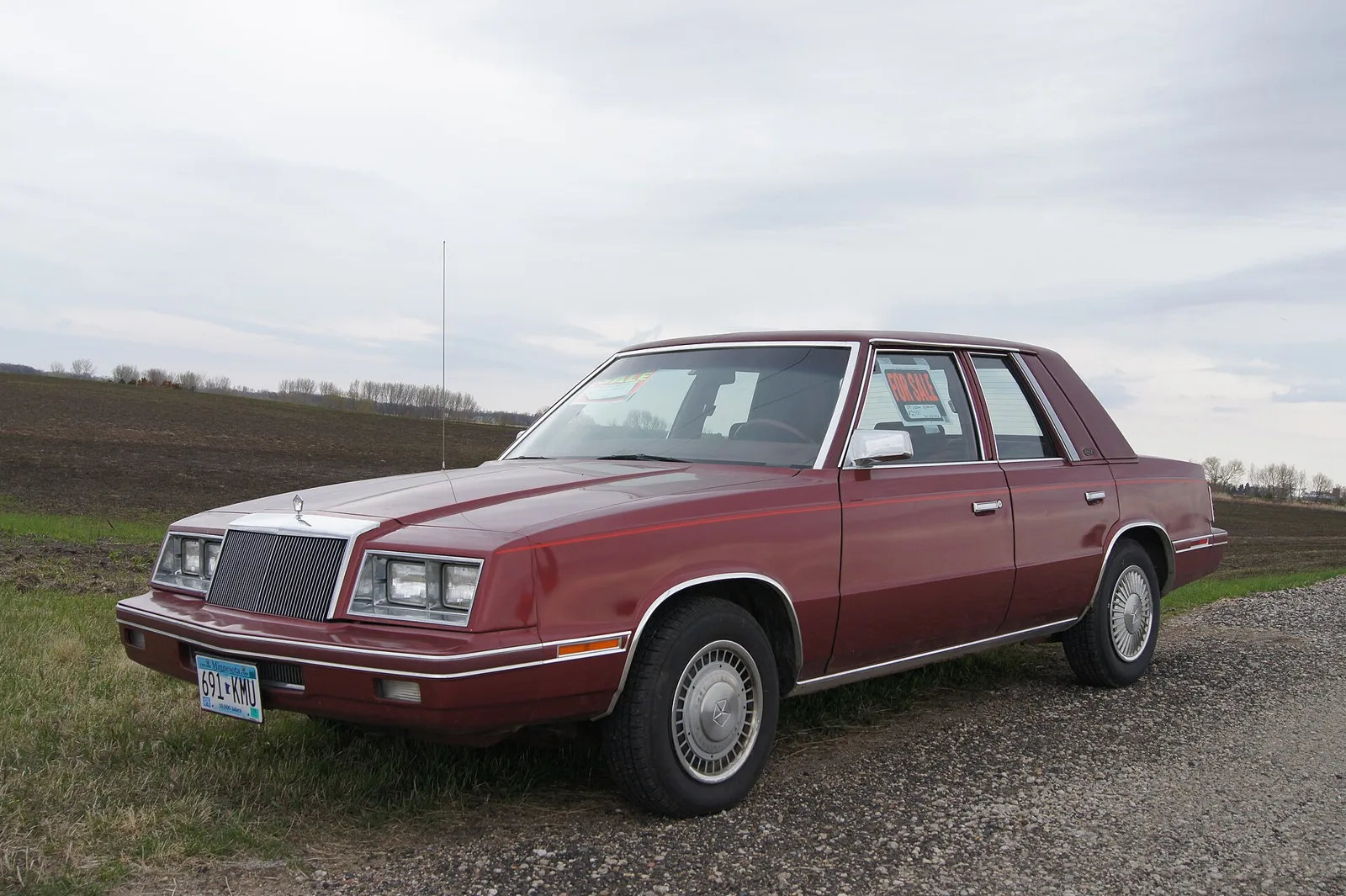
The LeBaron used a self-supporting steel body that matched the Aries and Reliant in dimensions and basic design, and several panels were interchangeable between them. The differences lay mainly at the front and rear. The nose was longer and angled, with rectangular double headlights instead of single lamps, and the roof was covered in vinyl as standard. The two-door coupe carried a stylised opera window.
For model year 1986 the range received a facelift, with rounded front and rear masks and tail lights that extended sideways into the wings. The LeBaron was nominally a six-seater with a front bench. Two individual front seats made it a five-seater, and the convertible was offered only with individual seats.
Chassis and brakes
Under the skin the LeBaron is a typical K car, identical in its running gear to the Aries and Reliant. Its front wheels are independently suspended, while a torsion crank axle is fitted at the rear. Disc brakes sit at the front and drum brakes at the rear.
Which engines powered the LeBaron?
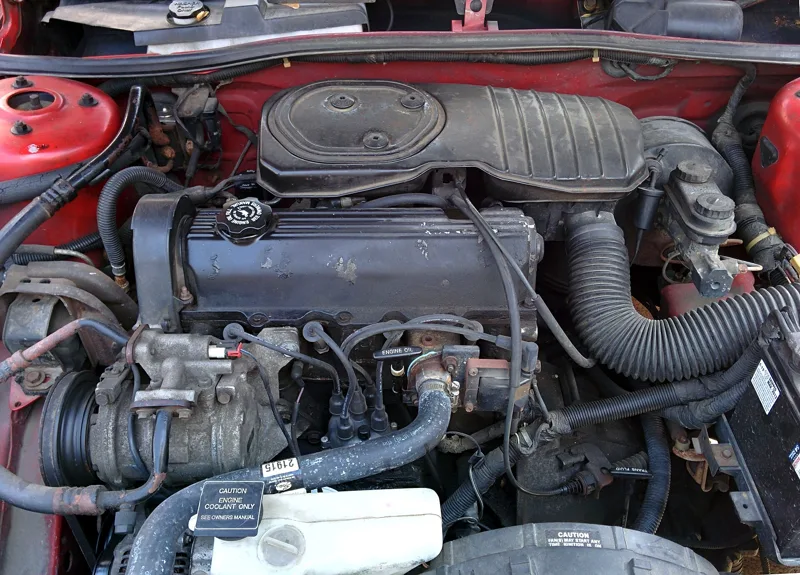
The base engine was a 2,213 cc (135 cu in) inline four with two valves per cylinder and a single overhead camshaft, used throughout production. Its light-alloy cylinder head first appeared in 1980 on the first K-car variants, and early engines had carburettors that were later replaced by petrol injection. Naturally aspirated versions ranged from 62 kW (85 PS; 84 hp) to 73 kW (100 PS; 99 hp). From 1984 the turbocharged Turbo I was the only turbo option among the first K cars.
Engine line-up at a glance
| Engine | Output | Years |
|---|---|---|
| 2,213 cc (135 cu in) four | 62 kW (85 PS; 84 hp) to 73 kW (100 PS; 99 hp) | Whole production run |
| Turbo I | 109 kW (148 PS; 146 hp) | From 1984 |
| 2,555 cc (156 cu in) Mitsubishi 4G54 | 68 kW (93 PS; 92 hp) to 75 kW (102 PS; 101 hp) | 1982 to 1985 |
| 2,501 cc (152 cu in) Chrysler four | 74 kW (101 PS; 100 hp), unboosted | From 1986 |
| Turbo II (LeBaron GTS) | 130 kW (177 PS; 175 hp) | 1988 and 1989 |
Alongside Chrysler's own 2.2-litre, a 2,555 cc Mitsubishi engine was available from 1982 to 1985, with two balance shafts and petrol injection as standard. Its output was roughly that of the Chrysler unit, but its maximum torque was about 30 Nm (22 lb ft) higher.
What did the LeBaron Convertible involve?
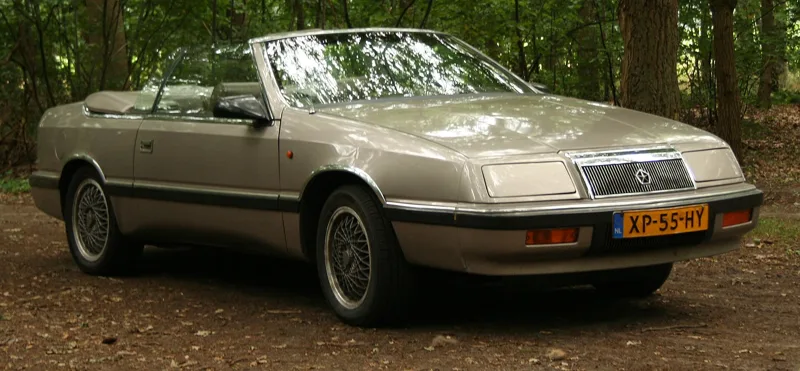
The LeBaron Convertible was a two-door, nominally four-seat car without a roll bar, based on the coupe. Its floor pan and windscreen frame were reinforced, which added only 30 kg (66 lb) over the coupe. A specialist firm in Brighton, Michigan built the first 11,000 series convertibles before Chrysler took series production in-house in spring 1983.
The car grew out of a one-off that Chrysler president Lee Iacocca had built mainly for publicity and his own use. The positive reaction led to a small series, and within two years General Motors and Ford had added open versions of their mid-size models.
The base price was US$12,600 in 1982 and fell to US$11,000 for model year 1983. A Town & Country convertible followed from 1983 at extra cost, with wood-effect trim and high-grade trims with genuine leather seat covers. A total of 1,105 were built up to 1986, and they are sought-after classics in the USA today.
What was the Town and Country estate?
The Town & Country was a five-door estate offered for the whole production run under Chrysler's traditional name. Its sides carried factory wood-effect vinyl, a reference to the woodie estates of the 1940s, and its suspension was reinforced to allow a higher payload.
The standard engine on the estate was the 2.6-litre four from 1984, switching to the 2.5-litre from 1986. Until the Chrysler 300 Touring of 2004 it was the last conventional estate sold under the Chrysler brand.
How did the LeBaron GTS differ?
From 1985 to 1989 the LeBaron GTS offered a five-door hatchback with its own design, built on the H platform, which evolved from K technology. Its wheelbase was longer than that of the notchback, and it was aimed at European imports. The strongest version, with a Turbo II producing 130 kW (177 PS; 175 hp), was offered only in 1988 and 1989.
The GTS used transverse inline four-cylinder engines of 2.2 and 2.5 litres, standard as naturally aspirated units and optionally turbocharged. Some European markets sold a variant as the Chrysler GTS in 1988 and 1989. Some accounts pit the GTS against the 3 Series BMW and the Mercedes-Benz 190.
How did the Dodge 400 compare?
The Dodge 400 was an almost identical sister model, sold through Dodge's own dealer network in 1982 and 1983 as a saloon, coupe and convertible, but not as an estate. Its grille had horizontal bars in body colour, a design element borrowed from the larger Dodge Mirada coupe. Its drivetrain matched the LeBaron's, and its open version was sold without the Chrysler's richer equipment.
For model year 1984 the 400 range was discontinued. The Dodge 600 that replaced it had a four-door version on the longer platform shared with the Chrysler E Class and Plymouth Caravelle, while its coupes and convertibles stayed on the shorter wheelbase of the former 400.
Dodge had no counterpart to the Town & Country estate, and its open version was markedly less well equipped than the Chrysler convertible.
How many LeBarons were built?
Almost 555,000 LeBarons were built over seven years, across all body styles. The four-door saloon accounted for 283,972 of them. Chrysler built more than 160,000 LeBarons in 1982 and 1983 together, whereas only a little over 57,000 Dodge 400s came out in the same two years.