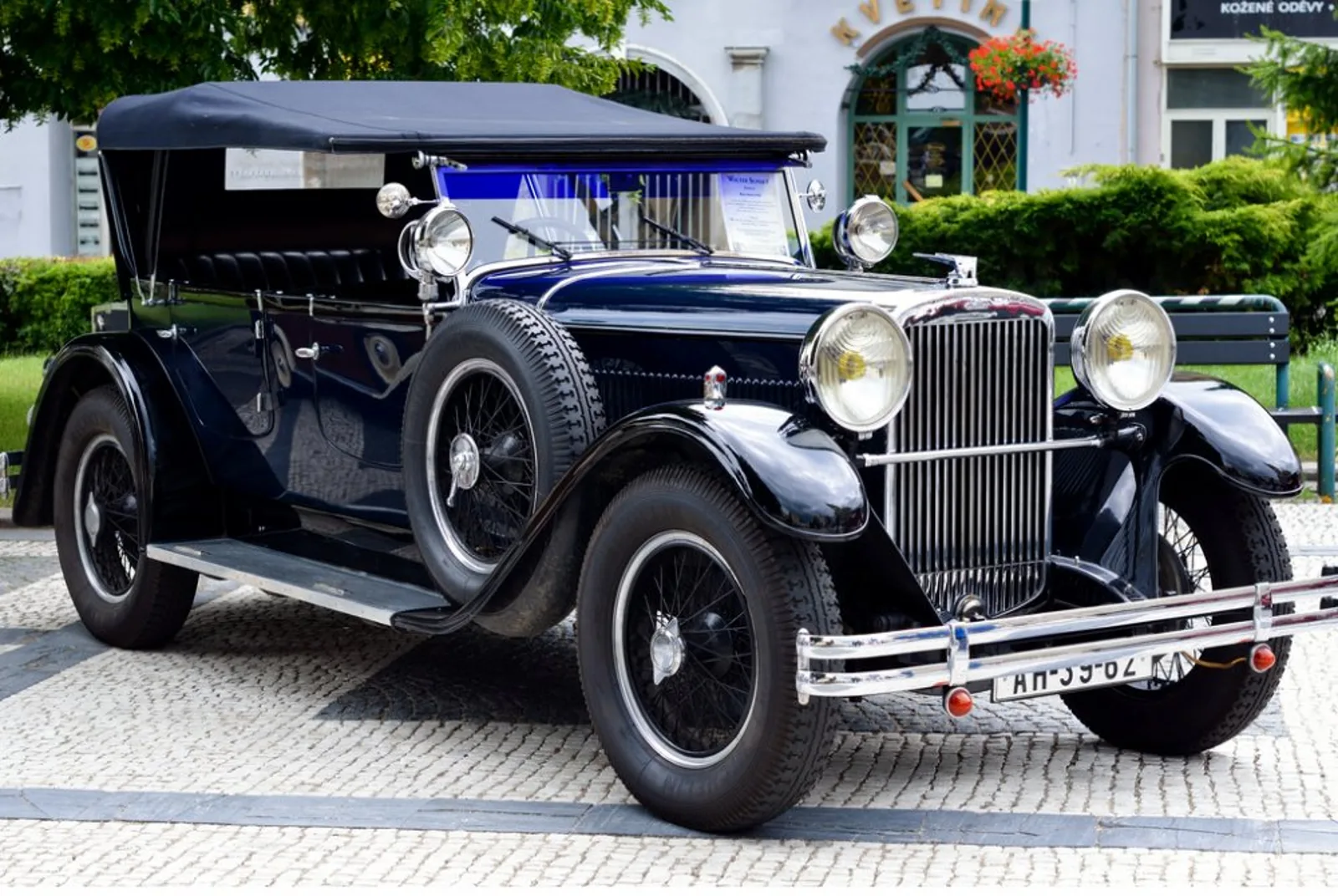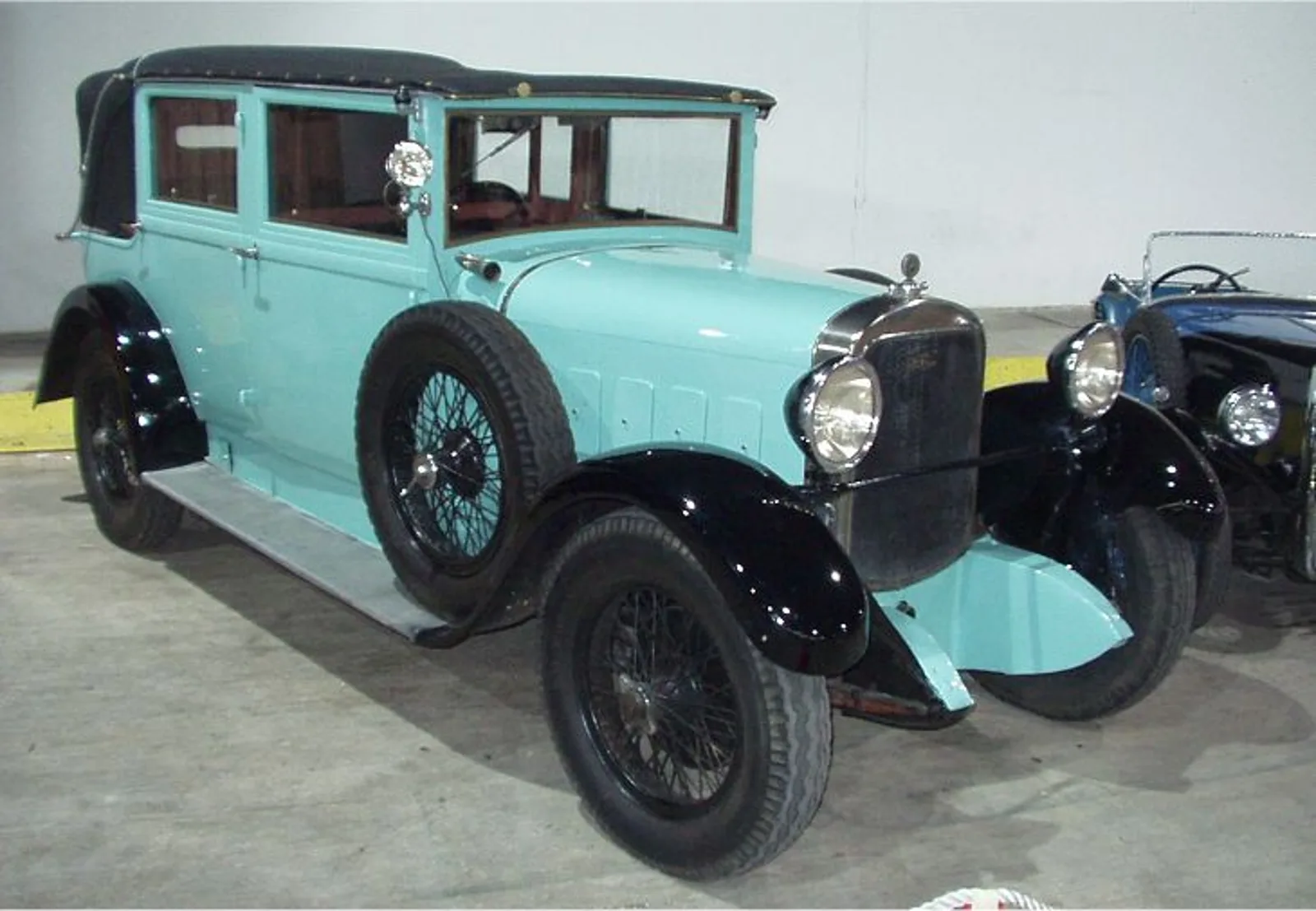
Overhead-valve Czech cars from Prague, a presidential customer, a Super Sport roadster and a 10,017 km test of endurance.
The Walter P was a Czech passenger car built at the Jinonice works in Prague from 1924 to 1928. The P I to P III had a 1,945 cc four-cylinder with overhead-valve gear, and the P IV enlarged it to 2,368 cc. The Super Sport roadster and a 1927 endurance run are among its notable episodes.
The Walter P was a Prague-built passenger car, produced at the Jinonice works from 1924 to 1928. Its engine was an overhead-valve four-cylinder, and its designer, Josef Plocek, had earlier patented the valve arrangement behind it. Its story includes a Super Sport roadster, a 1927 endurance run and a link to the presidential office.
Where did the Walter P come from?
The unified WZ series of Walter cars ran from 1919, and the P series continued it. Its founder, Josef Walter, was pushed out of management in early 1922, and the Kumpera family gradually took control of the joint-stock company. From 1923 the works also built aero engines, a side of the business that gradually outweighed the cars.
Ing. Jan Novak came from the Koprivnicka vozovka to become general director. He later left for Skoda, and from September 1927 the post went to Antonin Teny Kumpera, a newly qualified engineer. Plocek himself had moved to Skoda's Plzen works as chief designer, where he patented a two-axle steering system later used on Skoda armoured cars.
Overhead valves, a presidential customer and a 10,017 km endurance run from Prague.
What made the P I engine different?
The P I, P II and P III shared one engine: a liquid-cooled, in-line four-cylinder with two valves per cylinder and no supercharging. The camshaft acted on rockers mounted on roller bearings, through covered strut-type pushrods that had ball ends. The cover kept grit away from the lifters and pushrods.
The crankcase was high-strength aluminium alloy, the removable cylinder head and pistons were light aluminium alloy, and the crankshaft was forged from chrome-nickel alloy. It ran in three main bronze bearings lined with bearing metal, and a drilled crankshaft carried oil from the mains to the big ends. Lubrication was by pressure and circulation through a full-flow filter, and cooling was by thermosiphon with a belt-driven fan.
How did the Walter P's fuel and ignition work?
Ignition came from a magneto, and a dash button worked the electric starter. The 12-volt electrics powered twin-filament headlamps for main and dipped beams, along with a rear stop lamp, interior lighting and a horn.
Vacuum drew fuel from a rear tank mounted between the ends of the frame. The P I and P II used one carburettor type, and the P III and P IV used another. Both carburettors had a double diffuser.
How did the gearbox and drive work?
The gearbox had no synchromesh. It began as a three-speed unit and later became four-speed, with fourth in direct drive. Its shafts ran on ball bearings, which was not so common in the 1920s. A single-plate friction clutch sat in the flywheel, linked to the gearbox by a rubber coupling.
The gear lever and the handbrake lever were placed at the right-hand door rather than the centre, a quirk that the other Walter types did not share. Power reached the rear wheels through a balanced propeller shaft with enclosed universal joints, and a bevel pair with spiral teeth drove the axle. The steering was on the right.
What did the P's brakes and wheels look like?
The P I had a foot brake acting on the front wheels through a servo, and a mechanical handbrake on the rear drums. From the P II the foot brake worked on all four wheels, and the handbrake acted on the gearbox shaft. Buyers could also order a car without front brakes if they wanted one.
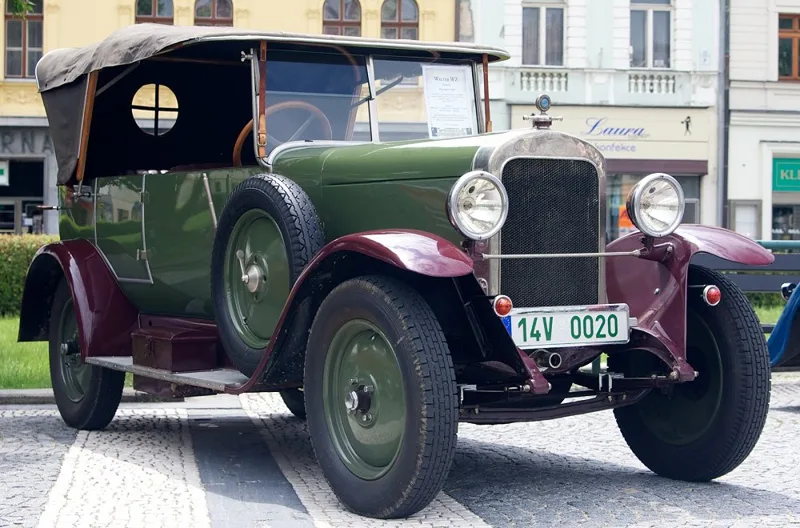
Wire-spoke wheels replaced disc wheels as standard, although disc wheels could be ordered as an option. Two spare wheels were carried on the sides of the car. The P IV's wide track of 1,400 mm (55.1 in) gave it good stability in corners, and an open car was lower in its centre of gravity than the saloon.
How were the bodies built and equipped?
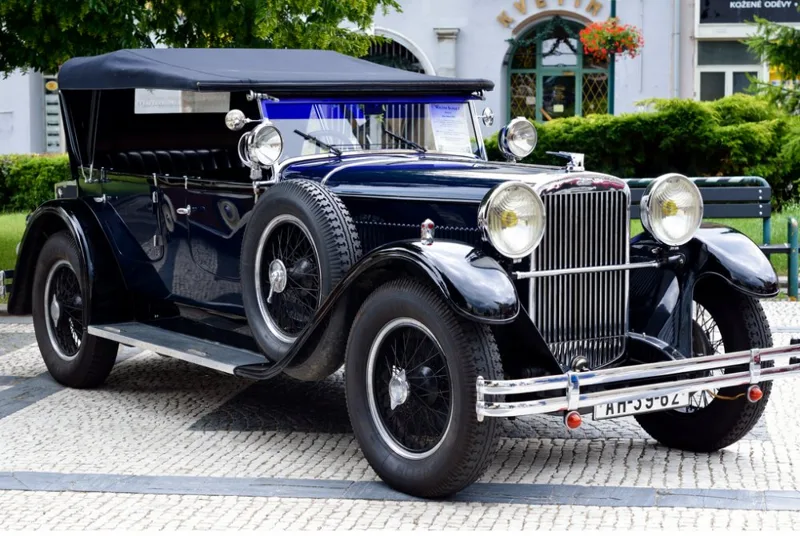
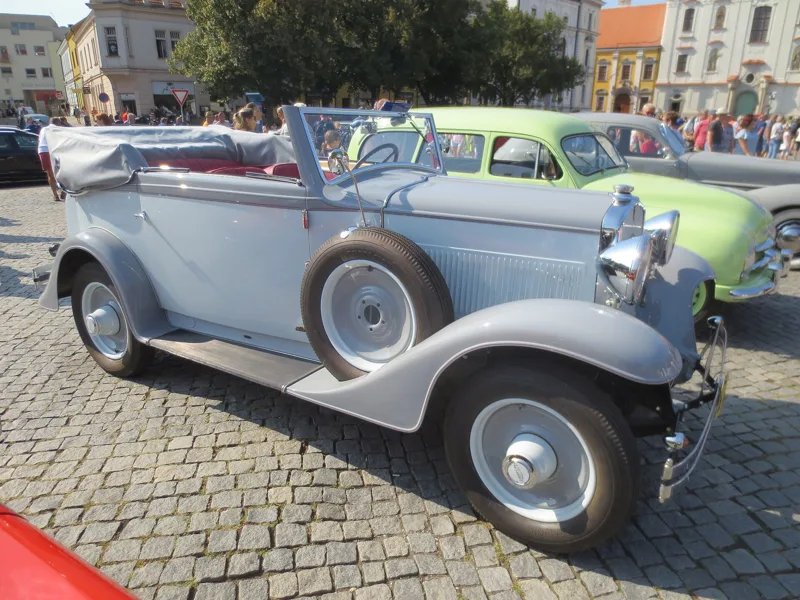
The P type came as a four-door saloon or limousine, a convertible, an open tourer, a luxury coach, or a van or flatbed. Every body was bolted to the same frame at six predetermined points, an economical system first used on the WZ. The closed car weighed 1,400 kg (3,086 lb) in its P I and P II form, and 1,600 kg (3,527 lb) in the larger P III and P IV.
Standard instruments included a speedometer with daily and total odometers, a fuel gauge, an electric horn and a clock. Luxury bodies went further, with a cigar lighter, a telephone to the driver, interior ceiling and side lighting, and side windows that wound down. Folding seats could be stowed in the front partition, and the sturdy running board proved its worth on cobbles.
The Walter lacked effective spring dampers, so it rocked remarkably softly, though with a large amplitude. The car also appeared in the Czech Television series The First Republic.
Which sporting events did the Walter P enter?
The works did not enter the P officially in competitions. The exceptions were the racing Walter 0, which ran in 1924 and 1925, and the tail-end WZ series from 1924. When a Walter appears in results from 1925 to 1928, it usually came from an amateur, private driver rather than the factory.
The rift was rooted in the Kumpera family's split with the Automobile Club of the Czechoslovak Republic (AKRCs), which had been opening up from 1925. The family founded the League of Czechoslovak Motorists on 28 April 1927, a rival club outside the AKRCs and its affiliated clubs. The League soon had more than 20 thousand members, more than the whole Cartel with its 30 clubs, and the works largely boycotted sporting events run by the Cartel.
How did private Walters fare in the hill climbs?
Private drivers scored well in several events. In the third year of the Brno-Sobesice hill climb, on 6 June 1926, Jaburek and Divisek took second and third in the touring car class up to 1,500 cc. Uhlir placed second in touring cars up to 2,000 cc on the Slansky kilometre on 29 August 1926.
At the Hrebenka hill climb from Kosire to the Sokol grounds on 28 September, J. Brandejs took third in touring cars up to 2,000 cc and Josef Vejtruba second in the class up to 2,500 cc. In 1927 V. Kynzl finished third in the up-to-2,000 cc class at Zbraslav-Jiloviste.
What was the 1927 endurance run?
In September 1927, timed to the Prague motor show, the works attempted a record endurance run with a Walter P III. The car had an open body in yellow, an extra fuel tank and auxiliary headlamps. Its routes radiated out from Prague, and each circuit began and ended at the exhibition grounds, where a service station took on fuel and oil.
The run started at noon on Saturday 3 September 1927, with several official guests present. Knapp, Nemota, Traube and Havlicek, all works drivers, shared the driving, and commissioners approved by the AKRCs sporting commission carried out checks on the way. Lidove noviny followed the attempt almost daily and reported that nearly every level crossing had to be opened by waking the barrier keeper.
The run ended on Sunday 11 September at 16:20. The works drivers covered 10,017 km at an average of 52.6 km/h, in just under 200 hours of driving. The distance was covered with almost no stops and not one defect across 8 days, 4 hours and 20 minutes. Total consumption was 1,485 l of petrol and 84.5 l of oil.
Jindrich Knapp covered more than half the distance, and for his record drive he received the gold medal of the AKRCs sporting commission. Auto magazine, published since 1913 as the magazine of the Automobile Club, described the run as proceeding without complications, apart from a few collisions with small animals.
Who else was linked to the P III and P IV?
In February 1927 the presidential office bought a closed P III with six side windows, for the private use of the head of state. Pestry tyden reported the purchase on 2 March 1927. It was meant for the head of state and for guests of the presidential office. When important visitors were invited to Prague Castle or to Masaryk's chateau at Lany, the office would normally send a car, among them a black Walter 8/30 HP.
In 1928 President T. G. Masaryk ordered a P IV limousine for his own use, and it was shown at the Prague motor show that September before delivery. From 1929 he also used a black Walter 6B limousine, a different model from the Jinonice works, rated at 12/60 HP.
How did the Super Sport come about?
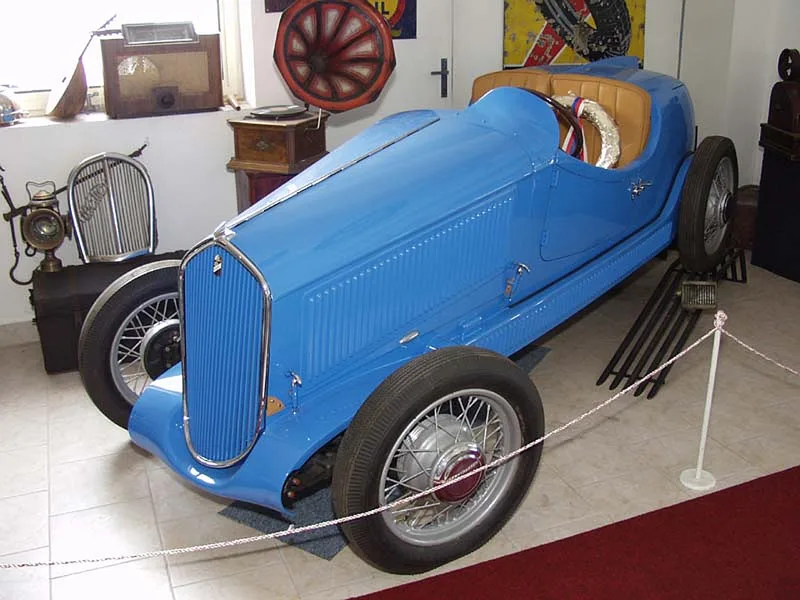
The Walter P III Super Sport, introduced in 1926, was a two-seat sports car with a slim, aerodynamic body and a gently sloping tail. It was the first sporting Walter offered commercially, and it took its chassis and engine from the P III. It offered private drivers an affordable, durable sports car for the long circuit races of the day. At an elegance contest on 3 August 1930 in Trencianske Teplice, held under the patronage of the Zilina AKRCs branch, a Walter P III Super Sport took first prize.
At the XVIII Prague motor show in 1926, Walter showed an open 8/30 HP touring car with polished Sapelli mahogany panels, and the sporty P III SS was presented there too.
The car was derived from the Walter 0 racing car. In 1924 that car ran with a modified version of the later P II engine at 1,945 cc, and in 1925 with a modified version of the later P IV engine at 2,368 cc. At the 1927 show it was labelled the sporting Walter Super Sport, with a Grand Sport roadster body and diagonal tyres.
In brisk driving the Super Sport needed 14 l per 100 km (20.2 mpg-imp). Its kerb weight was around 1,300 kg (2,866 lb), and the contemporary press gave it a top speed of 140 km/h (87 mph). A 70-litre tank sat in the frame behind the rear axle.
What became of the surviving Super Sport?
The custom Super Sport body was a one-off, built for the 1927 Prague show. In 2023 the car was restored and shown to the public at the Sosnova Classic motor show. It then took part in the 1000 Miles historic race, a commemorative run on the Route of Spa Towns and the Brno-Sobesice hill climb in September.
The car has no conventional front window, only a very low windscreen. Walter aimed to sell the Super Sport to domestic buyers at a lower price than European rivals, but the plan did not succeed. The single example built was used mostly by companions of the works owner Teny Kumpera for trips beyond everyday life.
Key specifications at a glance
| Specification | Detail |
|---|---|
| Displacement, P I to P III | 1,945 cc (118.7 cu in) |
| Displacement, P IV | 2,368 cc (144.5 cu in) |
| Swept volume reduction | 2.12 l (129.4 cu in) to 1.94 l (118.4 cu in) |
| Fuel use | 11-14 l per 100 km (20.2-25.7 mpg-imp) |
| Chassis weight, P I and P II | 900 kg (1,984 lb) |
| Chassis weight, P III and P IV | 1,080 kg (2,381 lb) |
| Closed car weight | 1,400 kg (3,086 lb) on P I-II; 1,600 kg (3,527 lb) on P III-IV |
| Track, P IV | 1,400 mm (55.1 in) |
| Super Sport top speed, period press | 140 km/h (87 mph) |
| Basic price, 8/30 HP | 87,000 Kc |