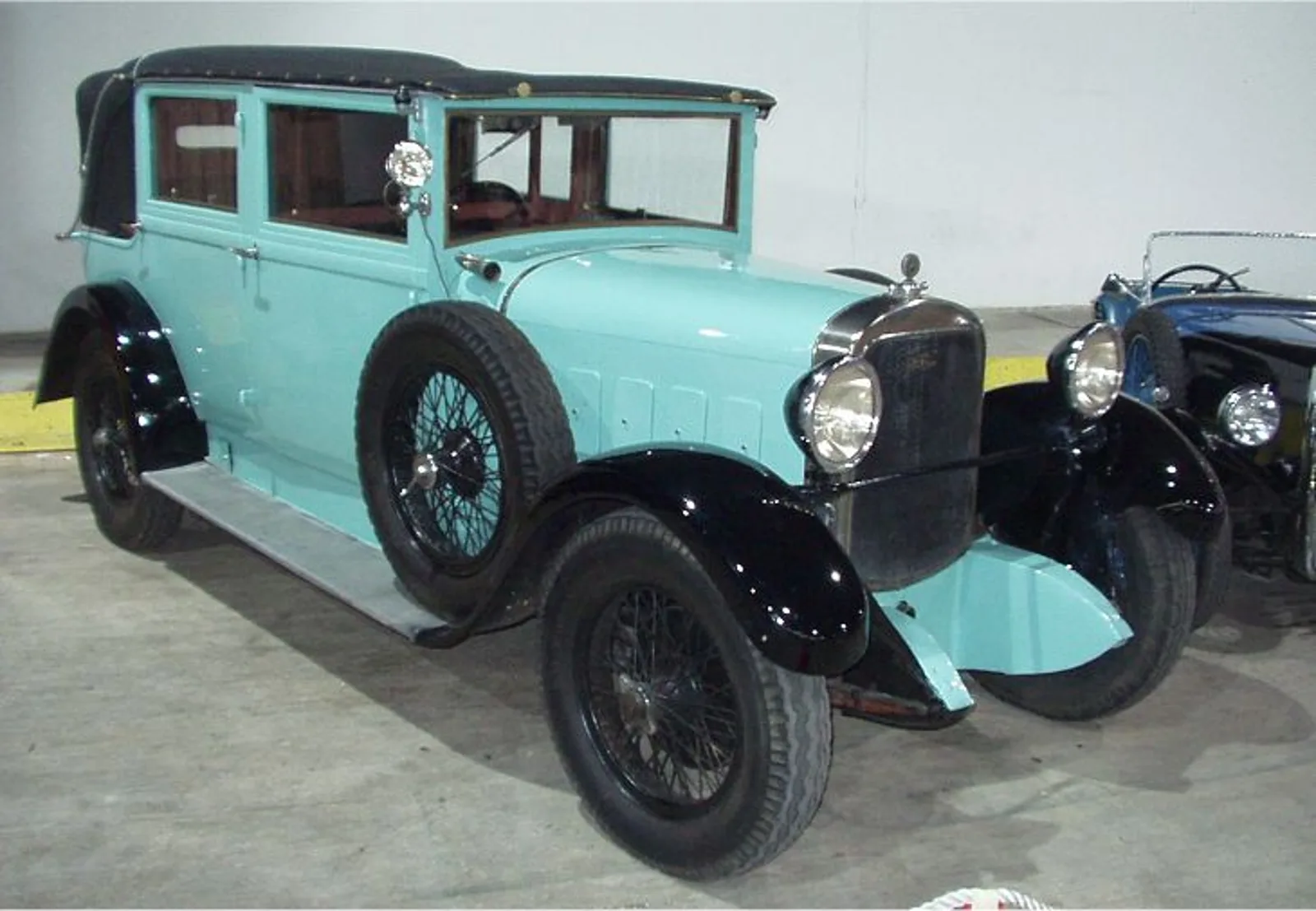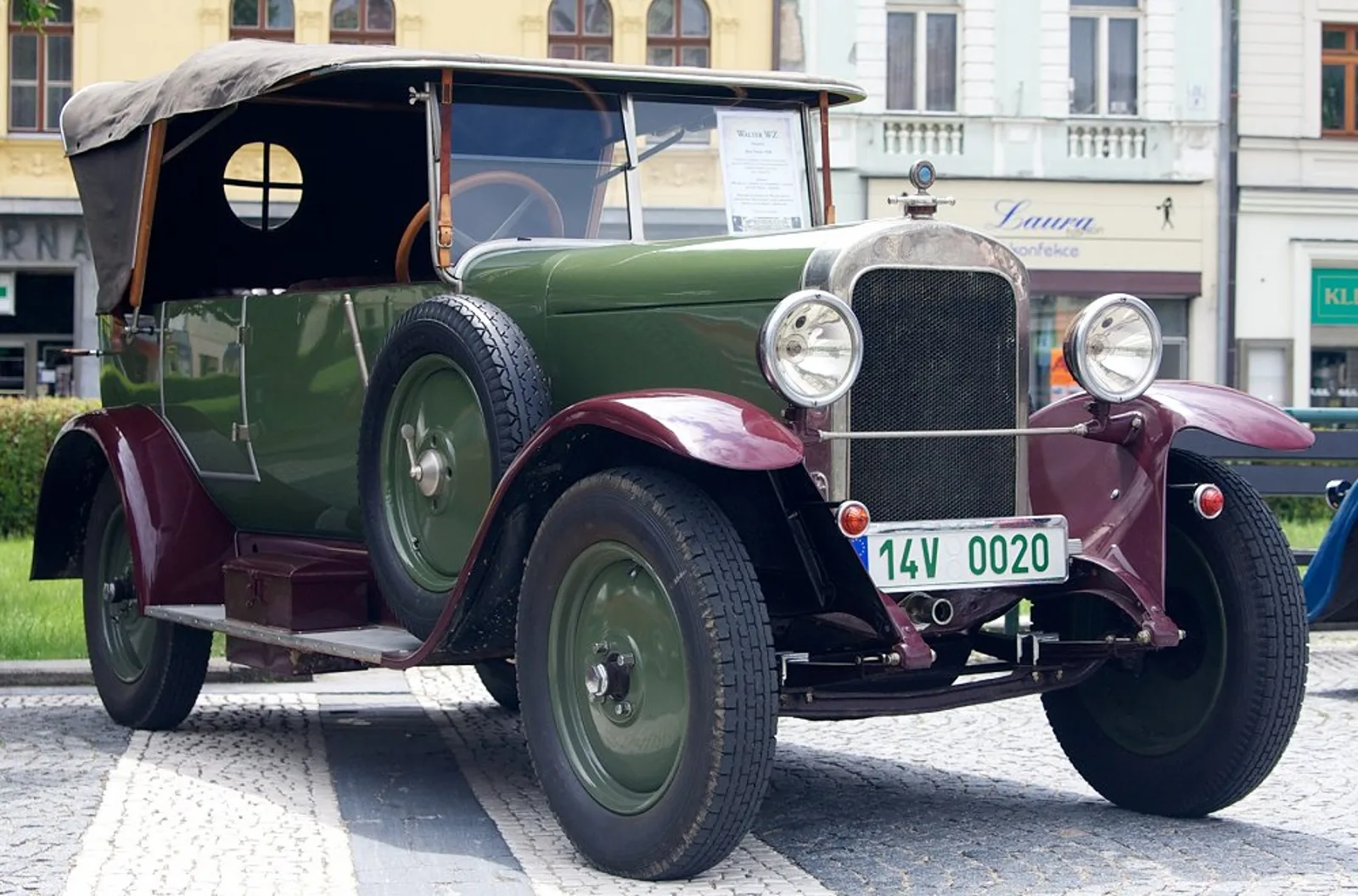
A family of Czech cars from the Jinonice works, built from 1919 to 1928, with one chassis carrying several bodies and engines that moved from side valves to overhead valves.
The Walter WZ, WIZ and WIZI were Czech passenger cars built at Prague-Jinonice between 1919 and 1928. They shared a unified chassis, took bodies in many forms, and moved from side-valve to overhead-valve engines in 1923.
The Walter WZ was a Czech passenger car from the Walter works at Prague-Jinonice, built in several forms between 1919 and 1928. The WZ, WIZ and WIZI shared one chassis and gearbox design, so that different bodies could be bolted on. Engines grew from 1,544 cc to 2,120 cc, and the valve gear changed from side valves to overhead valves in 1923.
Behind the Z in the name stood the engineer who drew the range. Behind the car lay a growing company, a founder who left his own firm, and a run of motor shows, hill climbs and an army ambulance trial.
Who designed the Walter WZ?
The letter Z in the designations came from Ing. Josef Zubaty, a designer who was still twenty-four when the range was drawn up. Soon after the war Zubaty moved on from Jinonice, first to Farman in France and later to the United States. His work was carried on by Ing. Josef Plocek, who changed the valve gear from SV to OHV in 1923 and then designed the successor range, the Walter P.
The original range was launched in 1919 with the WZ and WIZ, followed in 1920 by the WIZI. The numbers in the names, such as 6/18 HP, were the taxable and nominal horsepower ratings of each car. In the literature the cars appear under a threefold designation: at the time they were standardly named by taxable power, and the Roman numerals in the names also appear as Arabic ones, so WIZ is also written W1Z.
One chassis, many bodies, and an engine that moved from side valves to overhead valves in the space of a few years.
What was the uniform car idea?
The idea was to build one range of cars with parts large enough to take stronger engines later. The transmission and chassis parts were sized with a margin, so the same chassis parts could serve more powerful engines. This unification was the core of the so-called uniform car type, even though the bodies it carried were very varied.
The body was the flexible element. Each body was attached to the chassis with six bolts, and the dashboard, with its instruments and wiring, belonged to the chassis rather than the body. That let owners swap a limousine for a flatbed truck in about half an hour, and it let the works offer one car in many forms, from a saloon to a commercial vehicle.
How did the company grow after 1919?
The company was converted into a joint-stock firm on 29 June 1919. Its Jinonice plant then had 195 workers, 25 office staff and 170 machine tools, with 7,100 m2 of production space. Share capital stood at 2 million Kc. The firm had grown to 280 workers and 185 machine tools by 1920, when its profit reached 302,077 Kc and its share capital doubled to 4 million Kc.
Share capital grew again in the early 1920s. By 1923 the share capital was 8,400,000 Kc, the workshops covered about 6,000 m2, and about 250 workers were employed. The plant could produce 300 cars, 100 motorcycles and 150 aero engines a year at that time, so cars were only one part of the business.
What happened to the founder, Josef Walter?
Josef Walter had founded the original firm, but the new joint-stock company brought changes in management and disagreements among the directors. His ten-year term of office, running from 1911 to 1921, was coming to an end, and on 30 January 1922 the board approved the end of his role as company director. He stayed on the board for a short time before the board accepted his resignation on 10 April 1922.
The company thanked him in writing and asked him to remain a supporter of the works. His seat on the board ended on 27 June 1922. Walter did not leave business. With the money from his departure he built a gear factory at Kosire, and in time he began making car accessories and further motorcycles and cars to his own designs.
How were the cars first shown to the public?
The WZ-series cars were presented at the XII international motor show in Prague in August 1920, and again at the XIII show in May and June 1921. Both shows were held at the Exhibition Grounds, and the Walter stand was in the middle of the Industrial Palace. In 1920 the company showed six cars of a single chassis type, which the company used to show the range.
In 1921 the stand also carried the two winners of the Zbraslav-Jiloviste race, which had been run a week before the show on 22 May. The winning cars were the 6/18 HP and the 8/25 HP, and they put racing results beside its series production.
How did the WZ engine work?
The WZ engine, built from 1919 to 1928, was a spark-ignition, liquid-cooled in-line four with side valves. It displaced 1,544 cc (94.2 cu in), with a 64.0 mm bore and a 120.0 mm stroke, and it had no supercharger. The original output was 16 PS (11.8 kW; 15.8 hp), and the later rating was 13.3 kW/18.0 PS (17.8 hp) at 2,000 rpm.
The block and head were cast in grey iron together, with a light-alloy crankcase bolted on. The pistons were aluminium, and the connecting rods were lightened. The crankshaft was made of chrome-nickel steel and ran in three white-metal bearings. Air came in on the right and the exhaust left through a collector on the left, a layout that kept the exhaust and intake on opposite sides.
How did the rest of the WZ drivetrain work?
The car could be started by a crank handle, and from 1920 by an electric starter that engaged a toothed ring on the flywheel. The steel flywheel carried suction ribs that cooled the clutch. Ignition came from a Bosch magneto driven by screw gears from the camshaft, with a flexible coupling that let the ignition advance be set.
The four-speed gearbox had the fourth gear in direct drive and selected its gears through a gate. All of its shafts ran in ball bearings, which was not common at the time. Lubrication was pressure-fed through a full-flow filter by a gear pump with a relief valve, and the cooling system used a thermosiphon assisted by a belt-driven fan.
What changed in the WIZ and WIZI engines?
The WIZ engine of 1919 matched the WZ in its parameters, but from 1923 its valve gear switched from side valves to overhead valves. The WIZI, which arrived in 1920, was a larger engine with a 2,120 cc (129.4 cu in) displacement, a 75.0 mm bore and two valves per cylinder. It delivered 18.4 kW, or 25.0 PS (24.7 hp), at 2,000 rpm.
The OHV conversion was the big change, made with a detachable cylinder head already in place. A removable head guarantees identical compression spaces, and so the same output from every cylinder. With the new valve gear and a compression ratio of 4.6:1, the WIZ rose to 14.7 kW/20 PS (19.7 hp), and the WIZI reached 22.4 kW/30 PS (29.6 hp), giving top speeds of 90 km/h (56 mph) and 100 km/h (62 mph).
What were the Walter WZ specifications?
| Item | Detail |
|---|---|
| WZ engine | 1,544 cc (94.2 cu in), side valves, 64.0 mm bore, 120.0 mm stroke |
| WZ output | 16 PS (11.8 kW; 15.8 hp) originally, 13.3 kW/18.0 PS (17.8 hp) later |
| WZ top speed | 75 km/h (47 mph) |
| WIZI engine | 2,120 cc (129.4 cu in), 75.0 mm bore, two valves per cylinder |
| WIZI output | 18.4 kW (25.0 PS; 24.7 hp) at 2,000 rpm |
| WIZI top speed | 85 km/h (53 mph) |
| WIZ and WZ wheelbase | 2,760 mm (108.7 in) |
| Track | 1,200 mm (47.2 in) on the WZ and WIZ; 1,250 mm (49.2 in) on the WIZI |
| Chassis weight | 650 kg (1,433 lb) on the WZ and WIZ; 750 kg (1,654 lb) on the WIZI |
| Equipped weight | 1,000 kg (2,205 lb) on the WZ and WIZ; 1,080 kg (2,381 lb) open car on the WIZI |
| Fuel tank | 55 l on the WZ and WIZ; 65 l on the WIZI |
| Fuel and oil use | 10-15 l/100 km, with 0.5 l/100 km of oil |
| Coolant | 15 l |
How was the chassis built?
The steel frame was pressed from sheet, and the wings were hammered. The rear axle was a rigid banjo type, driven through a three-satellite bevel differential from the propeller shaft. Because the drive torque and the thrust force went through the propeller shaft's ball joint, the leaf springs were relieved of both.
The front axle was also rigid, forged from an I-section of chrome-nickel steel. Suspension used longitudinal leaf springs, and the steering was right-hand with a self-locking worm gear. The foot brake acted on the driven gearbox shaft at first, and from 1923 the Poulet servo brake also worked on the front wheels. The hand brake acted on the rear wheels.
What bodies could buyers order?
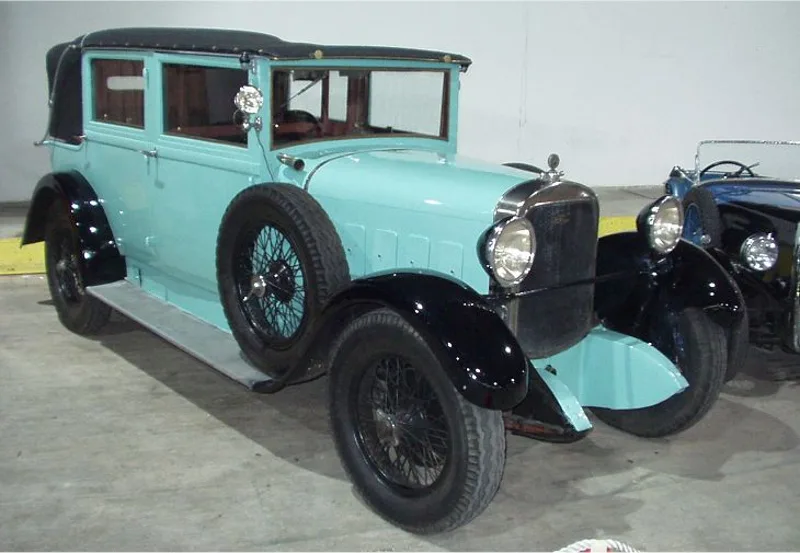
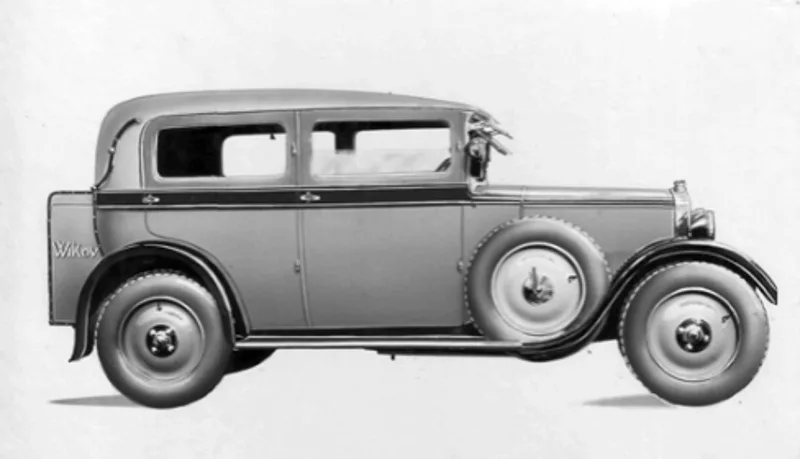
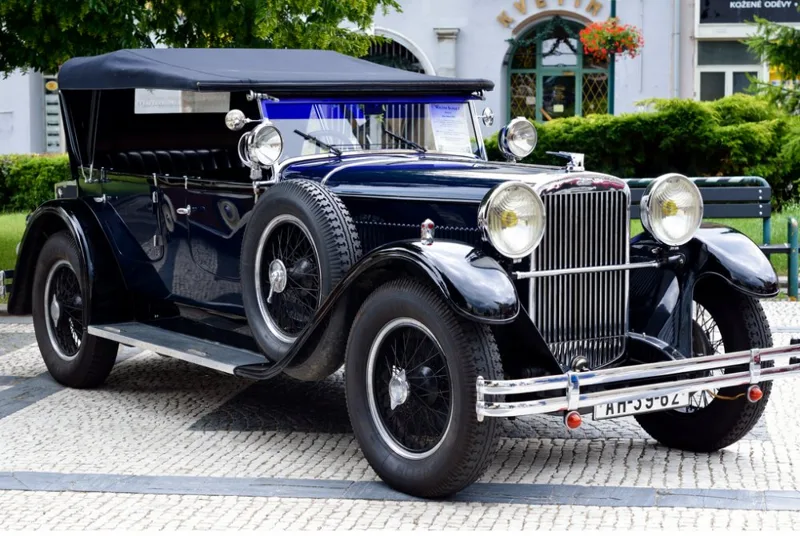
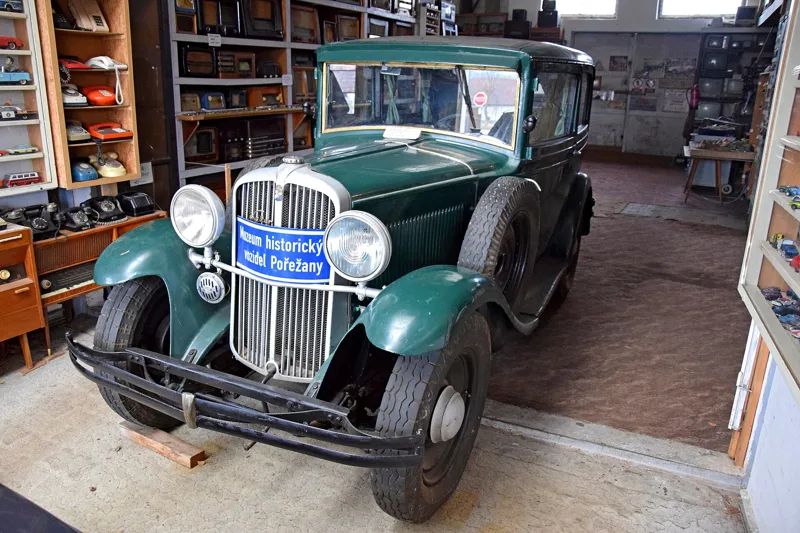
Walter offered the car in up to twelve body versions. These included a limousine in normal or luxury form, known as the Grand Luxe, an open phaeton with an American-style body or a flush roof, a sedan, a cabriolet, a landaulet, and a boat-shaped two-seater sports body that carried one emergency seat.
Commercial forms were also built, with load capacities of 400 kg on the WZ, 500 kg on the WIZ and 650 kg on the WIZI. Versions included flatbeds with tipping sides, box bodies, a cab for taxi service, cars for the Salvation Army and an ambulance on the WIZI in 1922. Others went to the liaison service of the Ministry of Posts and Telegraphs.
Did the state buy the Walter cars?
The Ministry of Posts and Telegraphs took two types from the works. The first was a light-blue van for express delivery of letter post, fitted with compartments for money and other valuable consignments, supplied in large series. The second was an assembly vehicle for telephone and telegraph crews, with a body fitted for tools and wire, used to inspect rural lines and find faults.
In March 1923 the Ministry of National Defence ran a comparison of new ambulances from four makers, Praga, Laurin and Klement, Tatra and Walter. Walter entered a WIZI (8/25 HP). Army officers drove each car, so the factory drivers could not influence the results. The contest produced no winner, because the ministry wanted experience to shape future orders.
How much did the Walter cars cost?
Prices fell quickly over the early years. The WZ 6/18 HP was offered as a phaeton for 128,000 Kc in 1921, 88,000 Kc in 1922 and 70,000 Kc in 1923. The WIZI 8/25 HP was offered for 156,000 Kc in 1921 and 105,000 Kc in 1922, and in 1923 its stronger 8/30 HP form sold as a phaeton for 85,000 Kc.
Limousines and combination bodies were listed too. The WZ was listed as a limousine at 85,000 Kc, the WIZ limousine at 88,000 Kc, and the WIZI limousine at 105,000 Kc. Combination bodies ran from 90,000 Kc on the WZ and WIZ to 108,000 Kc on the WIZI.
How did the Walter cars perform in competition?
The WZ-series cars did well in hill climbs and in the reliability trials that were popular at the time. Hill-climb entries were stripped down, and their bodies were rebuilt in a sportier, closer-to-racing form. Output was raised too, and the weaker 1.5 l engine went up to 26 PS (25.6 hp) with side valves and 32 PS (31.6 hp) with OHV.
The larger 2.12 l side-valve type had a standard output of 25 PS (24.7 hp), and with OHV it could reach 35 PS (34.5 hp) at 3,000 rpm. With these outputs the cars passed the 100 km/h (62 mph) mark with ease.
What was the Walter legacy?
The cars of the uniform WZ and Walter P range were produced continuously for nine years, until 1928. Ing. Josef Plocek, who carried out the change to overhead valves in 1923, also designed the Walter P.
The Walter WZ combined the uniform car idea with competition results in hill climbs and reliability trials, and it gave Prague a passenger car that could be built in many forms from a single chassis.