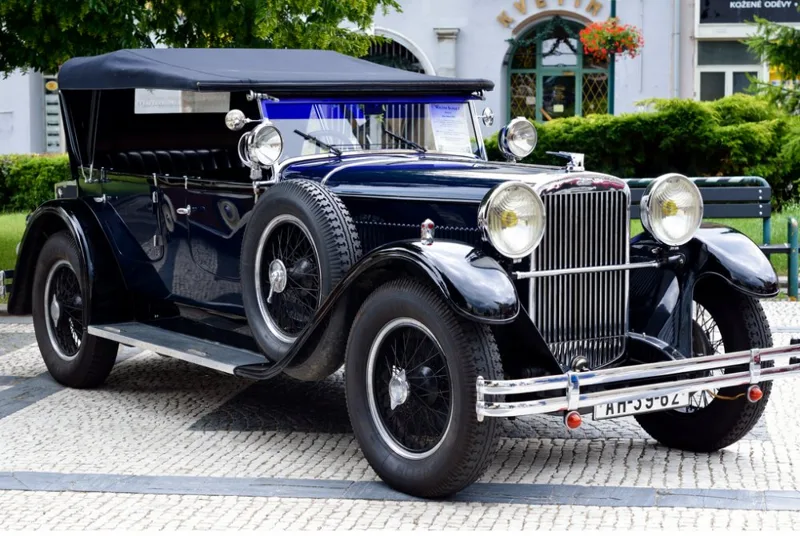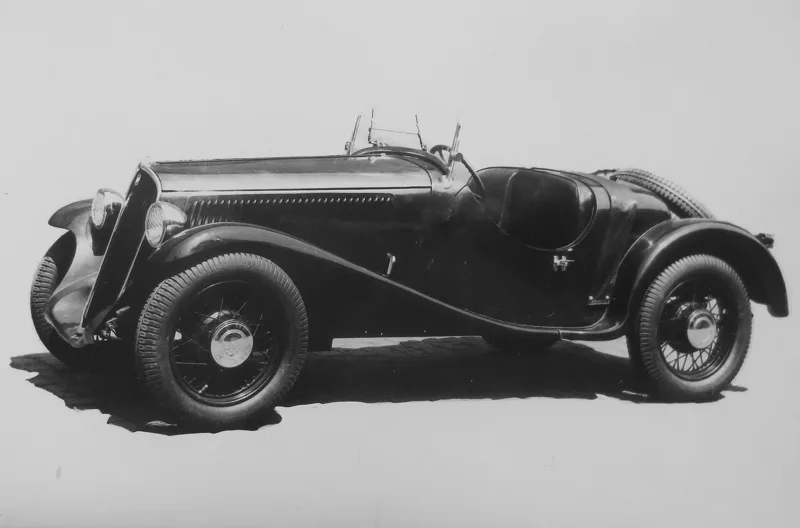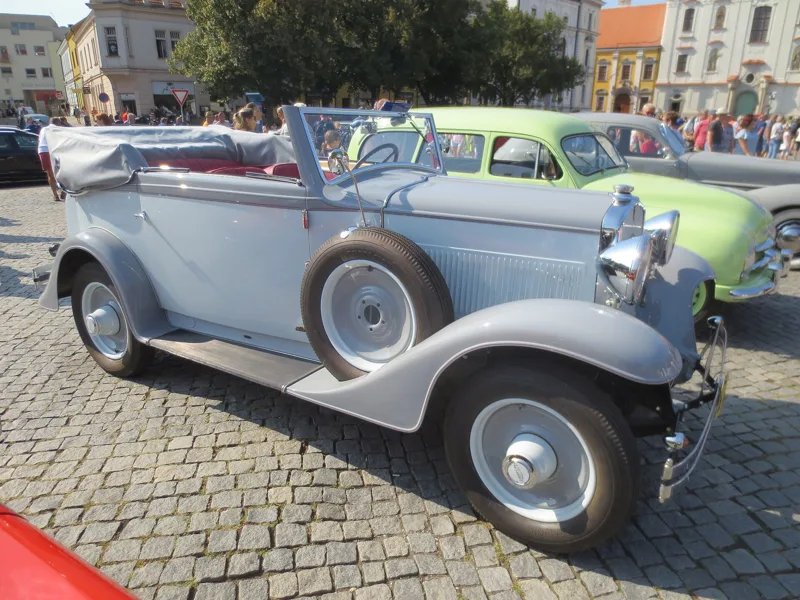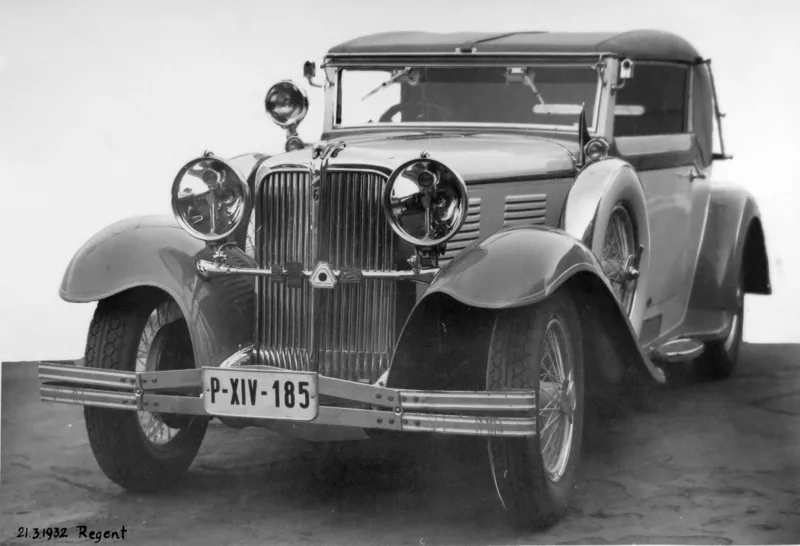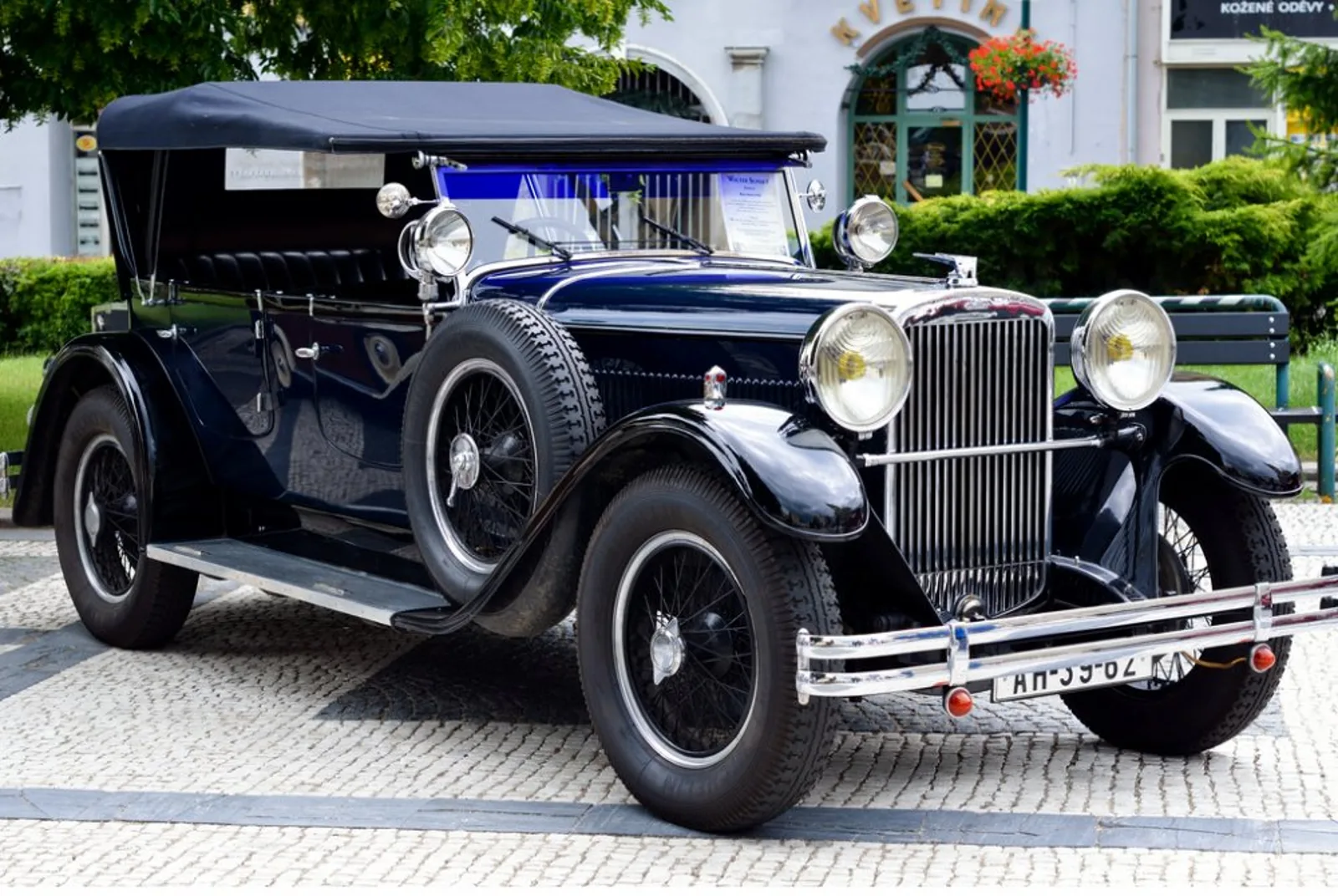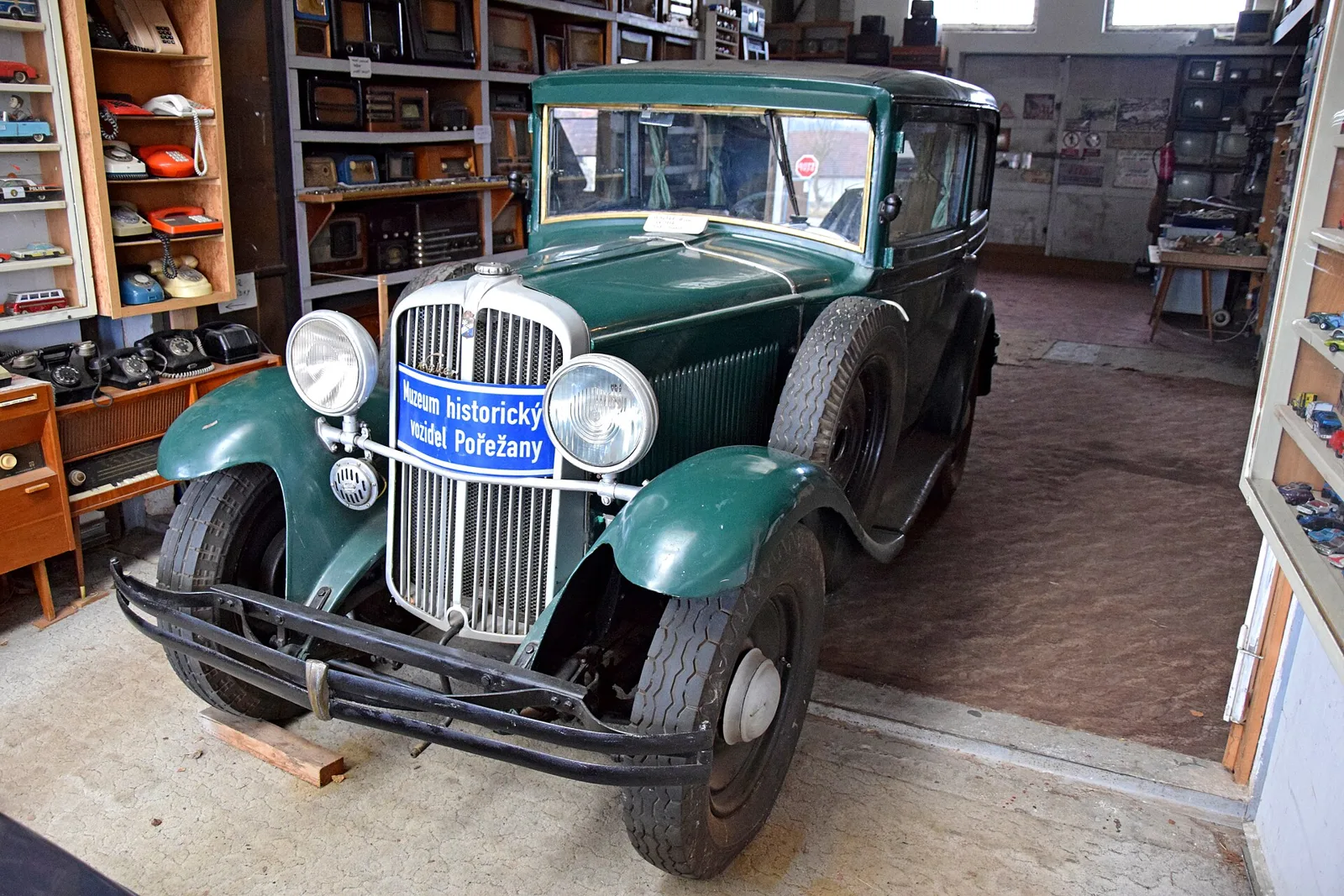
A licence-built Fiat 514 from Jinonice, sold from 1931 to 1935, with a side-valve four, a partial takeover of Fiat's sales network and a run of Alpine and regional trials.
Walter Bijou was a licensed Fiat 514 built by the Czech maker Walter at Jinonice from 1931 to 1935. It had a 1,438 cc side-valve four, a top speed of 90 km/h and saloon, tudor, cabriolet and roadster bodies.
Walter's mid-size car was a licensed Fiat 514, built at Jinonice for a market that the crisis had squeezed. Its 1,438 cc side-valve four powered a body range that ran from saloons to roadsters, and the car found its place in reliability trials and Alpine runs rather than on the racetrack.
Why did Walter license the Fiat 514?
Walter's six-cylinder three-litre cars failed to reach a wide audience as the world economic crisis deepened, and the firm had no small car ready. It therefore signed a licence agreement with Fiat in Italy, a partner it already knew well from aircraft work, and the Bijou appeared in spring 1931.
Other Czech makers already had lower-middle-class cars, such as the Skoda 430, the Praga Piccolo and the Tatra 57. Walter, which built automobiles and aero engines, had nothing to set against them until the Fiat deal.
Development ran in parallel in the two factories, especially for the later Junior models. Other accounts say that most of the cars were built from imported parts.
Spain built the car too. Fiat Hispania produced it at Guadalajara, in a plant bought from Hispano-Suiza, under the name Hispano-514 from 1931 to 1935.
Walter's mid-size car was a licensed Fiat 514, built at Jinonice for a market that the crisis had squeezed.
How did the Fiat deal change Walter's sales?
Fiat's Turin company had run its own Czech sales organisation since 1925, with assets of 4.8 million crowns. Poor financial results and the worsened economy led it to close that operation. In autumn 1931 Fiat and Walter agreed that Walter would take over part of the Fiat dealer network and, above all, all spare parts sales for Fiat cars, of which about 3,000 were in use in Czechoslovakia in the early 30s.
Walter also took over Fiat's Prague showroom in Nekazanka street, number 857/2, and set up its second Prague showroom there, aimed at the Praha-jih district. The building now belongs to a bank, which has a corporate banking branch there.
What was under the Bijou's bonnet?
The Bijou used an inline four-cylinder of 1,438 cc (87.8 cu in) with side valves, driven by a chain-driven camshaft. It made 32 PS (23.5 kW; 31.6 hp) at 3,400 rpm, with a 5.9:1 compression ratio and no supercharger.
Walter designed the combustion chambers with great care, so the engine delivered strong output on very little fuel. The pistons were aluminium alloy with Invar inserts, and the crankshaft was balanced both statically and dynamically and ran in three large bearings.
Oil was pumped under pressure by a gear pump and passed through a plate-type filter with a removable screen. The side valves ran quietly thanks to a special cam profile, and the chain drive kept the camshaft quiet too.
Fuel reached a Zenith 26 or Solex 26 UAHD carburettor by gravity from a 34-litre tank mounted on the bulkhead. Cooling used a 14-litre radiator with forced circulation, a pump on the fan shaft and honeycomb tubes behind protective louvres.
Ignition was a 6 V dynamo-battery system with a 112 Ah battery, first from Bosch and later from Scintilla. The distributor sat upright in the middle of the head, with automatic advance up to 15 degrees and a further 15 degrees of hand adjustment.
Gearbox, chassis and brakes
The four-speed gearbox with reverse was joined to the engine through a dry, single-plate disc clutch. Its gradual engagement made gear changes easier for less experienced drivers, and the long central lever was quiet and simple to use. Four forward gears gave economical use of the power.
The frame was a robust pressed-steel rectangle with cross bracing, built to take heavy loads. The steering was worm-type with a high ratio, and at first it was right-hand drive. Later it was changed to left-hand drive.
A hollow shaft carried the drive to the rear axle, with two universal joints turning in an oil bath. The rear axle used Gleason spiral-toothed gears, and the differential was easy to reach. Semi-elliptic leaf springs at both ends carried hydraulic dampers and sat in rubber bushes called Silencblok, which need no lubrication.
The brakes were mechanical, of proven design, and both the footbrake and the handbrake worked softly on all four wheels. Each drum carried two wide, durable aluminium shoes, which gave excellent cooling. The wheels were 18-inch pressed-steel discs, painted in the body colour, with balloon tyres of 4.75 x 18 in.
The Bosch 6 V electrics included a dynamo with regulator, a starter engaging the flywheel ring gear, two large chrome headlamps, a number-plate light, an electric horn and electric arm-type indicators. The instruments sat in a frame on an illuminated dashboard, lit from inside the panel.
How did the Bijou's bodies differ?
Walter launched the Bijou as a saloon, a touring car, a two-door city coupe, a tudor cabriolet and a roadster. By 1932 it was also offered as a pick-up, a bare chassis for coachbuilders, and closed two- and four-door bodies.
The four-door saloon with six side windows measured 3,920 mm (154.3 in) long, 1,450 mm (57.1 in) wide and 1,660 mm (65.4 in) high, and weighed 1,100 kg (2,425 lb). Simpler cars were about 50 kg lighter. Its seats were covered in velvet or cloth, and the driver's seat slid on rails along the car's axis.
The four-seat cabriolet had leather upholstery and a folding roof of waterproof fabric or artificial leather, with its own cover. Transparent side screens could be fastened to the roof and body, and the doors carried pockets as in the saloon.
Prices in Czech crowns show how the car's standing shifted. In summer 1932 the pick-up cost 42,000 Kc. A bare chassis was 39,800 Kc, a four-seat tudor 49,800 Kc and a four-door saloon 52,000 Kc, while the two-door cabriolet was the most expensive at 62,000 Kc. By the 1935 list, after crisis price cuts, the tudor had dropped to 34,000 Kc and the saloon to 36,000 Kc.
The bodies themselves changed as production went on. The saloon and cabriolet gained rounder shapes, a sloping radiator grille and a flowing tail. Specialist firms, such as Theodor Petera of Vrchlabi, also built Bijou bodies, as they had done for other Walter designs.
Walter Bijou specifications
| Specification | Walter Bijou |
|---|---|
| Engine | 1,438 cc (87.8 cu in), inline four, side valves |
| Power | 32 PS (23.5 kW; 31.6 hp) at 3,400 rpm |
| Compression ratio | 5.9:1 |
| Gearbox | Four speeds plus reverse, dry single-plate clutch |
| Length | 3,920 mm (154.3 in) |
| Kerb weight | 1,050-1,100 kg (2,315-2,425 lb) |
| Width | 1,450 mm (57.1 in) |
| Wheelbase | 2,555 mm (100.6 in) |
| Height | 1,660 mm (65.4 in) |
| Track | 1,214 mm front, 1,220 mm rear |
| Fuel use | 7-10 litres per 100 km (28.2-40.4 mpg-imp; 23.5-33.6 mpg-US) |
| Tank | 34 litres |
| Top speed | 90 km/h (56 mph) |
| Tyres | 4.75 x 18 in |
How well did the Bijou race?
The Bijou was never meant for hill climbs or circuits. Walter used it in reliability trials and star-route rallies, mainly for publicity, and it appeared in the 1931 Alpine Trial, the 1932 Across Sumava contest and a 1934 race at the Telc circuit.
The six-stage International Alpine Trial ran from 30 July to 6 August 1931 over 2366 km. It crossed 17 of the highest Alpine passes, including the Brenner, the Stelvio and the Great St Bernard. A Bijou in the 1100 to 3000 cc group, crewed by Vitezslav Kumpera Sr., the chairman of the Walter board, and driver G. Caslavsky, finished and collected a commemorative medal for the Glacier Cup. The Super 6 team did not finish, after one of its cars crashed.
The factory also sent a team of three to the fourth Across Sumava contest, a 385 km event held on 8 May 1932 by the Western Bohemian Automobile Club in Plzen. Of 96 crews entered, 88 started and 65 reached the finish without penalty points. The Walter Bijou team took the gilded winners' plaque, with Leo Sabat, J. Ulc and V. Paur at the wheel.
The Telc race, held on 12 August 1934, was a time trial, with cars leaving at intervals. Its rules required the average for the whole race to beat the average of the first lap, so charging at the start was costly. Ivan Hodac set the day's best time on a Walter Junior SS, 2:10:19 hours at 82.7 km/h, yet he could not be classified because his race average fell short of his over-fast first lap. B. Fiser from Brno was placed fourth and was disqualified as well.
The factory still claimed a win in the event. The up to 1,500 cc class went to L. Grus, a private driver from Mrakotin, in a Bijou.