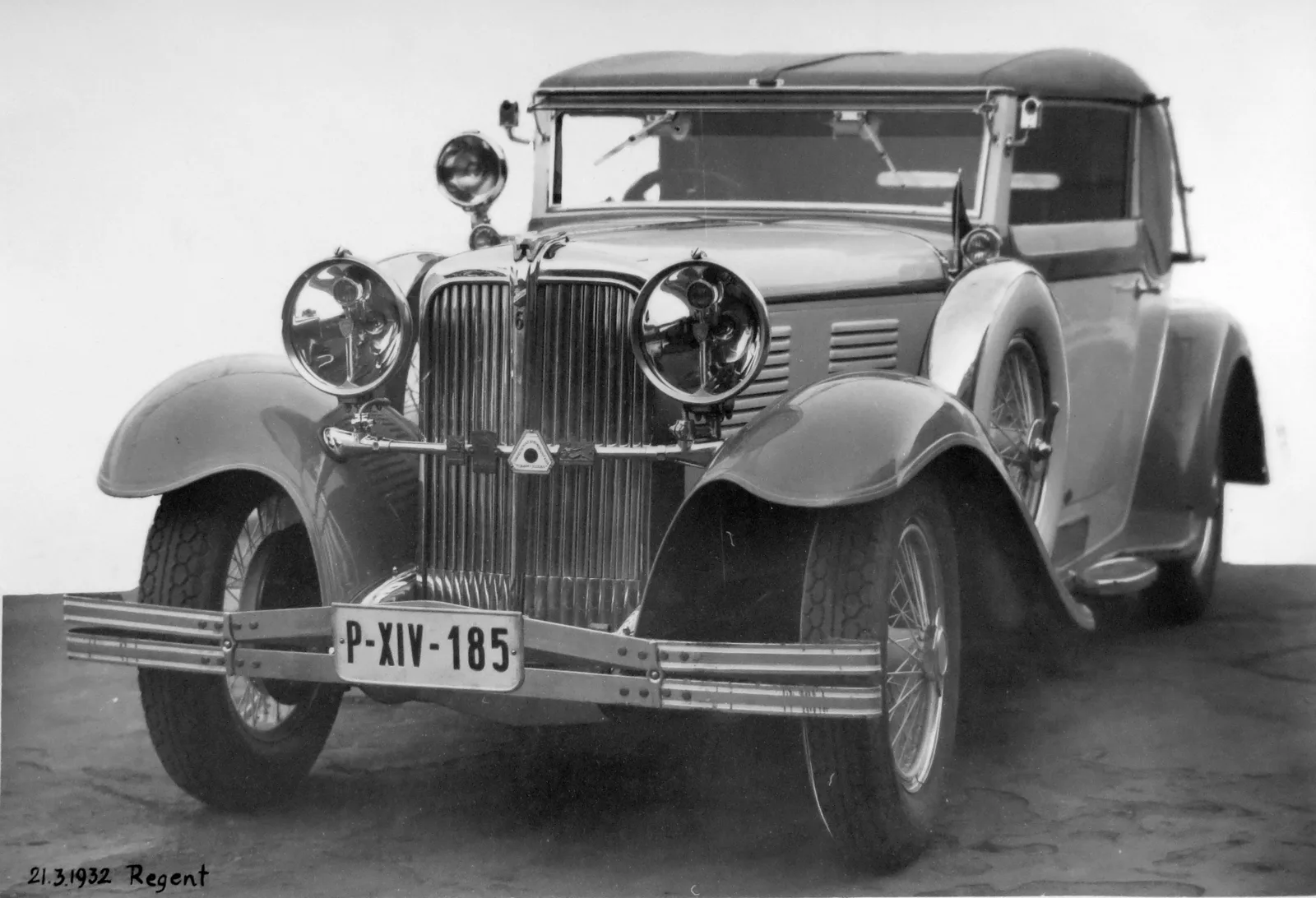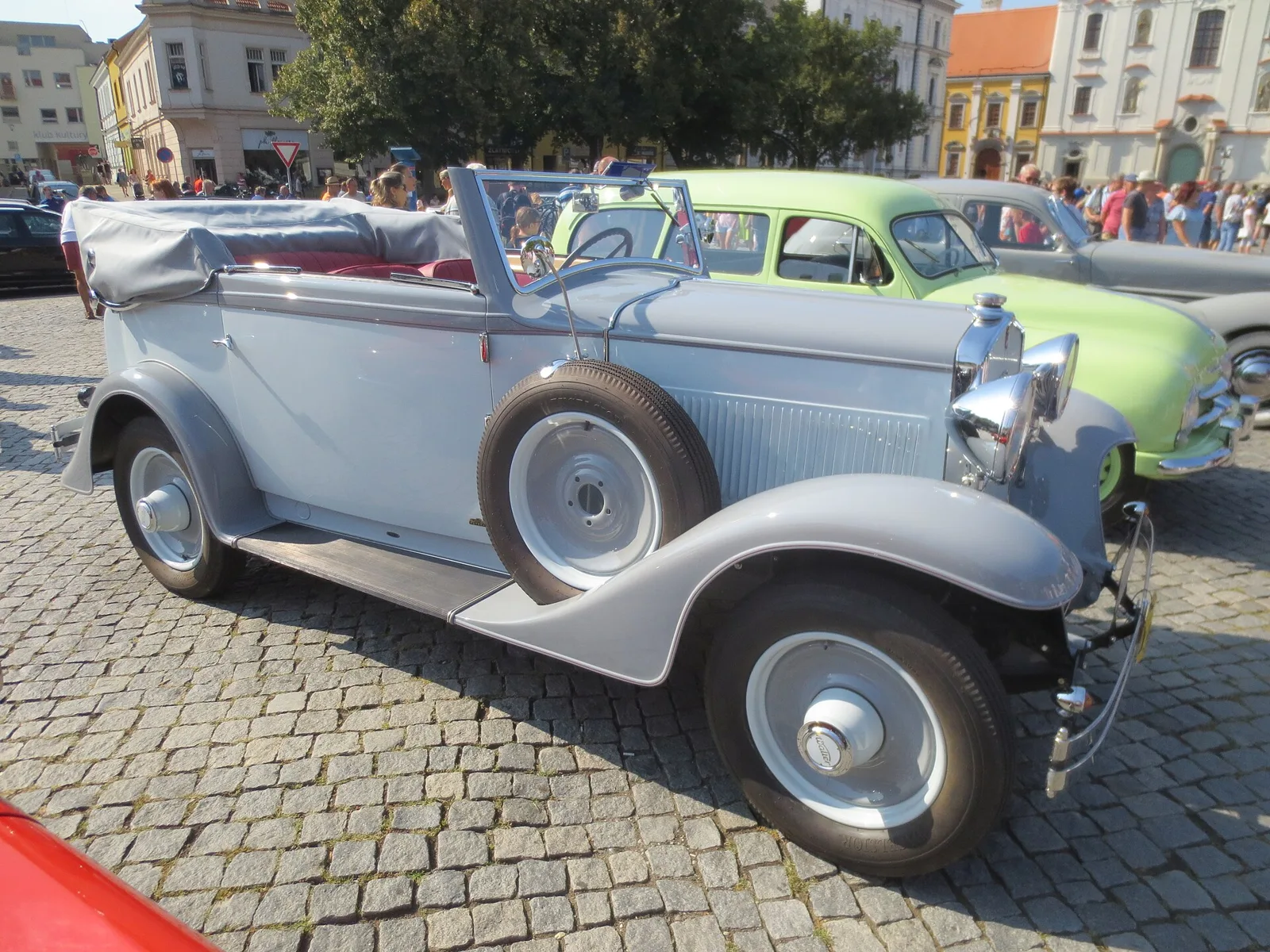
A Czech six-cylinder built from a Fiat design, sold in small numbers, and entered in the 1935 1000 Miles by a past winner.
A licensed Fiat-derived six from Jinonice, the Walter Princ arrived in late 1932. Its 2,492 cc (152.1 cu in) engine produced 50 PS (49 hp), and car production ended in summer 1936 after output stayed in the dozens.
The Walter Princ was the smaller of Walter's two Fiat-derived six-cylinder cars, and its engine formed the link between the company's one-litre Juniors and its larger models. It was presented at the end of 1932 by the Walter factory in Jinonice, a Czech maker of cars and aero engines. Output stayed in the dozens.
Where did the Walter Princ come from?
The Princ was a licensed six-cylinder derived from the Italian Fiat 522C, where the C stands for Corto, meaning short chassis. Its larger brother, the Walter Lord, was presented at the same time, and the Princ and Lord differed only in equipment and wheelbase. The Lord's wheelbase was 3,250 mm (128.0 in), against 2,775 mm (109.3 in) for the Princ.
Some accounts named the Fiat 524 as the model's basis, but that Fiat corresponds more closely to the Walter Lord. The sporty Walter Standard S followed in 1934.
The Walter factory was a joint-stock company that made aero engines as well as cars. Its general director, Ing. Antonin Teny Kumpera, managed the imports and exports of those engines directly, and the company's slogan ran: Walter, king of the air, king of the roads.
A six-cylinder built from a Fiat design, in a factory that also made aero engines for Italy.
How did the Walter Princ engine work?
The engine was a spark-ignition, liquid-cooled inline six with side-valve timing and two valves per cylinder. Its displacement was 2,492 cc (152.1 cu in), with a bore of 72.0 mm and a stroke of 102.0 mm. It produced 36.8 kW (50 PS; 49 hp) at 3,300 rpm, and it had no supercharging.
- Fuel: a Solex 30 VAFD carburettor fed by a diaphragm pump from a 51-litre tank at the rear
- Lubrication: pressure-fed and circulating, as was usual
- Cooling: water, with a fan and forced circulation through a pump and radiator
- Ignition: dynamo and battery at 12 V, by Bosch or Scintilla
- Transmission: four-speed manual, with synchromesh on third and fourth
Consumption ran at about 13 to 14 litres of petrol per 100 km. Its declared cylinder volume sat just below the 2.5-litre (152.6 cu in) tax threshold of the period.
What was the Princ's chassis like?
The frame was orthodox and solid, with an added central X-shaped brace to resist twisting. Both axles were rigid, carried on longitudinal leaf springs with hydraulic dampers. The steering was a worm-gear arrangement that sat on the left, even though Czechoslovakia still drove on the left at the time.
Drum brakes were fitted to every wheel, with separate hydraulic circuits for the front and rear axles. A mechanical handbrake worked on the rear wheels.
How big was the Walter Princ?
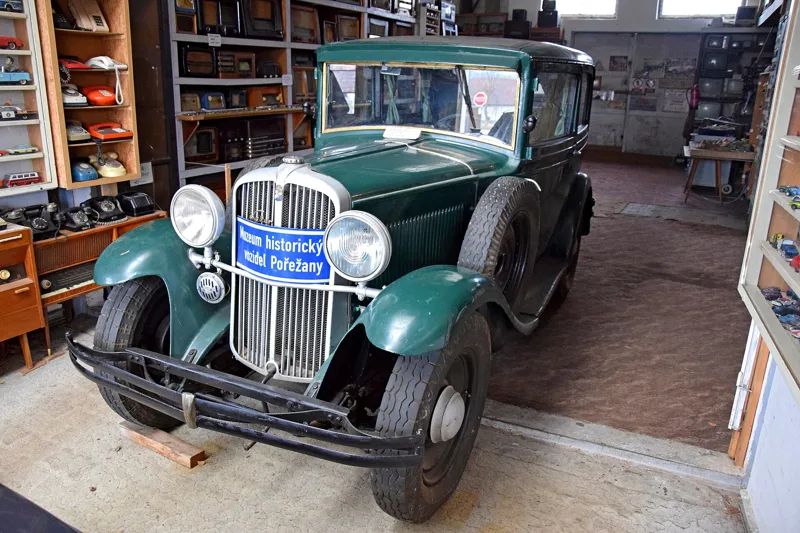
The Princ had a wheelbase of 2,775 mm (109.3 in), with 1,410 mm between the front wheels and 1,450 mm between the rear ones. Measured overall, the five-seat four-door saloon with six side windows came to 4,230 mm (166.5 in) in length, 1,750 mm (68.9 in) across and 1,640 mm (64.6 in) tall.
The chassis weighed 950 kg (2,094 lb), and a fully equipped saloon weighed 1,330 kg (2,932 lb). Top speed was 105 to 110 km/h (65 to 68 mph). Quiet running and light controls were its strengths, while its road manners were not especially good.
What did the Walter Princ cost?
By March 1934 a saloon cost 65,000 Kc, and a cabriolet 69,000 Kc. Both prices sat close to those of six-cylinder cars such as the Praga Alfa and the Skoda 650 and Superb.
For the 1935 and 1936 seasons the roadster was offered at 49,000 Kc, the closed five-seat saloon at 52,000 Kc, and the four-seat cabriolet, with a patented folding waterproof roof, at 59,000 Kc. Even these revised prices did not lift output, which stayed in the dozens.
How did the Princ's bodywork develop?
The Walter Princ received a run of bodywork changes between 1933 and 1936. A new or revised version was shown each year at the traditional Prague motor show, or simply during the year. The early changes altered the flowing tail, and later the radiator shell was tilted forward. In this way the car moved away from its boxy shape towards the aerodynamic profiles of later years.
From 1935 the saloon could be ordered with a Webasto sliding roof. The claim was that a saloon with an opening roof had many advantages over a cabriolet. It was not open in the full sense, yet it kept full daylight and an upward view, a particular help on mountain trips.
Who built special bodies for the Princ?
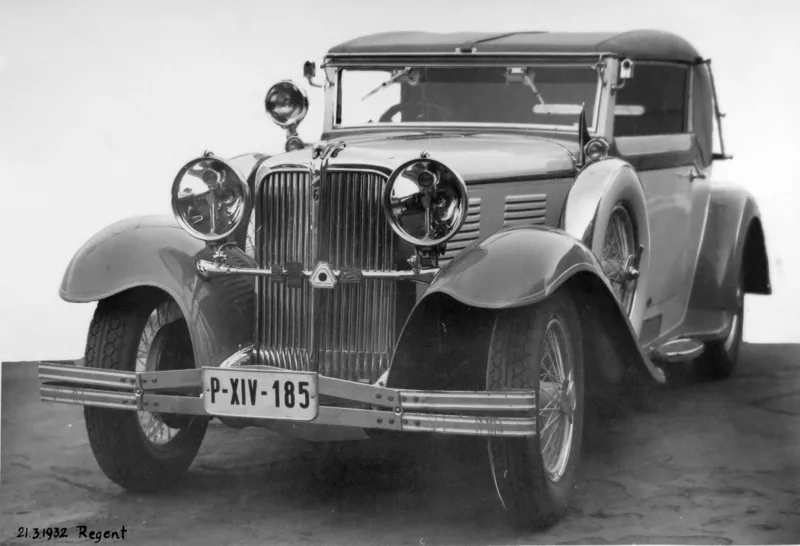
Beyond the factory bodies, specialist coachbuilders produced a range of versions. Cabriolets from Sodomka of Vysoke Myto and from Peter and Sons of Vrchlabi attracted wealthy clients. A typical example was the two-door, four-seat Peter cabriolet of 1933.
In 1934 further two-door Walter Princ cabriolets followed from Vrchlabi, five examples in all. The special bodies also show that the Walter factory did not follow the Italian documentation strictly when it built these licensed cars.
How did Walter Princ production end?
From 1935, when Italy invaded Abyssinia, Czechoslovak officials asked that money flowing to the aggressor country be stopped. Imports of parts became very difficult, and exporting aero engines was out of the question.
Car production ended in summer 1936, after the last promotional advertisement appeared in the magazine Auto. The factory was busy with aero-engine work and had no new model in preparation. In 1937 only earlier-built cars were still being sold, and the car business ended quietly.
Did the Walter Princ go racing?
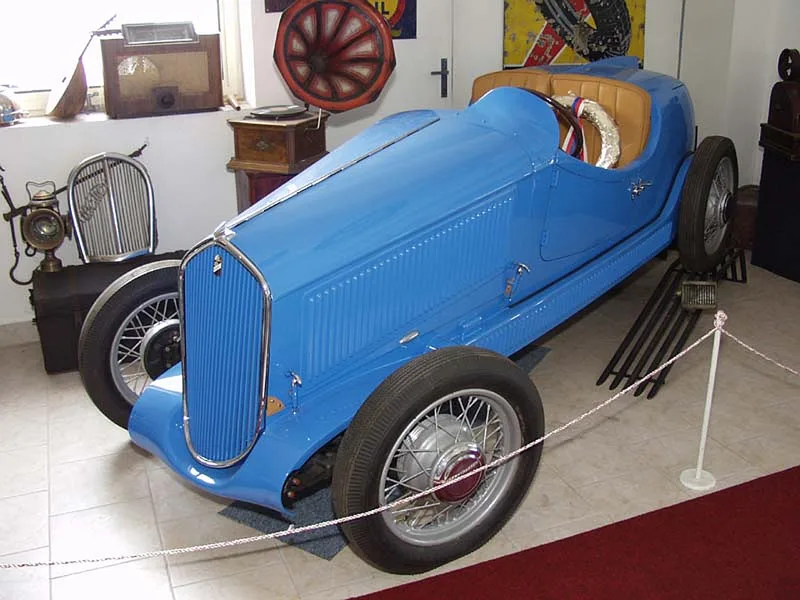
Racing was not much planned for this model, so a report in May 1935 came as a surprise: Jindrich Knapp, winner of the 1934 Czechoslovak 1000 Miles, had entered the 1935 event. His original Standard S had been converted into an aerodynamic roadster called Autosalon 1935, so he prepared a Walter Princ from the Jinonice range instead.
He was to drive the six-cylinder Princ, with Karel Vojir as co-driver. The sport-tuned Princ shared its axles with the 1934 winning car, and its wheelbase of 2,775 mm (109.3 in) compared with 2,880 mm (113.4 in) on the Standard S.
In the first 1000 Miles Knapp had won the under-1,100 cc class in a Walter Junior S and set the second-fastest time of the day. In the second he won overall on the Walter Standard S. For the third edition he was listed in the over-2,000 cc class with race number 2. The crew of Ivan Hodac and Kuhne, who had finished second in the under-1,100 cc class in 1934, was also due to start with race number 41. For reasons unknown, neither crew appeared on the factory Walters at the start on 15 June 1935. The decision probably came from the Walter management, and Hodac was so angered that from then on he raced mainly in Aero cars.
Which film and events featured the Princ?
In 1934 the Princ appeared in the film Hrdinny kapitan Korkoran, in which Vlasta Burian lost his suitcase on arrival at the spa. A servant from the most expensive spa hotel mistakenly drove off with it in the cabriolet of a wealthy lady, and Captain Korkoran tried in vain to catch the car.
At the second competition of beautiful cars, held on 28 September 1936 at Podebrady, a Walter Princ fitted with Sodomka coachwork, owned by Mrs M. Svobodova of Prague, took the Golden Wreath, the Grand Prize of the Podebrady spa and the blue ribbon among others.
Did a Princ serve as a fire engine?
As late as 1946 the volunteer fire brigade in Sestajovice bought an older Walter Princ as its first vehicle. It was converted for fire service use and served into the sixties, when it was replaced by Praga RN vehicles.
Walter Princ key specifications
| Specification | Detail |
|---|---|
| Presented | End of 1932 |
| Engine | 2,492 cc (152.1 cu in) inline six, 72.0 mm bore, 102.0 mm stroke |
| Output | 36.8 kW (50 PS; 49 hp) at 3,300 rpm |
| Gearbox | 4-speed manual |
| Wheelbase | 2,775 mm (109.3 in); Walter Lord 3,250 mm (128.0 in) |
| Dimensions | 4,230 mm (166.5 in) long, 1,750 mm (68.9 in) wide, 1,640 mm (64.6 in) high |
| Weight | 950 kg (2,094 lb) chassis; 1,330 kg (2,932 lb) fully equipped |
| Top speed | 105 to 110 km/h (65 to 68 mph) |
| Fuel use | 13 to 14 litres per 100 km |
| Fuel tank | 51 litres |
| Saloon price | 65,000 Kc, March 1934 |