From the 1897 Prasident and the streamlined Tatra 77 to the Beetle controversy, the 603 limousine and the military trucks of today.
Founded in 1850 as a workshop in Koprivnice, the Czech firm is among the longest-running vehicle makers. Its 1897 Prasident was an early factory petrol car, the Tatra 77 pioneered streamlined production cars, and the company now focuses on heavy off-road trucks.
Tatra is a Czech vehicle maker based in Koprivnice, and it traces its roots back to 1850. It is the third-oldest motor vehicle maker with an unbroken history, and its engineers built the first factory petrol car in Central and Eastern Europe. Tatra is best known today for heavy off-road trucks, but its cars were once some of the most advanced in the world.
Where did Tatra begin?
The company was founded in 1850 as Ignatz Schustala & Cie, a maker of horse-drawn vehicles in Koprivnice. In the 1880s it began building railway carriages, and by 1890 it had become a joint-stock company called the Nesselsdorfer Wagenbau-Fabriksgesellschaft.
In the same year, Hugo Fischer von Roslerstamm became technical director. After Schustala died in 1891, von Roslerstamm took over management of the business. The firm's move into motor vehicles followed soon after, with the Prasident.
A Czech maker whose streamlined cars and backbone-chassis trucks shaped the region for more than a century.
What was the Prasident?
The Prasident was built in 1897 under the direction of engineers Hans Ledwinka and Edmund Rumpler. It was the first factory-produced car with a petrol engine made in Central and Eastern Europe, and the company used a Benz automobile that von Roslerstamm had purchased as its inspiration. The car was exhibited in Vienna later that year.
Orders followed, and between 1897 and 1900 nine improved cars based on the Prasident were made. The company also made its first truck in 1898, so commercial vehicles and passenger cars developed side by side from the start.
Who was Hans Ledwinka?
Hans Ledwinka was the designer who shaped Tatra's identity. The first car he designed completely by himself was the Nesselsdorf A of 1900. It had a rear-mounted 2714 cc engine and a top speed of 40 km/h (25 mph), and 22 units were built.
Ledwinka left to concentrate on steam engine development, returned in 1905 to design the Type S with a 3308 cc four-cylinder engine, and then left again in 1916 to work for Steyr-Werke in Graz. He came back in 1921 to run the new car plant, and that return led directly to the backbone-chassis cars that made Tatra famous.
Why is the marque called Tatra?
The Tatra name arrived in 1919, when the company began using it for its cars. It was named after the nearby Tatra Mountains on the Czechoslovak-Polish border, which gave the brand a sense of place from the start.
The company changed its name several times in the early 1920s. It became Zavody Tatra in 1924 and Ringhoffer-Tatra in 1927. The Tatra name survived each of those changes.
What did the Tatra 11 and Tatra 17 introduce?
The Tatra 11 of 1923 introduced a rigid backbone tube chassis with swinging semi-axles at the rear, which gave independent suspension. Its front-mounted, air-cooled engine was a 1056 cc two-cylinder unit, and the design made Tatra's affordable cars recognisable across the interwar period.
The Tatra 17 followed in 1925 with a 1930 cc water-cooled six-cylinder engine and fully independent suspension. The Tatra 12 replaced the Tatra 11 in 1926 with four-wheel brakes, and Tatra's specialty was luxury cars built with the newest technology of the day.
Why was the Tatra 77 so important?
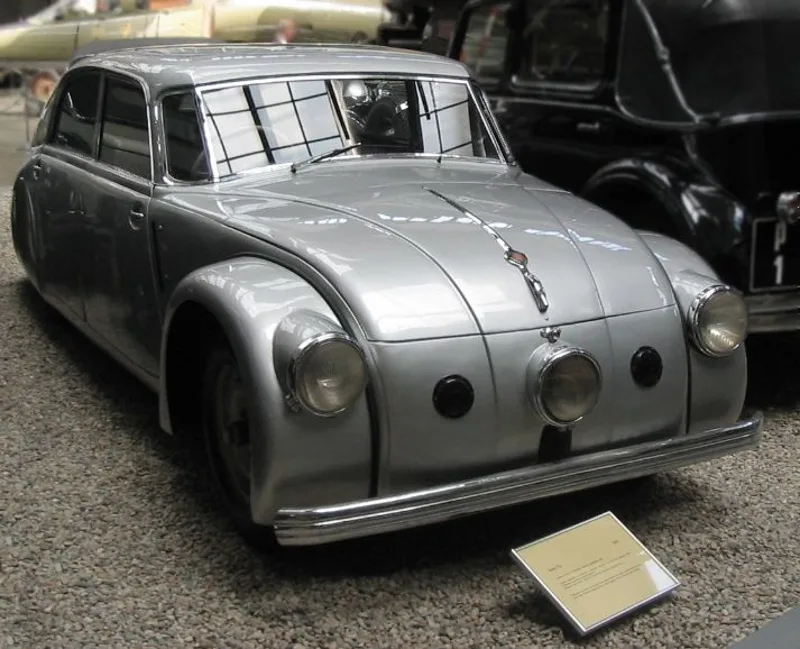
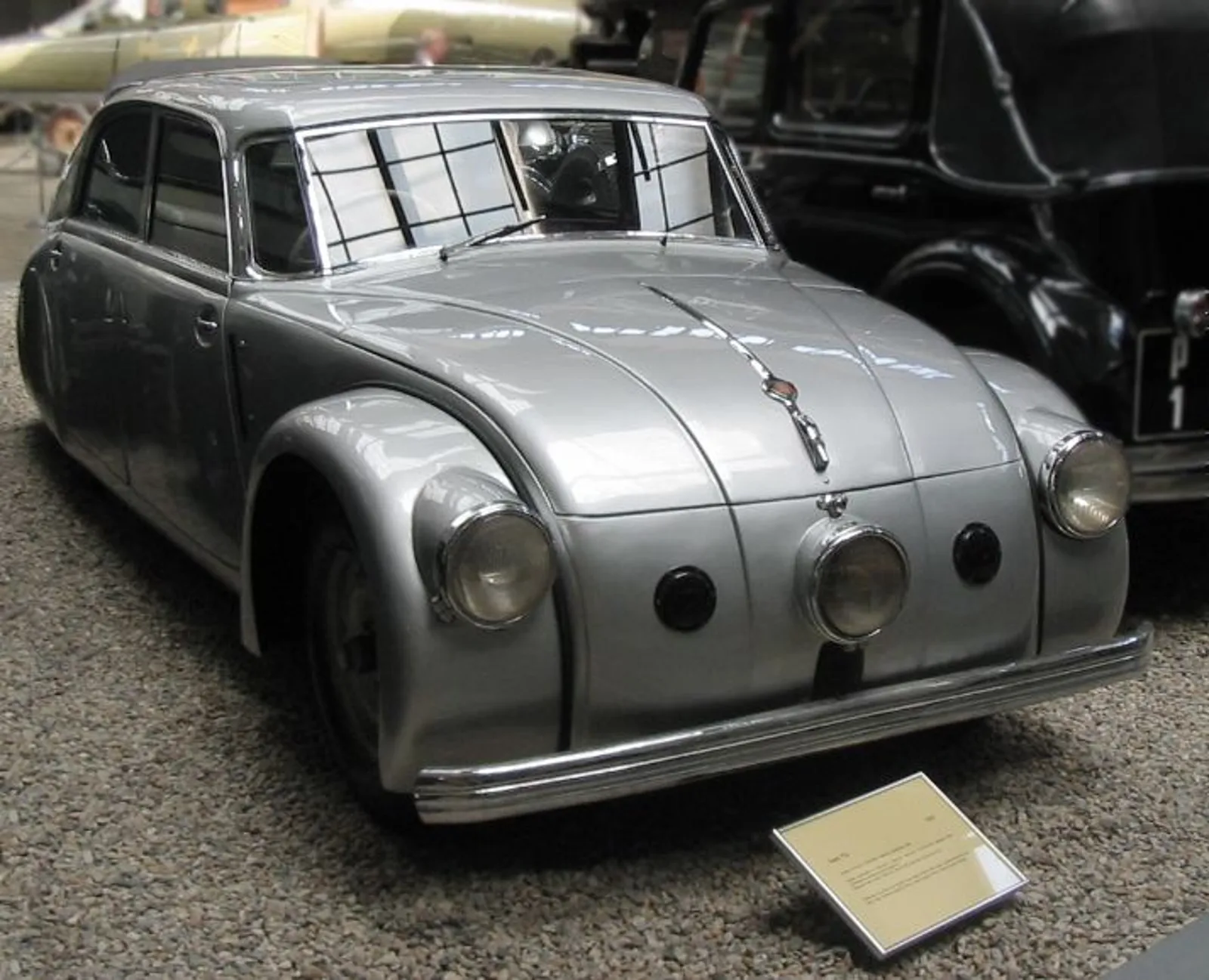
The Tatra 77 of 1934 was the world's first production aerodynamic car. Engineers built it under licences from Paul Jaray, and a 1:5 model of its fastback body recorded an average drag coefficient of 0.2455.
The large Tatra cars that followed almost all used a rear-mounted, air-cooled V8. That layout, combined with the streamlined bodywork, became a lasting feature of the company's large cars.
Did Tatra influence the Volkswagen Beetle?
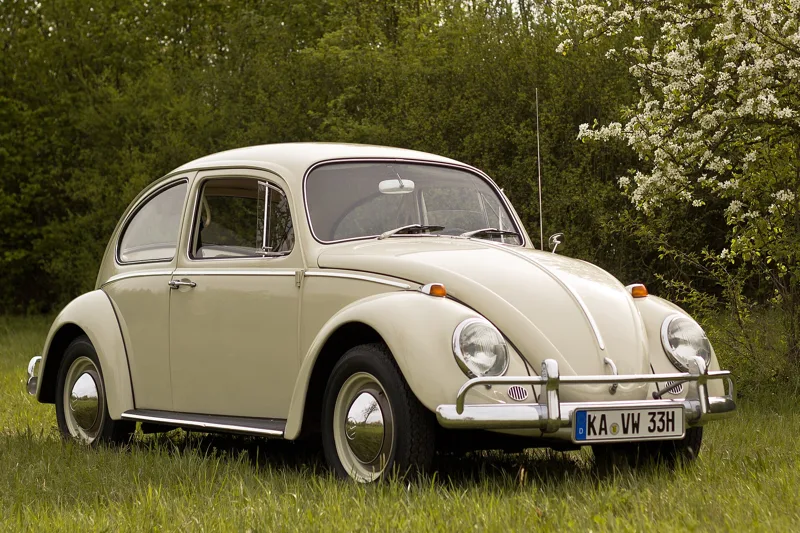
Yes, the relationship between Tatra and the Beetle is well documented. Adolf Hitler rode in Tatras during political tours of Czechoslovakia and dined with Ledwinka many times. After one of those dinners, Hitler told Ferdinand Porsche that this was the car for his roads.
Ledwinka and Porsche met regularly from 1933, and Porsche admitted that he had looked over Ledwinka's shoulder while designing the Volkswagen. The Tatra 97 of 1936 had a rear-located, air-cooled four-cylinder boxer engine and a central structural tunnel, and the resemblance to the Beetle was striking.
Tatra sued Volkswagen for patent infringement, but the German invasion of Czechoslovakia stopped the case. The matter was reopened after the war, and in 1965 Volkswagen paid the Ringhoffer family DM 1,000,000 in an out-of-court settlement. Hungarian engineer Bela Barenyi had also sketched Beetle-like designs as early as 1925.
How did the Second World War affect Tatra?
After the German invasion of 1938, Tatras stayed in production, largely because German buyers liked the cars. Many German officers died in accidents caused by driving the heavy, rear-engined cars too fast around corners. The cars earned the nickname the Czech Secret Weapon, and at one point German officers were ordered not to drive them.
Tatra was also drawn into the war effort. Its trucks and tank engines served the German military, and the T111 that evolved in 1942 became instrumental for the German war effort. It was produced until 1962, with a total of 33,690 units made.
What happened to Tatra after nationalisation?
The factory was nationalised in 1945, and in January 1946 it was renamed Tatra Narodni Podnik. Prewar models continued in production while a new car, the Tatra 600 Tatraplan, was designed to celebrate the new planned economy. It went into production in 1948.
In 1951 the state planning department moved Tatraplan production to the Skoda plant in Mlada Boleslav. That freed Tatra to concentrate on trucks, buses and railway equipment, and the company's identity as a truck maker grew stronger from that point on.
Why was the Tatra 603 so exclusive?
The Tatra 603 was a luxury car that Tatra was permitted to build in 1953, when Communist leaders were dissatisfied with poor-quality official cars imported from Russia. It used a rear-mounted, air-cooled V8 and the company's trademark aerodynamic styling. It initially had three headlights, and it wore thick chrome bumpers with bullet-shaped tips.
Almost all 603s were hand-built, and ordinary citizens were not permitted to buy them. The cars went to the Communist Party elite and industrial officials, and they were exported to most other communist nations as official state cars. Cuban President Fidel Castro had a white 603 fitted with air conditioning.
Production ran until 1975, a period of around twenty years. Cars were sometimes reconditioned rather than new, and older examples were returned to the factory for upgrade. That practice makes it difficult to trace the history of surviving cars.
What replaced the Tatra 603?
The Tatra 613 replaced the 603 after a development programme that started in 1968. Italian styling house Vignale gave it a more modern, less rounded shape. The car went into production in 1973, and its new engine was a 3495 cc unit with four overhead camshafts.
More than 11,000 Tatra 613 cars were built before production ended in 1996. Sales slowed to a trickle of just a few dozen a year towards the end, as Tatra's cars began to look outdated.
Was the Tatra 700 a success?
The Tatra 700 was a large luxury car released in 1996. It was essentially a heavily restyled Tatra 613 with updated body panels and detailing, and it came as both a saloon and a coupe with 3.5 or 4.4 litre air-cooled V8 petrol engines.
The model was neither successful nor produced in large numbers, with between 69 and 72 cars built. The Tatra 700 was the last passenger car the company made, with production halting in 1999. Tatra then left car manufacturing behind to concentrate on trucks.
What was the MTX V8?
The Tatra MTX V8 was described as the fastest Czech car of all time. Production started in 1991 in Koprivnice, and the car used a Tatra 623 V8 with inlet manifold injection producing 225 kW at 6500 rpm. It reached 100 km/h in 5.6 seconds and had a top speed of 265 km/h (165 mph).
The Czech designer Vaclav Kral created the MTX V8, and only five were ever produced.
How did Tatra keep the air-cooled engine alive?
Tatra kept its air-cooled engine tradition going into the modern era. In February 2008 the company announced what it described as the world's first and only air-cooled engine meeting the forthcoming Euro 5 emissions standards, and it said that all Tatra vehicles from that month onwards would use it.
Tatra also said that air-cooled engines reduced greenhouse gas production because they had no liquid cooling system. Air-cooled engines remain part of the company's truck range, linking modern trucks to the cars of the 1930s.
How did Tatra's trucks begin?
The first truck was made at Koprivnice in 1898. It was a flatbed with two liquid-cooled Benz engines of 2.7 litres each, producing 8.8 kW (12 hp) and carrying 2.5 tons. The two engines could be run one after another depending on the load.
A second truck, a flatbed R type with a 2.5-ton capacity, was built in 1909. Tatra also built its first bus, the Omnibus type SO, in 1910, with five units made. Serial truck production began in 1914 with two trucks, and the output grew rapidly after that.
How many trucks did the early Tatra lines build?
By the end of 1915 Tatra had produced 105 TL-2 units, and in 1917 the company built 303 TL-4 models, which marked the peak of that period. Production then declined, and a similar number of one model in a year was not reached again until the T27 in the 1930s.
The T27 was the most popular Tatra truck before the Second World War. It was produced from 1930 to 1947, with a total of 7,620 units made. The T111 of 1942 evolved from the T81 and contributed to rebuilding efforts across Central and Eastern Europe after the war.
What did the T813 and T815 bring?
In 1967 Tatra began production of the T813, an off-road truck built with its modular construction methods. Its design target was towing up to 100 tons GCM, and it became common on Czechoslovak roads carrying oversized cargo.
The T815 went into production in 1983 after its 1982 introduction. It had 142 main assembly components, compared with 219 on its predecessor, and its engine power output rose by up to 45 per cent. Modular engine designs gave it V8, V10 or V12 options, with or without a turbocharger.
Why did Tatra's ownership change so often?
The American company Terex acquired 71 per cent of Tatra in late 2003. By late 2006 the majority was held by Tatra Holdings, an international consortium that included investors from the UK, the US, Belgium and the Czech Republic.
A contract signed in December 2006 covered 556 trucks for the Czech Republic at about $130 million. In August 2011 DAF Trucks built up a 19 per cent stake to tighten cooperation, and in March 2013 Czechoslovak Group and Promet Group acquired the majority stake after manufacturing had been halted by bank refusals.
Tatra sold 722 units in 2013 and planned to sell more than 2,000 trucks in 2023. The new owners focused production on specialist vehicles built to custom orders.
What trucks does Tatra make today?
Tatra's core production is heavy, off-road trucks built around its backbone chassis, swinging half-axles and air-cooled engines. The Tatra 817 Force is aimed primarily at military operators, while the Tatra 158 Phoenix uses a DAF cabin and a water-cooled engine for civilian buyers.
The Tatra 810 Tactic is a medium off-road truck with a conventional frame and a Renault engine and cabin, offered to both military and civilian customers. The T816 LIWA was built under a UAE contract worth $180 million, and Navistar Defence and Tatra showed ATX models at Eurosatory 2010.
Did Tatra race cars?
No significant motorsport record is listed for the Tatra marque. Its competition story is mainly one of technical innovation rather than race results, with aerodynamics and rear-engined layouts defining its cars.
Its historic list of prototypes and racing cars includes a Tatra 12 Targa Florio from 1925, a prototype built for the famous Sicilian road race. Those entries are curiosities rather than a record of wins.
What are the Tatra specifications?
Tatra's cars were defined by backbone chassis, air-cooled engines and rear-mounted layouts. Its trucks were defined by the T27, T111, T813 and T815 lines. The table gives the key figures for the most significant models across both sides of the business.
| Specification | Detail |
|---|---|
| Founded | 1850 as Ignatz Schustala & Cie, Koprivnice |
| Prasident | 1897, first factory petrol car in Central and Eastern Europe |
| Nesselsdorf A | 1900, 2714 cc rear-mounted engine, 40 km/h, 22 units |
| Tatra 11 | 1923, 1056 cc air-cooled two-cylinder, backbone chassis |
| Tatra 17 | 1925, 1930 cc water-cooled six-cylinder |
| Tatra 77 | 1934, world's first production aerodynamic car, drag 0.2455 on a 1:5 model |
| Tatra 603 | 1953 to 1975, rear-mounted air-cooled V8 |
| Tatra 613 | 3495 cc, four overhead camshafts, more than 11,000 built |
| Tatra 700 | 1996, 69 to 72 built, last passenger car |
| MTX V8 | 225 kW at 6500 rpm, 0-100 km/h in 5.6 seconds, 265 km/h (165 mph), five built |
| First truck | 1898, two Benz engines totalling 8.8 kW (12 hp) |
| T27 | 1930 to 1947, 7,620 units |
| T111 | 1942 to 1962, 33,690 units |
| T815 | 1983 production, 142 main assembly components |