A state-backed small car, a long list of rival claimants to its design and a record held for 25 years.
The Volkswagen Beetle was a small German car built from 1938 to 2003, the longest run of any single generation, with 21.5 million made. Ferdinand Porsche's team developed it from a 1934 contract, and it became the all-time sales leader when it overtook the Model T.
For 25 years the Volkswagen Beetle was the best-selling car in history, a record it took from the Ford Model T in 1972. It began as a German state project in the 1930s and was built until 2003, longer than any other single generation of car.
Why did Germany want a people's car?
In the early 1930s Adolf Hitler decided the country needed a "people's car", which in German is a Volkswagen: an inexpensive, simple, mass-produced car to serve the new Reichsautobahn road network. The idea itself is older than Nazism and has existed since mass production began, but the state gave it money, a deadline and a factory.
The specification was set at a meeting at Berlin's Kaiserhof Hotel in May 1934. Hitler demanded room for two adults and three children, and fuel consumption of no more than seven litres per 100 km (33.6 mpg US/40.4 mpg UK). Parts had to be designed for quick, cheap replacement. His reason for choosing an air-cooled engine was equally down to earth: not every country doctor had a garage.
On 22 June 1934 Ferdinand Porsche received a contract from the Verband der Automobilindustrie, the German Association of the Automotive Industry, to produce a prototype of an inexpensive and economical passenger car. At the 1933 Berlin Motor Show, Hitler had already announced a plan to motorise the nation, imagining a future where every German would own a car or a tractor.
Money was a real obstacle. Petrol was expensive in Germany because of taxes, and fuel was mainly reserved for the military. In 1930 the country had only about 500,000 registered cars, while France and Great Britain each had more than a million and the United States had more than 26 million. Even so, the regime saw a mass-produced car as a way to promote its system, a shift from a privilege of the wealthy to something lower-class Germans could aspire to. Hitler was especially keen since the design lent itself to military adaptation.
Sometimes I looked over his shoulder, and sometimes he looked over mine.
How was the first Beetle designed and tested?
Porsche ran his own consulting firm in Stuttgart, founded in April 1931, and he had been chasing a small car for years. An earlier idea from his Daimler-Benz days had gone nowhere with the board. Zundapp and then NSU had helped pay for a small-car project in his own office, but Zundapp lost interest after its motorcycle success and NSU backed out over the high cost of tooling.
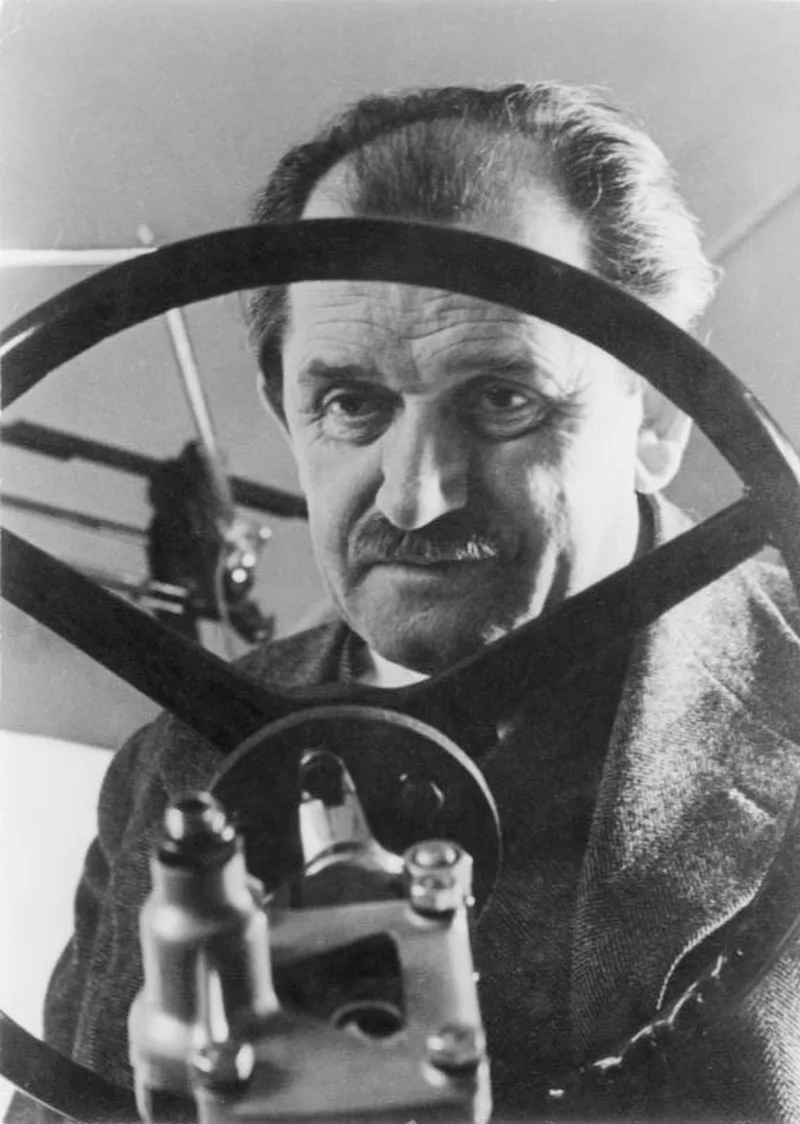
The state contract changed that. The project was first called the Type 60, and Porsche assembled a team. Erwin Komenda handled the bodywork, Josef Kales designed the engine and Karl Rabe served as chief engineer. Josef Mickl was part of the group too, and Franz Xaver Reimspiess is credited with devising the Volkswagen badge.
The first two prototypes appeared in October 1935. They were named V1 for the sedan and V2 for the convertible, the V standing for Versuchs, meaning "prototype". Three more, the V3 cars, began testing on 11 July 1936, and the first of them was driven to Obersalzberg for Hitler to inspect. The V3 cars went on to log more than 50,000 km (31,000 mi) across varied terrain.
A larger test followed. Daimler-Benz built thirty W30 development cars to Porsche's order, and in early April 1937 they covered a combined 2,900,000 km (1,800,000 mi). Every one of them had the rounded shape and rear-mounted, air-cooled engine that defined the final car. A batch of 44 VW38 pre-production cars in 1938 brought in a split rear window, and fifty VW39 cars were completed in July 1939.
How does the Volkswagen Beetle work?
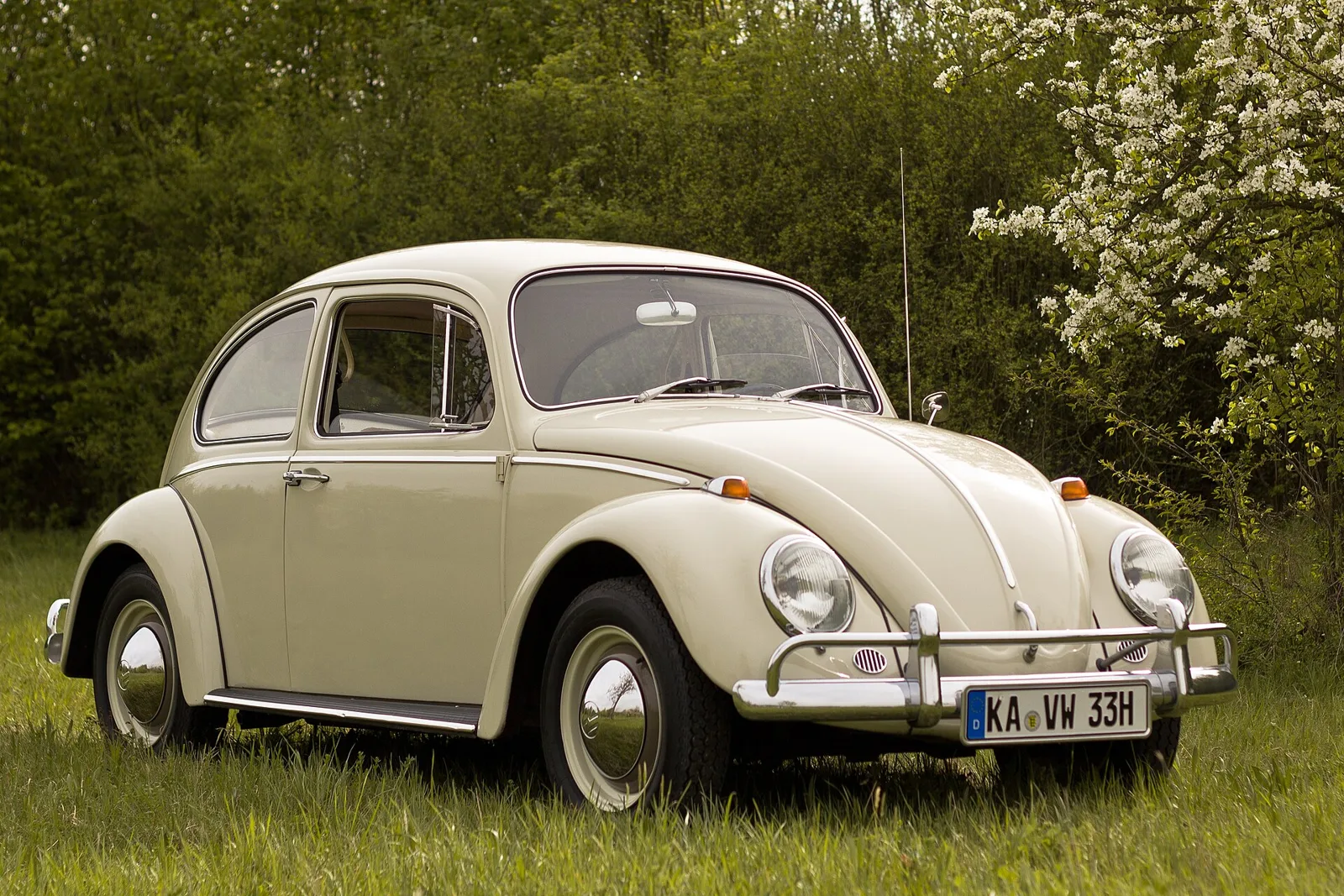
The Beetle puts a four-cylinder, air-cooled boxer engine at the back and drives the rear wheels. A boxer engine has its cylinders lying flat in two opposed banks, a bit like a boxer's fists swinging outwards. The body has two doors, a flat front windscreen and room for four passengers, with luggage space in two places: under the front bonnet and behind the rear seat.
The body is bolted to a nearly flat platform chassis with eighteen bolts, and a structural tunnel runs down the middle for stiffness. Torsion bars, a type of spring that works by twisting, handle the suspension at the front and rear, with a stabiliser bar at the front. All four wheels are independently suspended. The front axle uses double longitudinal trailing arms, and the rear uses a swing axle. The engine, transmission and cylinder heads are made of light alloy, and the drag coefficient is quoted as 0.48.
That sounds basic, and it was meant to be. Simplicity was the point, with air cooling and parts designed for quick, cheap exchange. Yet the design stayed consistent for more than six decades, even though Volkswagen made over 78,000 updates to it. Most were subtle changes to the exterior, interior, colours and lighting, though new engines, models and systems also arrived, with improved technology or comfort.
Did Ferdinand Porsche really design the Beetle?
Porsche and his team are generally named as the original designers, yet there has been debate over that for decades. Several engineers had ideas that appear in the finished car, and the strongest claim belongs to Bela Barenyi.
| Engineer | Contribution claimed | Date and evidence |
|---|---|---|
| Bela Barenyi | Beetle-like concept with air-cooled rear boxer four, gearbox ahead of the rear axle and a roundish shape | 1925; authorship upheld by a court in 1953 |
| Paul Jaray | Streamlining and aerodynamic calculations | Patents from the early 1920s; 2008 dissertation by Christian Binnebesel |
| Josef Ganz | Compact-car concept, central tubular frame, independent suspension | Hitler reportedly saw his cars at the 1933 Berlin Auto Show |
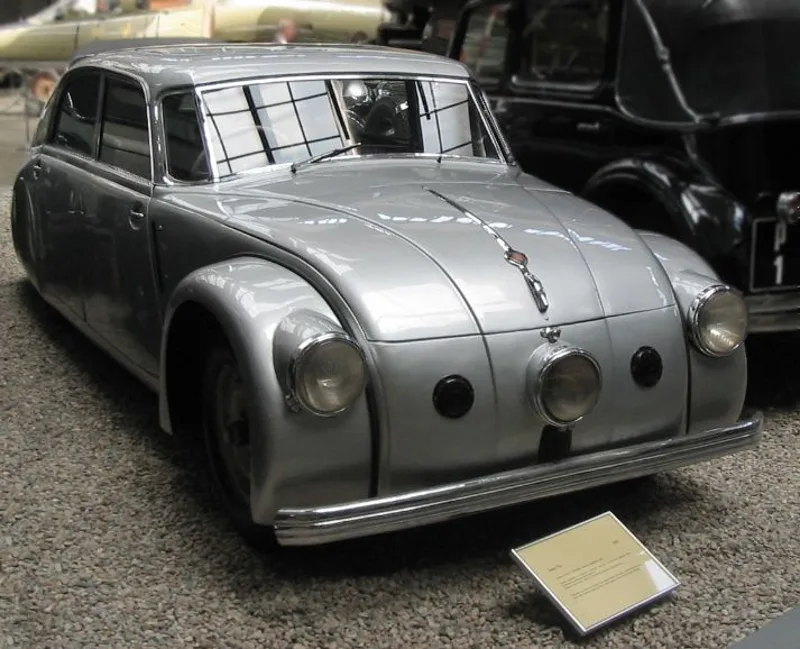
| Hans Ledwinka | Air-cooled rear-engine Tatra cars | V570 prototype of 1931; Tatra 97 of 1936 |
Barenyi designed a car shaped much like the Beetle in 1925, more than five years before Porsche unveiled his first People's Car design. He said he had explained the whole concept to Porsche in detail but had not protected it adequately with patents. A court ruling in 1953 accepted his claim to authorship. Dieter Landenberger, who runs Porsche's historical archive, later affirmed that Barenyi had a "decisive role" in the authorship of the later Beetle.
Jaray's aerodynamic research, which reached back to the early 1920s, also shaped what was then called the KdF car, according to a November 2021 update of research reported by the Frankfurter Allgemeine Zeitung. Ganz's role stayed controversial for years, though research suggests his compact-car idea played a part in the prototypes. His Standard Superior carried its engine transversely ahead of the axle, not at the back.
The most direct influence was Hans Ledwinka of Tatra. Tatra built the V570 prototype with an air-cooled flat-twin at the rear in 1931. Hitler rode in Tatras on tours of Czechoslovakia and told Porsche, "Sometimes I looked over his shoulder, and sometimes he looked over mine." From 1933 the two engineers met regularly, and Porsche admitted that sometimes he looked over Ledwinka's shoulder and sometimes Ledwinka looked over his. The 1936 Tatra 97 had a rear-located, air-cooled four-cylinder boxer of 1,749 cc and seated five.
Tatra sued over patents before the war. The case was halted by Germany's invasion of Czechoslovakia in 1938, and Tatra's factory came under Nazi administration that October, after which it was told to concentrate on heavy trucks and diesel engines, with the V8 Tatra 87 the only car left. The dispute returned after the war, and in 1965 Volkswagen settled out of court, paying Ringhoffer-Tatra one million Deutsche Marks.
Porsche the engineer
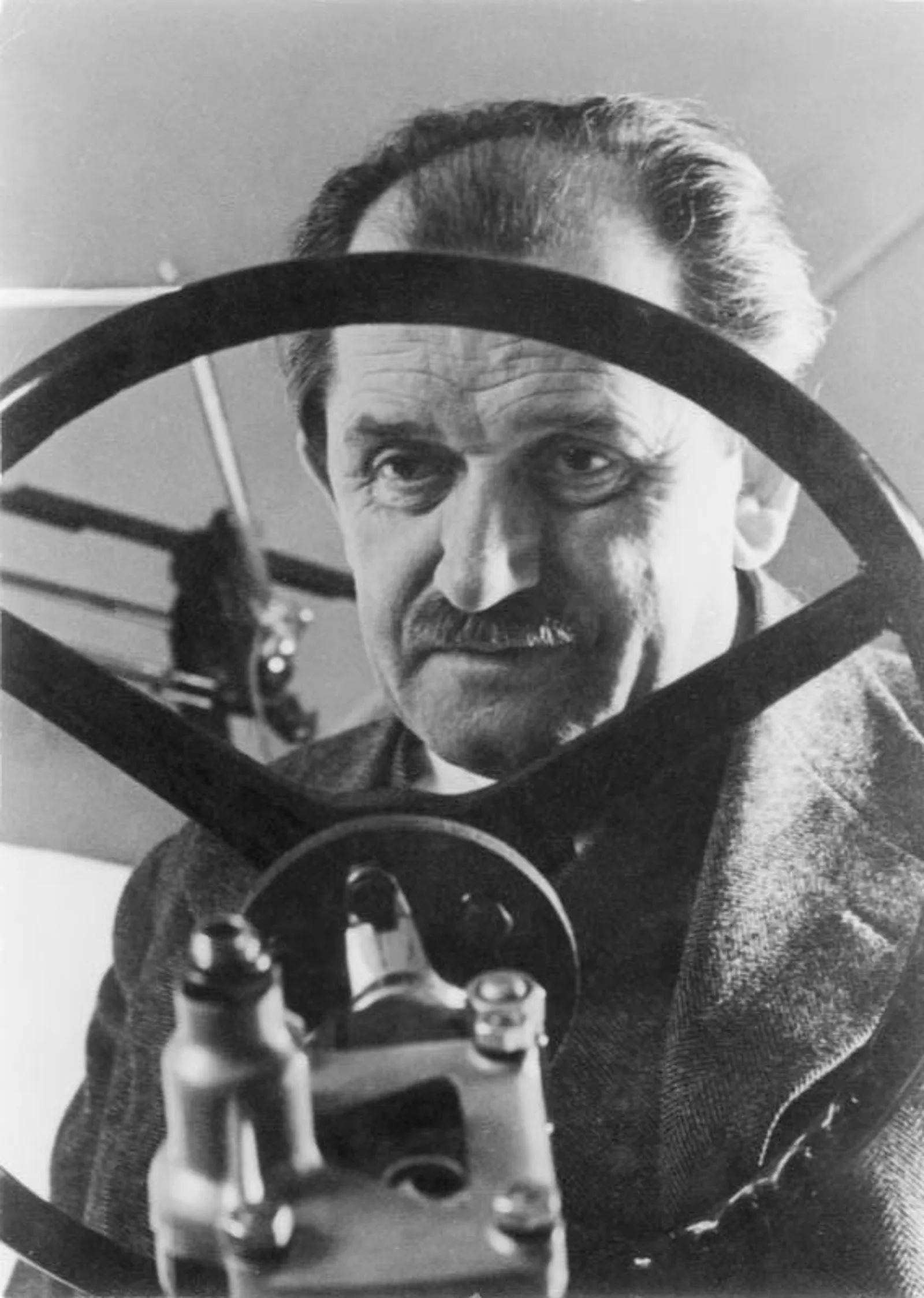
Porsche, born on 3 September 1875 in northern Bohemia, was already famous by then. His father was a master panel-beater, and he moved to Vienna in 1893 at the age of 18 to work for an electrical company. In 1901 his Lohner-Porsche Mixte used a petrol engine to drive a generator that fed electric motors in the wheel hubs, the first petroleum-electric hybrid on record. At Austro-Daimler he led the car that won the first three places in the 1910 Prince Henry Trial, and a 1922 design he made won 43 of 53 races.
He became Technical Director at Daimler Motoren Gesellschaft in 1923, moved to Steyr in 1929, lost that job to the Great Depression and set up on his own in 1931. He died on 30 January 1951. He was named Car Engineer of the Century in 1999 and entered the International Motorsports Hall of Fame in 1996. He joined the Nazi Party in 1937, as well as the SS, and during the war worked on tanks and other weapons.
What happened to the Beetle during the war?
Hitler ceremonially laid the foundation stone of the Volkswagen factory on 26 May 1938, and the car's name was officially changed to KdF-Wagen, after Kraft durch Freude, or Strength Through Joy, the organisation in charge. Robert Ley, who headed it, announced in 1938 that within a decade every German would have a Volkswagen of their own. Workers were urged to save five marks a week and get their car.
Many Germans signed up to a savings plan before the factory was finished. More than 330,000 savers never received their cars, because the factory turned entirely to wartime needs. After the war, many of them pressed for delivery, were refused and began the VW saver initiative, which ran for several years.
The plant at Fallersleben, now Wolfsburg, was not finished when the war began, so no series production of the Beetle took place. By May 1945, 210 KdF-Wagens had been made. In their place, the factory built the Kubelwagen (Type 82), the Schwimmwagen (Type 166) and other light utility vehicles for the Wehrmacht, all mechanically derived from the Type 1. Several hundred Kommandeurswagen (Type 87) put a Beetle body on the sturdy chassis of the four-wheel-drive Type 86 Kubelwagen prototype.
When fighting stopped, British occupying forces brought the factory back into operation. By the close of 1945 the factory had turned out 1,785 Volkswagens, which went to the occupying powers and the postal service. The city that grew up around the plant is called Wolfsburg today and remains the headquarters of the Volkswagen Group.
How did the Beetle outsell the Model T?
Across 65 years, 21.5 million Beetles came out of twenty locations around the world. No other car on a single platform has sold more, and only one nameplate sold more during the 20th century. The Beetle overtook the Ford Model T in 1972 and kept the all-time crown for 25 years, and it was the first car to pass 20 million units.
For most of that time it was not called the Beetle at all. The car was originally the Volkswagen Type 1 and was marketed simply as the Volkswagen, and it only received the official name "Beetle" in 1968. In the 1960s Volkswagen added numbered designations including 1200, 1300, 1500, 1600, 1302 and 1303. Many rank it among the most influential cars of the 20th century, and its success shaped how cars were designed and marketed.
What ended Beetle production?
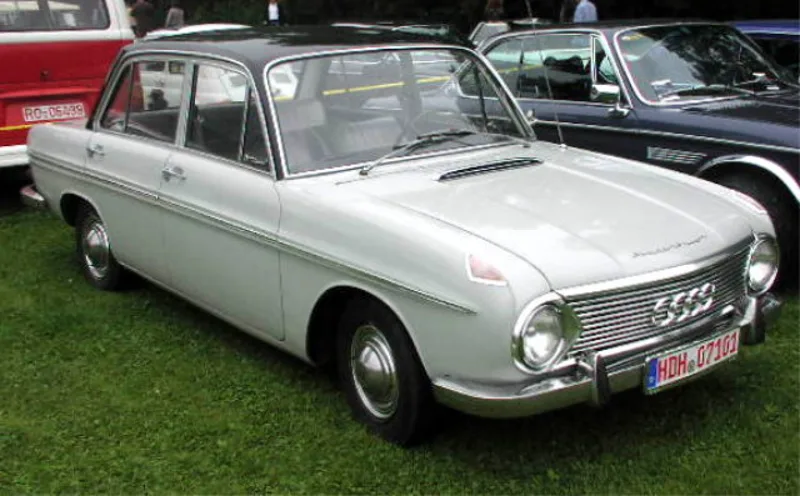
Volkswagen tried to supplement the Beetle with large luxury models through the 1960s and 1970s, the Type 3, the Type 4 and the K70, but none matched its success.
The market itself moved. European tastes shifted quickly towards compact front-wheel-drive hatchbacks, and Volkswagen began a gradual change of direction away from rear-wheel drive with the Golf in 1974. Then Japanese makers rose to dominate markets worldwide in the late 1970s and 1980s, a factor in the Beetle's slide in popularity. The original car stayed in production until 2003. Its influence also pushed Volkswagen to introduce a Golf-based series of vehicles.