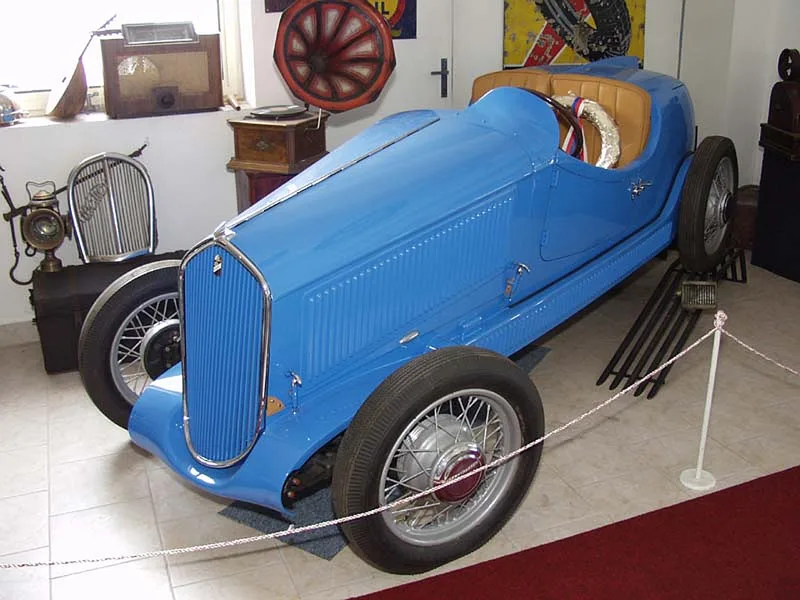
A Fiat-based Prague sports roadster, built in only about twelve examples, that raced the 1,000 Miles and the Krakonos circuit.
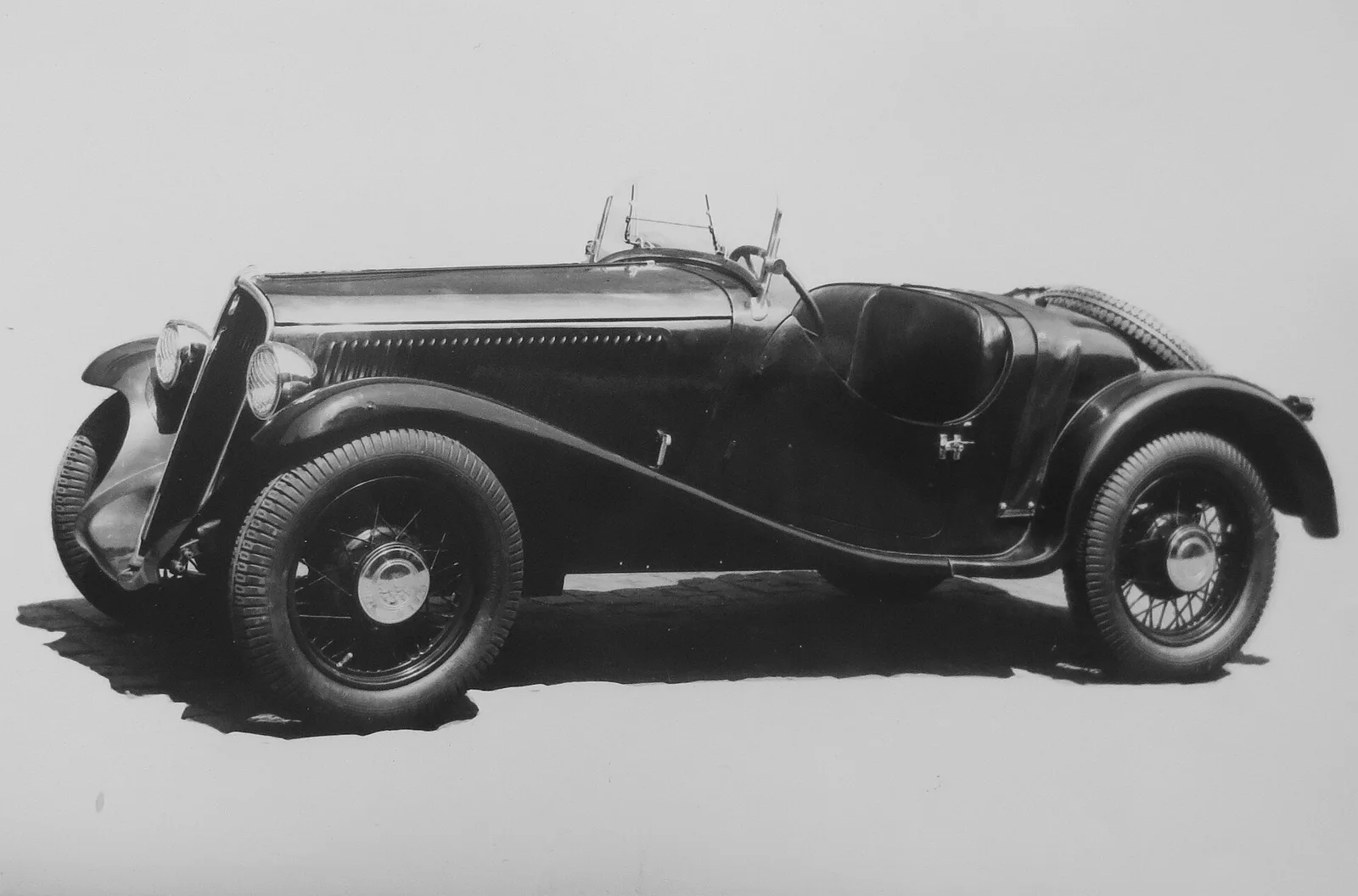
The Walter Junior SS was a Prague sports roadster built from 1934 to 1936 on the Fiat Balilla 508 S licence. Its 1,057 cc engine was bored out from the racing Junior S, and the factory built only about twelve cars.
The Walter Junior SS was a sports roadster built by Walter at Prague-Jinonice from 1934 to 1936, based on the licence-built Fiat Balilla 508 S. Walter made only about twelve of them, and its adapted engine was the direct predecessor of the Fiat 1100 of 1937. The Junior SS raced in the Czechoslovak national events of the 1930s and remains a rare survivor today.
Why was the Junior SS built?
The car was made specially for the 1934 1,000 Miles of Czechoslovakia race, in which the factory fielded eight Junior SS cars. Only about twelve were built in total.
Factory drivers included Ivan Hodac, nicknamed Bibisek, Mirko Sochor and Ing. Jaroslav Hausman. Besides the 1,000 Miles, the factory appeared at the Zlin Eight reliability trial in 1934, the Across the Sumava event in 1934, the Jeneralka hill climb in 1935, the Brandys circuit in 1936 and the Zdib circuit in 1937.
Built in only about twelve examples, the Junior SS raced the major events of the 1930s on a Fiat-based chassis.
How did the engine grow from the Junior S?
The Junior SS engine came from the racing Junior S, which was bored out by 2 mm, from 65 to 67 mm. That gave a swept volume of 1,057 cc (64.5 cu in) with a 75 mm stroke. Some sources give 1,089 cc (66.5 cu in), which would mean a 68 mm bore, and Jaroslav Hausman, who raced one, also confirmed that capacity.
The spark-ignition, liquid-cooled in-line four had OHV valve gear, two valves per cylinder and no supercharger. It was placed lengthwise behind the front axle, and its crankshaft ran on three main bearings. Tuned this way it produced 35 PS (26 kW; 35 hp) at 4,400 rpm, which was enough for a top speed of 125 km/h (78 mph).
Walter Junior SS key specifications
| Item | Detail |
|---|---|
| Engine | 1,057 cc (64.5 cu in), OHV in-line four |
| Power | 35 PS (26 kW; 35 hp) at 4,400 rpm |
| Top speed | 125 km/h (78 mph), 150 km/h (93 mph) in race trim |
| Fuel use | 9-10 l/100 km (28.2-31.4 mpg-imp; 23.5-26.1 mpg-US) |
| Wheelbase | 2,250 mm (88.6 in) |
| Track | 1,200 mm at both front and rear |
| Kerb weight | 620 kg (1,367 lb), gross 765 kg (1,687 lb) |
| Gearbox | Four-speed with partial synchromesh |
| Brakes | Hydraulic on all four wheels |
What did the chassis and body look like?
The Junior SS kept the touring Junior's basic chassis, with rigid axles and the rear one driven. It sat on a low rectangular frame with a cross brace, and a stiff central frame with an X-shaped brace gave it handling that suited motor sport even as a roadster.
The radiator was extended forward into a sloping, pointed mask, and the profiled wings reached almost to seat level. The windscreen folded fully and was made of shatterproof glass, while the deep door cut-outs gave the so-called elbow-out style that sports cars favoured for many years.
On the sports body there was only one visible change to the rear. The vertical fin was removed and the tail rounded off, as on the Walter Standard S of 1934. Up to two spare wheels could be carried at the back, and the folding roof was recessed into the body behind the two seats.
The sports version moved the 65 l fuel tank from the engine bay to the rear, behind the seats, and race cars received a four-speed gearbox with synchromesh on third and fourth. Their handbrake was also hydraulic instead of mechanical.
Which bodies were offered besides the roadster?
The usual form was the two-seat roadster. Some were built as two-door coupes with fixed roofs, which were sometimes called tudors. Coachbuilder Oldrich Uhlik of Prague-Strasnice produced individually bodied examples with rear-hinged doors.
Those special bodies were distinct from the factory cars, which had front-hinged doors and a more steeply raked tail.
How did the Junior SS fare at the 1,000 Miles?
In 1934 the factory's eight Junior SS cars were split into two teams, and all of them finished in front of the Automobile Club building in Opletalova street. Ivan Hodac and Frantisek Zima were the best of the Juniors, 2nd in class and 6th overall, at an average of 92 km/h.
Walter had offered a special cash prize for the winning car, but the Junior SS team missed both the class and the team prize by a single point. They went to the Z4 Sport of Josef Mamula from the Zbrojovka factory in Brno. Zbrojovka had prepared four closed aluminium two-seat aerodynamic cars and an open roadster on a shortened Z4 chassis.
In 1935 the race was won overall by Jan Kubicek on a 1927 Bugatti 35B fitted with a Ford V8 engine. Frantisek Kurka, driving a Walter Junior SS, was badly hurt in a crash and died of his injuries that evening. He was buried in Prague's Malvazinky cemetery, where Josef Walter is also buried. After several fatal accidents, President Masaryk refused to support an event where people died, and the race was held for the last time in 1935.
How did the Junior SS perform on the Krakonos circuit?
The Krakonos circuit, in the Podkrkonosi region, was the third most important circuit event of interwar Czechoslovakia after the Masaryk circuit and the 1,000 Miles. It was a regular stage for the Junior SS. Mirko Sochor won the sports class up to 1,100 cc in 1934 at 89.8 km/h, and Jaroslav Kubes took what was essentially the last Walter victory in 1938.
In its first three editions the circuit measured 34 km and the race ran over 10 laps, or 340 km. From 1936 the circuit was cut to 22 km and seven laps, or 154 km. Crowds regularly topped 15,000, and the 1937 edition drew a record 18,000 spectators.
In the 1934 race Walter's third place went to Materna, who had also won a silver plaque at the Luhacovice concours. Hausman set the fastest lap of the race but crashed heavily on lap 5 and wrecked his car. In 1936 Antonin Vitvar won overall, while Jaroslav Kriz took the class up to 1,100 cc in a Walter Junior SS, ahead of Vlasin and Formanek on Zetkas.
The final edition took place on 31 July 1938. Jaroslav Kubes took the junior class up to 1,100 cc in 1:20:52.3 hours, and it was the last major success for a Walter on the race tracks. The circuit ended with the outbreak of the Second World War in 1939, and attempts to revive it afterwards never came to fruition.
What happened at Telc and Lochotin?
The Telc race of 12 August 1934 was a time-trial format, in which the average speed of the whole event had to beat the average of the first lap. Ivan Hodac's Junior SS set the best time of the day, 2:10:19 hours at 82.7 km/h, but he could not be classified under the rules. Brno's B. Fiser, who finished 4th, was disqualified on the same clause.
The consolation for Walter was a win in the class up to 1,500 cc, which went to the private driver L. Grus from Mrakotin in a Walter Bijou. Rain began to fall from the third lap, which caught out the drivers who had set a sharp pace from the start.
At Lochotin, a 4.3 km circuit near Pilsen with three different surfaces, the Junior SS and the Z 4 Sport met repeatedly from 1934 to 1937. In 1934 Ivan Hodac retired on lap 3 with a clutch failure, and Jaroslav Manda took 2nd place for Walter. Leo Sabat, a representative of the Walter and Fiat firms in Pilsen, took 3rd, and he later became a victim of the Holocaust.
In 1935 Hodac took 2nd place in the class up to 1,100 cc, although a collision with Karel Vlasin's Z 4 slowed him down. His Junior SS was the fastest Czechoslovak-built car in the race, and it earned the Pilsen city council prize, awarded for the fastest time by a Czechoslovak car up to 1,500 cc.
In the 1934 Lochotin race a silver cup went to Boh. Fiser of Brno, who had won none of the prizes on offer and used a BS battery in the race. He took 6th place in a Walter Junior SS. The 1935 race was extended to 15 laps, or 64.5 km, and the class up to 1,100 cc went to Jiri Pohl on an English MG with a supercharger. Some rivals protested against the supercharger, but the organiser, Dr. Vitezslav Kumpera, rejected the protests because the rules did not forbid it.
The 5th edition, on 30 August 1937, produced a close finish in the class up to 1,100 cc. Jaroslav Horak took 2nd place on a Walter Junior SS in 44:28.1 min, at an average of 87.03 km/h, and finished 11 seconds behind Dr. Vladimir Pohorecky on a Salmson.
Did the Junior SS race at the Masaryk circuit?
Rudolf Manousek started a Walter Junior SS at the 1934 Masaryk circuit race in the weaker class up to 1,500 cc, but he did not finish. He crashed on lap 11 of the 15-lap race at Kohoutovice, destroying the car, although he was unhurt.
The Masaryk circuit at Brno had claimed a life on 28 September 1934, when the Slovak driver Josef Brazdil died in the wreckage of his new Maserati 6C-34 during an unofficial practice session. The race itself, held in front of 150,000 spectators, was won by the German Hans Stuck on an Auto Union, ahead of the Italians Luigi Fagioli and Tazio Nuvolari. The weaker class went to Emilio "Nino" Farina on a Maserati 4CM.
How did the Ceskobrod circuit race run?
The Ceskobrod circuits ran from 1934 to 1938. Prize money was modest and strong entries were hard to find before the June 1,000 Miles, but a few editions still drew Walter Junior SS drivers. The 1935 route ran from Cesky Brod through Tismice, Vratkov, Kostelec nad Cernymi lesy, Kruped and Klecek, then back via Liblice. The original circuit measured 26.3 km.
From 1937 the circuit was shortened to 7.65 km and run on a concrete state road with a sharp bend into Tismice. The road had been built before the war as a strategic route. In 1937 Jaroslav Horak took the class up to 1,100 cc, covering the 10 laps and 76.5 km in 53:05 min, averaging 86.5 km/h. In the junior race for beginners, over 5 laps and 38.25 km, the top two finishers were "Jiri" (Dr. Kraus) and Frantisek Stiller, both on Walter Junior SS cars.
How is the Junior SS remembered today?
Collectors prize the Junior SS for its quality, its looks and its rarity, since only a small number survive. Its duels with the Zetka Z 4 Sport are remembered as some of the most gripping races of the period.
The Between Two Gates race was revived in 2014 for cars built before 1939, and Marek Novotny takes part with a Junior SS fitted with a 1,057 cc engine. The Ceskobrod circuit was revived in 2002 as a veterans' race.
Even after the Second World War the cars appeared at early post-war events. In July 1946 the three-day Great Heinz Competition included a class for cars up to 1,100 ccm, in which Ing. Jan Lamac and Jindrich Bruha finished 5th on a Walter Junior SS.