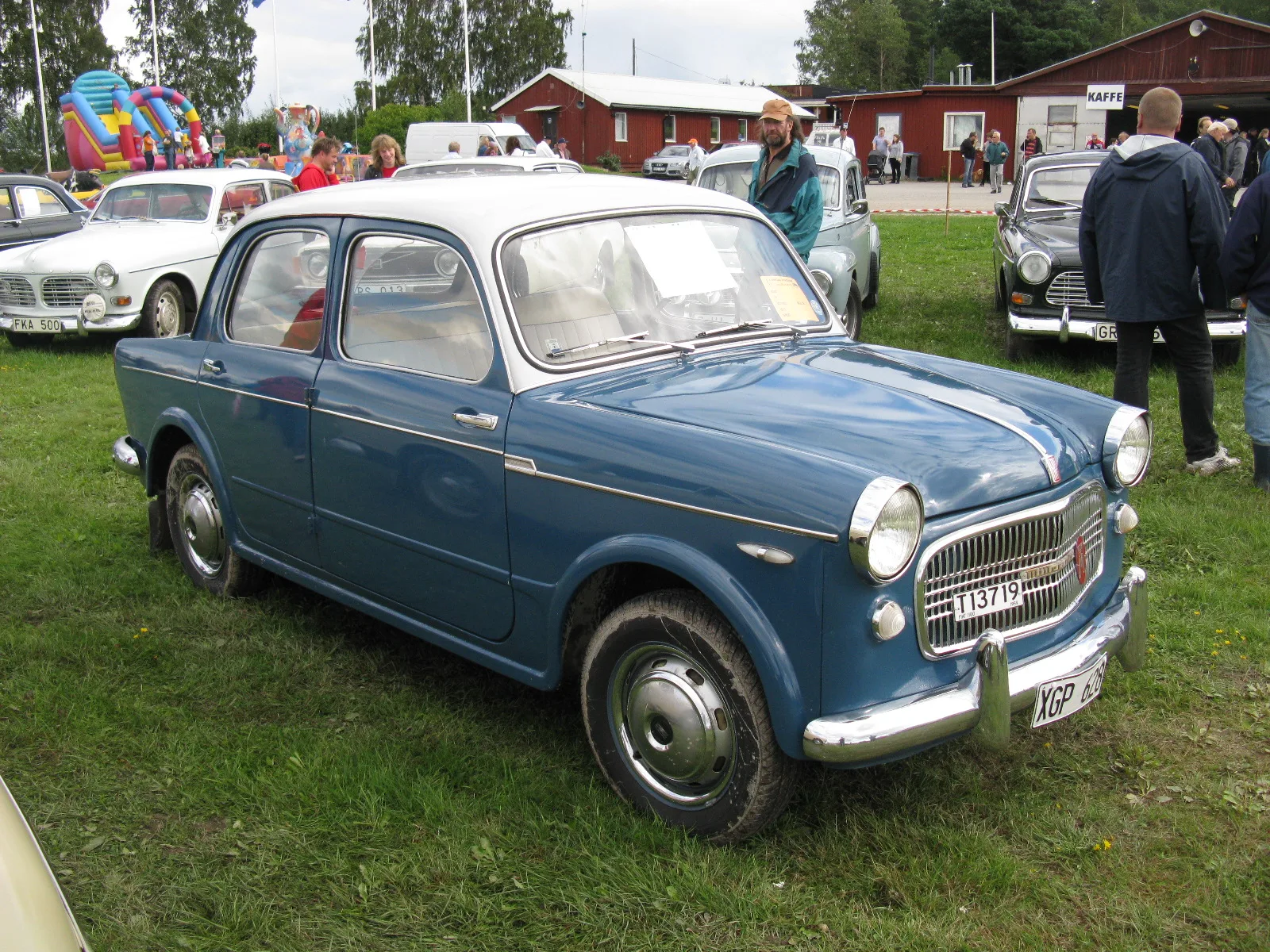
Fiat's unibody Millecento family car, from the 1953 Nuova 1100 through the sporting Turismo Veloce and Lusso models to the 1100 R of 1966.
The Fiat 1100, known as the Millecento in many markets, was a unibody family saloon built from 1953 to 1969. Its 1,089 cc engine descended from a 1937 design, and the range later spawned estates, sporting TV models, roadsters and an Indian licence build.
The Fiat 1100 was a small family car that Fiat produced from 1953 until 1969. The car replaced the 1100 E with a unibody design, and it was refined steadily through its life before the Fiat 128 took over in 1969.
Its engine had a long pedigree, since the 1,089 cc overhead-valve four-cylinder dated back to 1937. The saloon also found a second life in India and Argentina, where local builders kept it in production or assembled it for years after the Italian line had ended.
Where did the Fiat 1100 come from?
The Fiat 1100 replaced the 1100 E, the last development of the pre-war 508 C Balilla 1100. The new car, codenamed Tipo 103, used a unibody structure like the 1400 that Fiat had launched in 1950, while keeping the 1100 E's 1.1-litre engine unaltered.
Fiat's 1400 of 1950 had already brought unibody construction to the company, so the 1100 was the second postwar model to adopt the same method. Its body was an all-new pontoon four-door saloon rather than a reworked older shell.
The 1100 line grew over sixteen years into saloons, estates, sporting variants, roadsters and light commercial vehicles, with the commercial versions staying in production until 1971.
A unibody family saloon that carried the Millecento name from Italy to India and Argentina.
What was the 1953 Nuova 1100 like?
The Fiat Nuova 1100, known internally as the 1100/103, was shown at the April 1953 Geneva Motor Show. It had a four-door pontoon saloon body on unibody construction, a 1,089 cc engine producing 36 PS CUNA (26 kW), and it could reach 116 km/h (72 mph).
The engine was well tested before the 103 arrived. Its output of 36 PS CUNA came at 4,400 rpm, a single horsepower more than the 1100 E had produced from the same basic unit.
The four-speed manual gearbox had synchromesh on the top three ratios, and its gear lever sat on the steering column, a fashionable arrangement at the time.
Two trims were offered, the spartan Tipo A and the richer Tipo B. Left-hand drive Tipo A cars came only in grey-brown paint, had separate front seats and lacked a heater. The Tipo B came in a choice of paints and interior fabrics, and buyers could add whitewall tyres and a radio.
Doors on the 103 were hinged on the centre pillar, a distinguishing feature throughout the 1950s. The 1960 models moved to a modern bodyshell borrowed from the 1200 Granluce, which ended that arrangement.
What did the Turismo Veloce add?
The 1100 TV, or Turismo Veloce, was a sporting version introduced at the October 1953 Paris Motor Show. It was priced at 1,225,000 Italian lire in 1953, against 945 thousand lire for the basic Tipo A saloon, and it reached 135 km/h (84 mph).
The TV's engine delivered 48 PS CUNA at 5,400 rpm, against 36 PS on the regular saloons. The gain came mainly from a twin-choke Weber carburettor and a higher compression ratio of 7.4:1, up from 6.7:1.
Compression rose to 7.6:1 in 1954, lifting output to 50 PS CUNA. The propshaft was split into two pieces to damp the torsional vibrations that the extra output had made worse.
The body was built by Fiat's Carrozzerie Speciali department and had a larger, curved rear window with prominent rear wings. A single fog lamp sat inset in the grille, flanked by two chrome whiskers, and the car wore whitewall tyres as standard.
Fiat's sporting customers appreciated the TV and entered it in numerous races of the period. Class results at the Mille Miglia in 1954 and 1955, plus a rally victory across Africa, gave it a sporting reputation.
What was the Familiare estate?
The Familiare was a five-door estate added at the 1954 Geneva Motor Show. Its rear bench folded flat to carry 300 kg (661 lb), and two forward-facing jump seats in a third row gave two extra places, so six could travel.
The rear door hinged at the side, and the bench could be lowered to make a flat load area. Export markets called the estate by local names, among them Kombiwagen and Familiale.
Aside from taller tyres, the Familiare was mechanically identical to the standard saloon. The third-row jump seats folded level with the boot floor when they were not in use.
What changed in the 1956 103 E update?
The 1956 103 E update raised compression to 7:1 on the standard engine and 8:1 on the Turismo Veloce. Output rose by 4 PS on the standard car and 3 PS on the TV, to 40 PS CUNA and 53 PS CUNA respectively, while the suspension was softened and the steering geometry altered.
The ordinary saloon got fresh chrome trim and a grille with vertical bars and an oblong fog lamp at its centre. The TV's grille was similarly redesigned, though it carried a pair of rectangular driving lamps beneath the headlights.
The dashboard was new and included a strip speedometer, an ivory plastic wheel and a lower padded fascia. Newly fitted items included a glove box, armrests for all four door panels, seats in two tones and a windscreen washer.
Luggage space improved with a fold-down rear backrest, and the spare tyre moved under the boot floor. The Trasformabile roadster took on the new TV specification, and its turn signals were now mounted directly on the front wings.
How did the 1958 model change?
The 1958 103 D replaced the 103 E in September 1957 with a redesigned rear end, a longer tail, tailfins and a bigger rear window. Power went from 40 PS CUNA to 43 PS CUNA, roughly 32 kW, and the top speed reached 125 km/h (78 mph).
The 1200 Granluce made its debut in October at the Paris show, alongside the 103 D. It had a more modern bodyshell and a 1.2-litre engine, and it took over from the TV, leaving the 1100 range without an upmarket variant for a time.
The grille was new, with thin vertical bars overlaid by four horizontal bars and a Millecento script in its middle. Almost every piece of exterior trim was new as well.
Brakes were uprated with self-centering shoes and wider drums. The engine gained a bigger carburettor, a new aluminium head and a water-cooled intake manifold with a separate duct for each cylinder.
What was the 1100 Lusso?
The Lusso, type 103 H, came back in 1959 as a richer 1100, sitting above the standard saloon and below the 1200 Granluce. Its twin-carburettor engine gave 55 PS SAE, equal to 50 PS CUNA (37 kW), and the top speed was 130 km/h (81 mph).
Elaborate exterior trim set the Lusso apart. The Fiat badge had been on the bonnet, but on the Lusso it sat in the centre of the grille, behind a new square mesh radiator, and the body-side chrome spear split to enclose a contrasting colour band that matched the roof.
A lockable flap concealed the fuel filler, and tall rubber-edged overriders sat on the bumpers. Inside, a padded vinyl shelf sat under the dashboard, and small deflectors were mounted on the front side glass.
The two-piece propshaft was inherited from the TV saloons, and the Lusso kept that arrangement until the 1960 range arrived.
How did the Export and Special models differ?
In 1960 the 1958 model gave way to three cars: the Export, the Special and the Familiare estate. The Special was the first 1100 with four front-hinged doors, taking the 1200 Granluce bodyshell, while the Export kept the Lusso body.
The Special changed its name by market, so it was the Speciale in Italy and the Spezial in Germany. Both saloons had nearly identical interiors, and a contrast colour roof stayed optional on the Special.
Both used the same twin-carburettor engine carried over from the Lusso, which produced 50 PS CUNA and gave a top speed of 130 km/h (81 mph). Thanks to new flexible rubber mounts, a simpler one-piece propshaft replaced the two-piece unit.
A Saxomat automatic clutch was offered as an option on the Special alone. During production the tooling was modified to remove the decorative ridges on the front flank, which had been present since 1953.
Both the Export and the Special stayed in the catalogue until 1962, when the 1100 D took over.
What was the 1100 D?
The 1100 D arrived in 1962 as the third-generation 1100, a four-door sedan that resembled the Granluce, though its sides were simpler and its front end rectangular. Power was 40 PS (29 kW) at launch, and it was later raised to 43 PS (32 kW).
The Deluxe added 50 PS (37 kW), extra side mouldings, a bench front seat with two reclining backs and floor carpets. Folding the rear seatback gave room for longer loads, and the Familiare estate stayed in the line-up.
These cars survived largely unchanged until 1966, when the 124 imposed a new style on the range. Production in India began in 1964, when the car was built there under licence by Premier Automobiles Limited.
In 1993 a diesel version of the Padmini had a 1366 cc engine developed with FNM of Italy, and it was badged the 137D. The Indian plant closed by 2000, ending the model's long run there.
What was the 1100 R?
The 1100 R, born in February 1966, was the last 1100 model. The R stood for Rinnovata, meaning refreshed, and it carried a longer, straighter body with a square back and a 48 bhp (36 kW) 1,089 cc engine, which was the only engine offered.
The larger engine was withdrawn to avoid overlap with the Fiat 124, so the 1100 R used the older 1,089 cc unit with its compression raised to 8:1. That engine had first appeared in the 1937 508 C Balilla 1100.
The tail fins were further reduced, and a round rear light cluster borrowed from the Fiat 850 took the place of the earlier vertical lamps. The car grew slightly longer, and its boot was usefully expanded.
A floor-mounted gear lever returned, linked to the gearbox by rods, and the motoring press welcomed the change. First gear still lacked synchromesh, a reminder that the design was ageing under the skin.
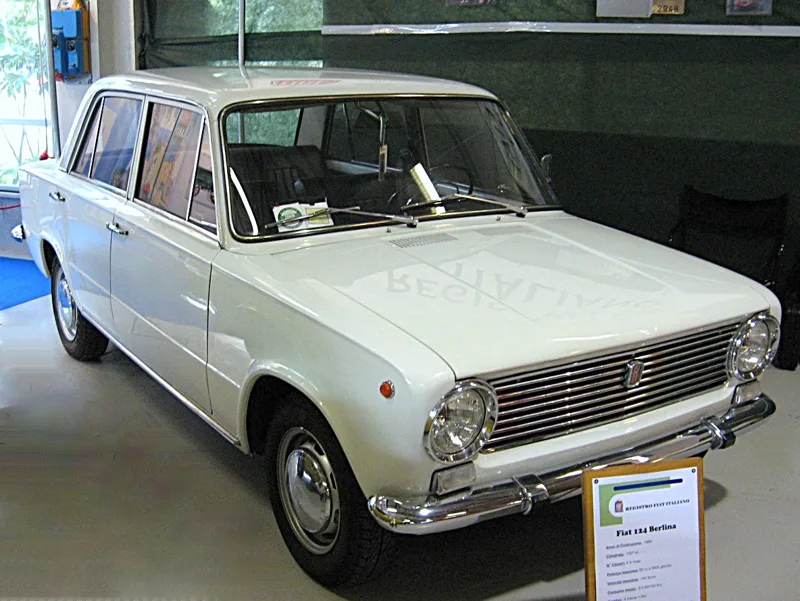
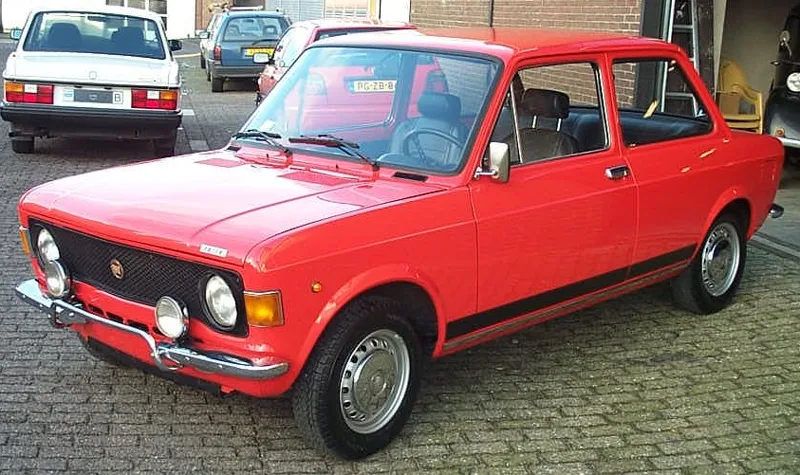
The Fiat 128 took over from the 1100 R in October 1969, five months after its own launch. Neckar in Heilbronn, Germany, also assembled a version called the Neckar 1100 Millecento, which differed only lightly in trim.
How did the 1100 T commercial range work?
Built from 1957, the 1100 T commercial range covered vans, pickups and minibuses. Its 1,089 cc engine made 38 PS (28 kW) at 4800 rpm, with the top speed set at 90 km/h (56 mph). The series ran until 1971 under the 1100 T4 designation.
The 1959 successor, the 1100 T2, had a 1,222 cc unit rated at 45 PS (33 kW). A steady stream of updated engines followed until production of the 1100 T4 came to an end.
How did the Fiat 1100 sell in India?
Premier Automobiles Limited (PAL) imported and built the Fiat 1100 in India, where the early car was called the Millecento and the centre-light model was the Elegant. From 1958 the tailfin model became the Select, followed by the Super Select in 1961 and the Delight in 1964.
In India the car was seen as a sportier alternative to the Hindustan Ambassador, and the Delight used a higher proportion of locally made parts than the early imports.
Premier later used the Premier President name for model year 1972, and the Padmini name from 1974 until production stopped in 2000.
How was the 1100 built in Argentina?
The Argentine car was the 103 D Export, built by Fiat Someca Concord S.A.C.I. at Ferreyra, Cordoba province, from 1960 to 1963. About 23,152 units were made, and the cars were nicknamed millecento, a name that Italian descendants in the region still love.
The Argentine build therefore overlapped with the Italian Export and Special models, which remained on sale in Italy until 1962.
Did the 1100 succeed in motorsport?
The Turismo Veloce won its class at the Mille Miglia in 1954 and again in 1955, and it also took the 1954 Cape Town to Algiers rally outright. Those results gave the sporting version real credibility with enthusiasts, who raced it in period.
The competition success rested on an engine that was tuned in steps, from 48 PS CUNA on the first TV to 50 PS CUNA after the 1954 compression increase.
What was the Pinin Farina coupe?
Between 1954 and 1956 Pinin Farina sold roughly 780 coupes, a two-door 2+2 built on TV mechanicals. The coupe was built in a small series and sold independently of Fiat's own range. The steel body had aluminium doors, bonnet and boot lid, which kept the weight of the hand-built car down.
The design was first shown as a one-off at the 1953 Paris Motor Show. Umberto Agnelli then entered a Pinin Farina coupe in the Orbassano 6 hours Cup near Turin in 1954.
From 1955 the coupe gained a panoramic rear window similar to those found on Pinin Farina-bodied Ferraris of the same period.
What was the Trasformabile roadster?
The 1100 TV Trasformabile was a two-seater roadster introduced at the March 1955 Geneva Motor Show, using TV mechanicals on a body from Fiat's own special bodies department. The first series had 571 examples, and 450 more followed in 1956.
Fabio Luigi Rapi, the department's head and an engineer and designer, drew the lines. Its American-inspired look was the work of Fiat rather than a third-party coachbuilder.
A transitional model appeared in 1957 with updated exterior styling and the same interior, and these cars were largely destined for export. They are now exceptionally rare.
The 1200 Trasformabile arrived in 1957 with a 55 PS (40 kW) 1221 cc engine. About 2360 of the 1.2-litre roadsters were built until 1959, and they had bigger headlights than the 1100 version.
What are the Fiat 1100 specifications?
| Specification | Detail |
|---|---|
| Built | 1953 to 1969 |
| Engine (1953) | 1,089 cc overhead-valve four-cylinder, 36 PS CUNA (26 kW) at 4,400 rpm |
| Top speed (1953) | 116 km/h (72 mph) |
| Turismo Veloce | 48 PS CUNA at 5,400 rpm; 50 PS CUNA after 1954; 135 km/h (84 mph) |
| Lusso | 50 PS CUNA (37 kW) (55 PS SAE); 130 km/h (81 mph) |
| 1958 103 D | 43 PS CUNA (32 kW) (48 PS SAE) at 4,800 rpm; 125 km/h (78 mph) |
| 1100 D | 40 PS (29 kW) at launch, later 43 PS (32 kW) |
| 1100 R | 1,089 cc, 48 bhp (36 kW), compression 8:1 |
| Familiare load | 300 kg (661 lb) with the rear bench folded |
| Trasformabile | 571 first series, 450 more in 1956, about 2360 with the 1.2-litre |
| Argentine build | 23,152 units at Ferreyra, 1960 to 1963 |
| Successor | Fiat 128, which took over in October 1969 |
.jpg)