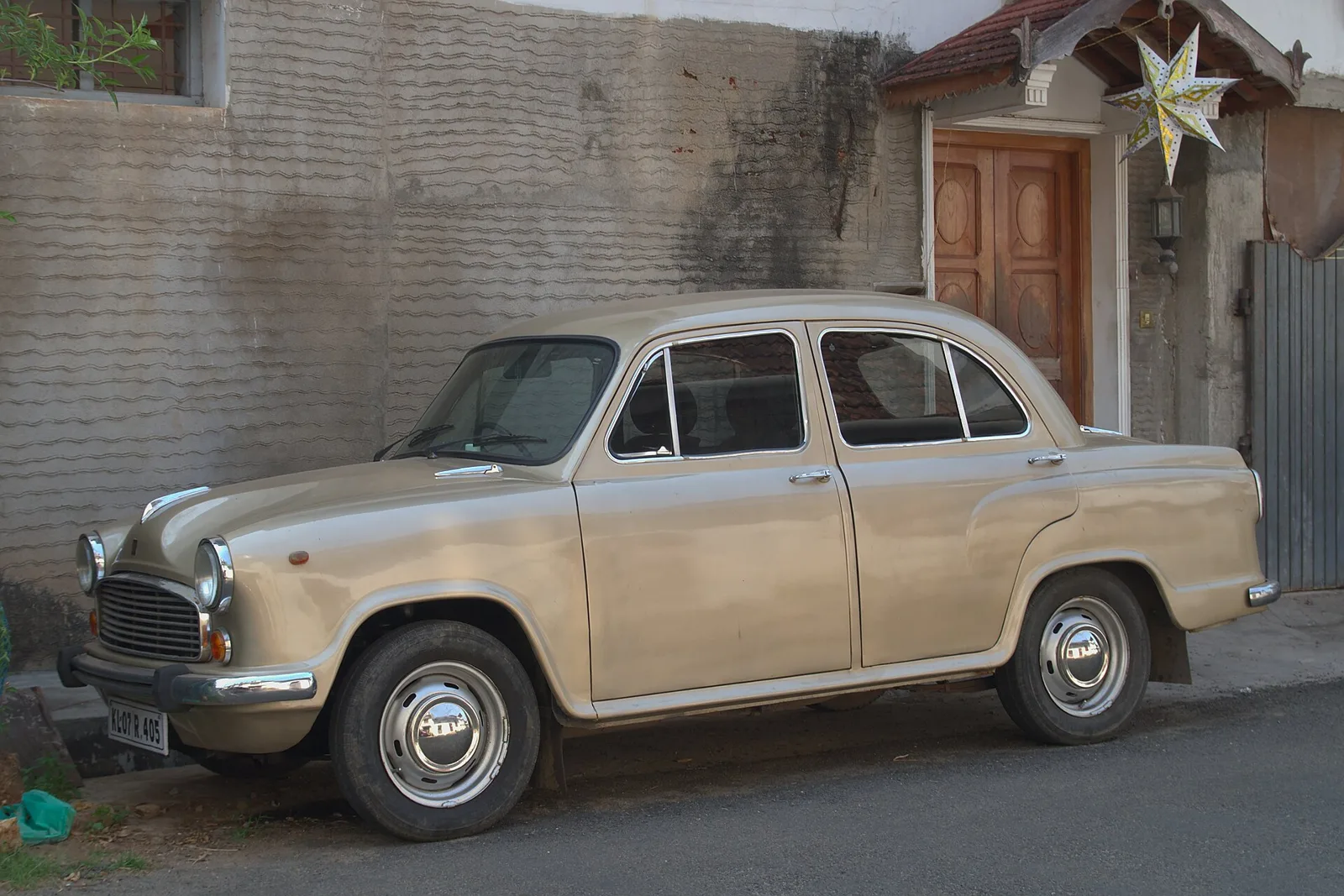
Built from 1957 to 2014 on a Morris Oxford design, the Ambassador outlived almost every rival in India and became the country's taxi and official car of choice.
Built by Hindustan Motors from 1957 to 2014 on the Morris Oxford Series III, the Ambassador served for decades as India's family car and taxi. Its brand was sold to Peugeot in 2017 for Rs 80 crore, and 2,200 were sold in the last financial year before production ended.
The Hindustan Ambassador was an Indian car built by Hindustan Motors from 1957 until 2014, and it was based on the Morris Oxford Series III. It stayed in production for longer than almost any car of its era, with very few changes to its basic design. Its long run ended on the same assembly line in West Bengal where it had started.
Where did the Ambassador come from?
In 1956 Morris Motors, then part of the British Motor Corporation, sold the rights and tooling for the Morris Oxford Series III to Hindustan Motors. The company had done the same for the earlier Series I and Series II models, which Hindustan sold as the Hindustan 14 and the Landmaster.
The Ambassador took over from the Landmaster, which was quite similar, and from the larger Hindustan Deluxe. Its design was a derivative of the Morris Oxford Series II, which had been developed before the Austin and Morris merger.
A car that began as a British design and ended as a symbol of Indian motoring, built on one assembly line for more than half a century.
Who ran Hindustan Motors?
Hindustan Motors was part of the Birla group and later became a flagship company of the C.K. Birla Group. It was founded in 1942 by B.M. Birla, just before Indian independence, and it began in a small plant at Port Okha in Gujarat.
The first cars there were the Morris 10, assembled as the Hindustan 10. Production later moved to Uttarpara in West Bengal, which gave the company a larger base for making its cars.
The political influence of the Birla family helped the Ambassador survive the 1954 government policy that favoured an indigenous car industry. Only a few models were still in production after that policy, and the Ambassador was one of them.
How did the Ambassador's body develop?
The first generation, the Mark I, arrived in 1957 with deep headlamp cowls and small rear wing tail fins. Its dashboard and steering wheel were redesigned, with a dished three-spoke wheel replacing the flat two-spoke design of the Landmaster. A new dimpled bonnet also appeared.
The Mark II followed in November 1963, with a facelift that brought a closely chequered grille reminiscent of the Morris Mini. Its redesigned dashboard and instrument cluster gave the car a more modern cabin, and the market soon nicknamed the early version the Mark I.
The Mark III arrived in 1975 with a louvred grille and a round indicator lamp set apart from the grille. Its dashboard moved to three standard instruments in a black recessed mesh, a clear break from the earlier wooden base.
The Mark IV came in 1979 with a smaller grille, square park lamps and amber indicator lamps on a lip spoiler below the bumper. It was the last of the Mark cars, and its front styling remained in use until the end of production.
What did the Nova and the 1800 ISZ change?
The Ambassador Nova launched in 1990 with a two-spoke steering wheel, a top-hinged brake pedal and a single glovebox in place of the earlier central instrument layout. Its petrol engine made 55 bhp, and a diesel version followed with 37 bhp.
In 1992 the Ambassador 1800 ISZ introduced a 1817 cc Isuzu inline-four with 75 bhp and a five-speed manual gearbox with a floor shift. The model made bucket seats an option for the first time, and the entire dashboard was redesigned around it.
The Classic name arrived at the 1998 Delhi Motor Show. Classic models were then sold with petrol, CNG and diesel engines from 1.5 to 2.0 litres, which kept the car in the market for a range of buyers.
What engines did the Ambassador use?
The first Mark I used a 1476 cc side-valve petrol engine from Austin. In 1959 that unit was replaced by an 1489 cc overhead-valve BMC B-series petrol engine rated at 55 bhp (41 kW). The Mark IV diesel used a 1489 cc BMC B-series diesel with 37 bhp (28 kW).
It was the first diesel car in India, and it sold for a 25 percent markup over a petrol Mark IV, which made it the most expensive car built in the country at the time. Late in the Mark III run, a limited batch of cars received 1760 cc engines, which were fitted to handle the load of air conditioning compressors. The Isuzu 1817 cc four produced 75 bhp (56 kW) and 13.8 kg m of torque, and it became a long-running option. The 2000 DSZ Turbo, a turbocharged intercooled Isuzu diesel, produced 75 bhp (56 kW). The 2013 Encore used a 1489 cc diesel with an intercooled turbocharger to produce 48.6 bhp (36.25 kW), a figure that matched the older BS III cars in size.
Why did the Ambassador last so long?
The Ambassador stayed in production for decades with very few improvements, largely because of protectionist policy in India. Little incentive existed for Indian companies to innovate, and the car held its place by offering space and ruggedness in a market with few alternatives.
It was also one of the few cars produced under the 1954 policy, and the Birla family's political influence helped it stay in the market. For many years it was the principal family car in the middle segment, despite its dated styling.
The Hindustan Contessa was launched to replace the Ambassador, but the Ambassador proved more popular and went on to outsell it. The car celebrated the Golden Jubilee of its production in 2008, and it stayed on the same assembly line in Uttarpara until 2014.
How did India's car market change around the Ambassador?
During the mid-1980s India opened up in a limited way, and Japanese companies began forming joint ventures there. Maruti Suzuki entered a small-car category that had barely existed, while the Ambassador held its ground in the middle segment. The existing manufacturers, Standard Motors, Premier Automobiles and Hindustan Motors, were licensed for cars in the larger category.
The Ambassador remained a pre-modern design with dated styling, even as the market began to offer newer choices. Hindustan planned a major upgrade to the car's mechanical and power plant systems, and that work later produced the Nova. The change was a response to a market that was starting to demand more modern engineering. The 1990 Ambassador was almost identical to the 1956 original, apart from the front cowl area and minor dashboard changes. That stagnation was largely a result of protectionist policy, which gave Indian companies little incentive to innovate.
How many Ambassadors were sold?
In the early 1980s the Ambassador made up more than two thirds of Indian car production, and waiting lists ran to 12 months. The Premier Padmini had a waiting list of nearly five years in the same period, which shows how strongly buyers wanted the Ambassador.
Hindustan sold 2,200 Ambassadors in the financial year ending March 2014. That figure was only a tenth of the sales the car reached in the mid-1980s, and production outside Kolkata and Chennai had already ended because of weak demand and financing problems.
How did the taxi market and emissions rules affect the car?
The Ambassador was a familiar sight as a taxi, especially in Kolkata. The model earned its place there through its size and toughness. Sale of taxis was outlawed from 1 April 2011, a year after BS IV emission standards were introduced in 11 Indian cities, including Kolkata.
Hindustan later fitted cleaner diesel engines to meet the new rules, which allowed the company to resume taxi service in Kolkata, one of the cities where the car had been banned. The diesel engine work was a practical response to the rules rather than a new design.
The Classic range ended because the 1.5-litre diesel engine failed to pass Bharat IV emissions. It could no longer be sold in several of India's major cities, which removed much of the taxi market for the car.
What did the Grand, Avigo and Encore add?
The Ambassador Grand was launched in 2003 with 137 changes compared with its predecessor. Its changes included body-coloured wraparound bumpers, camel-coloured interiors, fabric seats and a remote gear lever, and the acoustic insulation was developed by Treves SAS of France.
The Avigo arrived in 2004 as the most radical revision of the Ambassador. Its exterior was designed by Manvindra Singh, and its dashboard recalled the early models with a central meter cluster and wood-grain interiors. It was priced higher than the existing models.
The Encore launched in September 2013 to meet BS IV standards in the metropolitan cities. It was developed with the help of Magna Steyr in Austria, and its steering wheel was the two-spoke design first seen on the Nova.
Who bought the Ambassador brand in 2017?
Hindustan Motors agreed on 11 February 2017 to sell the Ambassador brand, including its trademarks, to the French manufacturer Peugeot. The sale was made for Rs 80 crore, which equalled US$8.3 million, and it created two joint-venture agreements between the two groups.
Hindustan confirmed in 2022 that it was working with Peugeot on a new Ambassador with a new design and engine. The company said the work was already in an advanced stage, and the new models were to be produced at its Chennai line.
Did the Ambassador sell outside India?
Export sales were small. The car was sold in the UK in 1992 as the Fullbore Mark 10, and left-hand drive versions were still built in small numbers in 2013 for export to tertiary markets such as Nigeria. The Uttarpara plant also made parts for the Bedford trucks that were being retired, which made it an unusual manufacturing site.
The same plant built the Contessa and utility vehicles, and it was the only facility of its kind for the Bedford parts. Hindustan's exports did not change the car's identity. The Ambassador remained a domestic product, shaped by Indian needs for space, durability and low cost, and it was never a global model.
How was the Ambassador received?
Top Gear named the Ambassador the best taxi in the world in Episode 2 of its 20th series. In July 2014 Hormazd Sorabjee wrote an article for BBC Magazine titled An Epitaph for India's Appalling National Car, which took a far less generous view.
The car appeared in many Indian films of its era, and it became a familiar presence on Indian roads. A local customiser, Parikh Coach Builders, also created an Ambassador limousine that was listed in the Limca Book of Records.
The Ambassador was sold briefly in the UK in 1992, imported as the Fullbore Mark 10. The cars were fitted with a heater and seat belts to meet European safety rules, but only a tiny number were sold before the importer went into liquidation.
Key Ambassador figures at a glance
| Item | Detail |
|---|---|
| Production span | 1957 to 2014 |
| Base | Morris Oxford Series III |
| First engine | 1476 cc side-valve petrol |
| Later engine | 1489 cc overhead-valve BMC B-series, 55 bhp |
| Diesel | 1489 cc, 37 bhp (28 kW), first diesel car in India |
| Grand engines | 2.0L and 1.8L, with a 1.5L added in 2007 |
| Last sales year | 2,200 Ambassadors in the year to March 2014 |
| Brand sale | Rs 80 crore (US$8.3 million), agreed 2017 |
.jpg)