Indianapolis wins, the 3500 GT grand tourer, the twin-turbo Biturbo years, a Ferrari ownership phase and a Stellantis-era range.
Maserati is an Italian luxury car manufacturer founded in Bologna on 1 December 1914, with headquarters now in Modena and a trident emblem. Stellantis has owned the company since 2021. Its landmark cars include the 3500 GT, the Biturbo and the MC20, and it won the Indianapolis 500 in 1939 and 1940.
Maserati is an Italian luxury car manufacturer that began in Bologna in 1914 and later moved its headquarters to Modena. Its trident emblem and racing background shaped a range that has moved from Grand Prix machines to grand tourers, twin-turbo models and sport utility vehicles. Stellantis has owned the company since 2021.
When was Maserati founded and by whom?
Maserati S.p.A. was established on 1 December 1914 in Bologna, Italy. The brothers Alfieri, Bindo, Ernesto and Ettore were the family behind the name, and Alfieri, Bindo and Ernesto built 2-litre Grand Prix cars for another manufacturer, Diatto, before setting out on their own. That early work gave them the racing experience that shaped the company.
Diatto suspended race car production in 1926, and the brothers then founded the Maserati marque. Alfieri drove an early Maserati to victory at the 1926 Targa Florio, which was the marque's first season on the racing calendar. The family's engineering skill was therefore tied to both the company and the sport from the start.
Alfieri's dates on record run from 1887 to 1932, so he did not live to see the Orsi family's 1937 purchase of the brothers' shares. Ettore lived until 1990 and Ernesto until 1975, so both outlived Alfieri by many years.
From a Bologna workshop to the MC20, the trident has stayed attached to cars built for speed.
Where does the trident badge come from?
The trident is based on Neptune's trident from the Fountain of Neptune in Bologna. Marquis Diego de Sterlich suggested the symbol in 1920, and it suited a sports car company because the statue links the emblem to the city where the firm began.
The emblem is still the mark of the Modena headquarters, which the company moved to in 1940 after the Orsi family had taken over the shares. Every car carrying the trident therefore points back to a Bologna fountain and a Modena factory at the same time.
A sports car maker needed a badge that suggested strength, and the trident served that purpose. The choice has survived several owners, including Citroen, Ferrari and Fiat, and it remains the one symbol that every model in the range shares.
How did racing shape the first Maserati cars?
The Tipo 26 of 1926 used a 1.5-litre inline-eight producing 120 hp. At the 1926 Targa Florio it took a class victory and finished ninth overall. The engine was small by later standards, yet it gave the young marque a result in its very first season.
Results kept coming through the late 1920s. The 1929 Tripoli Grand Prix gave the marque its first historic international victory, and the Cremona 10 km race speed record stood at 247.933 km/h. That figure shows how quickly the racing cars of the period could travel on the course.
The brothers had also managed Diatto's racing activities from 1922, so racing was already their trade before the marque bore their name. Their experience across both companies explains why the early Maserati programme was built around competition rather than around road cars.
Did Maserati win the Indianapolis 500?
Yes. Maserati won the Indianapolis 500 in 1939 and 1940, and Wilbur Shaw won in a Maserati 8CTF named the Boyle Special. Maserati is the only Italian manufacturer to have won the race, and that record still stands for the marque in the history of American speedway racing.
Those victories fell within the Orsi years, which began when the family bought the brothers' shares in 1937 and included the move of the headquarters to Modena in 1940. Two wins in consecutive years gave the company an achievement that no other Italian maker has matched at the speedway.
The Indianapolis results also show how the marque's racing ambitions reached beyond Europe. Its engineers had to build cars that could cope with the demands of a long oval race, and the 8CTF delivered two wins in a row.
Who designed Maserati's racing cars after the war?
Alberto Massimino oversaw the design of racing models for the next ten years, and he was joined by Giulio Alfieri, Vittorio Bellentani and Gioacchino Colombo. Together they formed the engineering group behind the marque's post-war racing programme, and their work is closely tied to the cars that followed.
The team's projects included the 4CLT, the A6 series, the 8CLT and the A6GCS. The A6GCS is described as pivotal for the company's future success, because it carried the engineering lessons from the earlier cars into the years that followed.
Giulio Alfieri later became central to road car engineering as well. He turned the 350S 3.5-litre inline six into the engine that powered the company's first ground-up grand tourer, which shows how far the racing programme fed into the road car range.
Did a Maserati win the Formula One championship?
Yes. Juan Manuel Fangio won the 1957 Formula One championship in a 250F, the car that gave the Italian marque its most prominent single-seater title. The result is the highlight of Maserati's Formula One history and of the company's 1950s racing programme.
The 1950s also produced the 350S and 450S sports racers, and the company later drew on both for its road cars. The 3500 GT used the 350S engine idea, while the 5000 GT V8 was born from a road car concept that used the 450S racing engine.
Factory racing ended after the 1957 Mille Miglia Guidizzolo tragedy. The company then turned its attention towards road cars and grand tourers, and the 1961 Tipo 61 Birdcage followed the sports racers of that earlier period.
What was the 3500 GT and why did it matter?
The 3500 GT, introduced in 1957, was the first ground-up grand tourer design from Maserati. It was critical to the company's survival after racing ended, and more than 2,200 examples were built. The car showed what the marque could do without a race team at its heart.
Giulio Alfieri turned the 350S 3.5-litre inline six into a road-going engine, and the body was a Carrozzeria Touring aluminium coupe built over a superleggera structure. The combination of a proven engine and a light body gave buyers a grand tourer with real sporting character.
Production rose from a dozen to a few hundred cars a year once the car was established. That growth gave the marque a more stable footing, and it prepared the way for the 5000 GT, a V8 road car born from the idea of a road-going version of the 450S racing engine.
What did the Bora change in the 1970s?
The Bora of 1971 was the first series production mid-engine Maserati, and it was the first Maserati with four-wheel independent suspension. Those two facts marked a clean break with the marque's older reputation for cars that were fast but technically behind the times.
The Bora also meant that the 1970s range began with a mid-engine car rather than a front-engined grand tourer. The Ghibli coupe had arrived in 1967 with a Ghia design and a 4.7-litre dry sump V8, and the Khamsin of 1972 was Bertone-designed with unibody construction.
Engineering in this period was shaped by the company's links with Citroen. The Quattroporte II shared mechanical parts with the Citroen SM, and its V8 was developed from the SM V6 at 260 PS (190 kW; 260 hp). Only a dozen Quattroporte II saloons were produced, so the car remains a rare chapter in the story.
Why did Maserati face liquidation in 1975?
The Italian domestic market shrank by 60-70% during the 1973 oil crisis, and domestic sales fell from 360 units in 1973 to 150 in 1974. On 22 May 1975 the company's liquidation was announced, putting 800 jobs at stake. Liquidation put the whole brand's future in question.
The De Tomaso years followed the 1975 crisis, and a state holding company, GEPI, held 88.75% of the business as of December 1979. The period was one of rebuilding, with new owners trying to restore the marque after the losses of the mid-1970s.
A Joe Walsh song boosted brand awareness during the De Tomaso years, a sign that the Maserati name still carried cultural weight even as sales were under pressure. Fiat later became sole owner after buying the 51% stake that De Tomaso held in 1993.
What was the Biturbo and why did it matter?
The Biturbo was a twin-turbocharged V6 that became the first such engine in a production car. The Biturbo family sold 40,000 units, making the family a commercial success for the brand. Its engine was the starting point for much of the 1980s range.
Chrysler bought a 5% share in 1984, rising to 15.6% in 1986. The American carmaker's involvement brought a link between Maserati and the United States that the company would later build on, and it linked the Italian brand to a wider industrial network.
The Shamal of 1989 offered a different direction, with bodywork by Gandini and a twin-turbocharged 32-valve V8 paired to a 6-speed gearbox. It showed that the company could still produce a large grand tourer with a modern engine after the Biturbo years.
How did Ferrari shape Maserati after 1997?
Fiat sold a 50% share in Maserati to Ferrari in July 1997, and Ferrari took full control in 1999. The 3200 GT of 1998 arrived during this period with a 3.2 litre twin-turbocharged V8 producing 370 horsepower (280 kW). The new ownership marked a sharper focus on performance.
The MC12 followed the link to Ferrari more directly. It used a chassis and engine derived from the Ferrari Enzo, and 50 homologation models were built. The MC12 then won the FIA GT championship three consecutive times, from 2005 to 2007.
On 9 June 2005 the 20,000th Maserati, a Quattroporte V, left the factory. The milestone came during a period when the company was rebuilding its production base and its racing credentials at the same time.
How many cars did Maserati sell in 2013 and 2014?
Maserati sold 15,400 units in 2013, up from just over 6,000 in 2012. Worldwide sales in 2014 reached about 36,500 cars, a 136% increase on the previous year. Wester said Maserati would not surpass 70,000 sales per year, which set a ceiling on the brand's planned growth.
That ceiling kept the brand in the upper end of the luxury sports car market rather than pushing it into smaller and cheaper segments. The 70,000 figure became a reference point for the company's plans, and it shaped the decision to keep the range focused on higher-priced cars.
Stellantis was formed in 2021 when FCA merged with the PSA Group. Maserati has been owned by Stellantis since then, and the parent group's wider strategy has shaped the brand's line-up ever since.
Which models make up the current range?
The MC20 is a two-door, mid-engined sports car that debuted in September 2020. It has a carbon fibre monocoque and a 3-litre V6 producing 630 horsepower, and an open-top Cielo version is available for buyers who want the same car without a roof.
The Grecale shares the Giorgio platform with the Alfa Romeo Stelvio. Its engines include a 300 or 330 hp mild hybrid inline-four, and the Trofeo version uses a 530 hp V6 Nettuno engine. The model gives the range a compact luxury crossover alongside its sports cars.
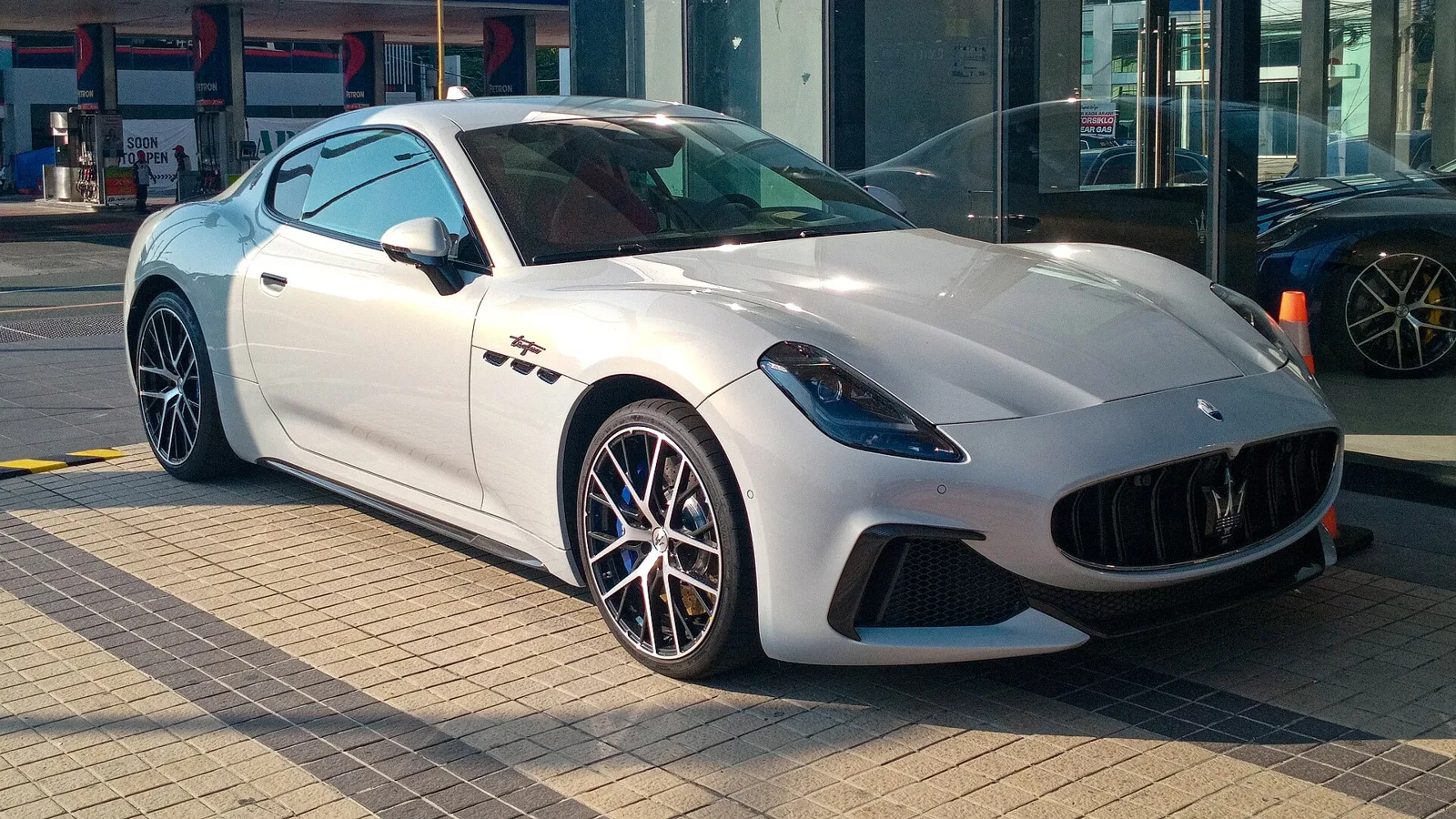
The GranTurismo of 2007 had a 4.7-litre V8 rated at 460 PS (338 kW; 454 hp). The 2023 GranTurismo V6 is detuned to 483 and 542 hp, and the Folgore version has three motors producing 761 hp, which shows the range moving from combustion to electric power.
The Levante, Maserati's first sport utility vehicle, was confirmed in 2014. Top variants of the Levante, Quattroporte VI and Ghibli use 570 PS (419 kW; 562 hp) V8s, and the MCPura was unveiled at the 2025 Goodwood Festival of Speed.
What is the plan for electric Maseratis?
In March 2022 the company announced that an electric version of all its models would arrive by 2025. Combustion-engined vehicles are planned to be phased out by 2030, and the electric models use the Folgore name as their badge. The plan sets a firm timetable for the transition.
The Folgore GranTurismo, with its three motors and 761 hp, is the clearest current example of the electric direction. It sits alongside the V6 GranTurismo, which shows the company keeping both paths open while the transition runs.
What are the key Maserati specifications?
The table lists landmark Maserati models with the year, engine and one defining figure for each. Where a model has several outputs, the table gives the figure that best describes the car, so the wider range is not blended into a single number.
| Model | Year | Engine | Defining figure |
|---|---|---|---|
| Tipo 26 | 1926 | 1.5-litre inline-eight | 120 hp |
| 3500 GT | 1957 | 3.5-litre inline six, from the 350S | Over 2,200 built |
| Bora | 1971 | Mid-engined layout | First series production mid-engine Maserati |
| Shamal | 1989 | Twin-turbo 32-valve V8 | 6-speed gearbox |
| 3200 GT | 1998 | 3.2 litre twin-turbo V8 | 370 hp (280 kW) |
| MC12 | 2005 to 2007 | Ferrari Enzo-derived | 50 homologation models |
| GranTurismo | 2007 | 4.7-litre V8 | 460 PS (338 kW; 454 hp) |
| MC20 | 2020 | 3-litre V6 | 630 hp |
| GranTurismo V6 | 2023 | V6, detuned | 483 and 542 hp |
Frequently asked questions
How many Biturbo cars were sold?
The Biturbo family sold 40,000 units. Its twin-turbocharged V6 was a pioneering unit, and it made the family an important step in the company's engineering history.
What did the Boyle Special achieve?
Wilbur Shaw won driving a Maserati 8CTF named the Boyle Special, and Maserati's wins at the speedway came in 1939 and 1940. The car gave the marque a standing that no other Italian manufacturer has matched in that race.
When did factory racing end?
The 1957 Mille Miglia Guidizzolo tragedy brought the company's works effort to a halt, and road cars took priority from then on. The Tipo 61 Birdcage had appeared in 1961, after the 1950s sports racers had made their mark.
What is the MC12?
The MC12 took its basis from the Ferrari Enzo. It claimed the FIA GT title in each season from 2005 to 2007, and 50 homologation models were built.