An Argentine founder, Ford money, a Ghia-bodied V8 line and a long, uneven decline that ended with a 2019 revival and a P72 sports car.
De Tomaso is an Italian car maker founded in Modena in 1959 by Alejandro de Tomaso. It built the Ford-powered Mangusta and Pantera, owned Maserati from 1976 to 1993, and returned in 2019 with the P72 sports car. The company is best remembered for its Ford-powered V8 coupes.
De Tomaso is an Italian car maker that Alejandro de Tomaso, an Argentine, set up in Modena in 1959. It is best known for the Ford-powered Mangusta and Pantera, and for owning Maserati and Innocenti in the 1970s and 1980s. The company later went through liquidation and several rescues before returning in 2019 with the P72.
Where did De Tomaso begin?
The firm started out building sports prototypes and racing machines, and its early finances rested on the backing of Amory Haskell Jr., an American investor. That support gave the founder room to build small batches of competition cars before any road model existed.
Racing was the first proving ground. A chassis designed by Giampaolo Dallara was built for Frank Williams Racing Cars for the 1970 Formula One season, and although it never became competitive, it kept the name of De Tomaso in front of motorsport audiences.
An Argentine founder, Ford money and a Modena V8 line that ended in liquidation before its 2019 revival.
What were the first De Tomaso road cars?
The first road-going model was the Vallelunga, shown in 1963 and named after the Italian racing circuit. A competition spider was running a few months before the road car appeared, and the production car was a mid-engined sports coupe with a Ford-based driveline.
Its 104 hp four-cylinder engine was shared with the Ford Cortina, allowing it to reach 215 km/h, or 134 mph. A fabricated steel backbone chassis underpinned it, and the design repeated itself across later De Tomaso models. Fissore built the first aluminium bodies, and production moved to Ghia in 1965, where fibreglass bodies were fitted. Roughly 60 cars left the line.
Why was the Mangusta important?
The Mangusta arrived in 1966 and was the first De Tomaso built in meaningful numbers. Its appearance marked the switch from European engines to American Ford power, using a 4.7-litre iron-block V8 in a coupe body supplied by Ghia, a coachbuilder that Alejandro de Tomaso also controlled.
Around 400 Mangustas were produced before the line ended in 1971. The car showed how the company could combine an Italian shape with a large American engine, a formula it returned to with the Pantera, and it gave the brand a recognisable identity beyond the workshop in Modena.
How successful was the Pantera?
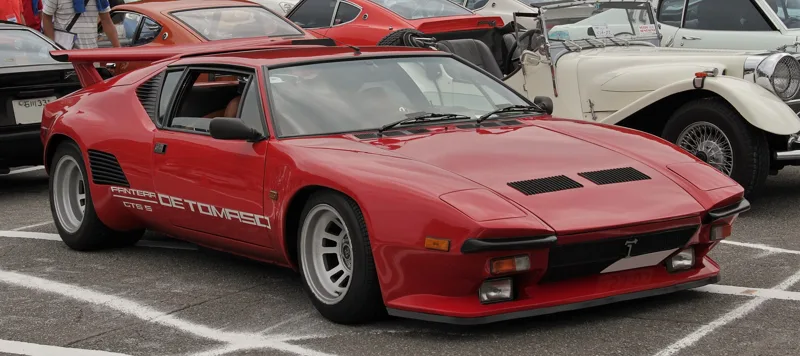
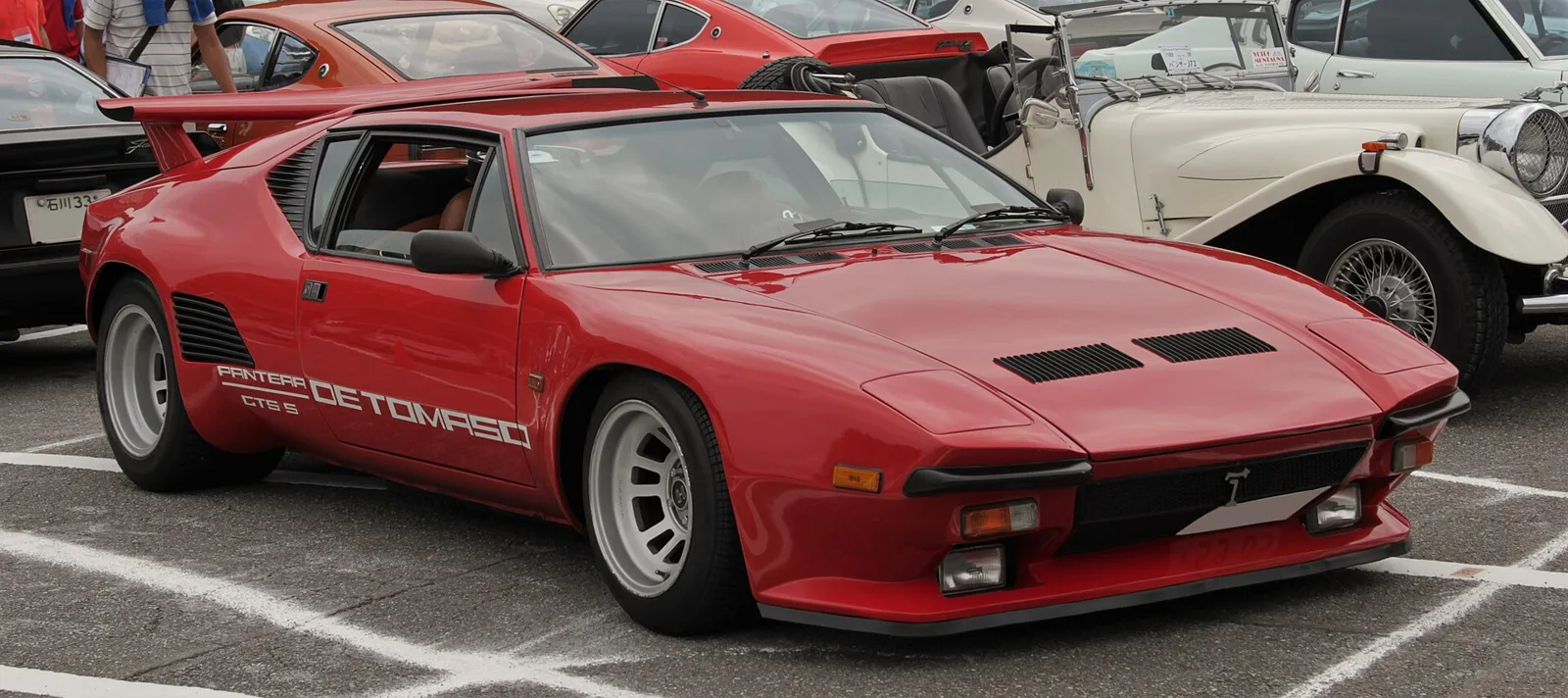
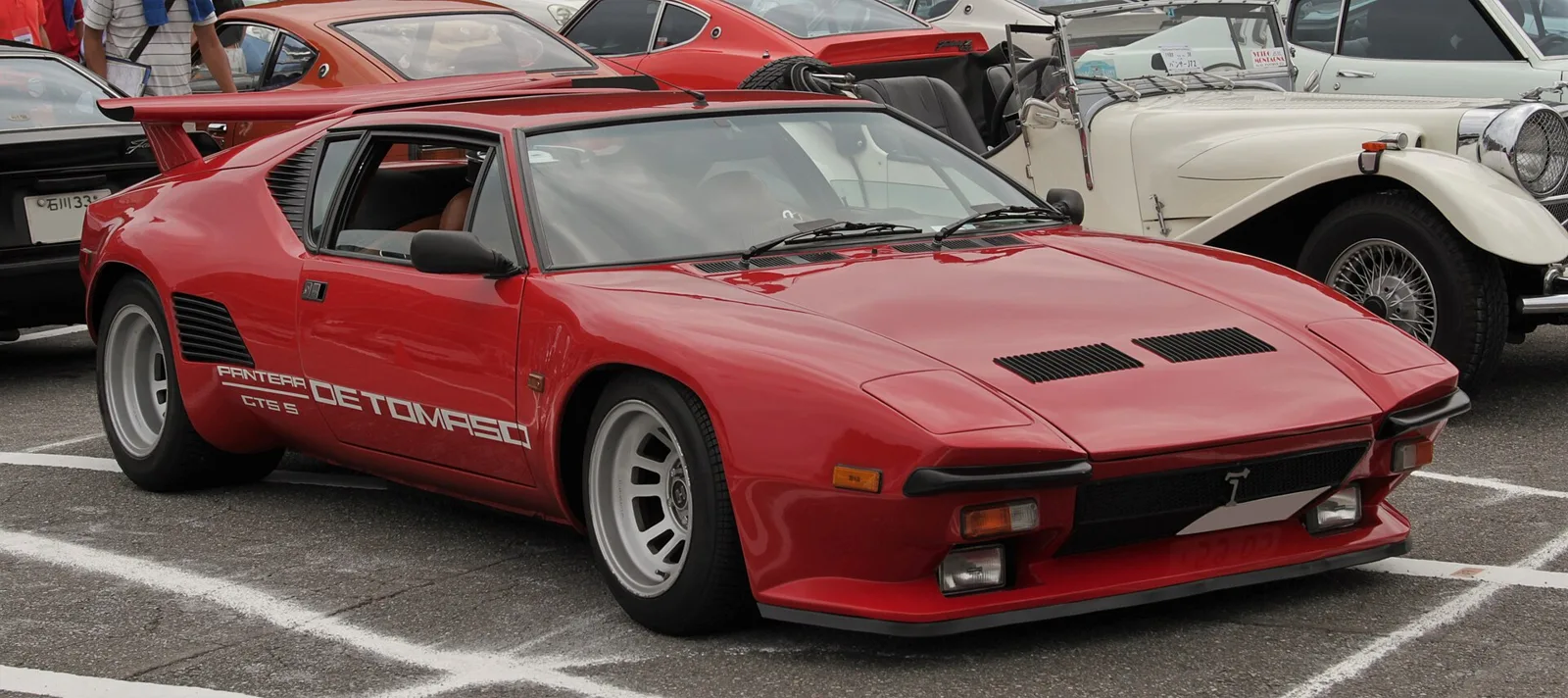
The Pantera was the most important De Tomaso of its era. The 1971 debut used a 351 Cleveland Ford V8 inside a low, wedge-shaped body that Tom Tjaarda drew at Ghia. Between 1971 and 1973, 6,128 were built in Modena, which remains the company's largest run of any model.
Ford's involvement was deep at the start. The American company acquired an 84 percent stake in 1971, and Panteras were sold in the United States through Lincoln-Mercury dealers. Ford later stepped away from the arrangement at the end of 1973, after the oil crisis and other pressures, and De Tomaso kept the right to build the car for markets outside North America.
Output then dropped sharply, to fewer than 100 cars a year through the 1970s and 1980s. The cars were increasingly hand-built, and the Pantera 90 Si, which arrived in 1990 with fuel injection, was a short-lived update. Only 41 of those were manufactured, with 38 sold, before the model was retired in 1993.
During the Pantera years three factories in northern Italy shared the workload, and Ford's share purchase had given it control over the whole production process.
What replaced the Pantera?
The Guara took over from the Pantera and entered production in 1993. Carlo Gaino of the Synthesis design house drew it, and Gaino also worked on the Maserati Barchetta. The Guara was based on a 1991 Maserati competition car and used a composite body that combined Ford and BMW parts.
It was offered as a coupe and as a barchetta. Like most De Tomaso models after the Pantera, the Guara was built in small and irregular runs, and it remained listed in certain markets during the mid-2000s.
Did De Tomaso build luxury cars?
De Tomaso's reputation rests on sports cars, but the firm also produced luxury coupes and saloons in small numbers during the 1970s and 1980s. These were aimed at buyers who wanted a grand touring machine, though they struggled to match rival makers on build quality.
The Deauville of 1971 was meant to challenge Jaguar and Mercedes-Benz saloons. It carried a Pantera-type V8 up front inside an angular four-door body, but only 244 were made even though it stayed in the range until 1985. The Longchamp coupe came in 1972 on a shorter Deauville chassis, and 409 cars of all versions were built before production stopped in 1989. A single Deauville estate was built for Isabelle Haskell, the wife of Alejandro de Tomaso and an American racing driver.
How did De Tomaso come to own Maserati and Innocenti?
De Tomaso took control of Maserati in 1976, after Citroen decided it would no longer prop up the loss-making company. Government help was part of the deal. The first car produced under the new owner was the Kyalami, a Longchamp reworked by Frua and fitted with Maserati's own 4.2-litre V8 instead of the Ford unit.
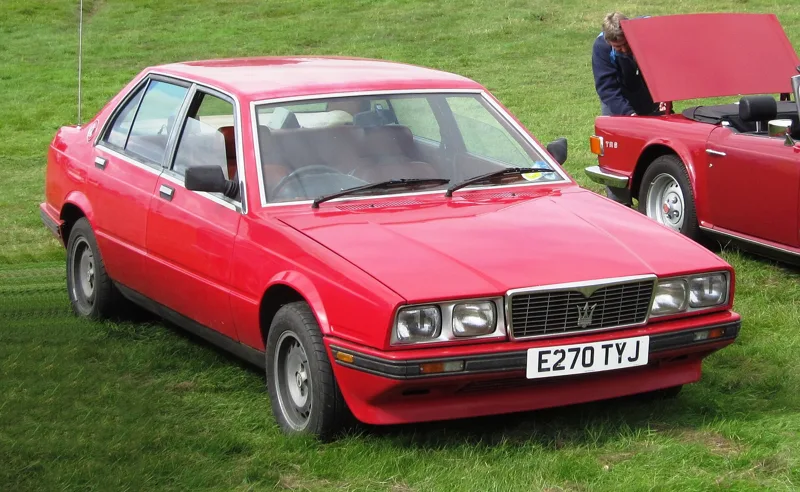
The Biturbo arrived two years before the Kyalami ended production, and it became the foundation for most later Maserati models, including the Ghibli and Shamal. The Quattroporte III and IV and the Barchetta also appeared under De Tomaso. The owner shared platforms between models to hold down development spending, and Fiat took Maserati over in 1993 after sales slumped.
Innocenti passed to Alejandro de Tomaso in 1976 and was reorganised as Nuova Innocenti. The sporty Innocenti Mini de Tomaso, which ran from 1976 to 1987, sat at the top of that range, and Fiat took the business over in 1993 as well. Early cars used a BLMC 1275 cc engine, and from 1982 the car used a 1.0-litre three-cylinder turbocharged Daihatsu unit.
How did De Tomaso end up in liquidation?
The company entered voluntary liquidation in 2004, although new cars were still being produced for a while afterwards. The founder's death in 2003 had weakened the business, and a planned off-road venture in Calabria with the Russian firm UAZ had already fallen apart before the end came.
The UAZ partnership had promised 10,000 cars a year by 2006, yet not one car was built under it. Before 2008 closed, the factory and the trademarks were on the market, and court-appointed liquidators oversaw the search.
Who revived the De Tomaso name?
In 2009 Gian Mario Rossignolo, a former Fiat executive, bought the trademark and founded De Tomaso Automobili SpA. The plan set out three models and 8,000 vehicles overall: crossovers and limousines at 3,000 each, plus 2,000 two-seater sports cars.
The 2011 prototype was planned as a five-door hatchback crossover with all-wheel drive, and its styling quoted models from BMW and Mercedes-Benz. The range was to include two petrol engines of 300 PS and 500 PS, with a 250 PS diesel from VM Motori.
A 2011 Geneva prototype, the new Deauville, never reached production. Rossignolo was arrested in 2012 over allegations that he misused 7.5 million euros of public money meant for reviving the brand, and around 900 employees lost their jobs. He received a sentence of five and a half years in 2018.
The brand changed hands again in 2014, when Norman Choi of Ideal Team Ventures acquired the rights. In April 2015 an Italian bankruptcy court signed off on the sale for 1,050,000 euros, and the new owner spoke of building cars in China under the De Tomaso name.
What did the P72 and P900 show?
The P72 was the first product of the reborn company, presented at the Goodwood Festival of Speed in 2019 during the brand's 60th anniversary year. Jowyn Wong designed it as a homage to the P70, the race car that Carroll Shelby built and Peter Brock styled for De Tomaso in the late 1960s. During development it was known internally as Project P. The design is meant to recall the Le Mans racers of the 1960s, while the cabin pairs a modern outlook with opulent instrumentation.
Its chassis meets LMP1 standards and borrows its architecture from the Intensa Emozione, a car from the sister firm Apollo Automobil, and 72 units were to be sold. In November 2022 the company announced the P900, a track-only hypercar with a 900 hp naturally aspirated V12 and a plan for 18 cars at US$3 million each. That project was later cancelled after the car missed its production schedule.
Did De Tomaso race in Formula One?
De Tomaso appeared in Formula One a handful of times from 1961 to 1963, running its own chassis with a mix of engines. The 801 carried a 1498 cc V8 that was claimed to make 200 CV, and its one Grand Prix start came at Monza in 1962, where it did not qualify.
The 1970 effort for Frank Williams Racing Cars produced no results. At the Dutch Grand Prix the 505/38 flipped and caught fire, killing the driver Piers Courage. The team tried other drivers, but the arrangement ended at season's close with little to show for it.
What are the key De Tomaso figures?
| Item | Detail |
|---|---|
| Founded | 1959, Modena, by Alejandro de Tomaso |
| Vallelunga | 1963, 104 hp four-cylinder, about 60 built |
| Mangusta | 1966, 4.7-litre Ford V8, about 400 built |
| Ford stake | 84 percent, 1971 |
| Pantera output | 6,128 built in Modena, 1971 to 1973 |
| Deauville | 244 made, production to 1985 |
| Longchamp | 409 built by 1989 |
| Brand sold | 2014 to Ideal Team Ventures |
| P72 | Unveiled in 2019 at Goodwood |
| P900 plan | 900 hp V12, 18 cars, US$3 million each |