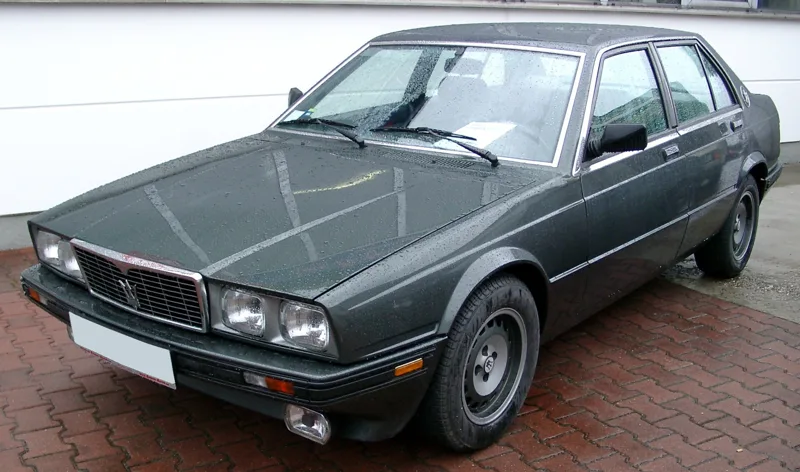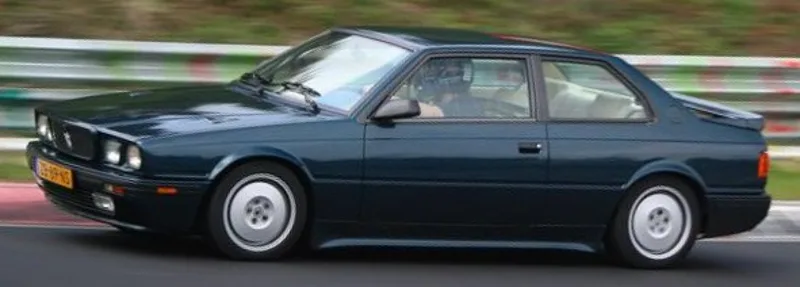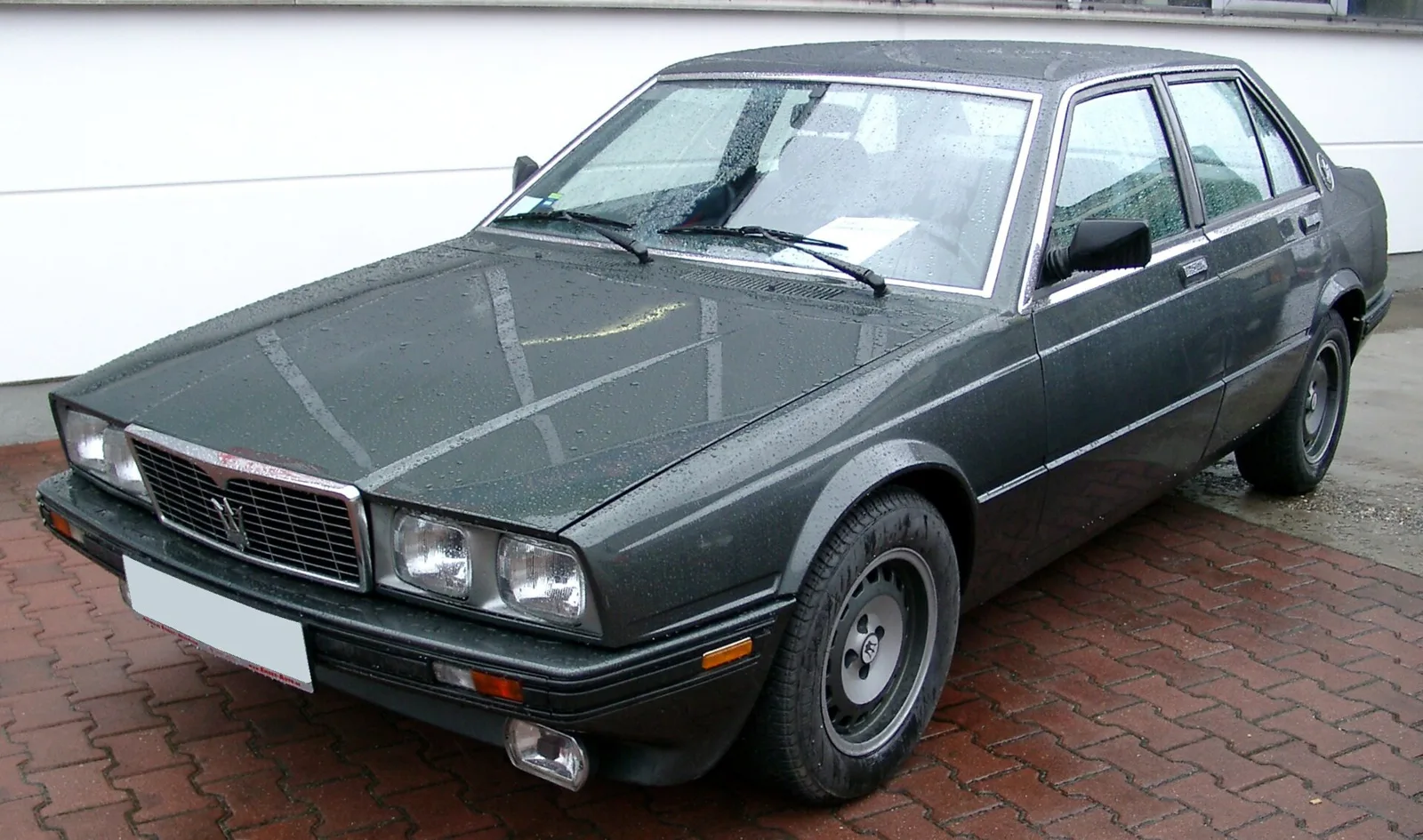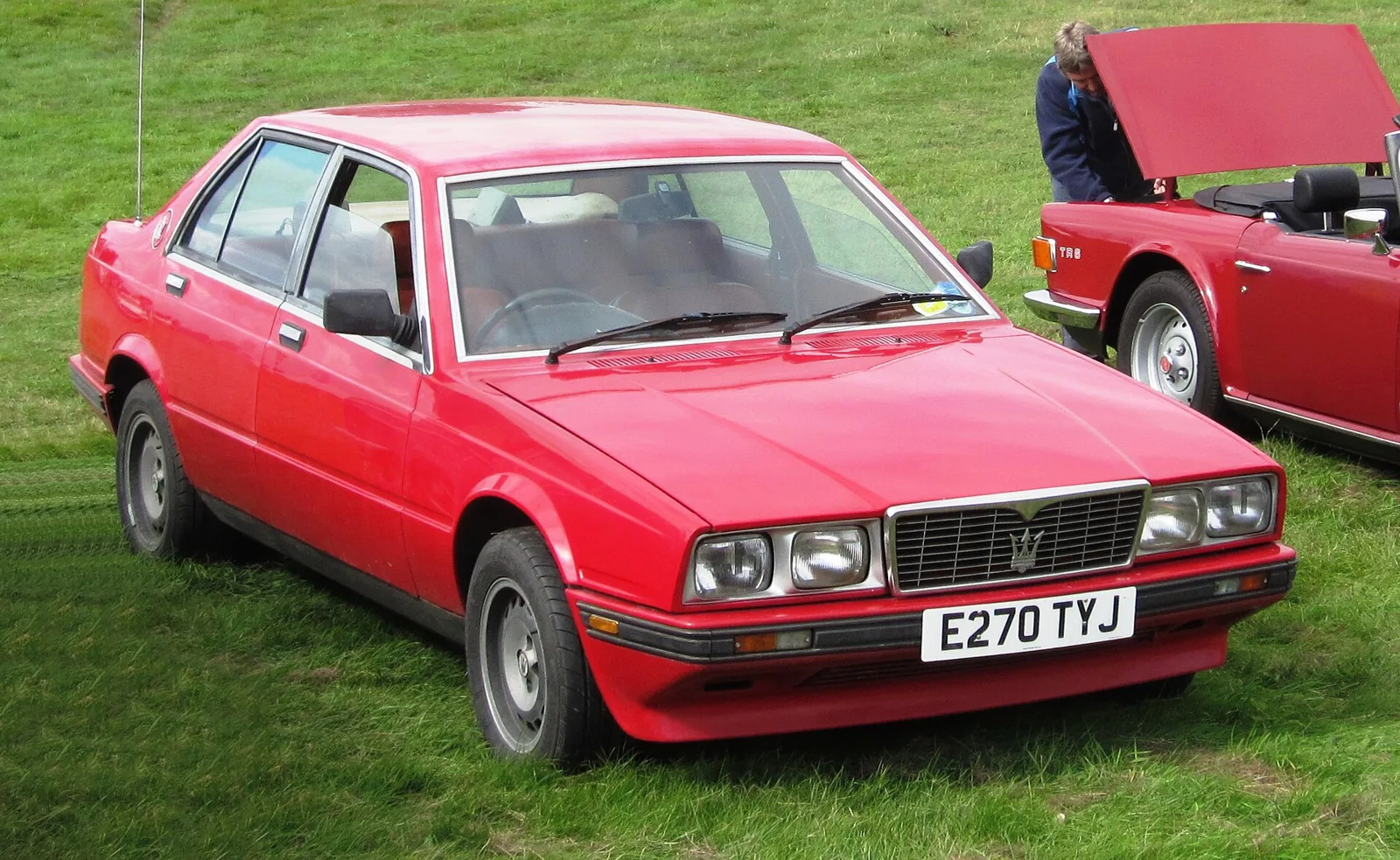
A four-door Biturbo from 1983, shaped by Italian tax rules, built in Milan and criticised for its carburettors.
The Biturbo 425 was a Maserati saloon sold from 1983 to 1988 with a twin-turbo V6 of 2,490.9 cc. Its carburettor versions drew most of the criticism, and 2,372 of the 425 and 425 i were built in total.
Between 1983 and 1988 Maserati sold the Biturbo 425, a four-door saloon that borrowed the mechanics of the two-door coupe. It opened the Biturbo range to four-door buyers, and its carburettors drew much of the press criticism from the start.
Why did Maserati build a four-door Biturbo?
Italian tax law set sales tax at 38 percent for engines of 2000 cc and up, against 19 percent below that. Alejandro De Tomaso, who had taken over the firm, wanted Maserati to sell in volume, and that meant cheaper cars than the hand-built sports cars it had made until then. The plan was a compact car on a smaller engine, built by automated methods.
The Biturbo reached the public in December 1981, following three years of work. Its engine was a six of just under two litres, boosted by a pair of turbochargers. For export Maserati enlarged the engine to 2.5 litres from 1983.
In 1983 both versions received a more potent S variant, the Biturbo S for Italy and the Biturbo ES for export. From 1986 the Biturbo line moved from carburettors to electronically managed intake-manifold injection, though the 425 itself got injection only in 1987. The saloon was added at the end of 1983, so the range grew from coupes alone to coupes and a four-door.
A four-door Biturbo built to make Maserati a volume maker, and judged by the press on its carburettors.
How did the 425 differ from the coupe?
The saloon borrowed the stretched floor pan of the coupe and its drivetrain, yet the body was new. The wheelbase ran 85 mm (3.35 in) longer than the coupe's, at 2600 mm (102.36 in), and the car weighed about 100 kg (220.46 lb) more with the same engine.
The body was self-supporting. Maserati also used this longer platform from 1986 for the luxury coupe Maserati 228.
Pierangelo Andreani, a former Pininfarina designer, had styled the two-door Biturbo and also drew the saloon. Because the new car was longer and taller, it shared no body panels with the coupe.
On the profile the door handles tell the two shapes apart: they sit below the crease on the coupe but above it on the saloon. The windscreen angle is steeper, and the tail stands noticeably higher. Visually and dimensionally the 425 echoed the four-door BMW 3 Series of the day.
Export cars came first, fitted with the 2.5-litre six. The Italian-market Biturbo 420, with the smaller 2.0-litre unit, reached showrooms two years after the 425. Maserati reasoned that the bigger, slightly stronger engine suited the heavier saloon better.
What was under the bonnet?
The 425 ran an aluminium-block V6 with its banks set at 90 degrees. As in the two-door coupe, the engine was a six-cylinder V. Displacement was 152.0 cu in (2,490.9 cc), and two exhaust turbochargers from IHI boosted the output. Each bank had its own camshaft, driven by a toothed belt.
Each cylinder carried a pair of inlet valves plus a single exhaust valve, actuated by cup tappets, with the inlet pair sharing a single tappet. The factory built no four-valve version. The cylinders carried pressed-in liners.
Weber twin-barrel carburettors, type 42 DCNVH, supplied the fuel mixture until 1985. Critics called the arrangement outdated as soon as it reached the market, and its fiddly setting caused trouble early on, including poor starting with a warm engine.
From 1987 the saloon could be had with Magneti Marelli electronic injection. The factory quoted 203 PS (149 kW; 200 hp) for the carburettor car, while a TUV measurement gave 196 PS (144 kW; 193 hp), both reached at 5,500 rpm. The injected car made the same power but was more pleasant to drive.
Why was there no sporting 425?
Maserati offered no sporting version of the 425, although the Italian 420 and 420 i also came in more powerful S and Si forms. The Italian models therefore had a sporty tier that the export saloon never received.
What was the interior like?
The cabin was rated highly for its equipment. The dashboard wore artificial leather, and the seats came as standard in a fabric designed by Missoni. Gathered leather seat covers were available for an extra charge.
The instrument carrier had a semicircular shape, a change introduced on the coupes at about the same time, where it replaced an angular unit.
Key specifications
| Item | Detail |
|---|---|
| Engine | Six-cylinder V, aluminium block, 90-degree bank angle |
| Displacement | 152.0 cu in (2,490.9 cc) |
| Turbochargers | Two exhaust turbochargers from IHI |
| Power, carburettor version | 203 PS (149 kW; 200 hp), factory; 196 PS (144 kW; 193 hp), TUV |
| Speed at peak power | 5,500 rpm |
| Wheelbase | 2600 mm (102.36 in) |
| Manual gearbox | Five-speed from ZF, standard |
| Automatic gearbox | Three-speed from BorgWarner, optional |
| Brakes | Servo-assisted disc brakes from ATE |
| Limited-slip differential | Sensitork, from the 1985 model year |
How did the chassis handle?
Contemporary testers found the early chassis could not cope with the engine's output, and both faults were recorded in the test reports. The car oversteered early, and strong reactions when the throttle came off were faulted as well. Handling was judged difficult.
The 1985 model year brought a Sensitork limited-slip differential in place of the Salisbury unit. Many drivers judged that a clear gain in handling.
Both axles sat on subframes with independent suspension. At the front were MacPherson struts, and at the rear semi-trailing arms, both paired with coil springs, telescopic dampers and anti-roll bars. ATE servo-assisted discs did the stopping, and the rack-and-pinion steering could be had with power assistance.
How was the saloon received by the press?
The criticism was aimed mostly at the carburettor versions, whose throttle response and starting were the main complaints.
Press opinion was split. Writers liked the styling and the performance, but the poor throttle response and starting problems of the carburettor models drew fire, along with high fuel use and careless workmanship.
The German magazine auto motor und sport tested the carburettor 425 in February 1986 and found that it had inherited every fault of the two-door Biturbo. Warm-up response, loose fits and a ride that was poor at all speeds were all still there.
Once warm, the magazine said, the 425 was a lively and flexible drive. It was no VW Jetta, it admitted, but it was entertaining.
How many were built, and where?
Only the engines were built at Maserati's Modena works. Innocenti in the Lambrate district of Milan produced the bodies and completed the cars, so the output was split across two cities. Across the 425 and 425 i, 2,372 vehicles were made, covering both the carburettor and the injected cars.
Production of the 425 i ended in 1987, and remaining stock was sold off into 1988. The Italian Biturbo 420 outsold it by a wide margin, reaching nearly 4,800 units in just three years.
In 1987 Maserati introduced the 430, which had a larger six of 2.8 litres. The two cars ran side by side until 1988, when the 430 took over from the 425 i.
What role did the car play in a Bond film?
A 425 i appears in the James Bond 007 film Licence to Kill, put there by the maker. Franz Sanchez, the film's villain, played by Robert Davi, drives it in several scenes, and the car is wrecked in a chase near the film's close.
What are the cars worth today?
The classic market regards the Biturbo series as underrated. Good saloons changed hands in 2017 for 10,000 to 15,000 euros, and restoration projects cost about 5,000 euros. Two-door versions generally fetch slightly more than the saloons.
Those prices date from 2017, so today's values may differ.
Saloons have also been bought as donor parts for more valuable coupes.