A small twin-turbo V6 brought Maserati prestige to a far wider audience, then a reliability reputation followed the family for years.
The Maserati Biturbo was an executive grand tourer family built by Maserati from 1981 to 1994. Its defining feature was a two-litre V6 with two turbochargers, and the range included coupes, saloons, the Spyder convertible and the 228 five-seat GT. Strong early sales gave way to a reputation for poor reliability.
Few Maserati models have shaped the brand's reputation as much as the Biturbo. Launched in 1981, it used a small twin-turbocharged V6 to put Maserati prestige within reach of a far larger group of buyers, and it spawned a family of coupes, saloons and a convertible that ran until 1994. Its reliability problems later became a lasting part of its story.
What was the Maserati Biturbo?
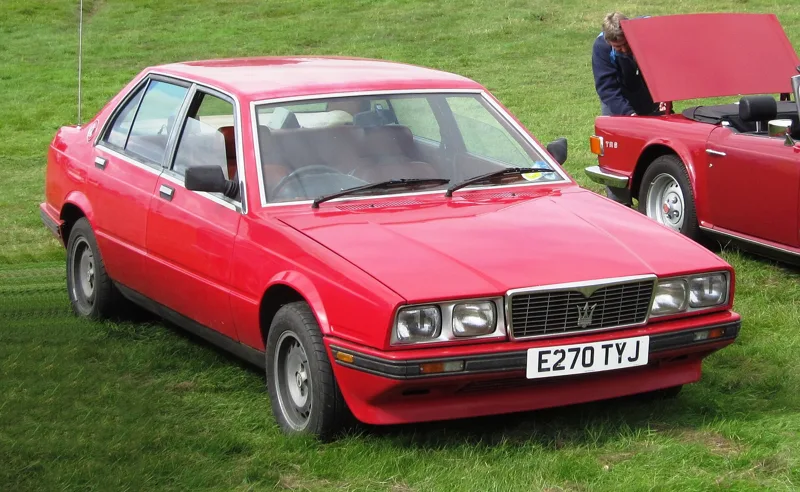
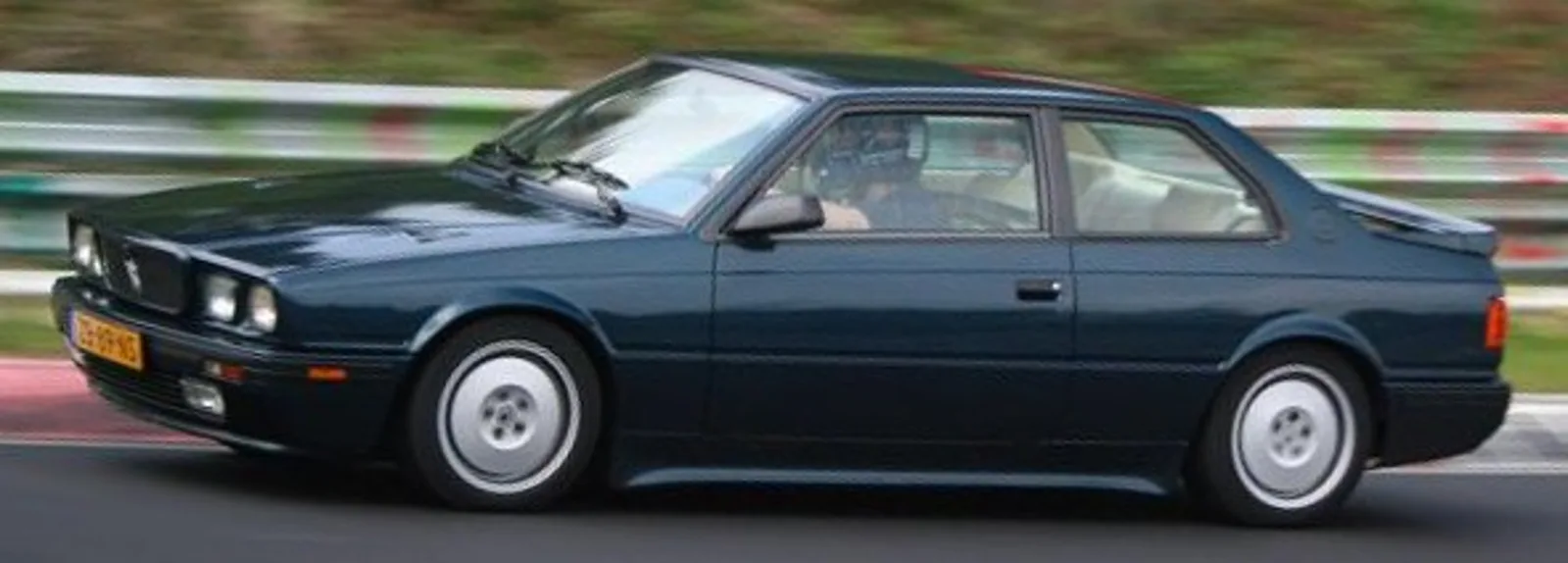
The Biturbo was a two-door, four-seat notchback coupe that Maserati introduced in December 1981. Its name came from the two turbochargers fitted to a two-litre V6, and the car was smaller than the BMW 3 Series of its day. Maserati then built a wider family of cars around the same basic architecture.
The car used a unibody steel structure with a front-longitudinally mounted engine and gearbox. The front end used MacPherson struts, the rear used semi-trailing arms, and both axles carried coil springs, dampers and anti-roll bars.
A small twin-turbo V6 brought Maserati prestige to a wider audience, and the family it started lasted until 1994.
Who designed the Biturbo?
Pierangelo Andreani designed the original Biturbo while he led the Centro Stile Maserati studio. The Quattroporte III, penned by Italdesign Giugiaro, had a noticeable influence on the shape. Marcello Gandini later restyled the range twice, first between 1987 and 1989 and again in 1991.
The same architecture underpinned later grand tourers such as the Shamal and the Ghibli II, so Andreani's basic layout travelled further than its first buyers might have expected. The 1994 fourth-generation Quattroporte also used a stretched version of the Biturbo saloon platform.
What was Alejandro de Tomaso's plan for Maserati?
Alejandro de Tomaso bought Maserati in 1976 and wanted to combine its prestige with a more affordable sports car. The Biturbo was meant to take the place of costlier models such as the Bora and Khamsin, which had been developed under Citroen ownership. It formed the foundation of his plan for the marque.
His strategy depended on volume. A cheaper car carrying the Maserati badge could reach buyers who had never been able to consider one, and the early response suggested the bet was paying off.
How well did the Biturbo sell?
The Biturbo was a strong seller at first, with sales of about 40,000 units, and it brought Italian prestige to a wide audience. Sales then fell away in later years as the car's reputation for poor quality and reliability spread through the market.
Maserati's American story was short. The Biturbo was sold in the US from 1981 to 1990, and some leftover Spyders were sold as 1991 models. The brand then stayed out of the US market until the Maserati Coupe arrived in 2002.
Why did the Biturbo's reputation suffer?
The Biturbo developed a reputation for poor quality and reliability, and sales declined in the years that followed. Early carburettored cars also had serious overheating problems, which were only resolved once fuel injection replaced the carburettors.
De Tomaso used Innocenti, another of his companies, to produce the body panels and handle final assembly. After suffering losses, he sold Maserati to Fiat, which grouped the company with its old rival Ferrari.
The reputation proved durable. The BBC book Crap Cars ranks the Biturbo at number 28, and in 2007 Time chose it as its worst car of 1984, although the magazine considered the Chrysler TC by Maserati an even greater embarrassment.
Did the Biturbo succeed in racing?
Not in any notable way. The Biturbo competed in the World Touring Car Championship in 1987 and the European Touring Car Championship in 1988 with the Marlboro Conquista Team, without significant results. Later, one car was rallied in Group A specification.
Overheating was already a problem for the touring cars until the carburettors were replaced with fuel injection. The touring cars then ran in Italian championships for a couple of years, which kept them in competition while the road cars were being refined.
What did Marcello Gandini change?
Marcello Gandini restyled the Biturbo twice. His first facelift, phased in between 1987 and 1989, softened the sharp bodylines with a taller, rounder grille, aerodynamic wing mirrors and 15-inch disc-shaped alloy wheels. The 1991 update spread the design cues of the Shamal across the range.
The 1987 430 was the first car to carry the new look, and the 2.24v brought wraparound bumpers with integral foglights and deep side skirts in early 1989. The second restyle added poly-ellipsoidal headlights developed by Magneti-Marelli and 16-inch seven-spoke wheels, and Maserati referred to the result as nuovolook.
What engine did the Biturbo use?
The Biturbo used an all-aluminium 90-degree V6 and became the first production car with a twin-turbocharged engine. The unit was roughly based on the V6 from the Merak, although it used a timing belt to drive the camshafts where the Merak used a timing chain. Early two-litre engines had three valves per cylinder.
The two-litre engines had Nikasil-coated wet aluminium sleeves, and the tax system explains why there were two versions of the car. In Italy, engines above 2,000 cc paid 38% VAT, against 19% on smaller engines, so Maserati sold two-litre cars at home and larger 2.5-litre, and later 2.8-litre, export versions abroad.
The first 2.5-litre carburettor engine used a single Weber carburettor and two turbochargers, and Spearco intercoolers were tried in several positions. The Weber 34DAT that replaced the original unit in 1986 proved less efficient and harder to maintain. Weber-Marelli fuel injection arrived the same year, and Maserati also developed a 1,996 cc DOHC 36-valve V6 that was never built.
How much power did the Biturbo make?
Early coupes produced between 180 and 205 PS (132 to 151 kW), depending on specification. The Biturbo S of July 1983 was the Italian-only sporting model, with 205 PS (151 kW) at 6,500 rpm. Fuel injection in 1987 lifted North American output to 187 hp (139 kW), and the 1989 2.8-litre engine delivered 225 hp (168 kW) in North America.
The 2.5-litre carburettor engine was rated at 185 hp (138 kW) and 282 N-m (208 lb-ft) in North American specification, and at 192 PS (141 kW) and 298 N-m (220 lb-ft) in Europe. European 2.8-litre cars were rated at 250 PS (184 kW; 247 hp) in 1989.
What were the key specifications?
| Item | Figure |
|---|---|
| Production span | 1981 to 1994 |
| Early coupe power | 180-205 PS (132-151 kW) |
| Biturbo S output | 205 PS (151 kW) at 6,500 rpm |
| 2.5 L carburettor, North America | 185 hp (138 kW), 282 N-m (208 lb-ft) |
| 2.5 L carburettor, Europe | 192 PS (141 kW), 298 N-m (220 lb-ft) |
| 2.8 L, 1989, North America | 225 hp (168 kW), 246 lb-ft (334 N-m) |
| 2.8 L, 1989, Europe | 250 PS (184 kW; 247 hp) |
| Racing power | 285 PS (210 kW; 281 hp) at 6,250 rpm |
| Racing torque | 374 N-m (276 lb-ft) at 4,250 rpm |
| Racing 0-100 km/h | 5.9 seconds |
| Racing top speed | 256 km/h (159 mph) |
| Spyder wheelbase | 2,400 mm (94.5 in) |
| 228 wheelbase | 2,600 mm (102.4 in) |
Which Biturbo coupe models were built?
The coupe line grew through several variants, starting with the original Biturbo in December 1981. It then added the Biturbo S, the 2.5-litre export Biturbo E, the Biturbo ES about a year later, and the 1985 Biturbo II range with its updated engines and differential.
In 1986 the range switched to fuel injection, and the Italian versions became the Biturbo i and Biturbo Si. The Si Black special edition, finished in black on metallic grey, was built in 105 units until 1988. The last car to wear the Biturbo badge was a 1987 US-market Biturbo (E) Si Black, of which only 25 were produced.
In May 1988 the car was facelifted and renamed 222, a name that signalled two doors, a two-litre engine and a second generation. The 222 premiered at the 1988 Turin Auto Show. In 1990 the 222 SE arrived, followed by the 222 SR with optional adaptive suspension and the 222 4v, which added a 2.8-litre DOHC engine to the direct Biturbo E line.
What was the 2.24v?
The 2.24v was the most powerful two-litre model in the coupe family, distinguished by a four-valve-per-cylinder engine. It reached Italy in early 1989, the country that mattered most to the car, and replaced the Si, which had been taken out of production in late 1988.
In 1991 the 2.24v became the 2.24v II, which added a catalytic converter and standard four-wheel Meccanica Attiva suspension. The 2.24v left production in 1993, and the range was effectively finished with it.
What was the Racing version?
The Racing, also known as the Tipo 331, was a more potent 2.24v that sat beneath the more aggressive Shamal. Only 230 units were built in 1991 and 1992, and 173 were delivered new to Italy. It produced 285 PS (210 kW; 281 hp) at 6,250 rpm.
Its suspension used electronic KONI dampers with four settings, adjustable at the flick of a switch, and the five-speed Getrag manual gearbox was paired with a limited-slip differential. Changes from the 2.24v engine included a lighter crankshaft and forged aluminium pistons, and the engine was made to run on lead-free petrol.
Performance was strong for the period. The Racing reached 100 km/h in 5.9 seconds, covered 0-1,000 m in 25.60 seconds and reached a top speed of 256 km/h (159 mph). Its colour choice was limited to red or black.
What was the Biturbo saloon?
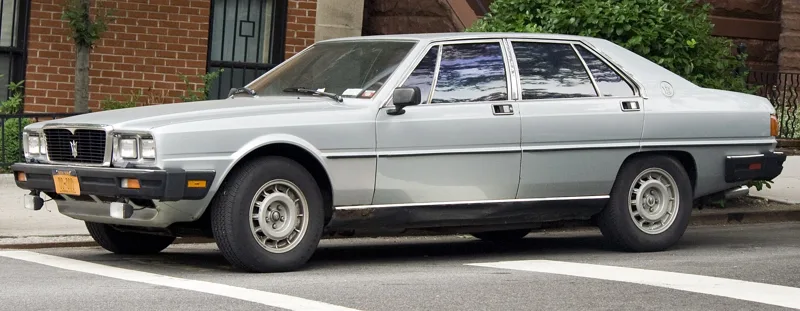
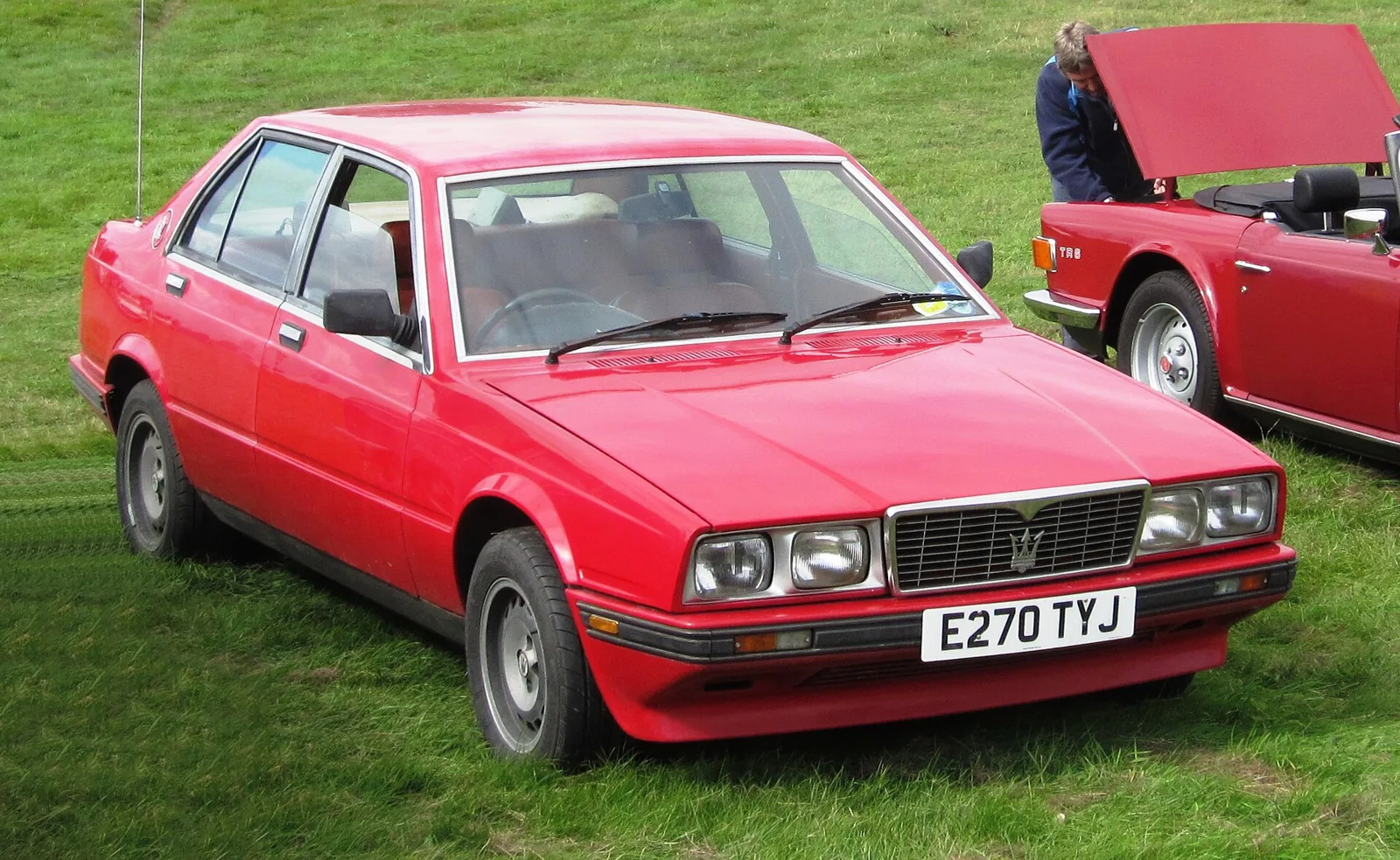
The Biturbo saloon was a four-door version with a wheelbase 8.6 cm (3 in) longer than the coupe, and it weighed 100 kg (220 lb) more. Its first model was the 425, a 2.5-litre export car built from 1983 to 1986, and the 420 followed in 1985 with a two-litre engine.
The 430 was the flagship saloon. Introduced in 1986, it used the largest 2.8-litre engine and came with leather upholstery as standard. The restyled 430 4v followed in 1991 with the latest four-valve engine, and 955 of those cars were made before the line ended.
The 422 was built from 1988 to 1992 as a 420 Si with the restyled grille, mirrors and wheels. The 4.24v paired a four-valve two-litre engine with Meccanica Attiva suspension. The 4.18v, launched in December 1990 for the Italian market, was the first Biturbo with ABS standard, and only 77 examples were made.
What was the Spyder?
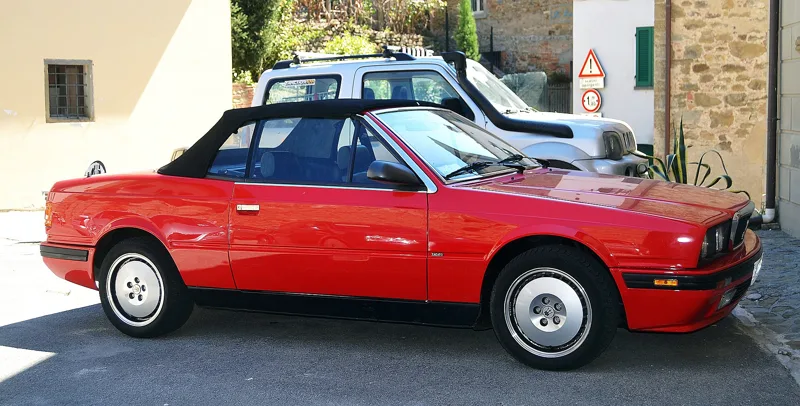
The Spyder was the Biturbo convertible, designed by Giuseppe Mittino and assembled by Zagato in Milan. It sat on a 2,400 mm (94.5 in) wheelbase, 114 mm (4.5 in) shorter than the coupe, which made it a strict two-seater with more luggage room. Across a ten-year run, 3,076 Spyders were built, which set a record for open Maseratis.
The first Spyder debuted at the Turin show, and two years later it gained fuel injection and became the Spyder i. The 1989 facelift, known as the Spyder i 1990, brought the full Gandini treatment, with a rounded grille, fuller bumpers and aerodynamic wing mirrors.
The Spyder III arrived in 1991 with the second Gandini restyle, including 16-inch seven-spoke wheels and a new bonnet and grille. The third-series 2.8-litre cars kept the older valve layout, which made them the only 2.8-litre Biturbo never to receive a four-valve head.
What was the Maserati 228?
The 228 was a two-door, five-seat GT coupe built on the longer chassis of the four-door Biturbos, with a 2,600 mm (102.4 in) wheelbase. It used the largest 2.8-litre fuel-injected V6, and its name reflected two doors and that 2.8-litre engine. Maserati built 469 examples until 1992.
Maserati claimed the European-specification car could reach 100 km/h in 5.6 seconds and a top speed of 235 km/h (146 mph). Bilstein gas shock absorbers replaced the usual hydraulic units, and a four-speed automatic was available on order.
How is the Biturbo remembered today?
The Biturbo is remembered as both a brand-widening car and a cautionary tale. Its twin-turbo V6 and the range built around it brought Maserati to new buyers, but reliability problems and a poor reputation followed it. Official Maserati Heritage pages and enthusiast buyers guides still document the family today.
The architecture also shows how far the Biturbo's ideas travelled. The name was dropped in 1988, but the platform carried on through the Shamal and the Ghibli II, and it lasted until the family finally ended in 1994.