A tax rule shaped the Biturbo, and a Milan coachbuilder turned it into an open two-seater that is now the most wanted car in its family.
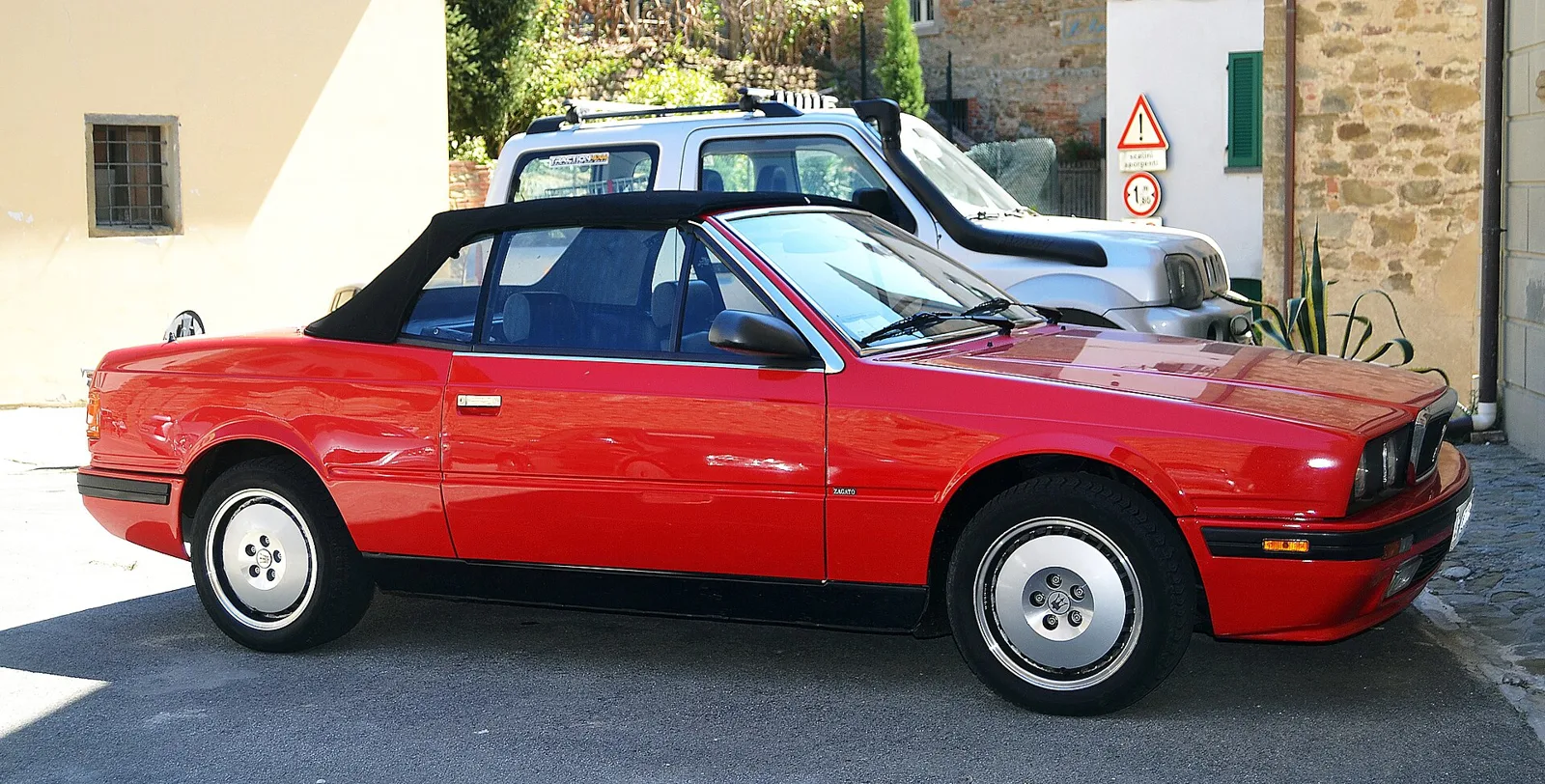
Maserati's open Biturbo, sold as the Spyder, was a two-seat convertible that Zagato built on the Biturbo platform with a shorter wheelbase. Italian and export versions ran from 1984 to 1994, with engines from 2.0 to 2.8 litres, and 3,076 cars were produced in total.
The Maserati Biturbo Spyder was a two-door open sports car built by Zagato on the platform of the Biturbo coupe. Maserati sold it between 1984 and 1994 in Italian and export guise, and 3,076 left the factory in total. As the first open Maserati since the Ghibli, it has become the most prized version of the entire Biturbo range, almost 30 years after production finished.
This convertible begins with a tax rule rather than a racing car. Along the way it passes through a Turin supplier, a Milan coachbuilder and a Turin bodyshell maker. Its history also shows Maserati trying to move from handcrafted exclusivity toward series production.
Why did Maserati build the Biturbo?
Alejandro De Tomaso took over Maserati in 1975 and wanted it to make cars in numbers. Before that, the firm built costly hand-made sports cars. Italian tax rules then charged a 38 percent sales tax on cars of 2,000 cc and above, while smaller cars paid 19 percent.
His plan needed a far cheaper car. The answer was a compact model, produced on automated lines and powered by a modest engine, which met the tax regime head on. Maserati was responding directly to that legislation.
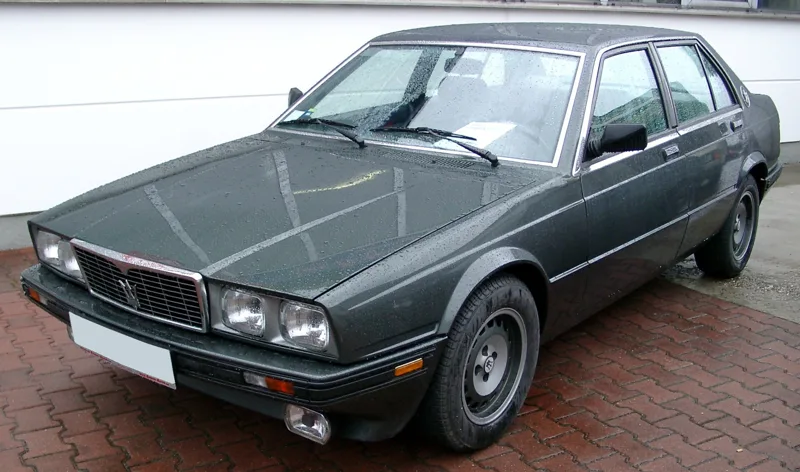
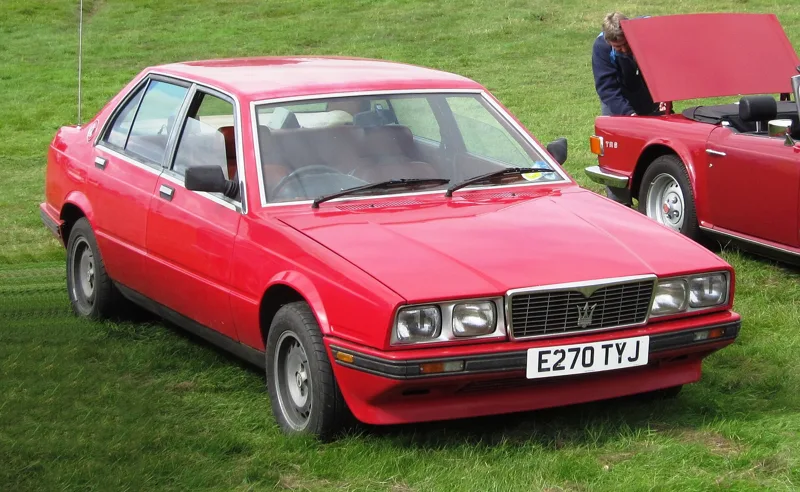
The Biturbo was unveiled in December 1981, three years after work began. Its six-cylinder displaced just under 2.0 litres and relied on two turbochargers. Maserati offered a 2.5-litre version on export markets from 1983, and that year also brought a four-door saloon, sold abroad as the 425 and 430 and in Italy as the 420.
A tax rule shaped the Biturbo, and a Milan coachbuilder turned it into the most sought-after car in the family.
Where did the open version come from?
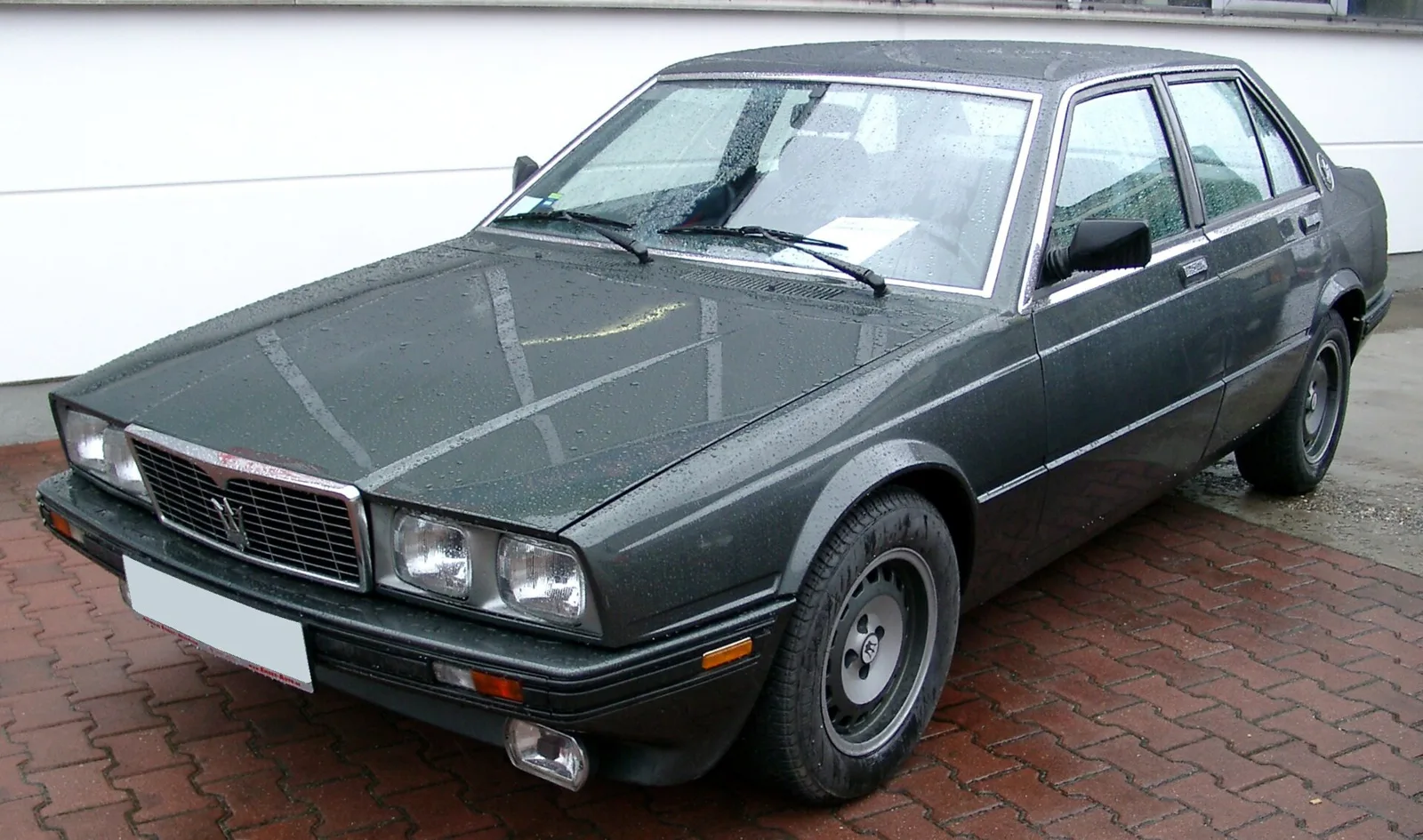
Embo, a Turin supplier, built a convertible on the Biturbo coupe and showed it at the Turin show in March 1982. It was a 2+2 finished in dark red metallic, with the coupe's unshortened chassis, but its broad fabric roof looked clumsy. The car never reached series production.
Reviewers found it more luxurious than sporty. Still, the open Biturbo had sparked public interest, so De Tomaso chose to add a convertible to the family. He saw the United States as the main market, where the Chrysler LeBaron convertible, a compact car on K-car underpinnings, had sold strongly since 1982 and started a revival of open sports cars.
Zagato, a Milan coachbuilder, was then commissioned in Embo's place. Zagato changed more than the body. It reworked the technical structure and cut the wheelbase, which Embo had not touched.
Why is it called Spyder?
Maserati spelled the name the American way, Spyder with a y, to speak directly to the car's main expected market. Zagato took over series production of the open car. The name was chosen with buyers across the Atlantic in mind.
Zagato also derived a hardtop, the Karif, from the open car and built it. For both versions, the Turin firm OPAC supplied the raw bodyshells. Across roughly ten years of production, the Spyder kept pace with almost every technical and stylistic change to the coupes and saloons, though its model names followed their own logic.
In 1988 the Biturbo name was removed across the family, leaving the open model as the Maserati Spyder.
How was the Spyder built?
Underneath, the Spyder shared the coupe's platform and a self-supporting body. Its styling and structure followed the 1981 coupe, which Pierangelo Andreani had designed using a Giorgio Giugiaro concept named Medici as a reference. The front end, windscreen and doors matched the coupe, though fixed triangular windows sat behind each door.
A shorter wheelbase of 2,400 mm (94.5 in) left the rear emergency seats barely usable, so the car was effectively a two-seater. The fabric top, trimmed inside with Alcantara, was raised and lowered by hand, since no electric system existed. Lowered, it disappeared into the bodywork, and the triangular rear side windows swung into the rear wings.
What engines did the Spyder use?
Every engine was a six-cylinder V with a 90-degree bank angle, and nearly all were shared with the coupes and saloons. Italian cars received two-litre units with carburettors, injection or four valves per cylinder. Export cars had 2.5 and 2.8-litre engines, each with three valves per cylinder.
Italian two-litres were the carburettor AM 452, the injected three-valve AM 470 and AM 471 in two power levels, and the four-valve AM 475. The export line used the 2.5-litre carburettor AM 453, the 2.5-litre injected AM 472, and the 2.8-litre AM 473.
Some engines never made it into the Spyder. The high-performance S variants that customers could order in certain early coupes and saloons were absent, and so were the four-valve 2.8 (AM 477) and Maserati Racing's especially potent two-litre.
Specifications at a glance
| Model | Built | Engine | Power | Units |
|---|---|---|---|---|
| Biturbo Spyder | 1984 to 1986 | 2.0-litre, carburettor | 180 PS (132 kW; 178 hp) | 276 |
| Biturbo Spyder i | 1986 to 1990 | 2.0-litre, injection | 185 PS (136 kW; 182 hp) | 297 |
| Spyder i 90 (Italian) | 1989 to 1991 | 2.0-litre, uprated | 220 PS (162 kW; 217 hp) | 309 |
| Spyder Nuova | 1991 to 1994 | 2.0-litre, four-valve | 245 PS (180 kW; 242 hp) | 409 |
| Biturbo Spyder 2500 (export) | 1985 to 1986 | 2.5-litre, carburettor | 196 PS (144 kW; 193 hp) | 1,049 |
| Spyder i 2500 (export) | Autumn 1987, one year | 2.5-litre, injection | 195 PS (143 kW; 192 hp) | 122 |
| Spyder 2800 (export) | From 1988 | 2.8-litre | 250 PS (184 kW; 247 hp) without catalytic converter | About 40 in that variant |
How did the range change over the years?
The first Spyder, built from 1984 to 1986, ran carburettors and made 180 PS (132 kW; 178 hp). In 1986 electronic injection arrived in the Spyder i, which dropped the Biturbo name in 1988. The Spyder Nuova of 1991 was the final version to be newly launched.
A revised Spyder i 90 appeared in autumn 1989, bringing the open car in step with the 222 coupe, which had replaced the closed Biturbo i in 1988. Its engine was raised to 220 PS (162 kW; 217 hp), and Zagato had made 309 of these Italian cars by 1991. Remaining stock sold into 1992.
The Spyder Nuova came out in the 1991 model year, borrowing front-end and side-skirt details from the Shamal sports coupe. Its four-valve Tipo AM 475 engine produced 245 PS (180 kW; 242 hp), raising the top speed to 230 km/h (143 mph). Output reached 409 units before production stopped in 1994.
What did the export Spyders offer?
Export Spyders were built around the 2.5 and 2.8-litre engines. The first, the Biturbo Spyder 2500, arrived in 1985 and looked like the Italian model. Its carburettor engine produced 196 PS (144 kW; 193 hp), and 1,049 were built by 1986, the largest total for any single version.
Autumn 1987 brought the Spyder i 2500, a short-lived car with the injected 2.5-litre engine, rated at 195 PS (143 kW; 192 hp). It ran for a single year, and 122 were built. That makes it one of the least common Biturbo family members. Remaining sales continued until 1990.
The 2.8-litre Spyder 2800 came along in 1988 with Tipo AM 473, rated at 250 PS (184 kW; 247 hp) in catalyst-free form and 225 PS (165 kW; 222 hp) with one. About 40 of that first variant were made. The iE 90 from autumn 1989 kept the same engine, with or without a catalyst, and both models stayed in the range until 1991, with 603 built between them.
The final export model was the Spyder Nuova 2.8, presented in December 1991. It adopted the Italian Nuova's styling and its family resemblance to the Shamal, yet kept the three-valve 2.8 unchanged. With a catalytic converter as standard, power dropped to 225 PS (165 kW; 222 hp), and 220 were produced.
Why did the Opac Spyder never reach production?
The Turin bodywork firm Opac unveiled a restyled Spyder at the 1993 Turin show, yet it was never built in series. Specialist publications repeatedly passed on a rumour that Alejandro de Tomaso had opposed the car and tried to stop it at all costs. The prototype stayed unique.
Its body had smoother, rounder lines and pop-up headlamps at the front, with Audi 80 B3 tail lamps at the back in the first showing. Under the skin sat the regular Spyder platform, but Opac had dropped in the eight-cylinder from the Maserati Shamal, offering more than 220 kW. Interest from the public and magazines ran high.
A reworked version appeared at the 1994 Turin show, painted dark red and fitted with four round rear lamps in the Ferrari manner. The car still exists.
Why does the Spyder remain the sought-after Biturbo?
Today the Spyder is the most prized variant in the Biturbo family, nearly 30 years after its run ended.
Early versions met criticism. Carburettors were seen as obsolete, and the carburettor models were also hard to drive. The Spyder i switched to electronic injection in 1986.
Some variants were produced in small numbers. The export 2800 arrived in about 40 units in its first form, and the Spyder i 2500 reached 122. The Opac prototype stands apart as a single car that never entered production.