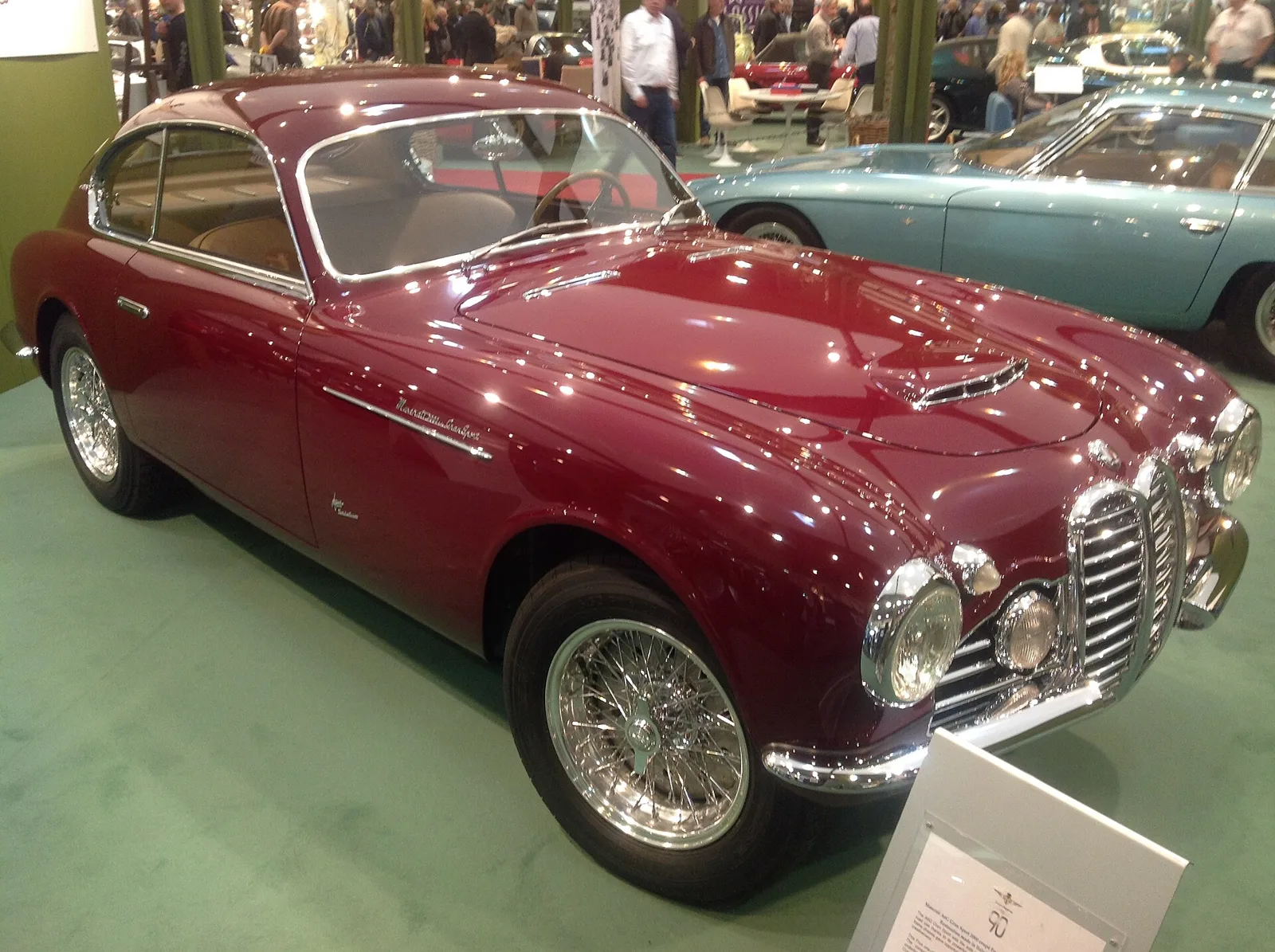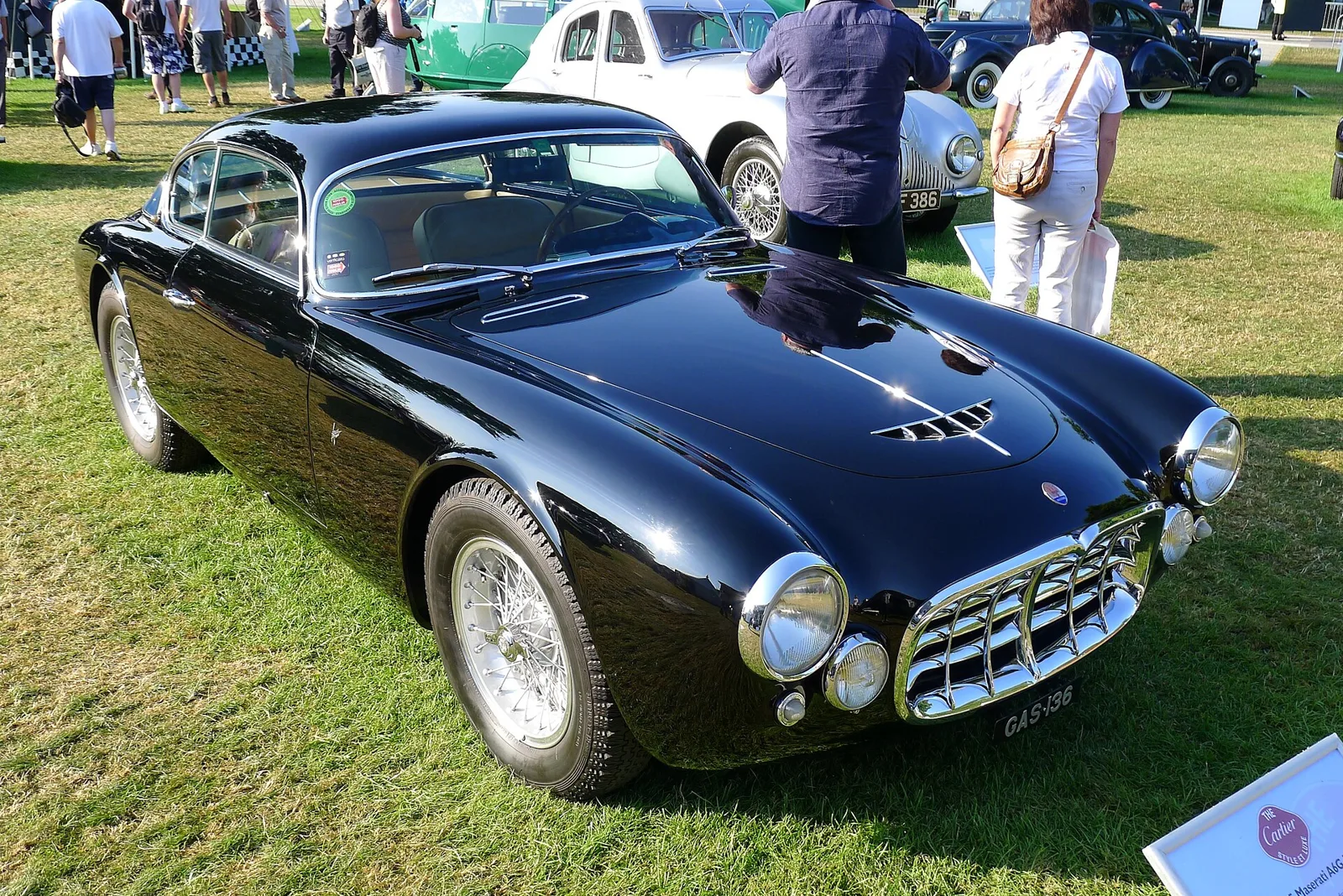
A 2.0-litre road sports car with two overhead camshafts, dressed by Frua, Allemano and Zagato, and built in only about 60 examples.
Built by Maserati between 1954 and 1957, the A6G/54 used a 1,986 cc six with two overhead camshafts, producing 150 PS (110 kW; 148 hp) at first. Its bodies came from Allemano, Frua and Zagato, and about 60 cars were made in total.
The Maserati A6G/54 was a road sports car that Maserati built from 1954 to 1957, the road version of its racing sports car, the A6GCS. Like its predecessor it was marketed as the Maserati 2000 GT. With about 60 cars built, it was never a big seller, but it gave Maserati a credible answer to Ferrari in the road sports car market.
Why did Maserati need a new road car?
Maserati's first sports car not primarily aimed at competition, the 1500 GT, went on sale in 1947 and was not a success. Its 1.5-litre engine produced only 65 PS (48 kW; 64 hp), and its top speed reached just 146 to 153 km/h (91 to 95 mph). Its successor, the A6G, sold only 16 examples between 1950 and 1953, so Maserati needed a stronger car.
Maserati had built a reputation in racing before the Second World War. Under Alfieri Maserati the company produced many successful competition cars in the 1920s and 1930s, entering some of them itself and selling others to private owners. Road sports cars came only occasionally, as one-off customer cars, and there was no series production of road sports cars until 1945.
The A6 had bodies from Pininfarina, and by 1950 Maserati had sold 59 of them. The A6G that followed was also sold as the Maserati 2000 GT, with an engine 30 per cent more powerful, yet even that model struggled.
Production also suffered from events outside the drawing office. Heavy labour disputes at the start of the 1950s led owner Adolfo Orsi to dismiss several hundred employees, which at times halted production altogether. Maserati therefore needed a more powerful car to stay in the market, and the A6G/54 of 1954 removed some of the A6G's weaknesses.
Built in small numbers, the A6G/54 gave Maserati a road car that could stand beside Ferrari.
What changed with the A6G/54 engine?
The A6G/54 used a 1,986 cc six-cylinder derived from the racing A6GCS, with two overhead camshafts, a first for a Maserati road sports car. Its output started at 150 PS (110 kW; 148 hp) and rose to 160 PS (118 kW; 158 hp) once twin ignition arrived in 1956. The engine was 50 per cent stronger than the A6G's.
With the bore now larger than the stroke, the engine was more willing to rev. The predecessors had only one overhead camshaft each, so the twin-camshaft layout was new for road models. The road engine kept the displacement of the racing unit but changed in detail, with chain-driven camshafts instead of gears and wet-sump rather than dry-sump lubrication.
Key specifications
| Specification | A6G/54 |
|---|---|
| Engine | 1,986 cc (121.2 cu in), six-cylinder in-line, front-mounted |
| Bore and stroke | 76.5 mm x 72.0 mm |
| Camshafts | Two overhead, chain-driven |
| Output, first version | 150 PS (110 kW; 148 hp) |
| Output, from 1956 | 160 PS (118 kW; 158 hp), with twin ignition |
| Chassis | Steel tubular frame |
| Front suspension | Double wishbones with coil springs |
| Rear suspension | Rigid axle with semi-elliptic leaf springs |
| Brakes | Hydraulic drum brakes on all four wheels |
| Wheelbase, Short Nose | 2,550 mm (8 ft 4 in) |
| Production | About 60 vehicles, 1954 to 1957 |
In its first version the engine produced 20 PS less than the racing A6GCS. Twin ignition, fitted from 1956, lifted output to the higher figure. The chassis used a tubular steel frame, with double wishbones and coil springs at the front and a rigid axle on semi-elliptic leaf springs at the rear. Houdaille shock absorbers were used at both ends, and all four wheels had hydraulically operated drum brakes.
Why were there no Pininfarina bodies on the A6G/54?
Pininfarina had grown so close to Ferrari that it could no longer build bodies for the rival Maserati. Its earlier work on the racing A6GCS had come through the Maserati dealer Mimmo Dei, not as factory orders. That route was no longer open for the A6G/54, so the car's bodies came from Allemano, Frua and Zagato instead.
Maserati's sales papers gave each body type its own label. Frua's spider was Tipo A, Frua's coupes Tipo B, and the Allemano and Zagato coupes Tipo C and Tipo D.
Who designed the Frua spiders and coupes?
At the end of 1954 Mimmo Dei ordered a run of ten open cars from the Carrozzeria Pietro Frua, and these used regular A6G/54 production chassis and engines. In spring 1955 Frua also showed an open two-seater on an A6GCS chassis (number 2109) with the reduced-output road engine. Its attribution is disputed: some sources call it the first A6G/54 spider, others a member of the A6GCS series.
The spring 1955 car had a public moment of its own. Italy's head of state, Giovanni Gronchi, used it to open the 1955 Italian Grand Prix, and it has been in the United States since the mid-1970s. A comparable spider with chassis 2110 has an equally disputed attribution.
The first ten open cars, ordered at the end of 1954, began with chassis 2104, which Maserati sent to Frua in December 1954. The finished car only reached its French first owner in summer 1957, through Mimmo Dei. Stylistically it matched the first two cars, with a short front overhang and chrome ram bumpers in place of ordinary bumpers. The other nine spiders took the longer front end of the GranSport coupes, plus a stylised air intake on the top of the curved rear wings, an idea Frua reused three years later on the Renault Floride convertible.
Short Nose coupes
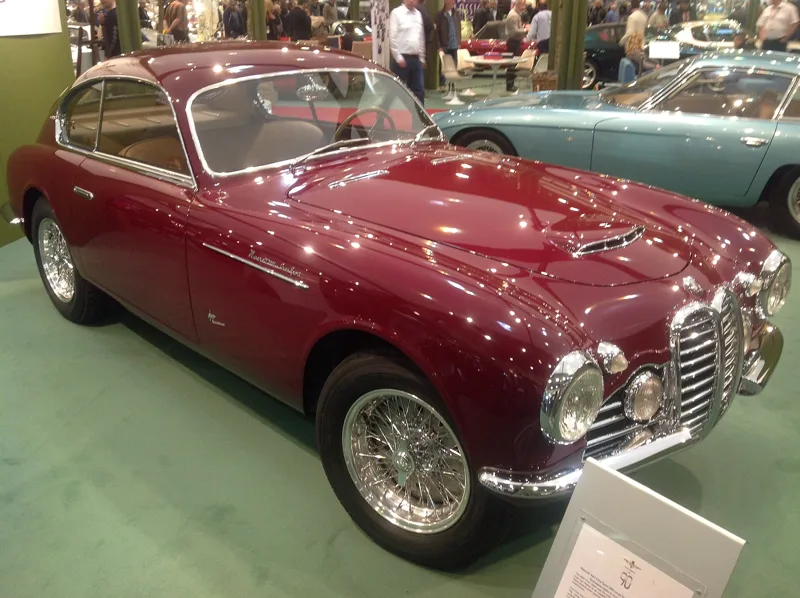
The first series of Frua coupes was sold as the Berlina 2000, with chassis numbers 2063, 2103, 2114 and 2140. All were completed by 1955 on the unshortened standard chassis, with a wheelbase of 2,550 mm (8 ft 4 in). Their comparatively short front overhang gave them the 'Short Nose' nickname that persists in the literature.
The prototype was shown at the Turin motor show in April 1954 and had chassis number 2063. Its low beltline, thin C-pillar and panoramic rear window stood out, and the contemporary press praised its harmonious and balanced form. A half year later it was shown at the Paris motor show, after which the Rome dealer Mimmo Dei took it on and sold it to an Italian customer.
The show car certainly carried the modified, output-reduced engine of the A6G/54, but the origin of its chassis is disputed. Some assume it was a first A6G/54 chassis, while others say it came from the A6GCS sports model. The radiator opening was clearly modelled and framed by a broad chromed grille.
Frua built at least three more of these coupes by 1957. They were similar in style but differed in details such as the radiator grille trim and the bumpers, which were sometimes one-piece, sometimes two-piece and in some cases missing altogether.
Long Nose coupes
In 1956 and 1957 Frua built two further coupes, sold as the Maserati Gran Sport, with chassis numbers 2181 and 2194. Their chassis were shortened slightly, giving a wheelbase of 2,250 or 2,350 mm depending on the figures quoted. The longer front end earned them the unofficial 'Long Nose' label, and both found their first buyers in the USA.
The first of these cars was completed in November 1956 and the second in May 1957. From 1956 Frua used the Long Nose design for most of its spiders as well. Almost 50 years later, from 2004, the GranSport name returned on a special version of the Maserati Coupe.
How did Allemano and Zagato differ?
Allemano's workshop in Turin built 21 notchback coupes in a conservative style, aimed mainly at buyers who wanted a luxurious car. The design is attributed to Giovanni Michelotti, while Allemano is thought to have handled the craft of building them. Its long bonnet, thin pillars and trapezoid roofline anticipated the look of later Maserati coupes.
Allemano's cars carried a British-made heater, a radio and luggage cut to measure, which distinguished them from Zagato's lightweight versions. On the first cars the radiator opening was framed in an oval, and some took two auxiliary headlamps; from summer 1956 it had a rectangular shape. Allemano completed 17 vehicles in 1956, one in 1955 and the last three chassis in 1957.
Zagato took a different route. Its 20 Barchetta coupes were fastbacks, built with especially thin aluminium sheet to keep the kerb weight down. Some had side windows made of Plexiglas, and the everyday usability was limited, and they were suited to motorsport use.
The Zagato coupes also differed among themselves. Some had smooth rear wings, others flared or slightly swelled ones, and one or two carried the 'Double Bubble' roof, the twin bulges above the driver's and passenger's seats that had become a Zagato trademark after the war.
How much did the Frua and Zagato cars cost?
The Frua spiders cost 10,450 US$, which made them the most expensive two-litre cars in the world at the time. The Zagato versions of the A6G/54 were priced at 8,900 US$. The Frua spiders were aimed first at American customers, though some also reached European buyers.
The Zagato coupes were sold through Maserati dealers, and the 1955 Zagato spider remained a one-off outside the factory range.
How did the A6G/54 perform in competition?
A Zagato-bodied example, chassis 2148, won the GT class of the Italian hill-climb championship in 1956. A second car, chassis 2121, was entered for the Mille Miglia that same year.
The racing driver and journalist Paul Frere was scathing about the Zagato version. He called it loud, hot and hard, and said it combined the drawbacks of a racing machine with none of the merits of a touring car.
Chassis 2155 has a special place among the Zagato coupes. It was built in 1956 with standard Barchetta bodywork, but an accident involving Gianni, the son of Ugo Zagato, damaged that body. In 1957 it received a jagged notchback body and served as a design study for a possible Zagato take on the 3500 GT, though series production never came.
Chassis 2101 was clothed as a spider before Zagato began building the factory coupes. The car had smooth flanks, a horizontal beltline and wings that curved gently over the rear wheels, and it was perceived as extremely elegant. Its instruments were doubled, with a speedometer and rev counter on each side of the dashboard.
What happened to the A6G/54 after 1957?
The Maserati 3500 GT replaced the A6G/54 in 1957. The 3500 GT was available from the factory with standardised bodies, and with it Maserati became a series manufacturer.
Many individual cars changed hands over the decades. The Zagato Spyder, which had been finished in December 1954, was shown at the Geneva motor show in March 1955, where Juan Peron, then Argentine president, bought it and asked for changes. While the car was being reworked, Peron lost power in a military coup and never took it over.
The Zagato Spyder later stood three years at the Maserati works and appeared at the Paris motor show in 1958, by which time it had petrol-coloured paint. It was restored at the start of the 21st century and has been shown repeatedly at exhibitions since. A Long Nose coupe, chassis 2181, sold for 2.3 million US dollars in 2017, while the last Berlina 2000 coupe, which had stood for some decades in the Roger Baillon collection, was auctioned unrestored for 1.7 million euros in 2015.