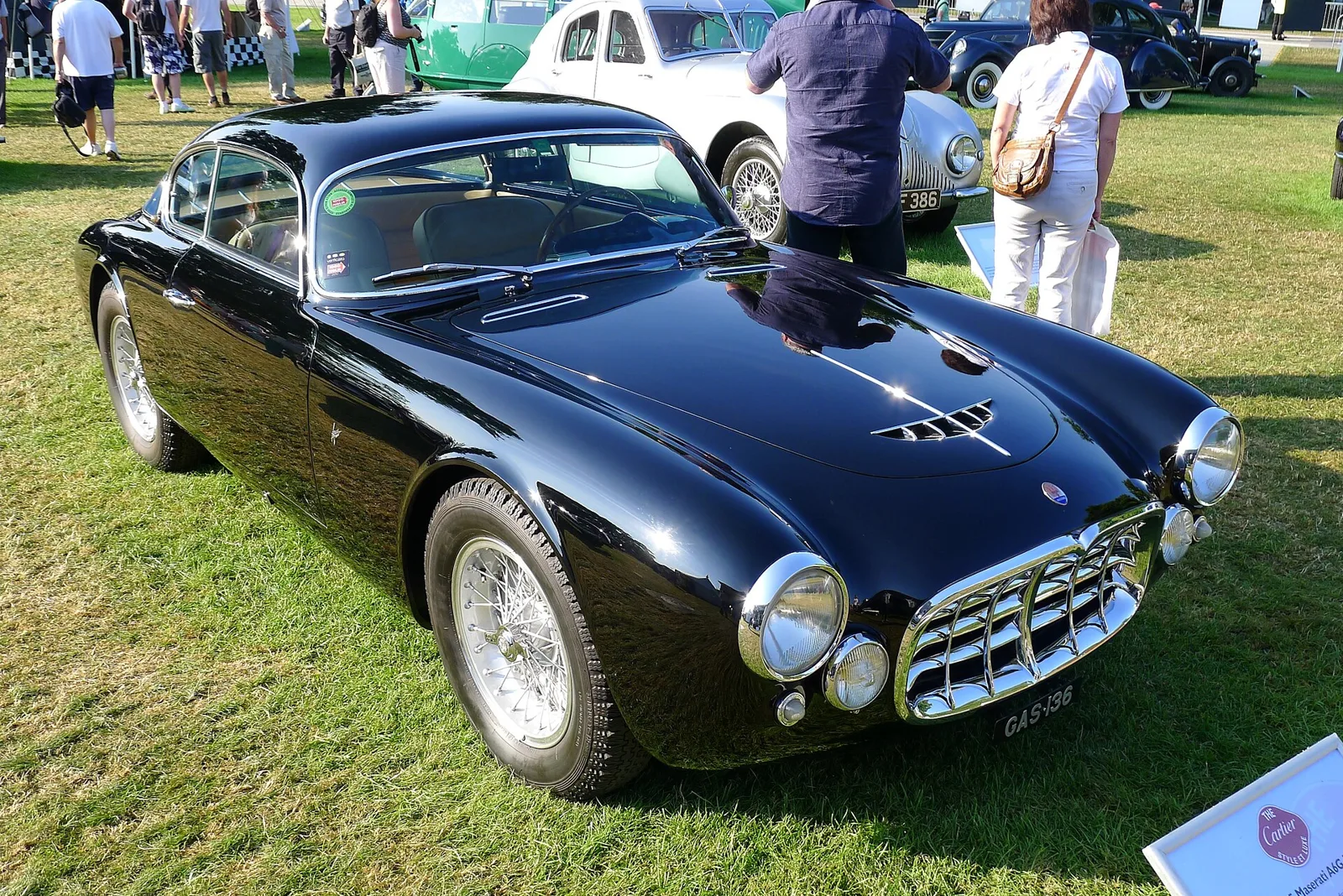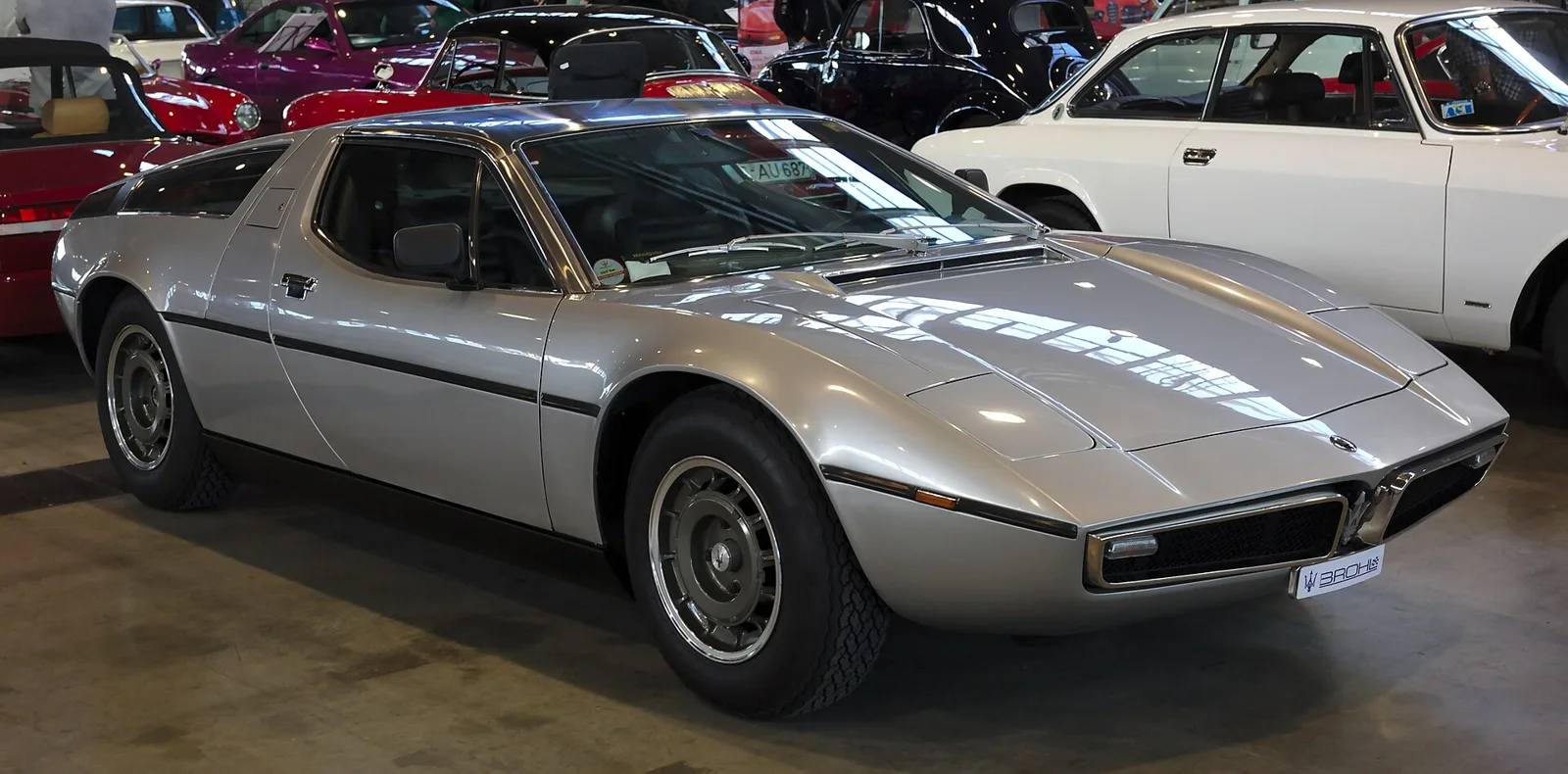
The A6 family put Maserati on the road in 1947, and the Citroen-era Bora gave it a mid-engined coupe with hydraulic pedals, a front boot and wishbones in place of struts.
The Maserati A6 was a series of straight-six cars from 1947 to 1956, named for Alfieri Maserati, beginning with the A6 1500 road car. The Bora was Maserati's first mid-engined street car, built from 1971 to 1978 with 4.7 or 4.9-litre V8 engines and Citroen hydraulics.
The pedals in a Maserati Bora move. Press a button and a hydraulic system slides the brake, clutch and throttle pedals forward or back by about 76 mm (3.0 in), the first time a production car had offered such a thing anywhere in the world. That small piece of engineering says a lot about the Bora, a Maserati built under Citroen ownership that finally threw off the company's reputation for fast but old-fashioned cars. It also sits a long way from where the story began: with the straight-six A6 family of the late 1940s, named for Alfieri Maserati and built as Maserati's first road cars, racing sports cars and single-seaters.
Maserati Bora, the first mid-engined Maserati road car
The Maserati Bora (Tipo AM117) was a two-seat sports car and grand tourer with its engine behind the cabin and drive to the rear wheels, built from 1971 to 1978. Like other Maseratis of its time it takes the name of a wind, in this case the wind of Trieste. It was the company's first mid-engined street car, and it was the first Maserati with independent suspension on all four wheels. Lamborghini had used full independent suspension as long ago as 1964.
The idea came shortly after Citroen took a controlling interest in Maserati in 1968. Lamborghini and De Tomaso already had the Miura and the Mangusta, and Ferrari was known to be developing a mid-engined car of its own. Work on the project, first called Tipo 117, began in October 1968, and a prototype was running by mid-1969. The finished car was shown at the Geneva Salon in March 1971 and reached customers before that year was out. Maserati struggled after De Tomaso bought it in 1975, and the Bora was discontinued during 1978. In all, 564 were built: 289 with 4.7-litre engines and 275 with 4.9-litre engines.
Only minor changes followed the first deliveries. Around early 1974 the front lid was rehinged at its front edge, the pop-up headlights gained rounded inner corners, and a black rectangular air-exit grille, like the Pantera's, appeared across the lid.
The Bora's hydraulic pedal box was a world first for a production car.
How the Bora was designed and made civilised
Giorgetto Giugiaro of Italdesign drew the Bora in the late 1960s. Its drag coefficient of just 0.30 would still have been called very aerodynamic a decade later. The all-steel panels were made by Officine Padane of Modena.
What set it apart from earlier Maseratis and from rival supercars was how civilised it was. Besides the pedal box, the steering wheel tilted as well as telescoped, easing the awkward business of getting in and out that afflicts many supercars. Where most offer little foot room and almost no luggage space, the Bora had a full-size boot at the front. Double-glazed insulating glass separated the cabin from the engine bay, and a carpeted aluminium engine cover cut the noise, harshness and vibration reaching the driver. The engine and five-speed ZF transaxle were bolted to a subframe, which was attached to the floor pan by four flexible mounts and helped the ride as well.
Brushed stainless steel on the roof and windscreen pillars was the Bora's most distinctive styling touch. Leather covered the bucket seats, dash, door trim, centre console and rear bulkhead, and electric windows and air conditioning came as standard. The steering column adjusted manually for rake and reach, while the auxiliary hydraulics also raised and lowered the driver's seat and the concealed headlights in the front wings.
Maserati Bora engine, power and top speed
The original engine was a high-revving 4,719 cc V8 producing 310 PS (228 kW; 306 hp) at 6,000 rpm and 461 N m (340 lb ft) at 4,200 rpm. American cars got the 4.9-litre unit from the Ghibli to offset power lost to emission rules. In 1976 Maserati moved the other markets to the larger engine as well, with an 8.75 to 1 compression ratio and a rating of 330 PS (243 kW; 325 hp) at 5,500 rpm and 481 N m (354 lb ft) at 4,000 rpm.
Both engines trace their lineage to the 450S racing car. Each was an aluminium alloy V8 with hemispherical combustion chambers and 16 valves worked by four chain-driven camshafts. They sat longitudinally in the middle of the car and drove the rear wheels through a ZF-1 five-speed transaxle. Four 42 DCNF/14 downdraught Weber carburettors fed them, with Bosch electronic ignition. Maserati quotes top speeds of 270 km/h (168 mph) for the 4.7 and 285 km/h (177 mph) for the 4.9.
The American-market 4.9 started at 280 hp (209 kW; 284 PS). From 1973 an air pump was added to cut exhaust emissions, and output rose to 300 hp (224 kW; 304 PS), both figures at 6,000 rpm. They also wore larger, sturdier bumpers to meet US rules, which many owners in the United States and Canada later swapped for the slimmer European type, and their taillamp indicators were red instead of amber.
Bora chassis, suspension and Citroen hydraulics
The Bora combined a steel monocoque body and chassis with a tubular steel subframe at the rear for the engine and transmission. Its four-wheel independent suspension used coil springs, telescopic dampers and anti-roll bars. The development prototype and the show car of 1971 had MacPherson struts at the front, but Maserati dropped them for production because of a severe drivability problem. Struts, very wide front tyres and rack-and-pinion steering together produced strong and unwelcome kickback, so production cars returned to conventional wishbones.
Citroen's high-pressure LHM hydraulics were adapted into two circuits. The main one operated the ventilated disc brakes. The auxiliary one moved the pedal box, raised and lowered the driver's seat and worked the retractable headlights. Wheels were 7.5 x 15 inch Campagnolo alloys, with polished stainless steel hubcaps on early cars, and the tyres were Michelin XWX 205x70 at the front and rear. Those early cars tended to tramline at speed, so later cars got 215/70VR15 rear tyres, in either Michelin XWX or Pirelli Cinturato CN12.
Weight was originally estimated at 1,400 kg (3,100 lb), but noise and safety work lifted it to 1,535 kg (3,384 lb). Many people think the Bora is heavier than the Ghibli, but the Ghibli weighs 1,650 kg (3,640 lb), 115 kg (254 lb) more. The belief probably comes from the cars' different states of engine tune and gearing.
Maserati Merak and the Group 4 Boras
The Bora was the basis for the Merak, which kept the front half of the bodyshell but became a 2+2 by using a smaller, lighter and less powerful Maserati V6, which the Citroen SM also used. The Merak was popular, and a modified and improved Merak SS followed in 1981. Its engine cover was open, where the Bora's was glass-enclosed and heavier.
At the request of a French Maserati dealer, Thepenier, Maserati developed two Group 4 racing Boras tuned to 430 PS (316 kW; 424 hp). They were fully competitive, but Maserati could not build enough road cars to meet the 500-car homologation rule for Group 4, so the project was shelved.
What the Maserati A6 names mean
Between 1947 and 1956 Maserati built the A6 series in Italy, a mixed family of grand tourers, racing sports cars and single-seaters. The name honours Alfieri Maserati, one of the founding brothers, and the straight-six engine. In the model codes, A is for Alfieri and 6 for six cylinders. G stands for Ghisa, cast iron, the engine block material. CS means Corsa Sport, a racing sports car, and CM means Corsa Monoposto, a single-seat racer. The figures "1500" and "2000" are the engine capacity in cubic centimetres, rounded up, and a suffix such as "53" gives the year of introduction.
The 1.5-litre straight-six was called the A6 TR, for Testa Riportata, or detachable cylinder head. Its starting point was the pre-war Maserati 6CM, and it made 65 hp (48 kW). A 2-litre, 120 hp six powered the A6 GCS two-seater. The A6G road cars were coupes and spyders for the street rather than competition, with bodies from Pinin Farina, Pietro Frua, Ghia, Bertone, Allemano, Zagato and Vignale. They had cast iron engine blocks and typically ran on 16-inch Borrani wheels and Pirelli Stella Bianca tyres.
Maserati A6 Sport and A6GCS, the racing roots
Ernesto Maserati started on the Tipo 6CS/46, also called the A6 Sport or A6CS, in 1945, with Alberto Massimino. By late 1946 two barchetta prototypes were ready for the 1947 season, using the 1,493 cc straight-six from the pre-war 6CM. They took the first two places at the Circuito di Piacenza on 11 May 1947 with Giulio Barbieri and Mario Angiolini driving. The "Maserati 6CS 1500" that took the win at Voghera in October 1946, driven by Luigi Villoresi, was probably one of this type as well.
In 1947 Maserati built the A6GCS, a two-seater sports racing car with a 1,978 cc engine (72 mm x 81 mm bore and stroke), at first producing 120 hp (88 kW) and upgraded further in 1952. It is often called the Monofaro, after its single headlamp. This cycle-winged racer first appeared at Modena in 1947 with Luigi Villoresi and Alberto Ascari, and won the 1948 Italian Championship with Giovanni Bracco. Weight ran from 580 to 670 kg (1,280 to 1,480 lb). Fifteen were built between 1947 and 1953, two going to Brazil and one to the United States.
Maserati A6 1500, the first road car
The A6 1500, officially the 1500 Gran Turismo, was Maserati's first production road car. The Maserati brothers began developing it in 1941, but wartime production took priority and it was finished only after the war. Its first chassis, bodied by Pinin Farina, appeared at the Geneva Salon in March 1947 as a two-door, two-seat, three-window berlinetta with three square portholes on its integrated front wings, a tapered cabin and futuristic hidden headlamps. It went into low-volume production, mostly with Pinin Farina bodies. For production, Pinin Farina toned down the design with conventional headlamps, and a second side window soon followed. Later cars had a 2+2 fastback. A Pinin Farina convertible was shown at the 1948 Turin show, and two were made, and a car with a Zagato Panoramica coupe body and an extended glasshouse followed in 1949. Sixty-one A6 1500s were built from 1947 to 1950.
The engine was a 1,488 cc inline-six (66 mm bore, 72.5 mm stroke) with a single overhead camshaft and one Weber carburettor, producing 65 hp (48 kW), with triple carburettors on some cars from 1949. Top speed ranged from 146 to 154 km/h (91 to 96 mph) depending on gearing and body. The chassis was built from tubular and sheet steel sections, with double wishbones at the front, a solid axle at the rear, and coil springs and Houdaille hydraulic dampers on all four corners.
A6G 2000, A6GCM and A6GCS/53
From 1950 the improved A6G 2000 began to take over. The engine grew to 1,954.3 cc (72 mm x 80 mm) with the single overhead camshaft retained, and with triple carburettors it made 90 to 100 hp (66 to 74 kW), good for 160 to 180 km/h (99 to 112 mph). The rear axle now hung on semi-elliptic leaf springs. It debuted at the 1950 Turin Motor Show, and only sixteen were built, all between 1950 and 1951: nine 2+2 fastbacks by Pinin Farina, five convertibles and a coupe by Frua, and one Vignale coupe designed by Giovanni Michelotti.
The A6GCM was a 2-litre single-seater, built from 1951 to 1953 in a run of twelve. Gioacchino Colombo developed them, Medardo Fantuzzi built them, and their engines made 160 to 190 PS (118 to 140 kW) depending on tune. The A6 SSG of 1953, a revised GCM leading towards the Maserati 250F, won the 1953 Italian Grand Prix with Juan Manuel Fangio.
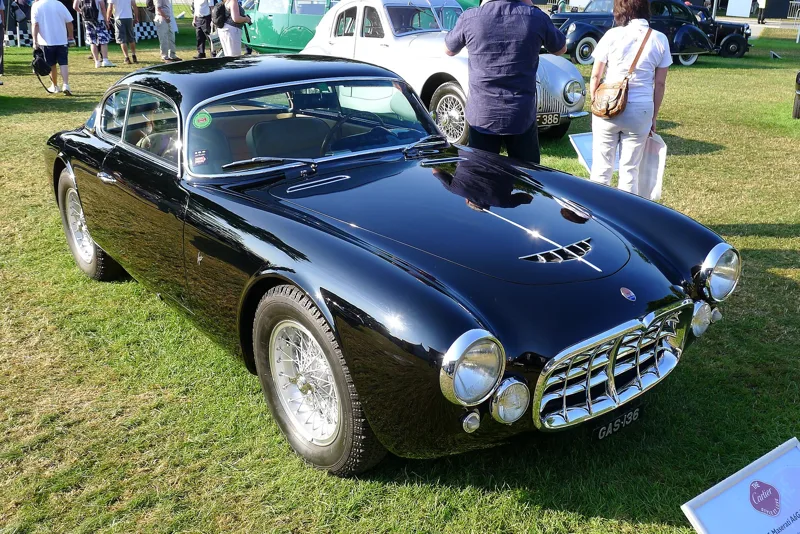
To race in the World Sportscar Championship, Maserati developed the A6GCS/53 in 1953, with an engine making 170 hp (125 kW; 168 bhp). Most were spiders, first designed by Medardo Fantuzzi and then with bodies from Carrozzeria Fantuzzi or from Celestino Fiandri of Fiandri e Malagoli. Fifty-two were made, including four berlinettas designed by Aldo Brovarone at Pinin Farina, for the Rome dealer Guglielmo Dei, who had acquired six chassis, and one spider, which would be Pinin Farina's last design for Maserati for five decades. Vignale made one spider too. In 1955 Dei bought two more chassis, 2109 and 2110, and had Carrozzeria Frua build two open cars with engines from the A6G/54, modified for racing with dry-sump lubrication. One of these cars won the Polyphony Digital Award, given by Kazunori Yamauchi, creator of the Gran Turismo games, at the 2014 Pebble Beach Concours d'Elegance.
A6G/54, the double overhead camshaft grand tourer
After a two-year gap, Maserati launched a new grand tourer at the 1954 Paris show, the A6G 2000 Gran Turismo, generally called the A6G/54 to tell it from its predecessor. Its new double overhead camshaft inline-six, derived from the A6GCS and A6GCM racing engines, had a bore and stroke of 76.5 mm x 72 mm for 1,985.6 cc. Three twin-choke Weber DCO carburettors helped it make 150 hp (110 kW; 148 bhp) at 6000 rpm and gave a top speed of 195 to 210 km/h (121 to 130 mph). Dual ignition in 1956 lifted output to 160 hp (118 kW; 158 bhp).
In total 60 were built between 1954 and 1956, in four body styles. Carrozzeria Allemano made a three-box coupe designed by Michelotti (21 built). Frua made a coupe (6) and a Gran Sport Spyder (12). Zagato built a competition-oriented fastback (20) and a single spider, chassis 2101, shown at Geneva in 1955. Juan Peron bought that spider, but his regime ended before Zagato could finish his revisions, and Maserati stored the car. After being shown in Paris in 1958 it went to an American living there. One more Zagato, chassis 2155, received a unique coupe body after Gianni Zagato crashed it on a test drive, and is distinguished by a rear end that is not a fastback, and eyelids over the headlights. Only one other car has its double bubble roof.
Maserati A6 models side by side
| Model | Years | Engine | Built |
|---|---|---|---|
| A6 Sport (6CS/46) | 1946 to 1947 | 1,493 cc straight-six from the 6CM | Two prototypes |
| A6 1500 | 1947 to 1950 | 1,488 cc, 65 hp | Sixty-one |
| A6GCS | 1947 to 1953 | 1,978 cc, 120 hp | 15 |
| A6G 2000 | 1950 to 1951 | 1,954.3 cc, 90 to 100 hp | 16 |
| A6GCM | 1951 to 1953 | 2-litre, 160 to 190 PS | 12 |
| A6GCS/53 | From 1953 | 2-litre, 170 hp | Fifty-two |
| A6G/54 | 1954 to 1956 | 1,985.6 cc double overhead camshaft, 150 to 160 hp | 60 |