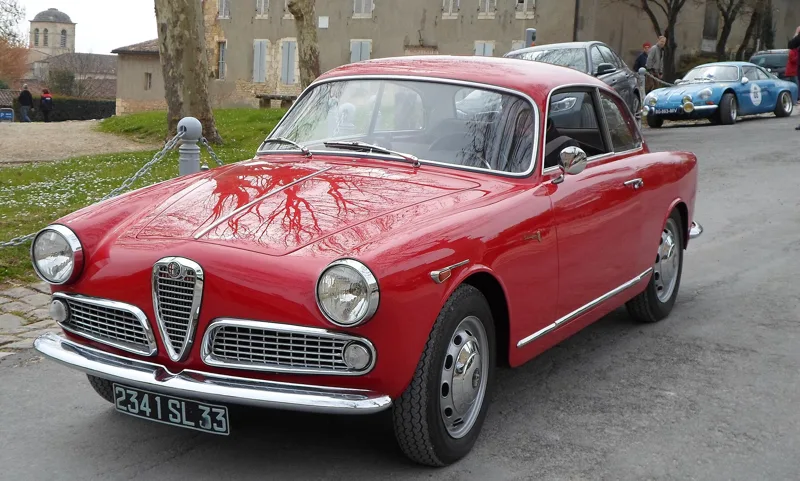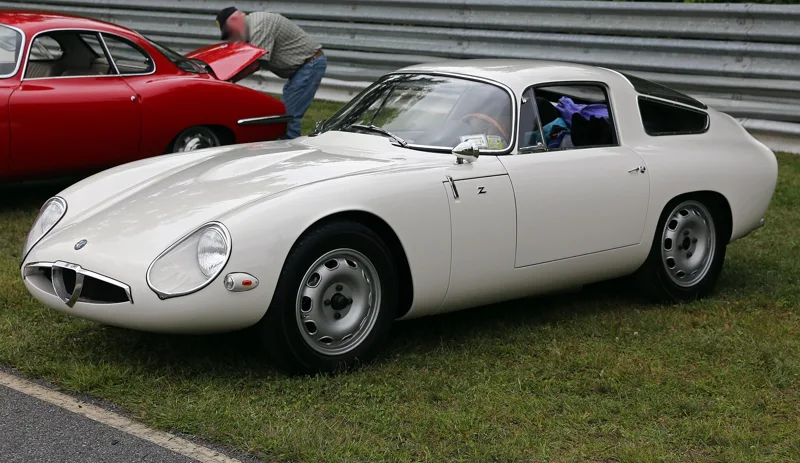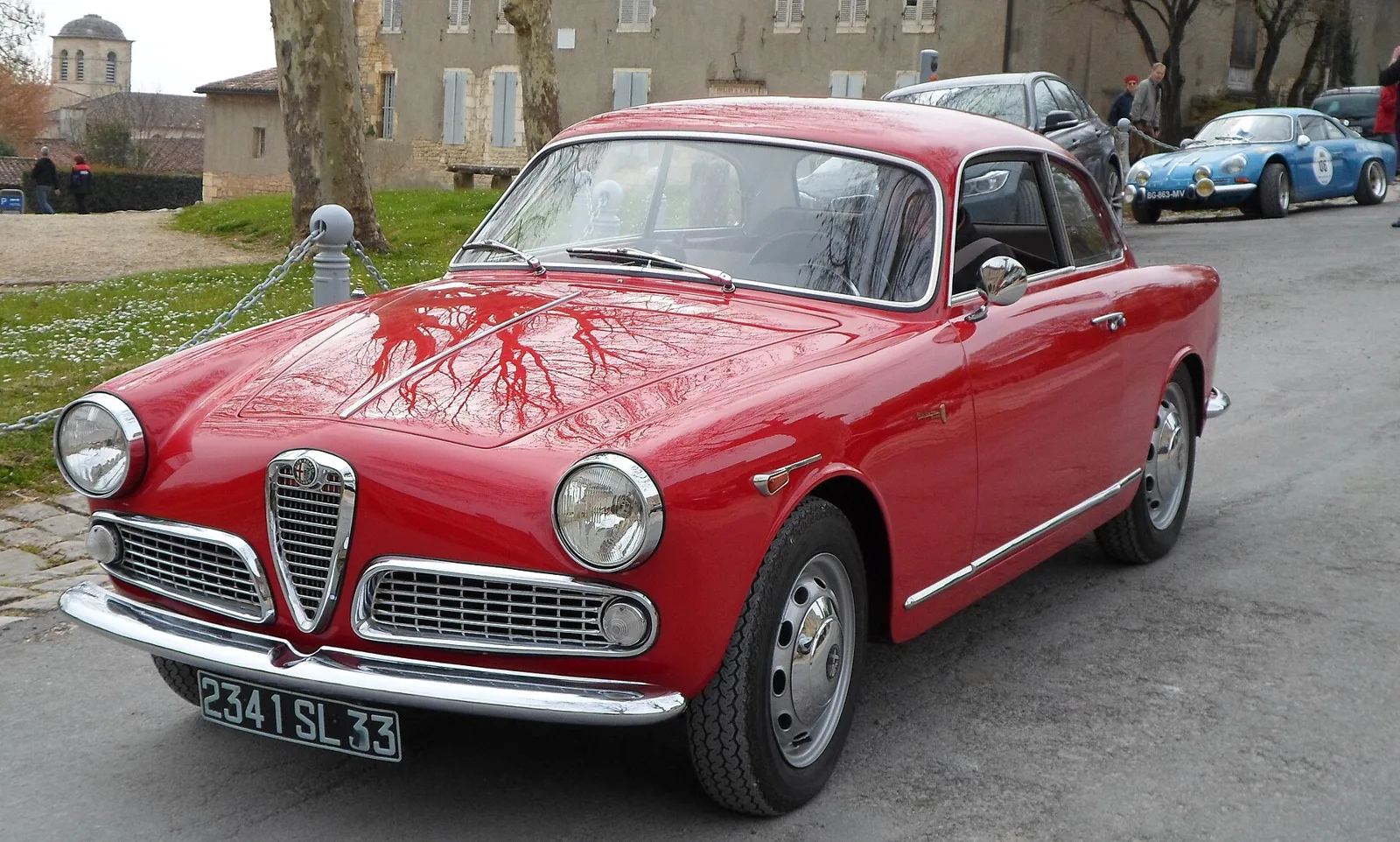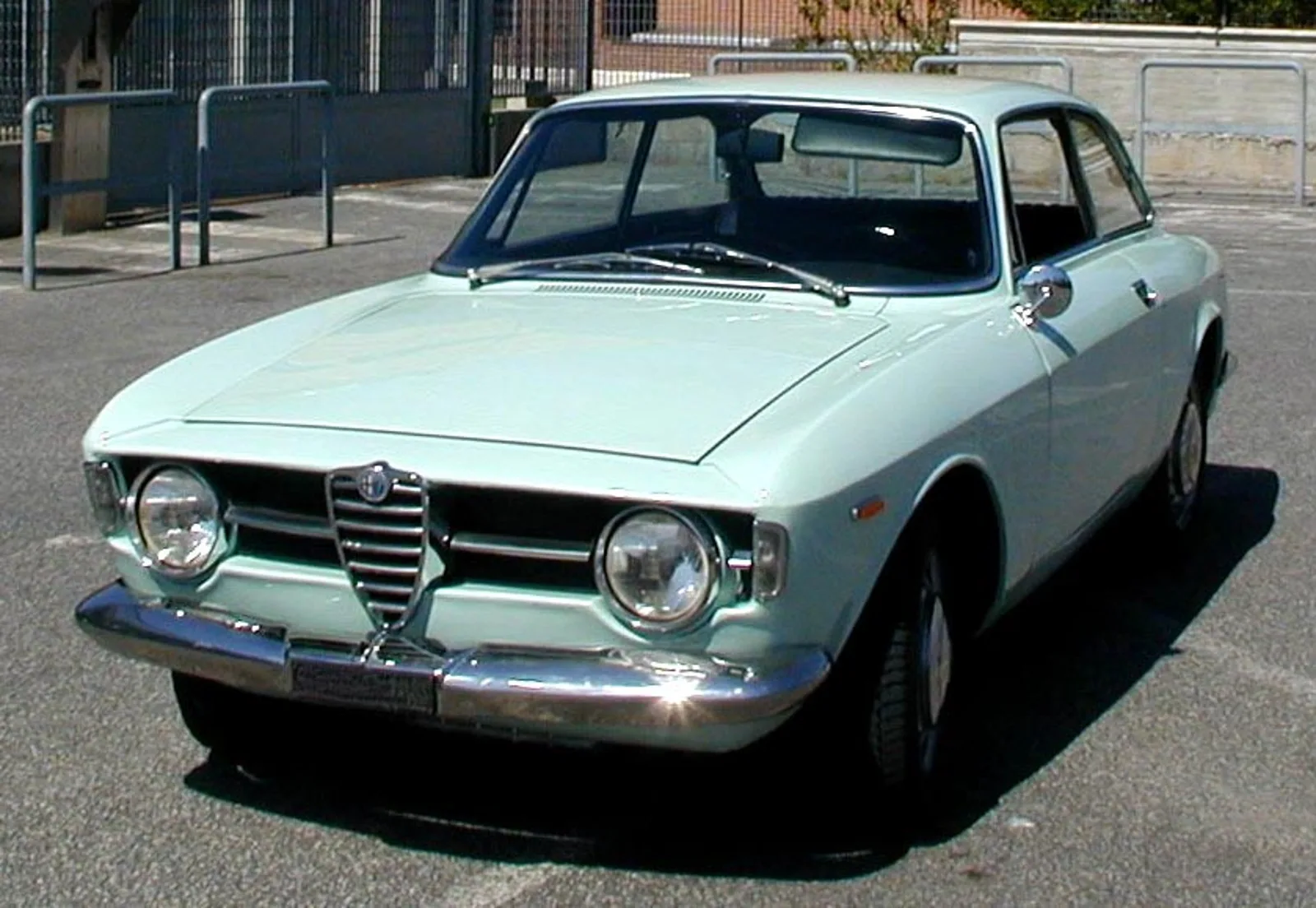
Giugiaro-styled coupes on a shortened Giulia floorpan, from the 1963 Sprint GT to the 2000 GTV, the GT Junior range and the GTA racers.
The Alfa Romeo 105/115 coupes were Italian two-door cars built from 1963 to 1977, sharing a shortened Giulia floorpan. They replaced the Giulietta Sprint, and Giorgetto Giugiaro styled the body at Bertone. The range ran from the Giulia Sprint GT to the 2000 GTV, with smaller-engined GT Junior variants and racing GTA models.
The Alfa Romeo 105 and 115 series coupes were built from 1963 until 1977 on a reduced version of the Giulia platform. They succeeded the Giulietta Sprint, and the family ranged from the Sprint GT through to the 2000 GTV, with the GT Junior models and the GTA racers alongside. Their Giugiaro styling and Twin Cam engines made them the sporting heart of the Alfa range.
Where did the 105 series coupe come from?
The coupes were based on a shortened floorpan from the Giulia saloon and replaced the Giulietta Sprint. Giorgetto Giugiaro designed the body for Bertone, one of his first major projects for the firm, and it borrowed heavily from his earlier 2000 Sprint and 2600 Sprint design.
The balance of glass and metal was a striking feature for the era. The shape of the front and rear glass shaped the cabin, and the flat grille with incorporated headlamps was a clean break from the styling of the period.
The Giulia Sprint GT was revealed on 9 September 1963 at the newly opened Arese plant and shown later that month at the Frankfurt Motor Show. Its original body is known as the step front, because the leading edge of the bonnet sat 1 cm (0.4 in) above the nose of the car.
Not every variant was a conventional coupe. A few GT Junior Zagato models had an aerodynamic two-seater body by Ercole Spada for Zagato of Milan, and Alfa Romeo offered them as catalogue models.
Giugiaro's flat-fronted Bertone coupe carried the Alfa Twin Cam into a family of cars from 1963 to 1977.
What engines did the coupes use?
Every model used the all-light-alloy Twin Cam four-cylinder, in capacities from 1290 cc to 1962 cc, with two valves per cylinder. Most had twin carburettors, but the US-market 1750 GTV and 2000 GTV cars used mechanical port fuel injection by SPICA.
A five-speed manual transmission and solid disc brakes on all four wheels were common to the range. A few automatic 2000 GTVs were built at South Africa's Brits plant with a three-speed ZF automatic.
The rear suspension used a live axle on coil springs. Later models could be ordered with air conditioning and a limited-slip differential, and the 2000 GTV sold in North America had the limited-slip unit as standard from 1972 to 1974.
Competition engines used cylinder heads with twin spark plugs, a layout that the GTA and GTAm racers relied on for more power.
What set the Giulia Sprint GT apart?
The Giulia Sprint GT used the 1570 cc version of the all-aluminium Twin Cam, with two twin-choke Weber 40 DCOE carburettors. It produced 106 PS DIN (78 kW; 105 hp) or 122 PS SAE gross at 6000 rpm, and the braking system used four Dunlop discs with a vacuum servo.
Alfa Romeo claimed a top speed of over 180 km/h (112 mph). The Italian magazine Quattroruote measured 181.935 km/h (113 mph) in its December 1964 road test.
Production totalled 21,902 Giulia Sprint GTs from 1963 to 1965, including 2,274 right-hand-drive cars. Of those, 1,354 were fully finished at Arese and 920 were shipped as knock-down kits for foreign assembly.
The rear brakes were an unusual arrangement, with the slave cylinders mounted on the axle tubes and operating the calipers through a system of levers and cranks. Buyers of the Bertone De Luxe body could add leather seats in dark brown or red, with five leather colour options across the Sprint GT range.
What did the Giulia GTC cabriolet involve?
The Giulia GTC was a cabriolet version of the Sprint GT, offered between 1965 and 1966, and built in around 1,000 examples. The cabriolet was introduced to the press at Monza on 4 March 1965 and made its public debut at the Geneva Motor Show that March.
Carrozzeria Touring of Milan carried out the convertible conversion. The car kept the coupe's specification and performance, with a black dashboard in place of the grey crackle paint, and Touring added reinforcement to restore some of the lost rigidity.
What changed with the Sprint GT Veloce?
The Sprint GT Veloce replaced the Sprint GT in 1966 with a revised engine rated at 109 PS DIN (80 kW; 108 hp), slightly more powerful and with more torque. It was distinguished by a black mesh grille with three horizontal chrome bars and by stainless steel bumpers.
Veloce badges included a green Quadrifoglio on the C-pillar, a chrome Veloce script on the tail and an imitation wood dashboard in place of the earlier grey finish. The seats were mildly bucket-shaped, and the steering wheel had three aluminium spokes with a black rim.
Early Veloces used the same Dunlop disc brakes as the Sprint GT, while later cars switched to ATE discs, which had first appeared on the GT 1300 Junior in 1966.
By the end of its run, total Giulia Sprint GT Veloce production reached 14,240 examples, including 1,407 right-hand-drive cars and 380 right-hand-drive complete knock-down kits.
What was the 1750 GT Veloce?
The 1750 GTV entered production in late 1967 and raised the engine to 1779 cc, producing 122 PS (90 kW; 120 hp) at 5500 rpm. The same engine powered the Berlina sedan and the Spider, a first for Alfa Romeo, and the torque peaked at 186 Nm at 3000 rpm.
Tyres moved to 165/14 Pirelli Cinturato or Michelin XAS from 155/15, with 14-inch wheels in place of 15-inch units. ATE disc brakes came fitted from the outset, and a rear anti-roll bar was added, which improved handling and braking.
US models had SPICA fuel injection to meet emissions rules and larger rear light clusters from 1971. Production estimates vary, with 44,269 cited in one account and 32,265 in a corrected count.
What was the 2000 GT Veloce and the GT Junior range?
The 2000 GT Veloce arrived in 1971 with a 1962 cc engine producing 132 PS (97 kW; 130 hp) at 5500 rpm. It replaced the 1750 range, and a separate instrument cluster took the place of the gauges that had sat in the dash.
GT Juniors were built with smaller engines to avoid higher taxes in some markets, Italy included. The GT 1300 Junior had a 1290 cc engine rated at 89 bhp (66 kW; 90 PS) and reached 60 mph from rest in 12.6 seconds.
Production reached 91,964 of the 1.3-litre Junior and 13,120 of the 1.6-litre version. The Junior weighed 2,050 pounds (930 kg), so the inside front wheel could lift off the road when driven hard.
How did the GT 1300 Junior change over time?
The first GT 1300 Juniors were based on the Giulia Sprint GT, with a simpler interior and a single horizontal chrome bar on the black grille. Together with the Giulia 1300 Ti, the Junior pioneered ATE disc brakes, which later went on the whole 105 series.
From 1967 a brake servo was fitted as standard, along with higher rear wheelarches. In 1968 the Junior took many 1750 GTV parts, including the dashboard and suspension, while keeping the early step-front body, which made it the most mechanically refined step-front model.
The GT 1300 Junior was dropped in the UK in 1972 but remained available in other right-hand drive markets. Around 340 right-hand-drive GT 1300 Juniors were made in 1972, according to one listing. From 1974 the 1.3 and 1.6 Juniors were rationalised with the 2000 GTV into one range.
What were the Junior Z and GTA models?
The Junior Z was a two-seater coupe with aerodynamic bodywork by Zagato, introduced at the Turin show in November 1969 on a steel body with an aluminium bonnet. The 1600 Junior Z followed in 1972, and 1,117 Junior Z and 402 1600 Junior Z cars were built in total.
GTA stands for Alleggerita, meaning lightened. Its outer panels were aluminium rather than steel, and the cars were priced well above the standard models for competition homologation. Practically all GTAs were used in racing, and many were tuned by Autodelta before delivery.
Unmodified factory-trim GTAs are known as GTA Stradale, although few were sold in that form. The GTA kept the lower rear wheelarches of the Sprint GT and GTV, while the GTA 1300 Junior carried the higher arches first seen on the GT 1300 Junior.
The GTAm, from 1969, was never built by the factory. Autodelta initially based it on US-spec 1750 GTV bodies, and the engine was enlarged to 1985 cc and later 1999 cc, producing up to 240 PS (177 kW; 237 hp). About 40 were built by Autodelta and racing workshops.
How did FIA rules affect the aluminium cars?
FIA rules allowed aluminium doors and boot lids on certain 1750 GTVs in Group 2 until 1972, when the rules changed. The twin-spark engine for the GTAm was homologated under FIA 1576 Group 2 from 1 January 1970, and from 1972 the GTAm could no longer race with aluminium doors and boot lid in FIA events.
Specifications at a glance
| Specification | Detail |
|---|---|
| Production | 1963 to 1977 |
| Styling | Giorgetto Giugiaro for Bertone |
| Engines | All-light-alloy Twin Cam, 1290 cc to 1962 cc, two valves per cylinder |
| Giulia Sprint GT | 1570 cc; 106 PS DIN (78 kW; 105 hp); 21,902 built |
| Sprint GT Veloce | 109 PS DIN (80 kW; 108 hp); 14,240 built |
| 1750 GTV | 1779 cc; 122 PS (90 kW; 120 hp) at 5500 rpm |
| 2000 GTV | 1962 cc; 132 PS (97 kW; 130 hp) at 5500 rpm; 37,459 built |
| GT 1300 Junior | 1290 cc; 89 bhp (66 kW; 90 PS); 91,964 built |
| GT 1600 Junior | 1570 cc; 13,120 built |
| GTAm | Up to 240 PS (177 kW; 237 hp); about 40 built |
| Transmission | Five-speed manual; three-speed ZF automatic on some South African cars |