A rear-drive two-seater built on Giulia mechanicals, from the 1966 launch to the fourth series of 1990, with a racing driver's edition along the way.
Built by Alfa Romeo from 1966 to 1994 across four series, the Spider used Giulia mechanicals beneath a body designed and assembled by Pininfarina. It succeeded the Giulia Spider, and its first three series were assembled at Grugliasco, with the fourth built at San Giorgio Canavese.
The Alfa Romeo Spider ran for almost thirty years, passing through four series between 1966 and 1994. It was a two-seat, front-engined, rear-drive roadster that borrowed its running gear from the Giulia, while Pininfarina designed and assembled the body. The first three series came from Pininfarina's plant at Grugliasco, and the fourth from San Giorgio Canavese.
Over that long run the car moved from a boat-tailed roadster with a 1.6-litre twin-cam engine to a fuel-injected model with plastic bumpers. The first generation alone accounted for 124,104 cars between 1966 and 1993, a substantial total for a sports car built in small numbers.
Where did the Spider come from?
The Spider followed the Giulia Spider and reused the Giulia's mechanicals, including its twin-cam inline-four and solid rear axle. Alfa Romeo introduced the 105 Series Giulia in 1962, and the new roadster was built around that platform. Pre-launch production cars began to emerge at the end of 1965, and the car was shown at Geneva in March 1966.
Alfa's sport variants of the older Giulietta stayed on sale until new models were ready. The Giulietta-based Giulia Spider 1600 was built from 1962 to 1965, and the Giulia Spider Veloce from 1963 to 1965. The Spider carried this lineage forward, with a unibody that incorporated crumple zones at both ends, a relatively new principle at the time.
Before the production car, Centro Stile Alfa Romeo and Bertone proposed a different two-seat sports car. The 1963 Giulia GT Spider, designed by Ernesto Cattoni, shared the chassis type of the future Duetto Spider, but it never went into production and remained a prototype.
Four series, one rear-drive roadster, and almost three decades of Pininfarina styling on Giulia running gear.
Who designed the Spider and where did its shape come from?
Pininfarina designed, built and assembled the body. Its shape grew out of concept cars, starting with the 1956 Superflow, which already showed the overall form and side scallops. The 1959 open-top Super Sport introduced the rounded tail that became the car's signature.
The Superflow was built on the chassis of a retired 6C 3000 CM racing car, and Aldo Brovarone designed it. It was an aerodynamic coupe with rear fins and a glass greenhouse, and it was updated three times before the open-top Super Sport arrived. That car dropped the rear fins of its predecessors and showed the tail that production cars would later use.
The 1961 Giulietta SS Spider Aerodinamica came closest to the final production form, although it used hidden headlamps. The design was almost ready by 1961, but the success of existing models and the economic challenges facing Italy delayed production. Battista Pininfarina was involved in the 1600 Spider, which was the last project he worked on, while Franco Martinengo led Pininfarina's design at the time.
Why was the car not called Duetto?
Alfa Romeo ran a naming competition that drew more than 100,000 ballots, and the winning entry was Duetto. A confectionery maker had launched a chocolate snack with that name in 1965 and registered it first, and the Court of Milan gave that company exclusive rights, so the car went on sale as the Alfa Romeo Spider 1600.
Guidobaldo Trionfi, from Brescia, proposed the winning name and received an example of the new car as his prize. Duetto survived as an informal name, and in North America the first series is still known as the dovetail Spider or the Duetto.
What did the Series 1 offer when it launched?
The first Spider used a 1,570 cc twin-cam engine with two Weber two-barrel carburettors, rated at 109 PS DIN (80 kW; 108 hp). Power went to the rear wheels through a five-speed manual gearbox, supported by disc brakes and 15-inch wheels shod with 155HR15 Pirelli Cinturato CA67 tyres. The launch price in Italy was 2,195,000 lire.
The price was set against British rivals. In the US the car sold for $3,950, compared with $3,991 for a Lotus Elan and $2,607 for an MGB. In the UK it cost close to a Jaguar E-Type, and the interior was sparsely fitted, with few standard features beyond the basics.
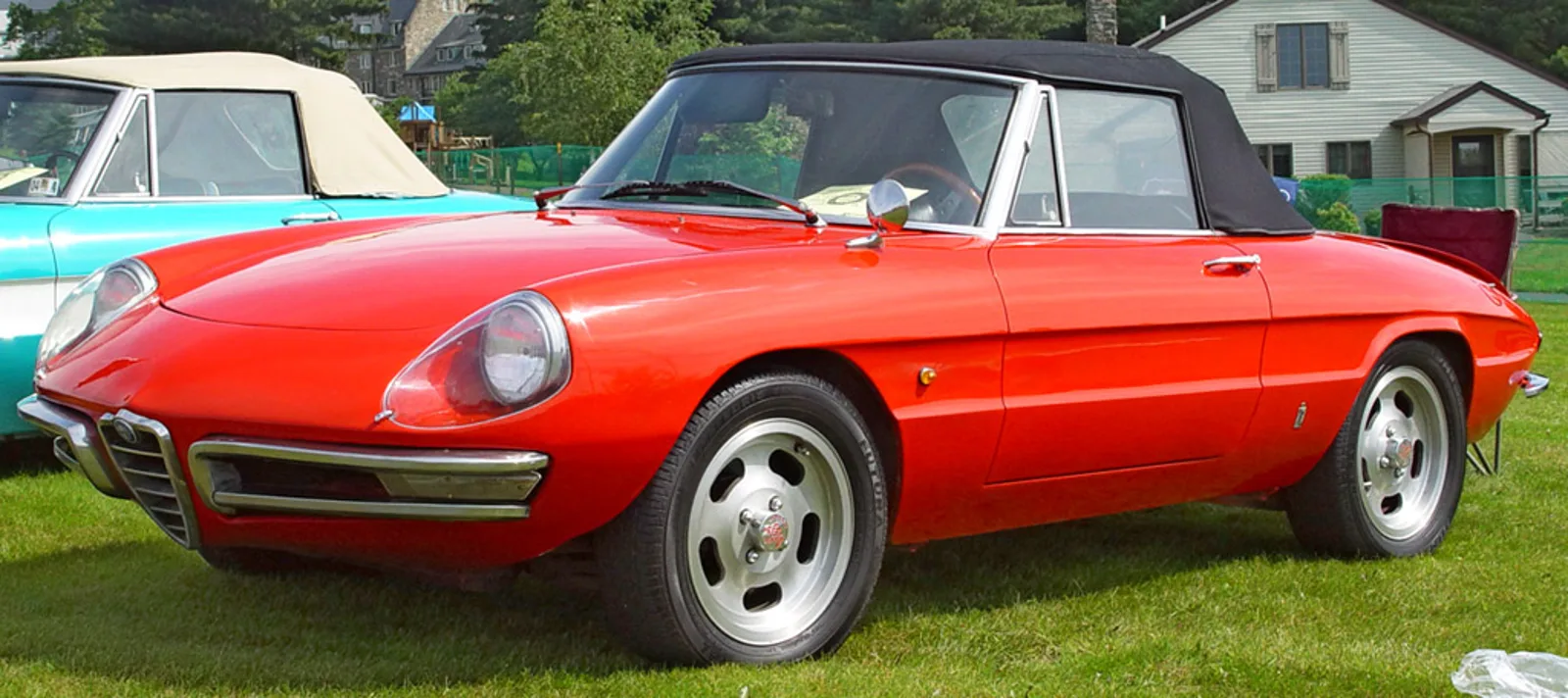
The long round tail gave the first series its nicknames. Italians called it osso di seppia, meaning cuttlebone, and the car was also known as the boat tail. Series 2 later replaced it with a Kamm tail for more luggage space. Series 1 production totalled 6,324 1600 Spiders alongside 2,680 1300 Junior cars.
How did the 1750 and 2000 Spiders differ?
From January 1968 the 1600 gave way to the 1750 Spider Veloce, with a 1,779 cc engine rated at 118 PS DIN (87 kW; 116 hp) and a top speed of 190 km/h (118 mph). In 1971 it became the 2000 Spider Veloce, with 1,962 cc and 132 hp (98 kW).
The 1750 carried no Spider badge, only a 1750 script below the rear Alfa Romeo badge. North American cars from 1969 used SPICA mechanical fuel injection and were identified by an injection badge on the tail. Visible changes were small, with the rear-view mirror moved to the door and new brakes, suspension and 14-inch wheels.
The 1300 Junior arrived in June 1968 with a 1,290 cc engine producing 89 PS DIN (65 kW; 88 hp), and it reached 170 km/h (106 mph). It was a cheaper car that lacked opening quarter lights, a centre console and the three-spoke wood-rimmed steering wheel of the 1750. It was recognisable by its black lower front bumper and the absence of plastic headlamp fairings.
What changed with the Series 2 and the Spider-Targa?
The Series 2, introduced in 1970, replaced the long round tail with a Kamm tail to improve luggage space. Other changes included a slightly different grille, new door handles, a more raked windscreen and top-hinged pedals. The model remained in production until 1982 or 1983 in its various forms.
In 1974 the factory introduced the Spider-Targa, which had a Porsche-style solid rear window and black lift-out roof panels made of glass-reinforced plastic. Fewer than 2,000 examples were built, and it remained the only Spider with a partly solid roof. The factory later offered a model-specific hard top as well.
The 1300 and 2000 cars gained two small seats behind the front seats in 1974 and 1975, becoming two-plus-two models. Stainless steel bumpers gave way to black rubber-clad units between 1974 and 1976 to satisfy stricter North American crash requirements. Series 2 output included 4,557 1300 Juniors, 4,848 1600 Juniors and 4,027 1750 Spider Veloce cars.
Was there a Niki Lauda special edition?
Yes. The Niki Lauda special edition was revealed in 1978, when the former Formula One champion joined the Brabham Alfa Romeo team. It was launched at the Long Beach Grand Prix, and chassis number 001 was driven around the circuit by Lauda himself. A total of 350 examples were made.
The edition changed little beyond the look of the car. It had revised badging and a rear spoiler, and its cosmetic trim changes set it apart from the standard Spider without any mechanical changes.
What did the Series 3 bring to the Spider?
The Series 3 arrived in North America for model year 1982 with 2.0-litre Bosch electronic fuel injection in place of the SPICA system. A styling revision in 1983 added black rubber bumpers, a front bumper that incorporated the grille and a small soft rubber spoiler on the Kamm tail.
The Quadrifoglio Verde arrived in 1986 with sideskirts, new mirrors, front and rear spoilers and unique 15-inch alloy wheels. It came in red, silver or black, with blood red carpets and grey leather seats trimmed in red stitching. Its twin-cam engine produced 128 PS (126 bhp; 94 kW) at 5400 rpm and 178 Nm (131 lbf ft) at 4000 rpm in Europe.
North American cars kept the Bosch L-Jetronic injection, with the variable valve timing mechanism activated through it, and they carried a five-speed manual. Mechanically the Quadrifoglio Verde matched the standard Veloce, so the changes were almost entirely cosmetic.
The Graduate trim was a North American tribute to the 1967 film The Graduate, which starred Dustin Hoffman. It was intended as a less expensive entry-level model, with steel wheels, manual windows, vinyl seats and a vinyl top. Air conditioning and a dealer-installed radio were the only options, and the Graduate was sold from 1985 until 1990.
What did the Series 4 change?
The Series 4 launched in 1990 with Bosch Motronic electronic fuel injection, full-width body-coloured plastic bumpers, an electric cooling fan and full-width rear lights. It dropped the front under-bumper spoiler and the rear boot-lid spoiler that earlier models had carried, and an optional automatic transmission was available.
In North America the Series 4 became a 1991 model, with power steering, larger knee bolsters and a driver airbag fitted as standard. The range came as the base Spider and the Spider Veloce, which swapped the vinyl seats for leather and added 15-inch alloy wheels, air conditioning and a cloth top as standard.
Production of the original Spider ended in 1993, and the last car left the line in April of that year. The model had been the last rear-wheel-drive Alfa Romeo until the 8C Competizione of 2007.
Limited editions took the car further. The French Beaute was a numbered edition of 120 cars in white and navy two-tone, with a blue hood and white leather seats. The 1994 Commemorative Edition for North America numbered 190 cars, each with a numbered dashboard plaque, a CE badge, gold centre caps and burl wood trim.
How many Spiders were built?
The first generation totalled 124,104 cars between 1966 and 1993. Pininfarina built the first three series, and the fourth was assembled at San Giorgio Canavese. Within the 2000 range, 16,320 Spider Veloce cars were made, and a further 22,059 fuel-injected US-market examples were built alongside them.
The Series 1 total was made up of 6,324 1600 Spiders and 2,680 1300 Junior cars, while the Series 2 1300 and 1600 Juniors added 4,557 and 4,848 cars respectively. The 1750 Spider Veloce accounted for 4,027 cars, and the Spider-Targa was a small run of fewer than 2,000.
Did the Spider appear in films?
Yes. A 1966 Series 1 Spider 1600 was featured in the 1967 film The Graduate, which gave the model wide exposure. In 2011 the animated film Cars 2 included Celine Dephare, a classic sports coupe based on the Spider who sells headlights at a Paris market.
Celine is unusual among the Cars characters because her eyes sit in her headlights rather than the windscreen. That detail makes her one of the most recognisable Spider-inspired characters in the franchise.
What are the Alfa Romeo Spider specifications?
| Specification | Detail |
|---|---|
| Production | 1966 to 1994, four series |
| Series 1 engine | 1,570 cc twin cam, 109 PS DIN (80 kW; 108 hp) |
| Series 1 gearbox and brakes | Five-speed manual, disc brakes, 15-inch wheels |
| Series 1 tyres | 155HR15 Pirelli Cinturato CA67 |
| Launch price | 2,195,000 lire (Italy); $3,950 (US) |
| 1300 Junior | 1,290 cc, 89 PS DIN (65 kW; 88 hp), 170 km/h (106 mph) |
| 1750 Spider Veloce | 1,779 cc, 118 PS DIN (87 kW; 116 hp), 190 km/h (118 mph) |
| 2000 Spider Veloce | 1,962 cc, 132 hp (98 kW) |
| Quadrifoglio Verde | 1,962 cc, 128 PS (126 bhp; 94 kW) at 5400 rpm |
| First-generation output | 124,104 cars |
| Niki Lauda edition | 350 examples, 1978 |