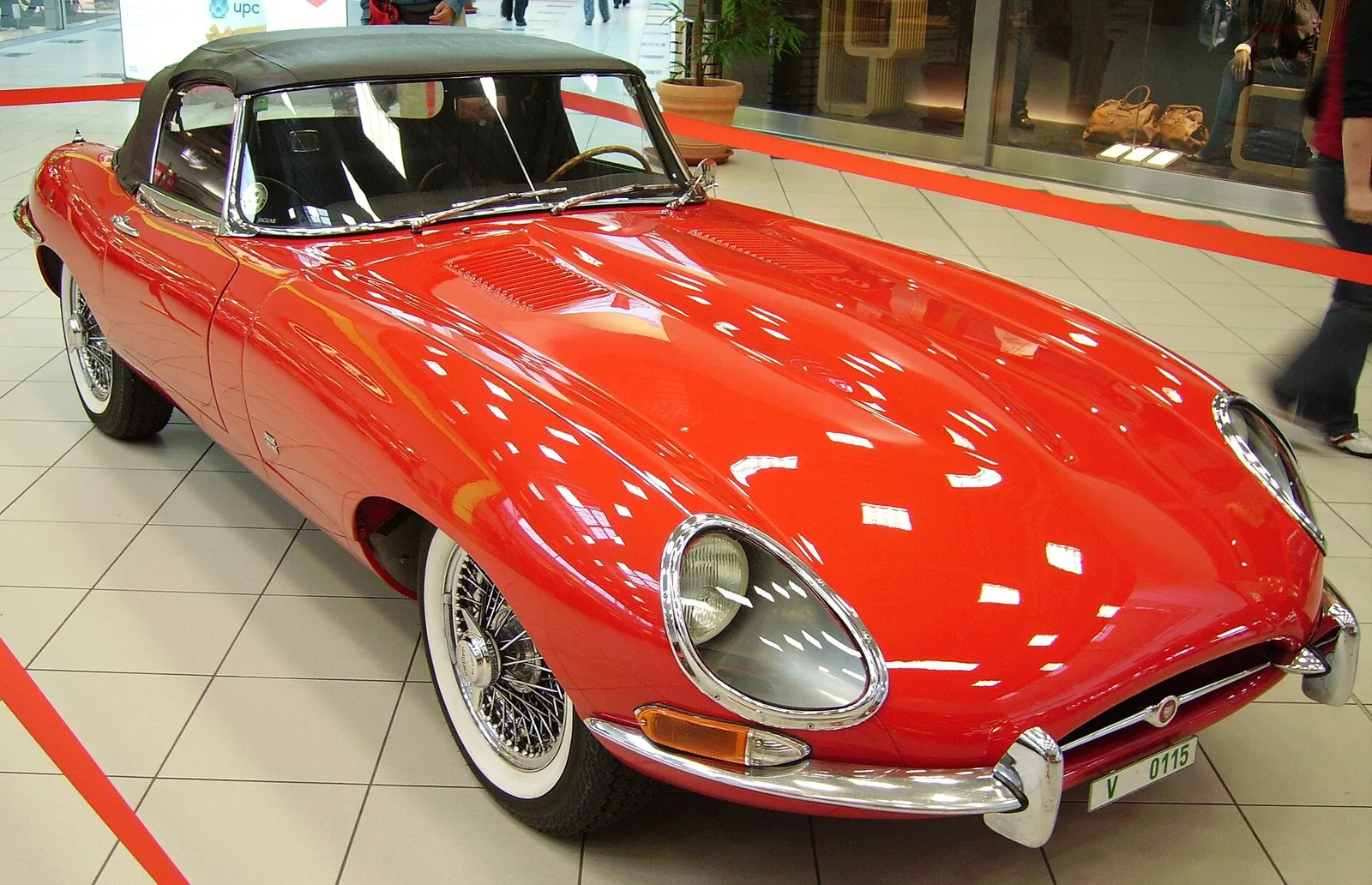
A 1961 grand tourer built on racing ideas, with a lightweight competition variant, a V12 finale and collector prices that ran well past its launch figure.
A front-engined British sports car from Jaguar, the E-Type was built between 1961 and 1974. It grew from the D-Type racer and came as a coupe, a roadster and a 2+2, with a V12 Series 3 closing out production. Production ran until 1974.
The Jaguar E-Type was a British sports car made by Jaguar Cars Ltd between 1961 and 1974, sold as the XK-E in North America. It grew from the thinking behind Jaguar's racing D-Type, and its body and suspension set a new standard for road cars of the period. This guide covers the design, the three series, the lightweight racing offshoots and the auction market that followed.
What is the Jaguar E-Type?
The E-Type is a front-engined British sports car made by Jaguar from 1961 to 1974. It was called the XK-E in North America and came as a fixed head coupe, an open two-seat roadster and, from 1966, a 2+2. Each variant kept the same front-engined layout.
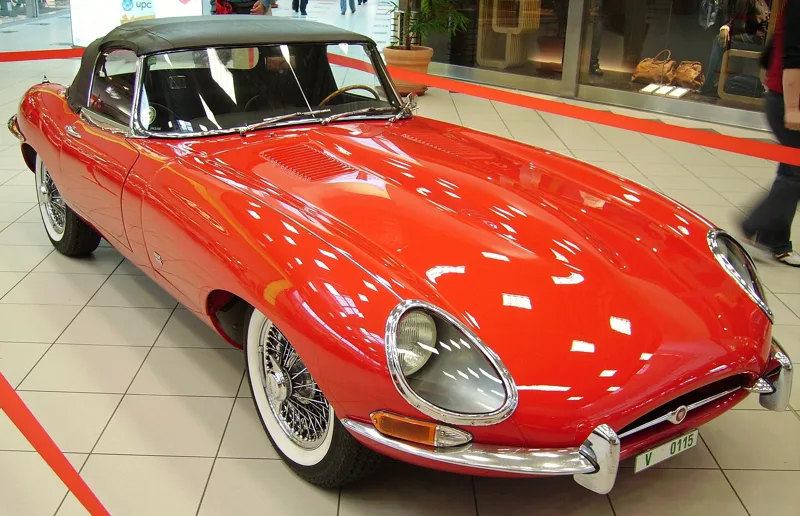
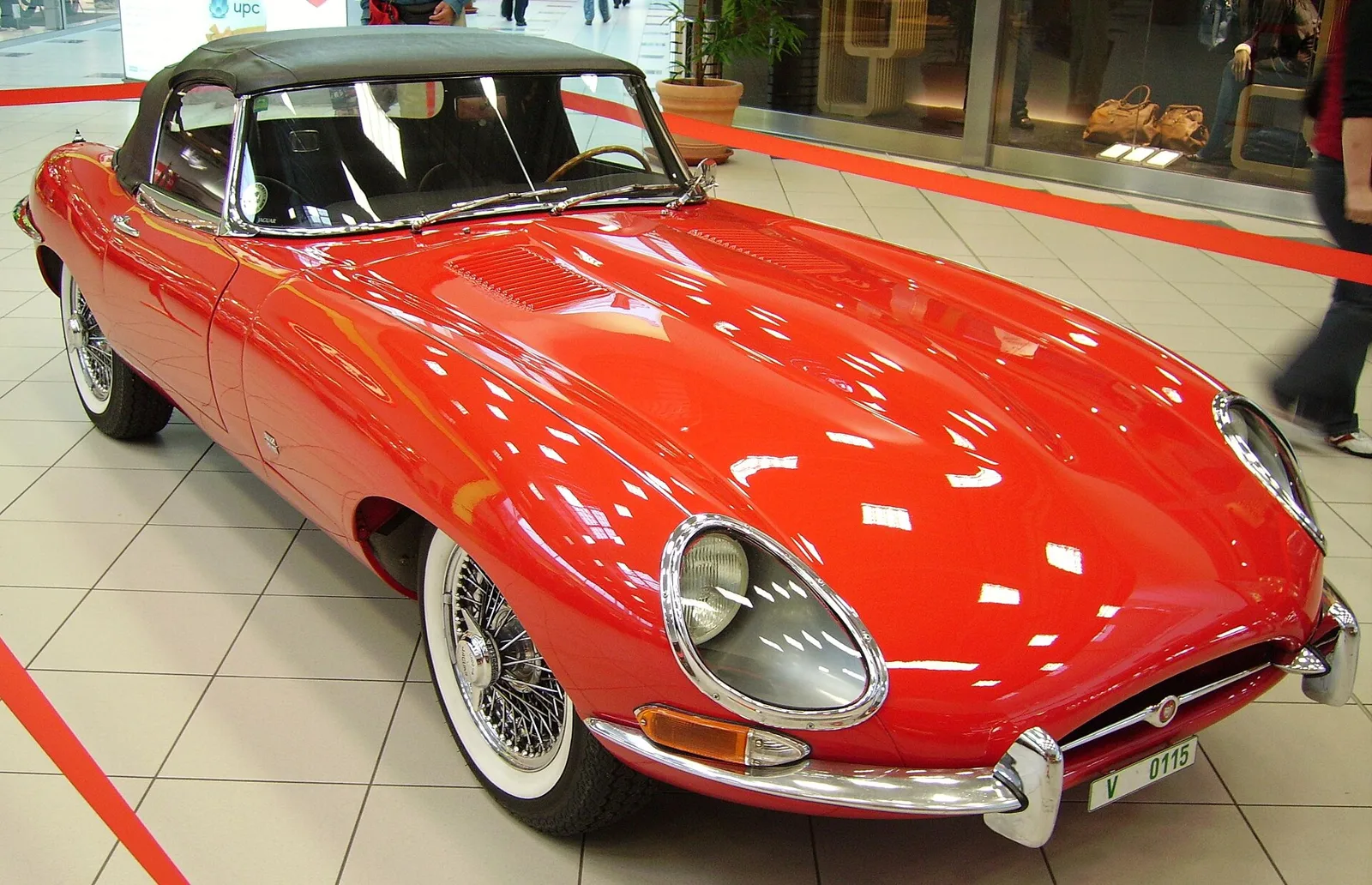
Its claimed top speed of 150 mph (241 km/h) and a 0-60 mph time of 7.1 seconds in one 1961 test made it a benchmark. The appearance is what most people remember. A long bonnet, a sweeping tail and an open roadster body combined to make the car look faster than it stood still, and that look helped turn a grand tourer into a design icon.
The 2+2 arrived in 1966 on a lengthened wheelbase, and its body was 9 in (229 mm) longer than the two-seat coupe. That extra length gave the car a second pair of seats while keeping the same basic character, so buyers who needed more room had a choice without leaving the range.
The 1961 launch came as a grand tourer, a car built for fast journeys over long distances. The first run of cars is known as Series 1, and collectors value those early roadsters more highly than the later series. That gap in value is one of the most discussed aspects of the car today.
A grand tourer built on racing thinking, sold as the XK-E across the Atlantic and still valued by collectors decades on.
Where did the E-Type's design come from?
The E-Type grew out of Jaguar's D-Type racer, a car that had taken the Le Mans 24 Hours in three successive years starting in 1955. Its engineers carried the lightweight, racing-derived thinking into a road car, using a front subframe that carried the engine and front suspension, bolted to a body tub.
That was a novel principle for the early 1960s. Instead of a ladder frame, the front subframe carried the engine and bolted onto the central tub. The first cars weighed 1,315 kg (2,899 lb),.
Front and rear suspension were both independent, and the car used four-wheel disc brakes with rack-and-pinion steering. These were advanced choices for a production sports car of the period.
How did the E-Type prototypes lead to production?
The first prototype, the E1A, was designed in 1957 by William Heynes and used a monocoque body with independent rear suspension. The second, the E2A, followed in 1960 with a steel chassis, an aluminium body and a 3-litre XK engine fitted with Lucas fuel injection.
The E2A raced for the privateer Briggs Cunningham after its Le Mans outing and later returned to Jaguar as a test vehicle. Roger Woodley owned it from 1970. It was offered at Bonhams Quail Auction in 2008, and the sale price was US$4,957,000.
What changed between the Series 1, 1.5 and 2 cars?
The Series 1 ran from 1961 to 1968 with a 3.8-litre engine, which was replaced by a 4.2-litre unit of 4,235 cc in October 1964. The cars built in between are often called Series 1.5, and later models became the Series 2 and Series 3. Each change responded to a mix of engineering needs and market rules.
The 4.2-litre engine gave the same 265 bhp (198 kW) as the 3.8, but its torque rose 18%, from 240 to 283 lb ft. Both engine sizes reached 150 mph (241 km/h), and the 4.2 carried a red marking on its rev counter from 5,000 rpm, earlier than the 3.8's limit.
The 1968 Series 1.5 cars switched from three SU carburettors to twin Zenith-Stromberg units for US emissions rules, which cut output from 265 bhp to 246 hp. Series 2 cars from 1968 to 1971 dropped the glass headlight covers and had a ribbed engine look.
Series 3 arrived in 1971 with a 5.3-litre V12 that produced a claimed 203 kW (272 hp). The short coupe body was dropped, so the Series 3 came only as a convertible and a 2+2, and the V12 gave the range a larger engine than any earlier car.
How fast was the E-Type in road tests?
Road tests from the period gave the E-Type impressive figures. A 1961 Motor test of an open 3.8-litre car recorded 149.1 mph (240.0 km/h), with 0-60 mph in 7.1 seconds. Autocar's May 1965 test of a 4.2 fixed head coupe recorded 153 mph (246 km/h) and 7.6 seconds to 60 mph.
Fuel use in the 1961 Motor test was 21.3 mpg-imp (13.3 L/100 km), a respectable figure for a car of that performance. Motor's October 1964 test of a 4.2 coupe recorded 150 mph and 7 seconds to 60 mph, with a quarter mile in 14.9 seconds, while Autocar's 1965 quarter mile took 15.1 seconds from a standing start.
Why were lightweight E-Types built?
Jaguar built the lightweight E-Type to carry the D-Type's competition legacy forward. The plan called for 18 cars, but only 12 were built, and they used aluminium panels with a 300 bhp (220 kW) tuned 3.8-litre engine. Three Weber carburettors and Lucas mechanical fuel injection set them apart from the road cars.
The lightweights never won at Le Mans or Sebring, but a 1963 Australian GT title went to Bob Jane in one of them. Peter Lindner, Jaguar's distributor in Germany, pursued a GT-class effort at Le Mans with a modified car, but mechanical problems ended that attempt before the finish.
What was the Low Drag Coupe?
The Low Drag Coupe was a 1962 test bed built to explore a lighter, more aerodynamic racing car inspired by the D-Type. It used aluminium panels on the production tub, and it was sold a year after completion to racer Dick Protheroe. The car was built to test an idea rather than to sell.
Its lessons fed into the wider lightweight programme. Its experience showed how far Jaguar was willing to push a road-based car toward a true competition machine.
How much do E-Types sell for at auction?
E-Types have reached high prices at auction. A 4.2 Series 1 roadster fetched $467,000 in 2013, while a 1961 flat-floor 3.8-litre Series 1 made $528,000 in 2014. A 1963 Lightweight fetched $7,370,000 at the 2017 Scottsdale auctions. The rarest early Series 1 cars, with flat floors and external bonnet latches, are the most sought after.
That explains why values can differ so sharply between cars that look almost identical to a casual observer. Originality and documented history often matter more than the spec sheet.
Prices for competition cars sit far above those for road cars, and the lightweights stand at the top of that market.
What was the E-Type Concept Zero?
The E-Type Concept Zero was an all-electric revival of the 1968 Series 1.5 roadster, shown in September 2017. It used a 40 kWh battery, accelerated to 60 mph in 5.5 seconds and had a range of 168 miles (270 km) on a full charge. It was a concept, not a production car.
The Concept Zero showed how the classic roadster shape could carry a modern drivetrain. It sits alongside the original cars as a statement about the design's longevity, even though it never reached showrooms as a production model. Decades after the first car, the basic silhouette remained instantly recognisable.
Why do collectors prize the Series 1?
Series 1 cars are the most collected because they were the first run, and their early details set them apart. Cars built before a certain point had flat floors and external bonnet latches, and those features now mark the earliest examples.
Buyers in the 1960s used the car as a usable grand tourer, and surviving examples carry a range of small factory details that enthusiasts now record with care.
Production figures help explain the premium. There were 7,828 open two-seaters with the 3.8-litre engine and 6,749 with the 4.2-litre, and in 1967 alone 1,508 Series 1 convertibles were built worldwide.
Which museums hold E-Types?
The New York Museum of Modern Art added a blue Series 1 roadster to its permanent design collection in 1996, one of only six automobiles to receive that honour. A London collection, the Victoria and Albert Museum, also holds a Series 1 open two-seater.
The recognition reflected the car's styling as much as its performance. Recognition beyond museums came too, when the Royal Mail issued a British Auto Legends stamp featuring the E-Type in 2013.
E-Type specifications at a glance
The table below lists the core figures for the Series 1 engines, the Series 3 V12, the production totals and the lightweight racers. Where a figure belongs to one series or one variant, the table names it, so the 3.8-litre and 4.2-litre details stay separate.
| Specification | Detail |
|---|---|
| Built | 1961 to 1974, Jaguar Cars Ltd |
| Debut | 15 March 1961 |
| Series 1 engine | 3.8-litre XK six, 265 bhp (198 kW) |
| 4.2-litre engine | 4,235 cc from October 1964; torque 283 lb ft |
| Series 3 engine | 5.3-litre V12, claimed 203 kW (272 hp) |
| Top speed | 150 mph (241 km/h) for Series 1 |
| Weight | 1,315 kg (2,899 lb) for the first cars |
| Lightweight racers | 12 built, 300 bhp (220 kW) |
| Robson production | 15,490 3.8-litre; 17,320 4.2-litre; 10,930 2+2 |
| Series 2 and 3 totals | 13,490 Series 2; 15,290 Series 3 |
How did the E-Type end its run?
The Series 3 closed the run with a V12 engine and a body offered only as a convertible and a 2+2. Fifty commemorative cars with black exteriors were built near the end, and the final open two-seat roadster left the factory in June 1974.
The E-Type began as a six-cylinder sports car and finished as a V12 grand tourer, which reflects how far the design had travelled from its origins.
Frequently asked questions
How many E-Types were built?
Robson's figures list 15,490 3.8-litre cars, 17,320 4.2-litre cars and 10,930 2+2 cars. Robson also gives 13,490 Series 2 cars and 15,290 Series 3 cars, so the total across the whole run runs into tens of thousands.
Did the Series 3 V12 come in a different body?
Yes, in one respect. The short coupe was no longer offered, leaving convertible and 2+2 versions. Its 5.3-litre V12 produced a claimed 203 kW (272 hp), and fifty commemorative cars finished in black were built near the end of the run.
Why are lightweight E-Types so valuable?
Only 12 lightweights were built, from a planned 18, and each used aluminium and competition parts. A 1963 example fetched $7,370,000 at the 2017 Scottsdale auctions. In 2014 Jaguar announced it would build six more, at approximately 1 million pounds each.
What was the E-Type's claimed top speed?
Jaguar's claimed top speed was 150 mph (241 km/h) for the Series 1, and that figure held for both the 3.8 and 4.2 engines.