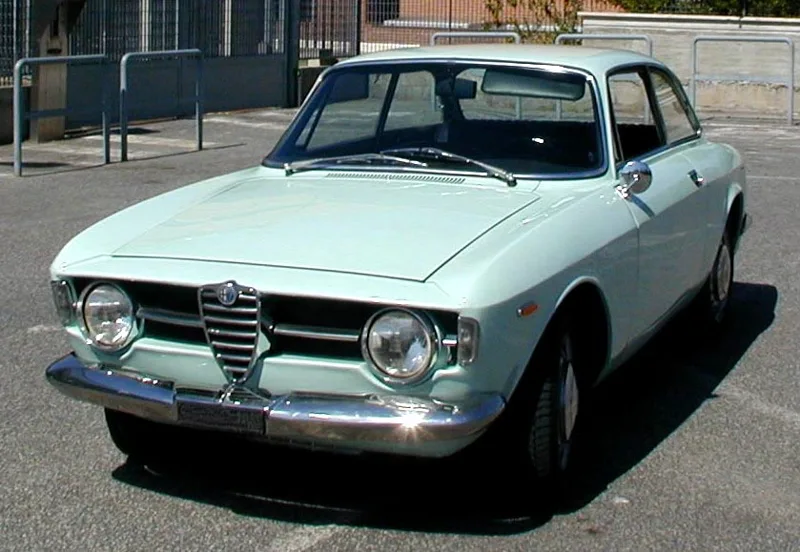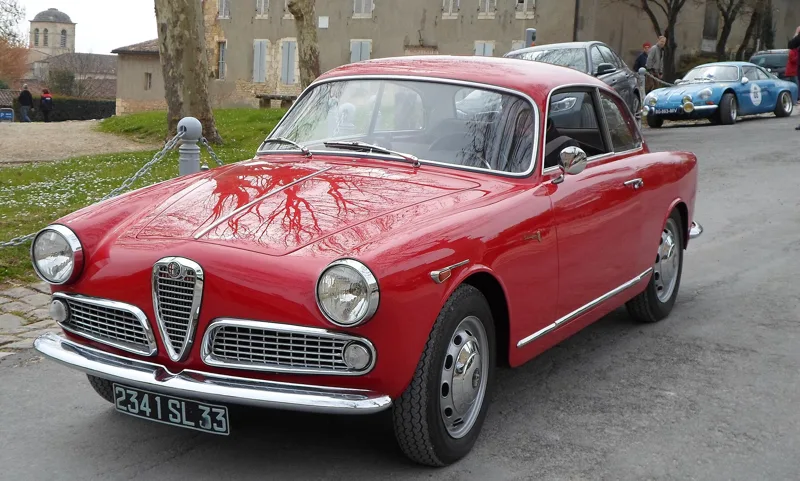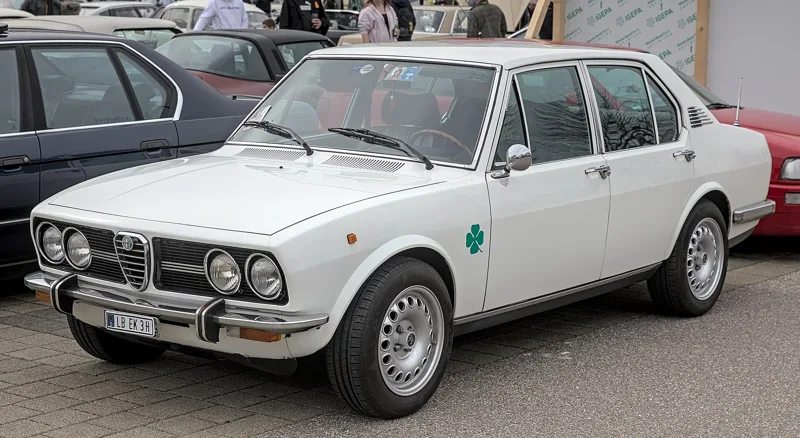
A line-built postwar saloon, the last twin-cam straight-six flagship and a 650 kg racing coupe that won on its debut.
The Alfa Romeo 1900, 2600 and Giulia TZ span a postwar family saloon built from 1950, a six-cylinder flagship made from 1962 to 1968, and a lightweight racing coupe from 1963. The 1900 was Alfa's first production-line car, the 2600 its last twin-cam straight-six, and the TZ won on debut.
The Alfa Romeo 2600 was the last Alfa to carry a twin-cam straight-six, a layout the company had favoured since the 1920s. It was also a sales disappointment. That mismatch is the thread running through three very different cars: the 1900, the postwar saloon that changed how Alfa built cars, the 2600, the old-school flagship that sold poorly beside the new Giulia, and the Giulia TZ, a featherweight racing coupe with a chopped-off tail that took the first four places on its debut.
What made the Alfa Romeo 1900 different?
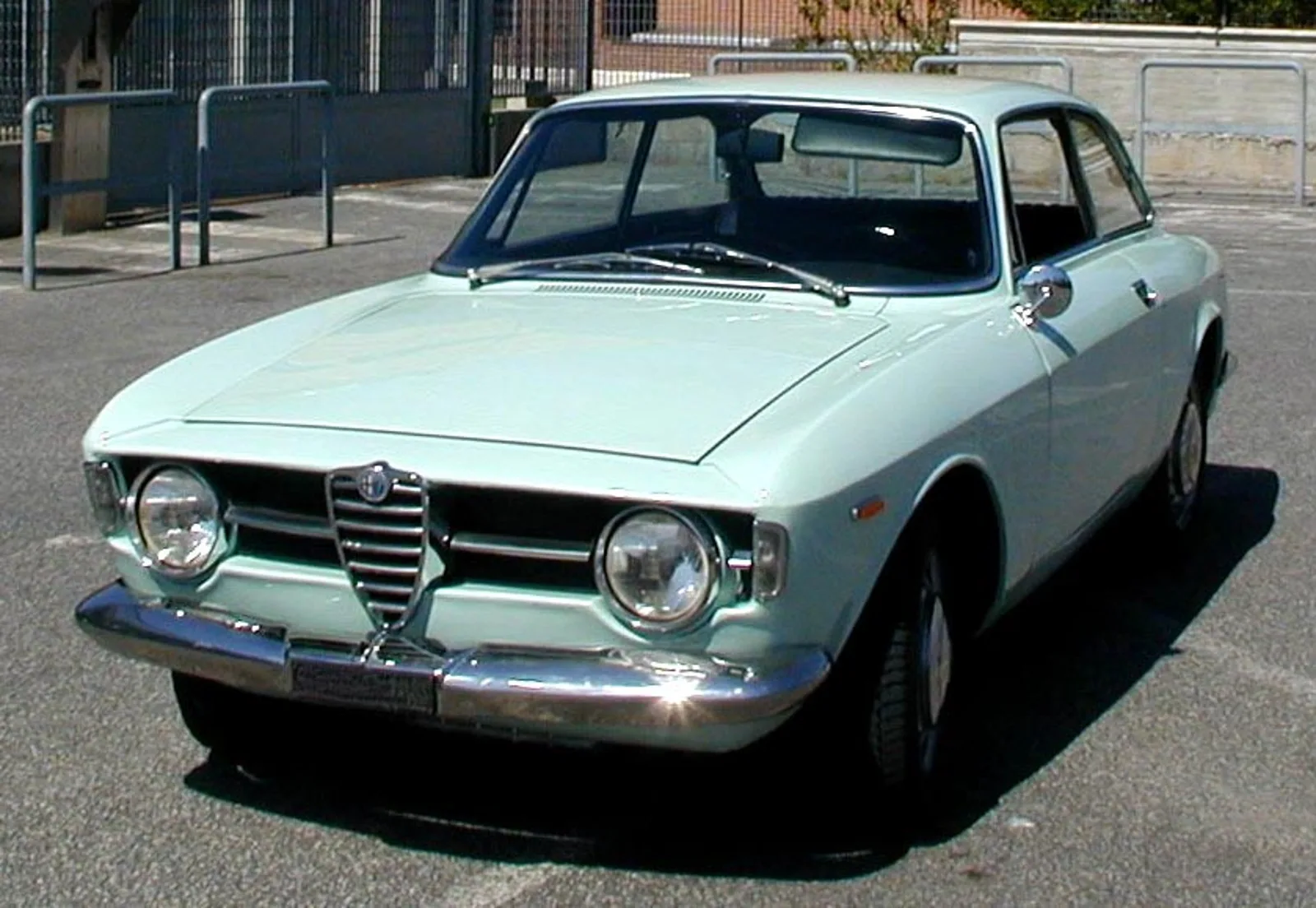
Alfa Romeo built the 1900 from 1950 until 1959. Orazio Satta designed it, and it counted as a landmark for three reasons: it was the first Alfa made wholly on an assembly line, its first production car without a separate chassis and its first to be offered with left-hand drive. It was introduced at the 1950 Paris Motor Show.
Buyers could have two doors or four. Under the bonnet sat a new four-cylinder twin-cam engine of 1,884 cc (82.55 mm bore, 88 mm stroke) producing 90 hp (66 kW). Spacious and simple but quick, the 1900 was sold under a slogan that called it the family car that wins races, a pointed reference to its results in the Targa Florio, the Stella Alpina and other events.
1900 variants and mechanics
A short-wheelbase 1900C, the C standing for corto, arrived in 1951 on a wheelbase of 2,500 mm (98.4 in). The same year came the 1900 TI, with bigger valves, a higher compression ratio and two twin-choke carburettors for 100 hp (74 kW). Two years later the 1900 Super and the 1900 TI Super, also called the 1900 Super Sprint, took a 1975 cc engine, the bore enlarged to 84.5 mm, for 115 hp (85 kW). The basic cars had a four-speed manual and the Super Sprint a five-speed, with drum brakes throughout.
Suspension was independent at the front, with double wishbones, coil springs and hydraulic telescopic dampers, and a live rear axle. The first cars rolled on 6.00-16 Pirelli Stella Bianca tyres, replaced in 1952 by the radial 165HR400 Pirelli Cinturato. At the Milan plant a total of 21,304 were built to 1959, including 17,390 saloons.
The 1900 and the coachbuilders
Alfa's general manager at the time, Iginio Alessio, worried that unibody construction might put Italy's independent coachbuilders out of business. He was also close to Gaetano Ponzoni, a co-owner of Touring Superleggera. So from 1951 to 1958 Alfa produced five variations of the 1900 unibody just for outside bodybuilders. Touring received an official contract for the sporty 1900 Sprint Coupe, and Pinin Farina for an elegant four-seat Cabriolet and Coupe. Other firms piled in.
Zagato built a small series of lightweight coupes, unofficially called the 1900 SSZ, with aluminium bodies and the firm's double-bubble roof, intended for racing. The one-offs ranged from Bertone's famous BAT aerodynamic studies to a science-fiction-style Astral spider that Boneschi built for the Dominican Republic dictator Rafael Trujillo, and a Ghia-Aigle Barchetta penned by Giovanni Michelotti with no doors or windscreen wipers. The 1900M AR51, called the Matta, was a four-wheel-drive off-roader.
In 1954 Alfa made two spiders and two coupes on a chassis like that of the C52 Disco Volante. Franco Scaglione drew unique aluminium bodies at Bertone. The coupe, known as the 2000 Sportiva, weighed 2,000 lb (907 kg), made 138 horsepower (103 kW) and could reach roughly 137 mph (220 km/h).
The design even travelled. Industrias Kaiser Argentina built the IKA Bergantin from March 1960 to February 1962, putting Willys drivetrains under the 1900 Berlina's body and suspension. Most had a 2.5 L (151 cu in) four of 77 hp (57 kW), while the Bergantin Super 6, from May 1961, had a 3.7 L (226.2 cu in) Continental six of 115 hp (86 kW). Nearly 5,000 were made, only 353 of them sixes.
The family car that wins races, said the slogan, and the 1900 backed it up on the Targa Florio.
Why did the Alfa Romeo 2600 struggle?
The 2600, Tipo 106, was Alfa's six-cylinder flagship from 1962 to 1968, succeeding the 2000. Its straight-six was the last twin-overhead-cam six Alfa fitted, closing a tradition that began in the 1920s and had already given way to four-cylinder engines from 1950, as the factory pointed itself at more economical mass-produced cars.
It appeared at the 1962 Geneva Motor Show in three forms. The 2600 Berlina was a saloon with a factory body. The 2600 Spider was a two-plus-two convertible bodied by Carrozzeria Touring, and the 2600 Sprint was a Bertone coupe. Bertone also showed a convertible on the Sprint in 1963, called 2600 Sprint too, but it never entered production. Three years after the launch, at the 1965 Frankfurt Motor Show, came the limited-edition 2600 SZ (Sprint Zagato), a fastback coupe by Zagato, and the very limited 2600 De Luxe, a five-window saloon by OSI.
The six-cylinder engine
The Berlina, Spider and Sprint grew from the corresponding 2000 models, with the same styling and minor facelifts. The big change sat under the bonnet. An all-new 2.6-litre six, all aluminium and with twin overhead camshafts, replaced a four-cylinder with a cast-iron block and alloy head, a design dating from the 1900 range of 1950. Berlina engines had two carburettors and made 130 bhp (97 kW). The Sprint and Spider had three twin-choke horizontal carburettors and 145 bhp (108 kW). The OSI De Luxe came with either set-up, and the Sprint Zagato, on three carburettors, made 165 bhp (123 kW).
| 2600 model | Output | Cars built |
|---|---|---|
| Berlina | 130 bhp (97 kW) | 2038 |
| Sprint | 145 bhp (108 kW) | 6999 |
| Spider | 145 bhp (108 kW) | 2255 |
| De Luxe (OSI) | Two or three carburettors | 54 |
| Sprint Zagato | 165 bhp (123 kW) | 105 |
Why sales stalled
The engine won acclaim, but the cars did not sell. High prices were only part of it. The 2600 compared poorly with its contemporaries, even Alfa's own. The factory chose, correctly as it turned out, to put its limited development money into the mid-sized Giulia launched about the same time. That left the flagship as a lightly facelifted 2000 with a new engine, and the 2000 had been a 1958 restyling of the 1950 1900, so the running gear was a dozen years old at launch. The new engine added weight and length at the front, which helped stability but not handling. When the Giulia appeared with all-new running gear, the 2600 looked worse still.
Styling hurt as well. The Berlina was not liked, so, unusually for an Alfa Romeo saloon, it outsold neither the Sprint nor the Spider. The Spider looked like an enlarged Giulietta Spider, handsome but without the smaller car's grace and balance. It was a four-seater, though the rear seats were cramped.
The Sprint, the police and the Pantera
The Sprint was the one that worked. A big grand touring coupe, it carried four adults in comfort at speed, and it did not face unfair comparison with the smaller Alfas because none of them could do the same job. Stability, a smooth ride and a broad spread of power and torque from the six suited fast touring. The sharp, modern shape came from Giorgetto Giugiaro's first major project as head designer at Bertone, and the Sprint was the top seller of the 2600 range.
The Italian government bought a number of Sprints and fitted them out as police patrol cars. They were nicknamed Pantera, after the panther emblem of the force's rapid intervention team, and suited high-speed pursuits at a time when armed robberies by motorised gangs were rising in 1960s Italy. They appeared in several genre films.
After the 2600
In 1968 the 1750 models took the top spot, refined versions of the 1600 cc Giulia that carried on alongside them. It was another flagship made by upgrading an existing car's engine and lightly restyling it, but the 1750s and the 2000s that evolved from them were a great success, especially in sales. Today the 2600 Sprint and Spider are known for their bodywork and interiors and for how the six performs and sounds. They are rare, and owners need to put real effort and money into restoration, since parts are unique to the range or inherited from earlier Alfas. Few Berlinas remain, and the 105 SZs rank among the most valuable. Pininfarina built two 2600 concepts that never reached production: the Cabriolet Speciale shown in Turin in 1962 and the Coupe Speciale in Brussels in 1963.
What was the Alfa Romeo Giulia TZ?
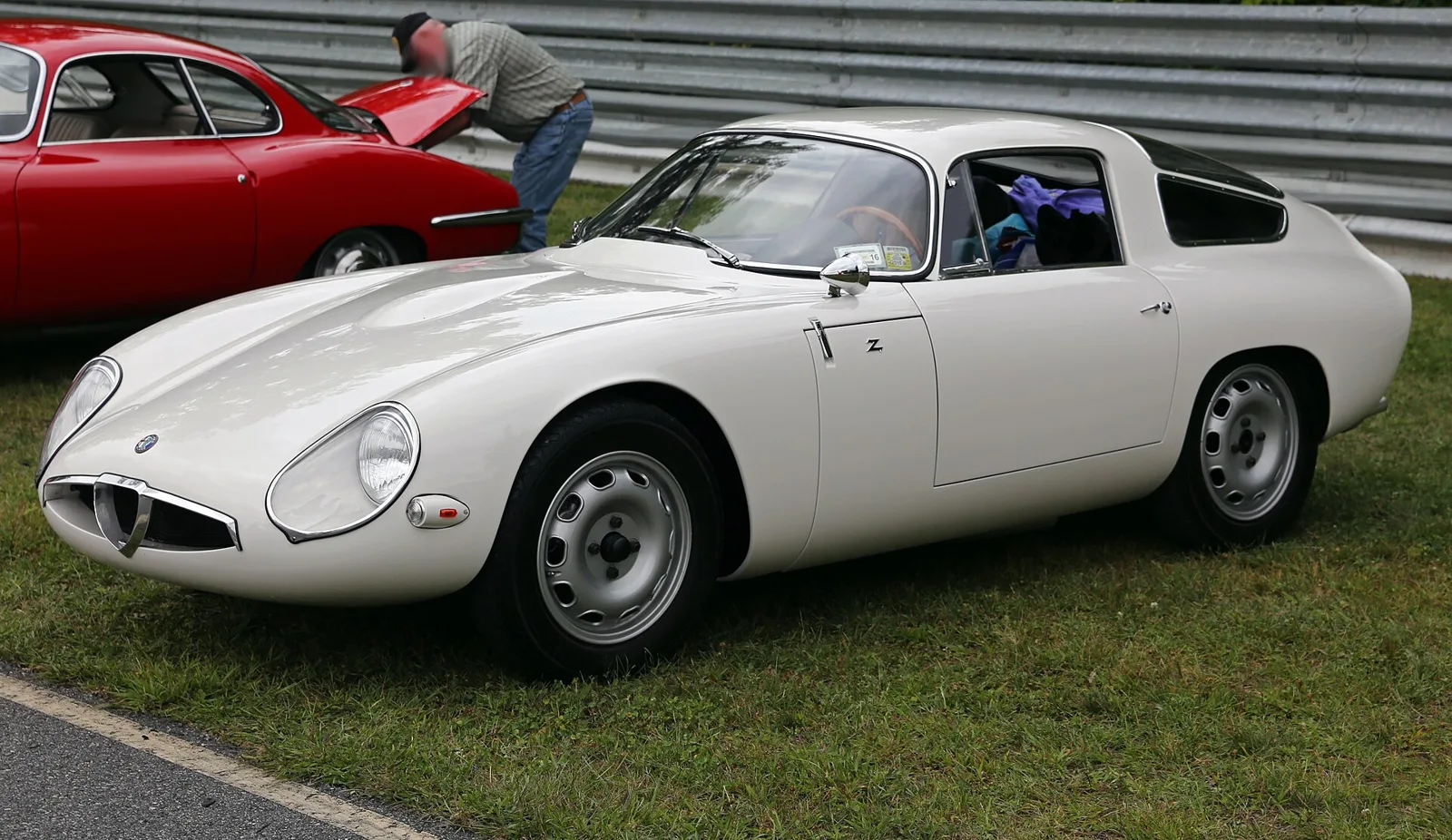
The Giulia TZ, short for Tubolare Zagato, was a sports and racing car built by Alfa Romeo from 1963 to 1967, taking over from the Giulietta SZ. The first car, now often called TZ1, was shown at the 1962 Turin Auto Show. It used a 1,570 cc twin-cam engine and other parts from the Giulia and carried a 105-series chassis number, but it was a purpose-built racer. SAI Ambrosini in the province of Perugia made the tubular spaceframe, Zagato made the light aluminium body, and final assembly took place at Delta of Udine, with Carlo Chiti first a consultant and then project leader. The firm soon became Auto-Delta and moved to Settimo Milanese, near Alfa's Portello plant.
How the TZ was engineered
It had disc brakes and independent suspension, and the coupe weighed only 650 kg (1,433 lb). Top speed was 216 km/h (134 mph). Road versions made 112 PS (82 kW) at 6500 rpm and the latest racing cars up to 160 PS (118 kW). The twin-spark cylinder head, also used on the GTA, helped, and the Giulia's standard alloy block, with wet steel liners, was tilted in the engine bay to improve airflow.
The rear bodywork did a lot of work. Following the research of Dr. Wunibald Kamm, Zagato used a coda tronca, Italian for short tail, now known as the Kamm tail. The idea is that, unless a car has an impractically long aircraft-style tail, chopping the tail off adds little if any drag while cutting lift markedly, or even producing some downforce. Zagato had already proved it on its Sprint Zagato sports-racing cars.
Racing record
The TZ debuted at the 1963 FISA Monza Cup, and TZs filled the first four places of the prototype class. At the start of 1964 it was homologated into the Gran Turismo category, which required 100 units, and began collecting class wins in Europe and North America. In all, 112 of the first TZ were built from 1963 to 1965. Limited numbers make them highly collectable, with listed prices of around 150,000-200,000 US dollars.
TZ2
A new version, the TZ2, appeared on the Zagato stand at the 1964 Turin show. To stiffen the structure and cut weight, Zagato swapped the aluminium for a more streamlined fibreglass body moulded tight to the chassis, reducing weight to 620 kg (1,370 lb). The TZ2 was built only for racing. Its Autodelta-prepared 1,570 cc engine had twin plugs and dry-sump lubrication, producing around 170 bhp (127 kW) at 7000 rpm, enough for 245 km/h (152 mph). The rear window became one piece instead of three. TZ development stopped at the end of 1965 to make room for the GTA racing programme, and just 12 TZ2s were built. One won the Gran Turismo Trophy at the 2009 Pebble Beach Concours d'Elegance.
On 25 April 1965 a TZ2 won its class in the 1000 km of Monza, with Bussinello and De Adamich seventh overall and first in GT 1600. Also in 1965 TZ2s won classes at the 12 Hours of Sebring, the Targa Florio, the 1000 km of Nurburgring, the 6 Hours of Melbourne, the Giro d'Italia and the Criterium des Cevennes. Class wins continued in 1966 at Monza, Sebring, the Targa Florio and the Nurburgring.
Down under, Sydney's Mildren Racing, run by former driver Alec Mildren, Australia's official Alfa Romeo importer then, raced a TZ2 painted in the team's bright yellow, driven by Kevin Bartlett. Bartlett and Doug Chivas finished third in the 1966 Rothmans 12 Hour race at Surfers Paradise in Queensland, covering 471 laps, 23 behind the winning Ferrari 250LM of Jackie Stewart and Andy Buchanan.
The TZ3 revival
For Alfa Romeo's centenary in 2010, Zagato made two homages. The TZ3 Corsa was a one-off track car that won the 2010 Concorso d'Eleganza Villa d'Este and was built for German collector Martin Kapp on the Gillet Vertigo.5. A carbon-fibre frame and hand-beaten aluminium panels kept it to 850 kg (1,874 lb), and a 420 hp (313 kW) dry-sump 4.2 litre V8 gave over 300 km/h (186 mph) and 0-100 km/h in 3.5 seconds. The TZ3 Stradale, its road-going sibling, was designed by Norihiko Harada of Zagato on a Dodge Viper ACR-X chassis, with nine built. Its 8.4-liter Viper V10 was reduced to 600 hp (447 kW; 608 PS), driving the rear wheels through a six-speed Tremec manual, and the interior was mostly Viper with Alfa Romeo badging.