A 1972 Alfa with a De Dion rear end, a Formula One name and a coupe family that won European touring car titles in the early 1980s.
The Alfetta was a front-engined saloon and fastback coupe built from 1972 to 1987, with its transaxle at the rear and a De Dion tube suspension. More than 400,000 were produced, and the V6 GTV coupe went on to win European touring car titles.
Alfa Romeo's Alfetta, type 116, was a five-passenger saloon and fastback coupe that the company built between 1972 and 1987. Its rear transaxle and De Dion tube suspension gave it a balanced chassis that reviewers praised for years, and the coupe family later won touring car titles across Europe.
When did the Alfetta launch, and where did its name come from?
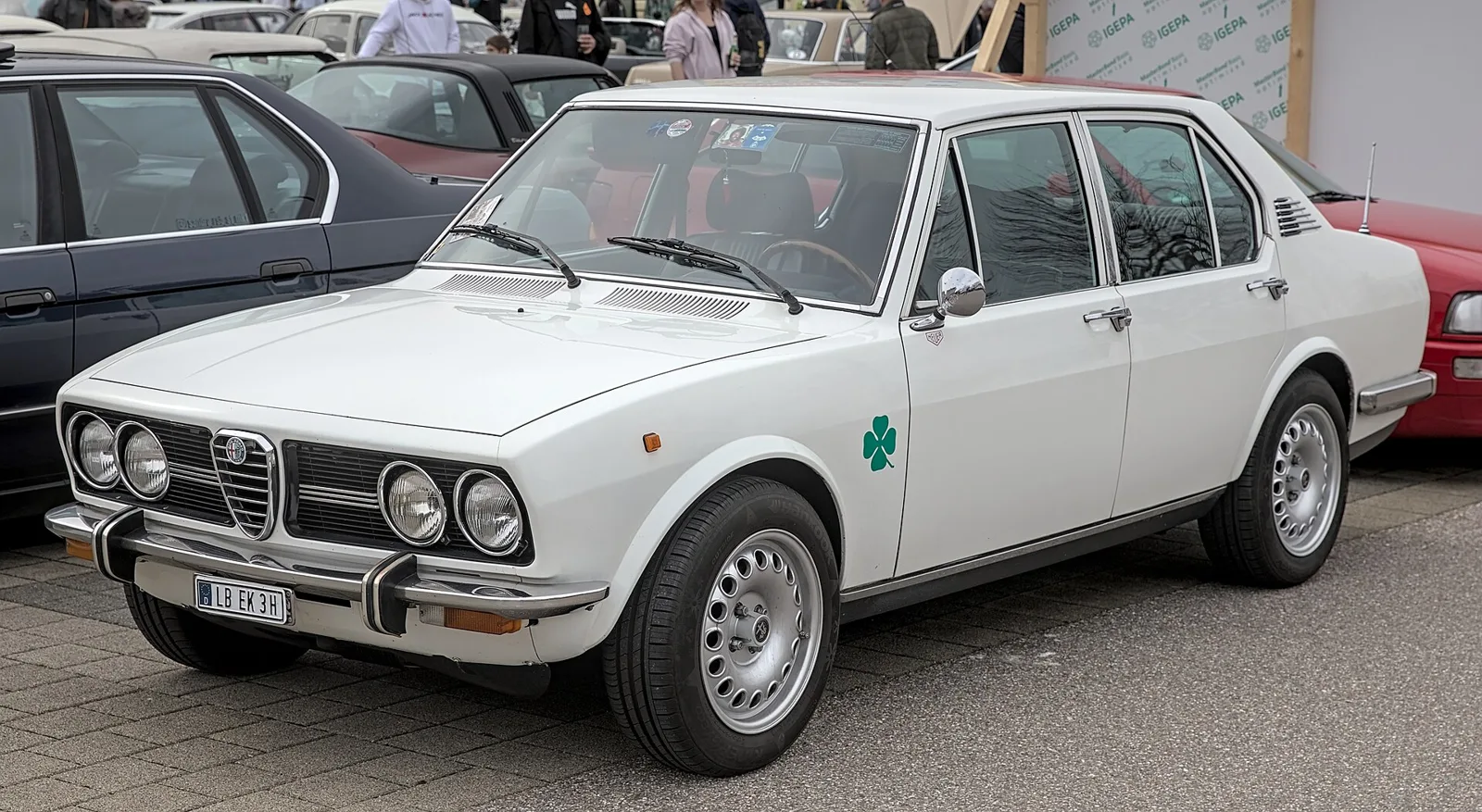
The Alfetta saloon debuted in 1972 with a 1.8-litre four-cylinder engine, and Centro Stile Alfa Romeo drew its three-box, four-door body in-house. The name translates roughly as little Alfa, a nickname borrowed from the Alfetta Tipo 159, a successful Formula One car whose last iteration was introduced in 1951.
That racing car had paired a transaxle layout with De Dion tube rear suspension, the same arrangement the road car adopted. The naming tied the family saloon to a racing heritage, and Alfa intended the connection to be obvious to buyers from the start.
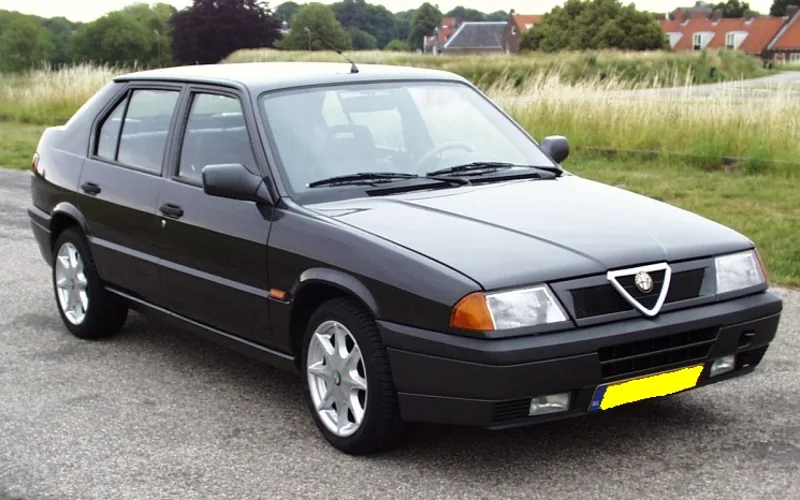
The saloon's front end had twin equal-sized headlamps, visually joined by three chrome bars to a narrow Alfa Romeo shield. Its taillights used three square elements, which gave the car a distinctive profile in the 1970s.
At the 1975 Brussels Motor Show Alfa introduced the Alfetta 1.6, with 1,594 cc and 108 PS (DIN) and single, larger round headlamps. The 1.8 was rebadged and restyled a few months later, and its grille gained a broader central badge and horizontal trim.
A rear transaxle and De Dion axle gave the Alfetta a balance that carried through the saloon and coupe families until 1987.
What was the Alfetta's transaxle and suspension design?
The clutch and gearbox sat at the rear alongside the differential, giving the car balanced weight distribution. The front used double wishbones and torsion bars, while the rear carried a De Dion tube, a layout that Alfa had first used on its Grand Prix cars.
This drivetrain layout was new to the marque, and it copied the arrangement of the Alfetta 158 and 159 Grand Prix cars. Reviewers of the day recognised the handling benefits, which came from the car's weight distribution and its well-located rear axle.
The rear end combined a Watt's parallelogram linkage with inboard brakes and a De Dion axle, which together delivered balanced traction. The front suspension was unusual, with independent longitudinal torsion bars acting directly on the lower wishbones and separate dampers.
Every Alfetta was originally fitted with Pirelli Cinturato 165HR14 tyres when it left the factory. Those narrow tyres suited the car's light, precise character, and they were replaced over time as the range moved to larger wheels.
How did the Alfetta 2000 and the turbodiesel change the range?
The 2.0-litre Alfetta 2000 was launched at the 1977 Geneva Motor Show, replacing the Alfa Romeo 2000. A turbodiesel followed in late 1979 using a 2.0-litre VM Motori engine that produced 82 PS (60 kW; 81 hp), and the range grew more varied as a result.
The 2000 was 10.5 cm (4.1 in) longer than the other models because of a redesigned front end with rectangular headlamps and larger bumpers with polyurethane inserts. Its rectangular tail light clusters, revised C-pillar vents, dash and upholstery completed the update.
In July 1978 the car became the Alfetta 2000 L, and its output climbed to 130 PS (96 kW; 128 hp) from 122 PS (90 kW; 120 hp). Fuel injection followed in 1979, and in the United States the car was sold as the Alfa Romeo Sport Sedan.
The Alfetta Turbo D was the first turbodiesel in an Alfa Romeo passenger car. It was equipped like the 2000 L but without standard power steering, despite carrying an additional 100 kg (220 lb) on its front axle, and it was sold mainly in Italy and France.
What was the Alfetta CEM experiment?
The Alfetta CEM was a semi-experimental car built with the University of Genoa, shown at the Frankfurt Motor Show in 1981. Its modular engine could shut off two of its four cylinders when they were not needed, and that idea was the main point of the project.
Its 130 PS unit used fuel injection and ignition under the control of an electronic module. Alfa claimed cylinder deactivation cut fuel use by 12% compared with a fuel-injected CEM engine without the feature, and by almost 25% against the regular carburetted 2.0-litre.
An initial batch of ten examples was assigned to taxi drivers in Milan to test the system in everyday use. In 1983 a small series of 1,000 cars was offered to selected clients, although 991 were ultimately produced before the project ended.
What were the later facelifts and engine changes?
The November 1981 Alfetta '82 range offered 1.6, 1.8, 2.0 and 2.0 Turbo Diesel models, all sharing the bodyshell and interior of the 2.0-litre cars. Standard equipment became richer, and black plastic trim appeared across the range.
In July 1982 the Quadrifoglio Oro took over from the discontinued 2000 L. It used a 128 PS (94 kW; 126 hp) version of the 1,962 cc engine with SPICA mechanical injection, plus a trip computer, a check control panel and electrically adjustable seats.
The Quadrifoglio Oro looked different from the rest of the range, with twin round headlights and concave alloy wheels. It was offered only in metallic grey or brown, with beige velour upholstery that set it apart from the cheaper trims.
The March 1983 facelift modernised the exterior with new bumpers that integrated a front spoiler, a new grille, lower body cladding and a full-width grey rear fascia with rectangular lights. Inside there was a redesigned dashboard, new door panels and an overhead console on top models.
The 2.4-litre Turbo Diesel arrived with the facelift, and a renewed two-litre Quadrifoglio Oro used Bosch Motronic injection and ignition. That engine matched the carburetted car's 130 PS while delivering more torque and better fuel economy.
The successor, the larger Alfa Romeo 90, debuted in April 1984. The Berlina left production at the end of that year, once close to 450,000 units had been built across a dozen years on sale.
Why was the Alfetta known as a police and escort car?
The Alfetta was used as a police car by the Carabinieri and by the Polizia di Stato, which made it a familiar sight on Italian roads in the late 1970s and early 1980s. Its handling and performance suited the demands of patrol work.
The car became known worldwide because it was the official escort car of former Italian prime minister Aldo Moro when the Red Brigades kidnapped him. That association gave the model an international profile that its sales figures alone would not have achieved.
How was the Alfetta sold in South Africa and North America?
South African Alfettas were first assembled at Rosslyn, outside Pretoria, in early 1973 alongside Datsun cars. From 1974 they were built at Alfa's own Brits plant, which became the centre of local production for the model.
The 1600 model arrived in mid-1976 with single headlamps like those in Europe, complementing the 1800 and 2000. From October 1982 the Quadrifoglio Oro was marketed in South Africa as the 159i, using the fuel-injected two-litre engine.
In the United States the four-door Alfetta sold from 1975 to 1977 as the Alfetta Sedan. A mildly restyled version followed from 1978 to 1979 as the Sport Sedan, a design that appeared in Italy under the name Alfetta 2.0 LI America.
What was the Alfetta GT and GTV coupe?
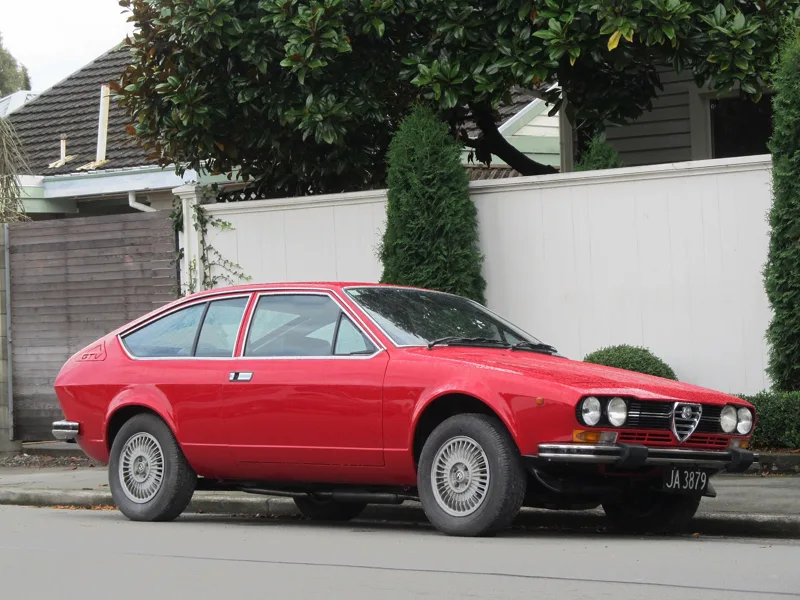
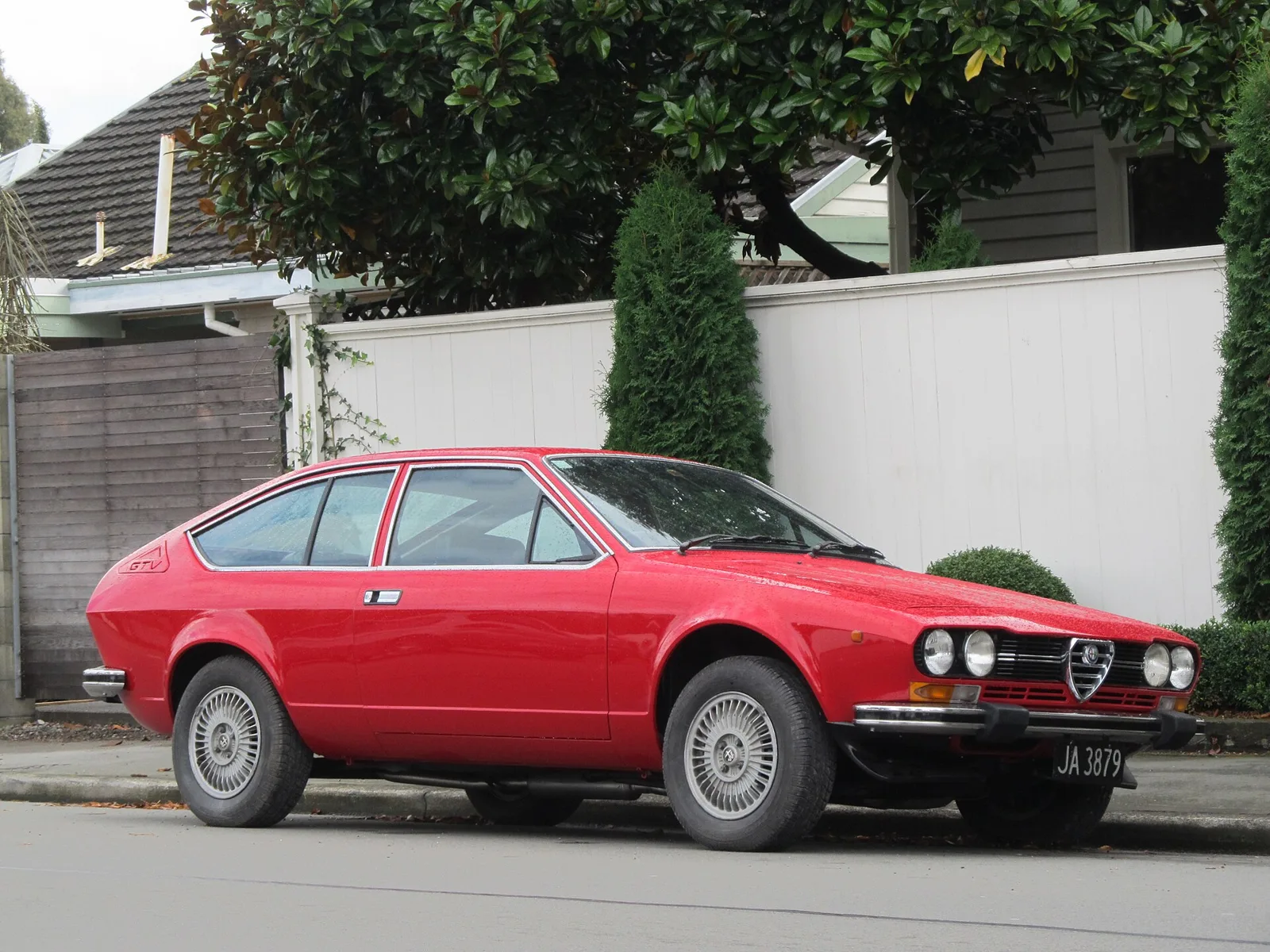
The GT was a two-door, four-seat fastback designed by Giorgetto Giugiaro at Italdesign and introduced in 1974. It later became the GTV, and the V6 version of the coupe went on to win the European Touring Car Championship four years in a row.
The saloon's platform formed the basis for the Alfetta GT, introduced in 1974 with the 1.8-litre twin-cam four in its 1,779 cc form. The engine had a chain-driven, eight-valve twin overhead camshaft cylinder head of cross-flow design.
In 1976 the range expanded to include the 1.6-litre GT 1.6 and the 2.0-litre GTV 2.0. The styling echoed the Montreal, with similar bonnet lines, scallops above the headlights and tail lights that resembled those of the larger coupe.
Autodelta's Turbodelta arrived in 1979 as a limited 2.0-litre turbocharged model, with 400 built for FIA Group 4 homologation. It used a KKK turbocharger to produce 175 PS (129 kW; 173 hp), making it the first Italian petrol car of its kind to use a turbo.
How did the GTV6 perform on track?
The GTV6 used a 2.5-litre SOHC V6 from the Alfa 6 saloon, fitted with Bosch L-Jetronic injection in place of the earlier carburettors. The injected engine started more easily, held its tune longer and met the strict Swiss emissions standards that applied from 1983.
The GTV6 was a successful racer. The European Touring Car Championship fell to it four years in succession from 1982 to 1985, and Andy Rouse drove one to the British Touring Car Championship in 1983. A Group A car driven by Yves Loubet won the French Supertouring Championship in 1983 and 1984.
Loubet also finished third in the 1986 Tour de Corse, a round of the World Rally Championship, in a GTV6 that had won its Group A class. Later that decade Greg Carr and Fred Gocentas took a GTV6 to victory in the 1987 Australian Rally Championship.
A Grand-Prix edition of the GTV6 reached showrooms in 1985, mainly in Switzerland and Germany. It carried a body kit designed by Rayton Fissore, and it was a further step in the coupe's development before the model ended in 1986.
What made the GTV6 3.0 and the South African cars special?
South Africa built the GTV6 2.5 from 1982, with 100 fully built cars shipped from Italy while local assembly was prepared. Each one carried a numbered plaque set into the wing ahead of the door, and only two markets received a turbocharged GTV6, with South Africa among them.
Alfa's own description put the 3.0-litre GTV6 at the top of its production sports car range. The car was aimed at the track, and only 200 units were needed for homologation, with 212 eventually produced in South Africa.
The engine had a capacity of 2,934 cc, with bore and stroke enlarged to 93 mm by 72 mm. Six Dell'Orto carburettors took the place of injection, since low-down pull mattered more than peak output, and the car still reached 224.2 km/h (139.3 mph).
Power reached 136.7 kW (185.9 PS; 183.3 hp) at 6,700 rpm. Acceleration was quoted at 8.36 seconds from 0 to 100 km/h and 7.2 seconds from 0 to 60 mph, while the redesigned fibreglass bonnet with its prominent bulge housed the new induction system.
How did Autodelta's racing Alfettas perform?
Autodelta raced the Alfetta GT and GTV in Group 2 and won the Elba and Costa Brava rallies overall in 1975. The team also took the Group 2 category of the World Rally Championship's Corsican event that year, with normally aspirated engines inherited from the GTAm racer.
The following year Autodelta shifted to circuit racing. The Alfettas claimed class honours for cars under 2.5 litres in Group 2 of the European Touring Car Championship, finished second overall at the 24 Hours of Spa and won the ETC race at Vallelunga.
Autodelta's effort ended prematurely because of Alfa's budget limits and its heavy commitments to Formula One and sports car racing. A 3.0-litre V8 GTV derived from the Montreal engine was also tested, but the plan for 400 roadgoing units was abandoned.
Around twenty V8 GTVs were built for the German importer in 1977, selling for DM50,000 each, against DM20,990 for a GTV2000. The Turbodelta Group 4 car later won the Danube Rally, but development was not pursued because Carlo Chiti preferred sports cars and Formula One.
What are the Alfa Romeo Alfetta specifications?
| Specification | Detail |
|---|---|
| Type | Front-engine saloon and fastback coupe, type 116, rear transaxle |
| Production | 1972 to 1987; over 400,000 built |
| Saloon engines | 1.6 (1,594 cc), 1.8 and 2.0 Twin Cam fours |
| 2.0 output | 130 PS (96 kW; 128 hp) from July 1978 |
| Turbodiesel | 2.0-litre VM Motori, 82 PS (60 kW; 81 hp) |
| Front suspension | Double wishbones and torsion bars |
| Rear suspension | De Dion tube with Watt's parallelogram linkage |
| Tyres at launch | Pirelli Cinturato 165HR14 |
| GTV6 2.5 | 2.5-litre SOHC V6, Bosch L-Jetronic injection |
| GTV6 3.0 | 2,934 cc; 136.7 kW (185.9 PS; 183.3 hp); 224.2 km/h (139.3 mph) |
| Turbodelta | 175 PS (129 kW; 173 hp); 400 built for Group 4 |
| Successor | Alfa Romeo 90 from April 1984 |