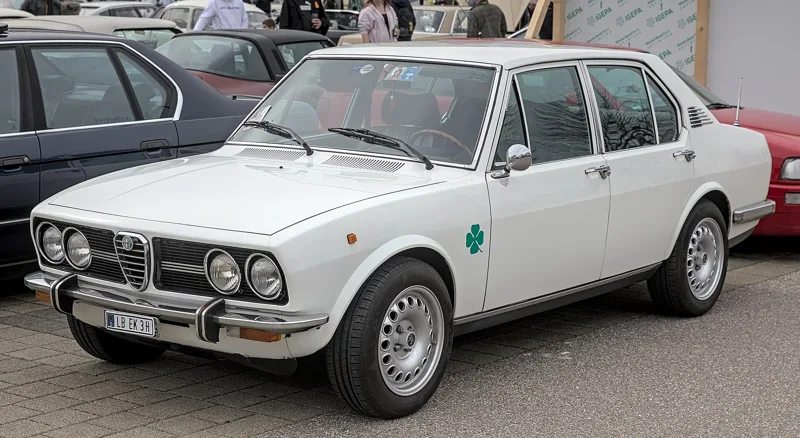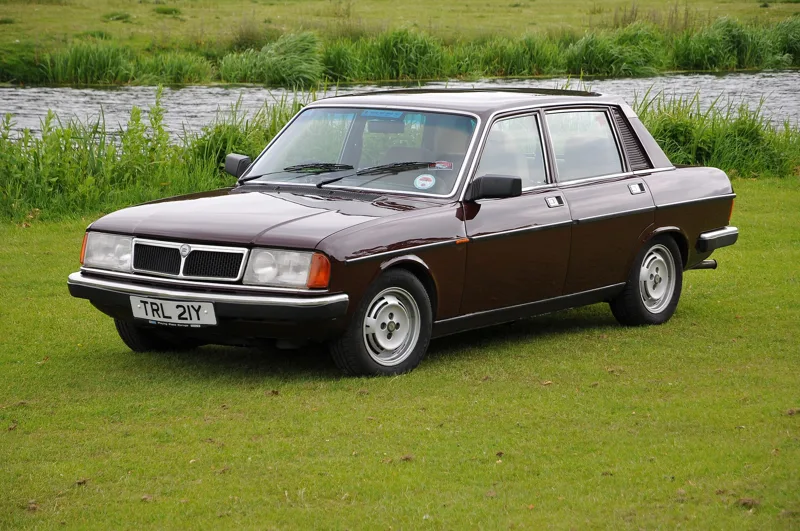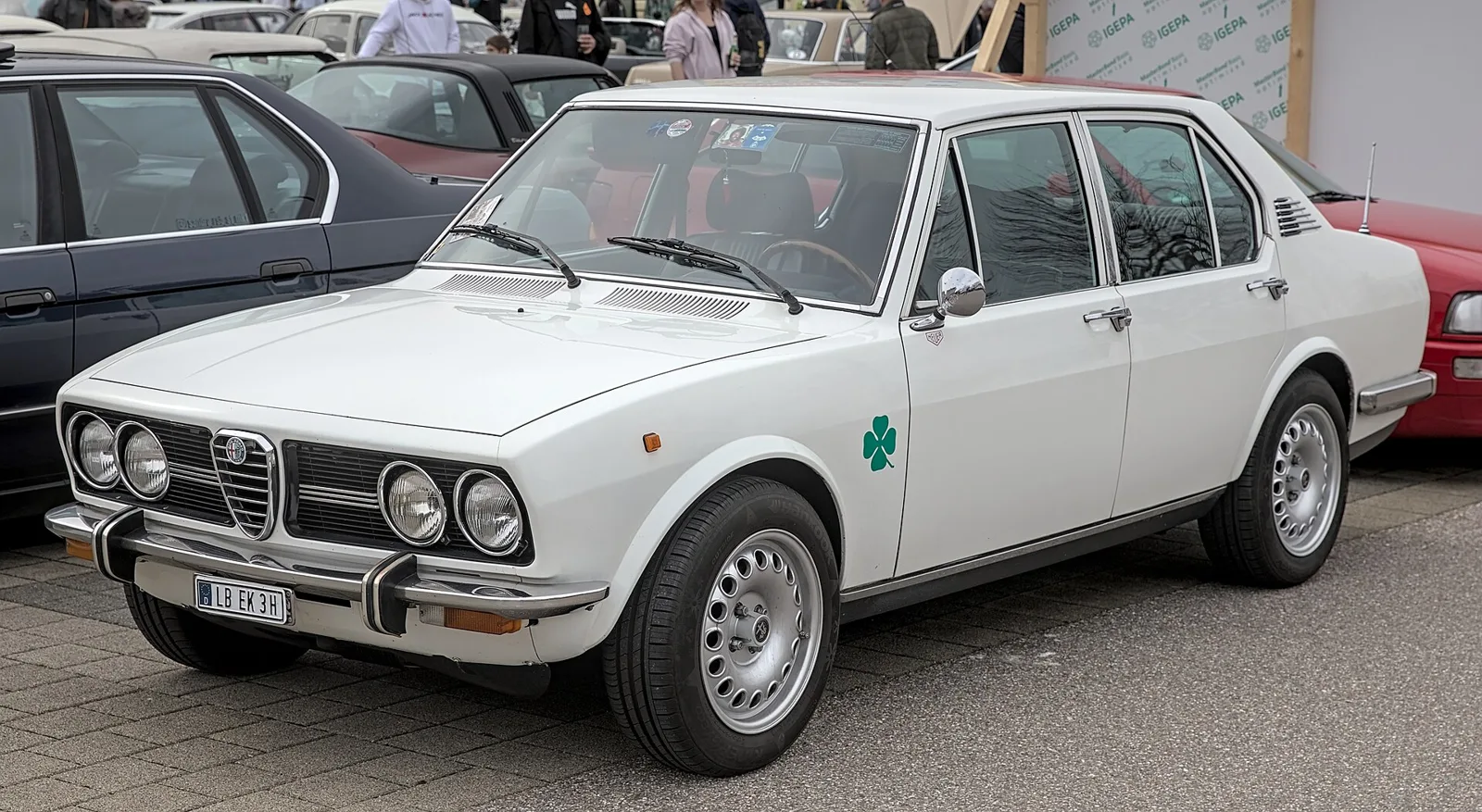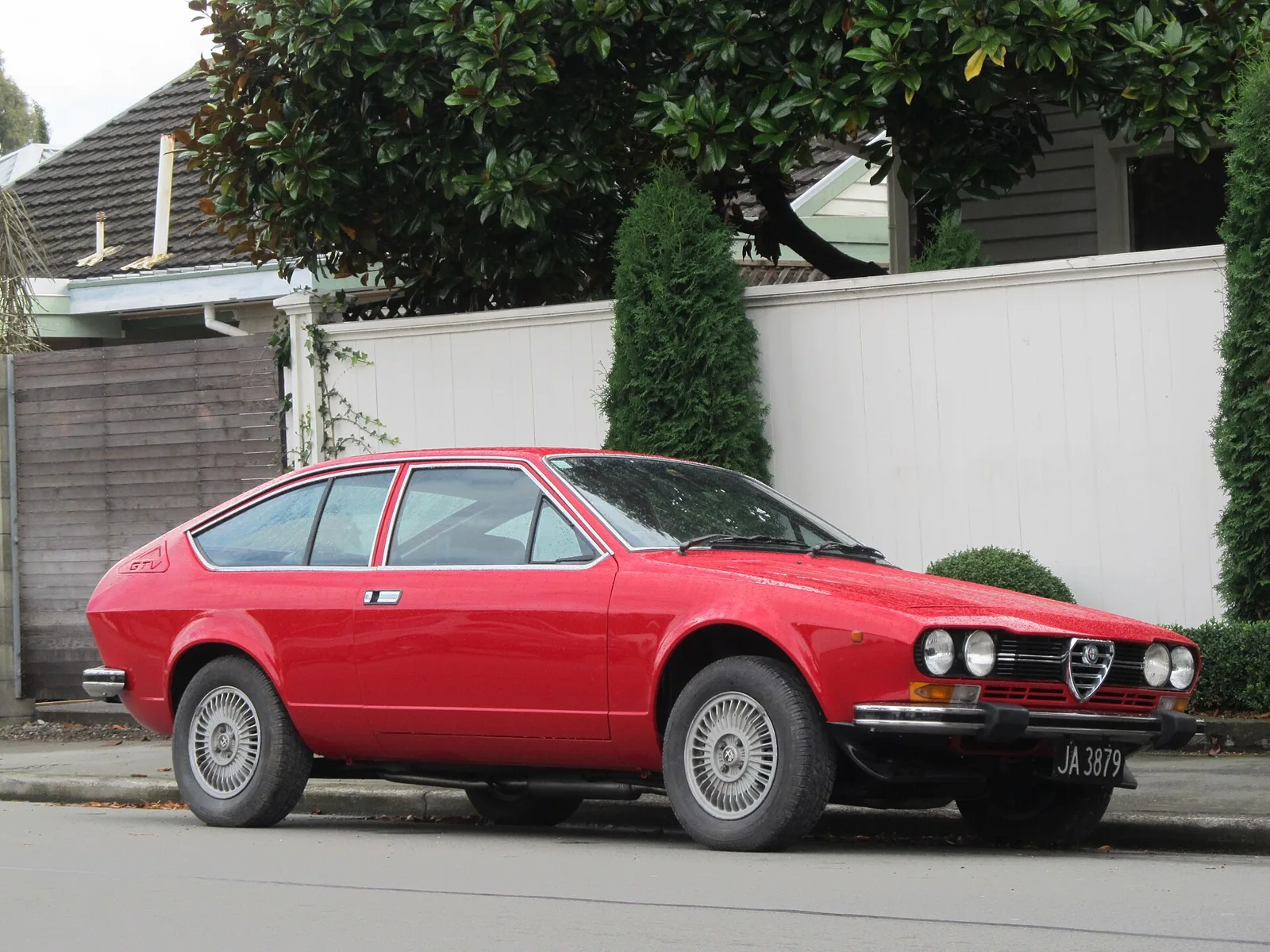
The Alfetta and the Trevi both sold in large numbers, yet they gave opposite answers to the question of how a sporting saloon should be laid out.
The Alfa Romeo Alfetta was a front-engine saloon and fastback built from 1972 to 1987 with a rear transaxle and De Dion tube suspension, with over 400,000 units made. The Lancia Trevi was a front-drive saloon built from 1980 to 1984, developed from the Lancia Beta, with a supercharged Volumex version and 36,784 cars made.
Alfa Romeo's Alfetta and Lancia's Trevi both sold in large numbers, yet they gave opposite answers to the question of how a sporting saloon should be laid out. One carried its gearbox at the back for balance, while the other put everything at the front and drove the front wheels.
The comparison also reflects two different corporate situations. The Alfetta was an Alfa Romeo model with a long run and a broad range of trims, while the Trevi was Lancia's attempt to rebuild confidence after the rust problems that had dented the Beta's reputation.
Why were the Alfetta and Trevi compared?
Both cars were saloons aimed at buyers who wanted handling and performance without the cost of a larger flagship. The Alfetta also offered a fastback coupe, so its family ran in more than one body style, while the Trevi stayed a three-box saloon.
The Trevi grew out of the Lancia Beta, and much of its hardware came from that earlier car. The Alfetta, by contrast, introduced a new drivetrain layout to Alfa Romeo, with the clutch and transmission housed at the rear of the car.
One saloon put its engine up front and its gearbox at the back for balance, the other put everything up front and drove the front wheels.
What were the chassis layouts?
The Alfetta used a rear transaxle, with the clutch, transmission and differential at the back, for a more balanced weight distribution like the Alfetta 158 and 159 Grand Prix cars. Its front suspension used double wishbones and torsion bars, while the rear used a De Dion tube.
The rear transaxle, combined with a Watt's parallelogram linkage and inboard rear brakes, gave the Alfetta balanced traction and handling. The front suspension was unusual in using independent longitudinal torsion bar springs that acted directly on the lower wishbones.
The Trevi's engines were transversely mounted in-line fours driving the front wheels, with twin overhead camshafts and electronic ignition. Its suspension used MacPherson struts all round with coil springs, and its steering was rack and pinion on 185/65 14-inch Pirelli P6 tyres.
How did the engines compare?
The Alfetta saloon began in 1972 with a 1.8-litre four, joined by a 1.6 in 1975. The 2000 L's output rose from 122 PS (90 kW; 120 hp) to 130 PS (96 kW; 128 hp) in 1978, and the Turbo D diesel offered 82 PS (60 kW; 81 hp) from a 2.0-litre engine.
The Trevi's range started with 1600 and 2000 cars fitted with Weber or Solex carburettors. The 2000IE brought Bosch electronic ignition in 1981 and 122 CV at 6400 rpm, and the 1982 Volumex added a Roots-type supercharger that lifted output to 135 CV (99 kW).
The Trevi 2000 tested by Autocar reached 113 mph and 0-60 mph in 11.1 seconds, which placed it near the top of its class. Its average consumption of 25.2 mpg was the third best among the cars it was judged against.
How did the two cars evolve?
The Alfetta was refreshed several times, with a 1975 model adding a 1.6, a 1978 update to the 2000 L and a 1982 Quadrifoglio Oro that used SPICA mechanical injection. A third facelift in March 1983 brought new bumpers, a grille and a larger range of Turbo Diesel engines.
The Trevi's life was shorter. It was introduced in 1980 as the Beta Trevi, took the Volumex name in 1982 and was discontinued in 1984. The Alfetta Berlina went out of production in 1984 after nearly 450,000 had been made, and the successor 90 arrived that April.
How were the two cars judged?
Autocar's 1981 review praised the Trevi's generally very good handling and powerful engine, but criticised its packaging, its confusing dashboard and its high fuel consumption. The verdict was that the car had the performance and economy to appeal to Lancia enthusiasts.
CAR magazine compared the Trevi 2000 with the Citroen CX Reflex and the Saab 900 GLS, and the Trevi won the test on handling. The same magazine called the dashboard diabolical to use and found the front seats lacked lumbar support.
The Alfetta's handling benefits were noted in contemporary reviews, and its rear transaxle layout gave it an excellent weight distribution. The car also became well known as an official police vehicle and as Aldo Moro's escort car when he was kidnapped.
What drove the Trevi's dashboard controversy?
The dashboard was designed by Mario Bellini, who described it as a complex architecture of interiors in a small, very restricted space. Critics found it ugly, gimmicky and overstyled, and some compared its shape to Swiss cheese or to a Star Trek set.
The dashboard remained a talking point long after the car was gone. A 2014 review in Klassik Autobild called it hardly a masterwork but also audacious, which captures the split in opinion that the Trevi always provoked.
How did the Alfetta GT and GTV develop?
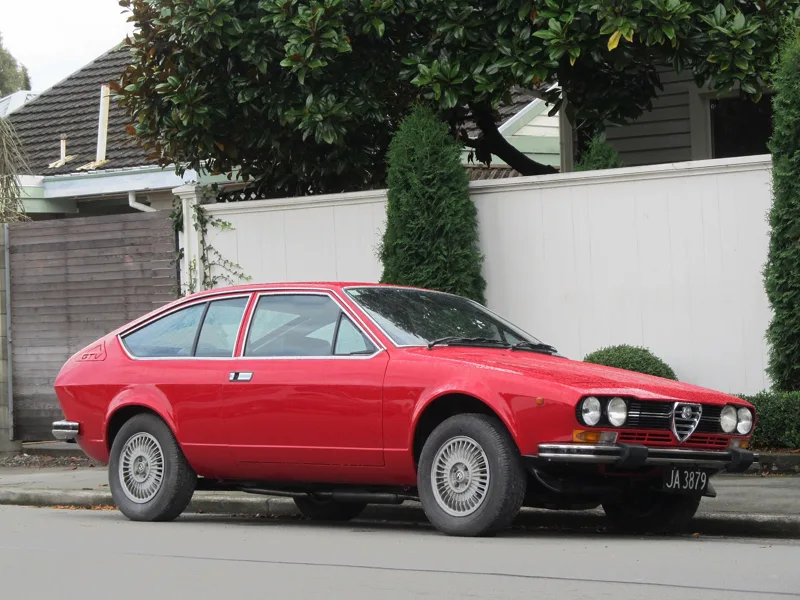
The Alfetta GT was a two-door, four-seat fastback designed by Giorgetto Giugiaro at Italdesign and introduced in 1974 with a 1.8-litre Twin Cam engine. In 1976 the range expanded to a 1.6-litre GT and a 2.0-litre GTV, and the GTV was distinguished by twin chrome whiskers in its grille.
In 1979 the 2.0-litre was redesignated the GTV 2000L after revisions to its engine. Autodelta also built a limited turbocharged model, the Turbodelta, with 400 examples made for FIA Group 4 homologation and a KKK turbocharger that pushed power to 175 PS (129 kW; 173 hp).
The Turbodelta was the first Italian petrol production car with a turbocharger, a landmark for a brand better known for its twin-cam engines. It also received a modified suspension layout to cope with the extra power.
In 1980 the GT was restyled with one-piece taillights and grey plastic bumpers, and the 1.6-litre was discontinued. The car became the GTV 2.0, although it kept its type code of 116.36 for left-hand drive and 116.37 for right-hand drive.
How did Alfa Romeo develop the Alfetta's engines?
Alfa Romeo tried several engine ideas for the Alfetta, from the Twin Cam fours to a turbodiesel and an experimental variable displacement unit. The turbodiesel was a first for an Alfa Romeo passenger car, displacing 2.0 litres and producing 82 PS (60 kW; 81 hp).
The Alfetta Turbo D was marketed mainly in Italy and France and in a few continental markets with favourable tax structures. It received a tachometer but no standard power steering, despite carrying an extra 100 kg (220 lb) on the front axle.
The Alfetta CEM was a semi-experimental model developed with the University of Genoa, using a modular engine that could shut off two of its four cylinders. Ten examples were assigned to taxi drivers in Milan, and Alfa Romeo reported that fuel use fell by about 12% compared with a fuel-injected engine without the system.
A small series of 1,000 examples went on sale in 1983, of which 991 were ultimately built, before the project development ended.
What were the Alfetta's official and popular roles?
The Alfetta was used as a police car by the Carabinieri and the Polizia di Stato, and it became famous as the official escort car of former Italian prime minister Aldo Moro when he was kidnapped by the Red Brigades. Its North American versions were sold as the Alfetta Sedan and then as the Sport Sedan.
In the United States the four-door Alfetta was sold from 1975 to 1977 as the Alfetta Sedan, and from 1978 to 1979 as the Sport Sedan, a mildly restyled version that was also offered in Italy as the 2.0 LI America.
South African models began at the Rosslyn plant outside Pretoria, alongside Datsuns, and later moved to Alfa Romeo's own Brits plant. The 1600 model arrived there in 1976, and the Quadrifoglio Oro was sold as the 159i from October 1982.
How did the Trevi come about after the Beta's rust problems?
The Trevi was developed from the Lancia Beta and introduced in 1980 to help restore the company's credibility after the Beta's rust scandal, when Lancia bought back cars with corroded sub-frame mounting points. Autocar's 1981 review reflected the company's claim that the new car would be as rust resistant as its rivals.
Sales literature stressed that the car was both luxurious and sporting, and the design set out to create a classic three-box notchback. That choice matched a conservative trend in which fastback cars were given more conventional looks, as the Golf became the Jetta and the Simca 1307 was restyled as a Solara.
The Trevi name came from the Italian tre volumi, meaning three volumes, a nod to its three-box shape. That detail gave the car an identity even as critics debated its looks.
What was the Trevi Volumex and what special versions existed?
The Volumex was the last Trevi version, introduced in 1982 at the Turin show to improve performance without hurting fuel economy. Its twin scroll Roots-type supercharger lifted output to 135 CV (99 kW), and the car had revised front seats and a matt-black chin spoiler.
The Volumex also received a power steering system from ZF as standard, and Lancia UK did not import the version for Great Britain or Northern Ireland. The car kept carburettors rather than fuel injection, a notable choice for a car of its period.
One special model, the Trevi Bimotore, was built in 1984 by former Abarth engineer Giorgio Pianta to help Pirelli test tyres for the Lancia Delta S4. Its second engine, placed at the rear, gave all-wheel drive, with two lightly tuned Volumex units producing a combined 300 CV.
Production totalled 36,784 Trevis before the car was discontinued in 1984, and that figure remains the car's final tally in the record.
How do the specifications compare?
| Specification | Alfa Romeo Alfetta | Lancia Trevi |
|---|---|---|
| Years built | 1972 to 1987 | 1980 to 1984 |
| Total built | over 400,000 units | 36,784 examples |
| Layout | front engine, rear transaxle, De Dion tube | front engine, front drive, MacPherson struts |
| Top variant output | 128 PS (94 kW; 126 hp) Quadrifoglio Oro | 135 CV (99 kW) Volumex |
| Diesel | 2.0-litre Turbo D, 82 PS (60 kW; 81 hp) | no figure given |
| 0-60 mph | no figure given | 11.1 seconds, Autocar test |
| Top speed | no figure given | 113 mph, Autocar test |
| Average consumption | no figure given | 25.2 mpg |
| Notable variant | Turbodelta, 400 built | Trevi Bimotore one-off, 1984 |
Which buyer suits each car?
The Alfetta suits a buyer who wants a saloon or fastback with rear-transaxle balance, a Grand Prix-derived layout and a wide choice of engines. The Trevi suits a buyer who wants front-drive packaging, a three-box saloon and the supercharged Volumex for more pace.
Enthusiasts who value an unusual dashboard and a rare supercharged variant will find the Trevi more interesting. Those who want a long production run and a coupe option will find the Alfetta the more flexible choice.
The record gives no current values for either car, so buyers should check present-day prices and condition before comparing purchase costs.