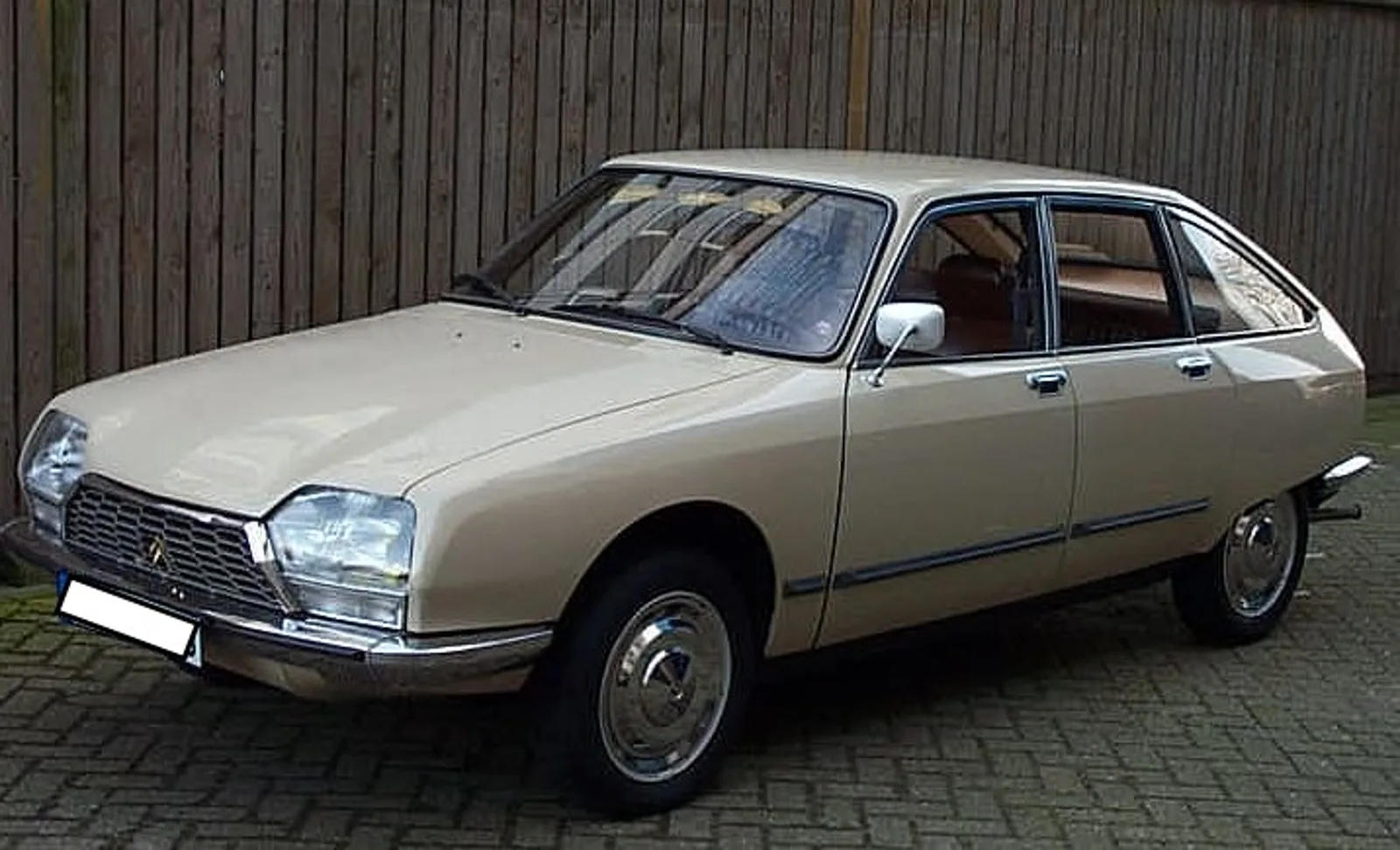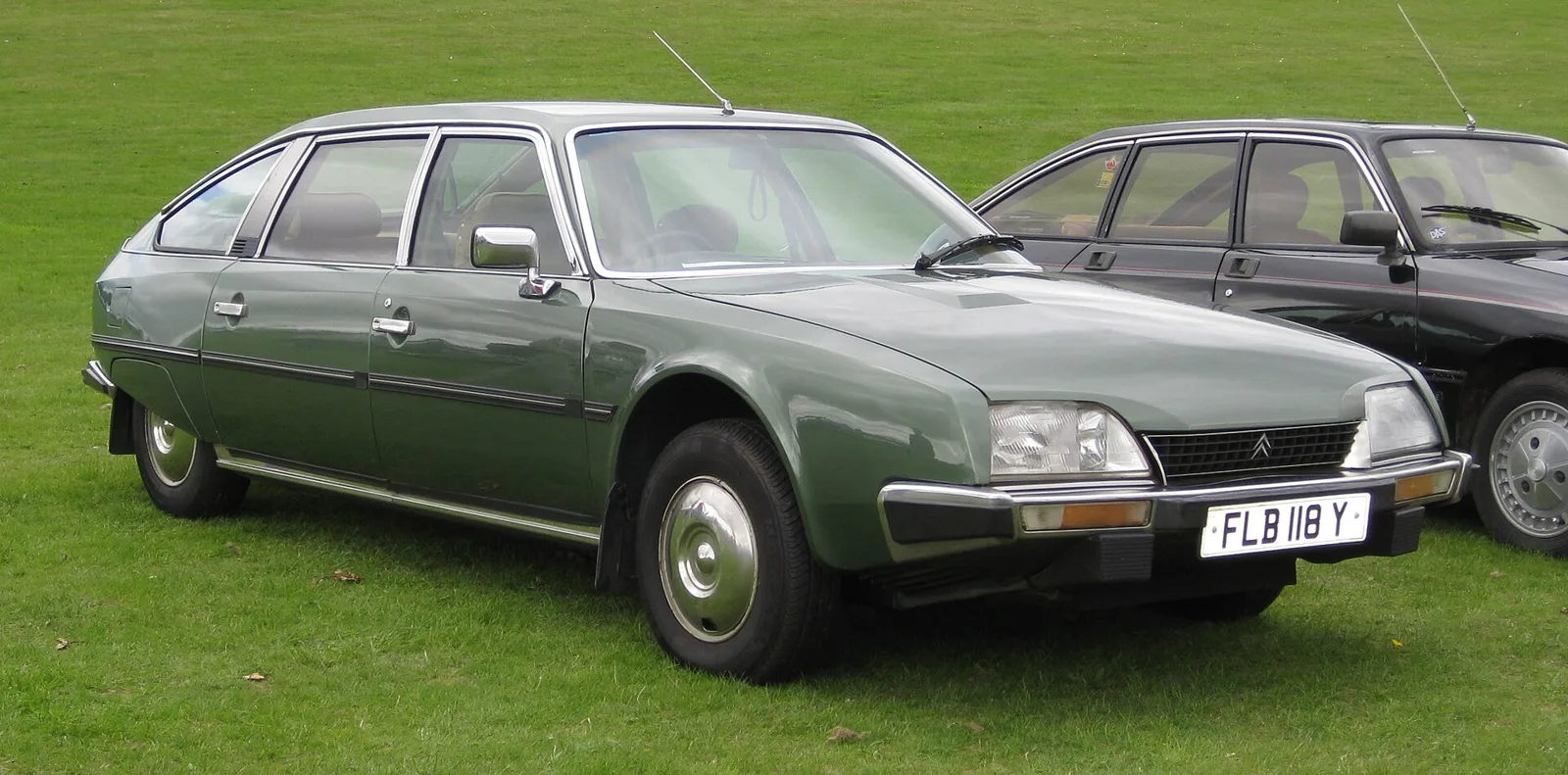
Launched at the 1974 Paris Motor Show, the CX won the 1975 European Car of the Year title and became the last great big Citroen of its era.
The Citroen CX was a large front-wheel-drive executive car built by Citroen from 1974 to 1991. It was known for hydropneumatic self-levelling suspension and a drag coefficient of 0.36, and it sold 1,170,645 cars across its run. The XM took over the saloon role in 1989.
Few cars of the 1970s leaned on engineering as openly as the CX, a large saloon that Citroen built between 1974 and 1991. It combined hydropneumatic self-levelling with a low drag figure, and it became one of the most distinctive cars of its decade. Its engineering set it apart from every rival on the road.
Where did the CX come from?
The Citroen CX was a large front-engined, front-wheel-drive car launched at the 1974 Paris Motor Show. Citroen could not schedule right-hand drive production until well into 1975. The name came from the French term for drag coefficient, and the restyled model underlined it with the CX badge.
Robert Opron designed the flowing body, which resembled its precursor, the GS. The car won the 1975 European Car of the Year title, and some enthusiasts still describe it as the last real Citroen before Peugeot took control of the company in 1976. It was also the final successful model of the big Citroen era, which dated back to 1934.
A luxury saloon that rode on hydropneumatic magic and took the 1975 European Car of the Year title.
Why was the CX so advanced?
The CX combined hydropneumatic integral self-levelling suspension, speed-sensitive DIRAVI power steering and a cabin without steering column stalks. The suspension was an evolution of the system used on the DS, and it kept the ride consistent whether the car was empty or fully laden.
The suspension sat on sub-frames fitted to the body through flexible mountings, which improved ride quality and reduced road noise. The constant ground clearance element was licensed to Rolls-Royce for the Silver Shadow and the Bentley T series. British Car magazine compared the feeling to a ship crossing above the ocean floor.
How aerodynamic was the design?
The CX was designed to perform well against air resistance, and its coefficient of drag was 0.36, a low figure for the period. The flowing lines ended in a sharp Kammback rear, and a concave rear window cleared rain without the need for a rear wiper.
The transverse engine was a major packaging gain. The CX was 20 cm (8 in) shorter than the DS, and its engine produced far less noise in the cabin. Engine bay access for many under-bonnet items also improved, which mattered to owners who did their own servicing.
Which engines did the CX use?
The entry model, the Normale, used a 1985 cc four-cylinder producing 102 PS (75 kW). The CX 2200 had a 2175 cc engine with twin carburettors and a claimed 112 PS (82 kW), while the Economique traded a little top speed for better fuel economy.
The 1979 Douvrin engine, developed with Renault, replaced the old pushrod two-litre. It produced 106 PS (78 kW) and was quieter, smoother and more economical. Later diesel models brought the 2.5 L turbo to the range, and the CX Turbo-D 2.5 was able to reach 195 km/h (121 mph).
How did the CX interior work?
The interior removed steering column stalks, so the driver could reach every control with both hands on the wheel. Turn signals were designed not to cancel themselves, a deliberate choice that left the driver in charge of the indicator.
That principle was not shared by almost any other car of the period, and it limited the CX's potential use as a rental car. Fleet operators struggled with a layout that differed so much from what their drivers expected.
How quick was the CX on the road?
The early CX 2000 took 12 seconds to accelerate from 0-60 mph (0-97 km/h), which was respectable for a heavy executive car of the time. Performance rose with the 1977 CX GTi, which gained Bosch L-Jetronic injection and 128 PS (94 kW) from its engine.
The CX 25 GTi Turbo launched in autumn 1984 with 168 PS (124 kW) and a top speed of 220 km/h (137 mph). It was the first genuinely fast CX, and it gave the chassis the engine it had long deserved. The turbo car stands apart from the rest of the range in that respect.
What problems did the CX face at launch?
The car was rushed to market in 1974 and suffered teething troubles. Some very early models had no power steering, and they proved hard to manoeuvre because the CX carries 70% of its weight over the front wheels.
The car was first developed as a rotary-engined model, and the Comotor three-rotor engine was never economical. The rotary project was scrapped in 1974, and Citroen went bankrupt that same year, partly because of investments like Comotor that never produced profitable cars.
What did the CX trim names mean?
Luxury models were badged Pallas, and sports variants were badged GTi. The long-wheelbase cars carried the Prestige badge with petrol engines and the Limousine badge with diesel, which kept the naming simple for buyers who wanted the bigger body.
The factory never produced a CX with both the powerful turbocharged petrol engine and an automatic transmission in the same car, so buyers had to choose between performance and convenience.
How did the Prestige and estate versions differ?
The Prestige was 25 cm (10 in) longer than the saloon and offered more rear legroom than any other standard-sized sedan in the world. It arrived in 1976 for chauffeur use, and in 1977 it gained a raised roofline. A diesel Limousine version followed in 1980.
The estate was 10 in (25 cm) longer and was built from 1975 until 1991. It was called Safari in the United Kingdom and Break in France. The Familiale carried three rows of seats for seven people, and its self-levelling suspension made it one of the most practical family cars in Europe.
What changed between the Series 1 and Series 2?
The Series 1 cars, built from 1974 to 1985, had stainless steel bumpers, suspension as soft as the DS, and a spaceship dashboard with a revolving drum speedometer. The Series 2 cars, built from 1985 to 1991, switched to plastic bumpers and a sloping centre dash.
The Series 2 kept the stalk-free layout, so the turn signals, wipers, horn and headlights could still be worked from the steering wheel. The suspension was firmer on most models, and the radio moved to a position sideways between the front seats.
How well did the CX sell?
The CX was a huge success in Europe early on, with more than 132,000 built in 1978. Over its full run from 1974 to 1991, a total of 1,170,645 cars were sold. Sales peaked early in the car's life and then declined as its reputation for running costs grew. The trouble lay largely with ordinary components such as door hinges and starter motors rather than the advanced hydropneumatic parts.
Citroen sold 2,500 CXs to China in 1984, and the car was assembled in South America from 1978 to 1984. Production at the Aulnay-sous-Bois factory ceased in 1989, and Heuliez took over estate production, which ended in 1991.
What replaced the CX?
The CX saloon was replaced by the XM in May 1989. The XM shared its chassis with the Peugeot 605 and offered a hatchback body and a conventional interior, which moved away from the CX's spaceship layout. It reached 333,000 sales in total, less than a third of the CX figure.
Citroen later produced the C6, which was introduced in 2006 and was seen as a direct descendant of the CX. Barely 20,000 examples were sold before it ended production in 2012, and the lack of an estate version hampered its sales.
How did the CX fare in motorsport?
The CX was entered in rally events such as the Tour du Senegal and Paris-Dakar, winning five events outright. Its most notable result came in the 1977 London-Sydney Marathon, where Paddy Hopkirk drove a CX 2400 to third place with a come-from-behind sprint.
The 1977 marathon covered 28,200 km (17,500 mi). The CX also competed in the 2022 and 2023 Dakar Rally, which showed that the car still had a place in extreme endurance events long after its production had ended.
Why was the CX hard to buy in America?
Despite a thin service network and little advertising, grey import firms supplied about 1,000 CX units to Americans during the 1980s. Citroen withdrew from the US market at the end of 1973 because a new bumper rule effectively made height-adjustable suspension illegal. The 1974 cars built for America could not be supplied, and the company's finances made a return difficult.
From 1979 Americans obtained CX models through grey import specialists, including Trend Imports. From 1983 CxAuto remanufactured cars in the Netherlands for US compliance, and it sold them as CXA models. A CXA cost $39,900 for the CX 25 GTi, against $17,775 for a 1988 Peugeot 505 GLS.
Which custom CX models were built?
The CX was often used as an ambulance and camera car, where its cosseting suspension was especially valuable. Some estates were elongated and fitted with a second rear axle, creating the Loadrunner, mostly used for high-speed bulk transport across Europe.
In 1984 Guy Deslandes Design built four CX Orphee two-door convertibles. Those cars were rare one-offs that showed how far the platform could be pushed, long after the factory had moved on to new models.
Who owned the CX?
Erich Honecker used 15 stretched CX limousines as state cars, built by the Swedish coachbuilder Nilsson from 1978 to 1989. The East German government also used CX models widely, and the CX Prestige was used by the French government, including former president Jacques Chirac.
Prominent owners also included Carlos Santana and Johan Cruyff. The CX became a favourite with officials and celebrities alike, which helped give it a reputation far beyond the typical executive car.
What is a CX worth today?
CX values depend strongly on condition, as befits a high-volume car with complex components. In 2015 one of the Erich Honecker limousines, a 1984 CX 2500 Injection Prestige, sold for EUR 95,360 (US$108,621) at Artcurial. The most collectible models are the rare Series 1 GTi Turbo and the Series 2 Prestige Turbo.
Frequently asked questions
When did the CX go out of production?
The CX was built from 1974 until 1991, when the last estate models were discontinued. The saloon had already been replaced by the XM in May 1989, and production at the Aulnay-sous-Bois factory had ceased two years earlier.
What was the Citroen CX drag figure?
The CX had a coefficient of drag of 0.36. Designers aimed the flowing body and its Kammback rear at keeping that figure low, a rare priority for a large saloon of the period.
How fast was the CX GTi Turbo?
The CX 25 GTi Turbo was rated at 168 PS (124 kW) and could reach 220 km/h (137 mph). It launched in autumn 1984 and was the first genuinely fast CX.
Did Citroen sell the CX in the United States?
Not officially after the end of 1973. Enthusiasts later bought CX models through grey import firms from 1979. From 1983 CxAuto converted cars in the Netherlands to meet American rules.