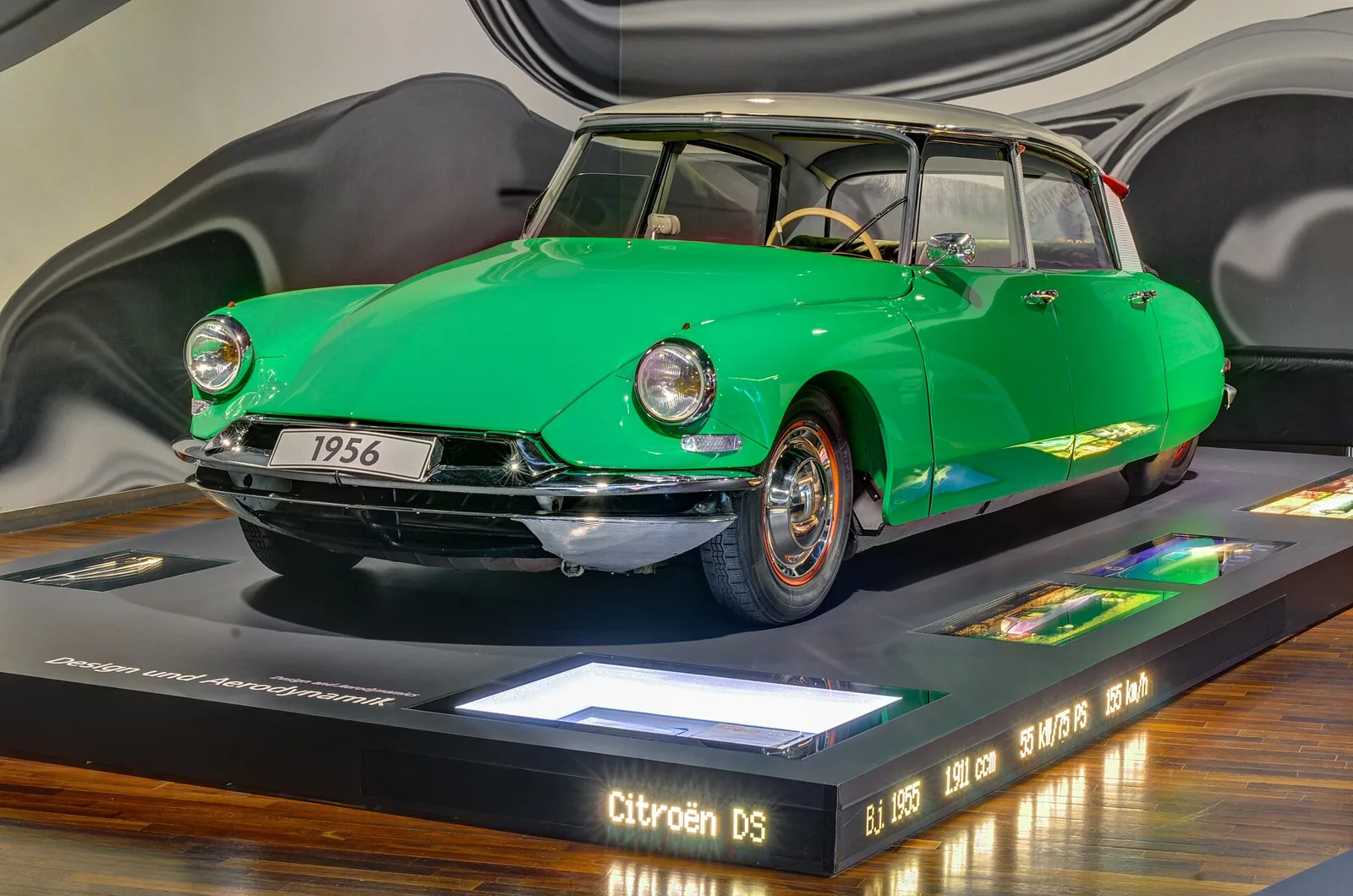
Hydropneumatic suspension, disc brakes and a sculptural body made the DS a design icon across two decades.
Citroen's DS was a 1955 to 1975 executive car with front-wheel drive, hydropneumatic suspension and early disc brakes. Citroen sold 1,455,746 of them across three body styles, and the design became known for its streamlined body, rally wins and cultural status.
The Citroen DS was a front-wheel-drive executive car that Citroen built and sold from 1955 to 1975, in fastback, estate and convertible forms. Its hydropneumatic suspension and early disc brakes made it one of the most technically advanced production cars of its time. Citroen built 1,455,746 examples in six countries, and most came from the Quai de Javel plant in Paris.
When did the DS go on sale and how did buyers react?
The DS was unveiled at the Paris Motor Show on 6 October 1955, when 743 orders were taken in the first 15 minutes. First-day orders totalled 12,000, and the show drew 80,000 deposits, a mark that held for over 60 years.
That record was eventually eclipsed by Tesla's Model 3, which logged 180,000 deposits on its first day of sales in March 2016. Journalists at the time argued that the DS had pushed the limits of what a road car could do in ride and handling.
The DS was distributed to many territories around the world, and it spoke to France's place in the Space Age. The structuralist philosopher Roland Barthes wrote that the car looked as though it had fallen from the sky.
A car that seemed to have fallen from the sky, and rode like a magic carpet over France's poor roads.
What technology made the DS ride so well?
The DS used hydropneumatic suspension, with each wheel linked to a sphere of pressurised nitrogen and oil rather than a metal spring. Paul Mages developed the self-levelling system, which let the driver choose ride height from five settings and suited the poor roads of the period.
The car also had power steering, a semi-automatic gearbox, inboard front disc brakes and a fibreglass roof that lowered its centre of gravity. Each wheel was held by a captive Allen bolt, a design that sped up puncture repairs and helped in racing.
Lanchester tried disc brakes on a car as early as 1902, and Crosley attempted volume production in 1949 without success. The DS was the first successful mass-produced car with disc brakes.
How did the hydraulic system work?
An engine-driven pump kept the closed system at pressure and fed the suspension, clutch and gearbox as well as the brakes and steering. Pressure of 13 to 15 MPa, roughly 1,900 to 2,200 psi, sat in two accumulators, one of which served only the front brakes.
Failure gave a warning sequence. Steering grew heavy first, then the gearbox stopped working, and the brakes were the last to fail.
The DS needed no jack. A stand fitted into a peg near the flat tyre, and the suspension was then lowered so the wheel hovered clear of the road, ready to be changed.
What engines powered the DS?
The first DS19 used a 1,911 cc four-cylinder derived from the 11CV engine of the Traction Avant, producing 75 hp (56 kW) at 4,500 rpm. Capacity rose to 1,985 cc in 1965, and the DS21 introduced a 2,175 cc unit in the same year with 106 hp (DIN).
Bosch electronic fuel injection arrived for 1970, which put the DS among the earliest mass-market cars to use it. The 1973 DS23 used a 2,347 cc engine with 115 hp (86 kW), and the fuel-injected version reached 141 hp (105 kW) SAE, or 130 hp DIN.
The cheaper ID shared the body but used a less powerful engine, producing 51 kW (69 hp) against the 56 kW (75 hp) of the DS19. Its price was more than 25 percent below the DS when it launched in France.
How did the gearbox work?
The earliest DS came solely with the Hydraulique four-speed semi-automatic. The driver moved a lever behind the steering wheel, and a hydraulic controller disengaged the clutch, changed gear and re-engaged it, so the car crept forward at traffic lights much as an automatic does.
A manual version of the same gearbox and clutch arrived as a cheaper option in 1963, and a five-speed manual followed in September 1970. A three-speed fully automatic Borg-Warner 35 unit reached the DS21 and DS23 in September 1971.
Fully automatic cars never reached the US, where automatics had become the majority of sales, but many were sold in Australia.
How was the DS styled and who designed it?
Flaminio Bertoni and Andre Lefebvre styled and engineered the DS, and Paul Mages developed its self-levelling suspension. Robert Opron later designed the 1967 Series 3 facelift, which also shaped the SM and CX. The body used easily removable, unstressed panels, so the car kept its size and shape for two decades.
Series 2 arrived in September 1962 with a more aerodynamic nose and better ventilation, and the ID and station wagon received the same nose. The 1967 Series 3 changed the headlamps, which sat under a smooth glass canopy.
Why did American regulators block DS features?
US rules required round, sealed-beam headlamps, which ruled out the DS's swivelling quartz-iodine units from its 1968 model year. Even the aerodynamic lens covers used on other cars had to go. NHTSA approval for the replacement hydraulic fluid came only in January 1969.
The fluid change caused its own problems. North American cars used conventional brake fluid, and about half of the 1969 US production used the older red LHS fluid while the rest used the newer green LHM.
Ford lobbied for composite headlamps, and the sealed-beam rule was finally rescinded in 1983. Canadian cars kept the European lamps, including the directional units, because they were legal there.
How well did the DS sell in North America?
Not well. North American sales ran from 1956 to 1972 and reached about 38,000 cars. It lacked automatic transmission, air conditioning and power windows, and it was built for French tax and road conditions rather than American ones. American buyers also expected features that the DS did not offer.
The price made it harder to sell. In 1969 a 115 hp DS cost $4,170, while $4,500 bought a 360 hp Buick Electra 225 Custom with a 7,040 cc V8 and an automatic gearbox.
Parts were also scarce. Jay Leno described spare parts as sporadic during his early years at a Citroen dealer in Boston, a problem that affected 1970s owners.
What convertibles and estates did Citroen build?
Citroen offered a station wagon from 1958, known as the Break in France, the Safari or Estate in the UK and the Wagon in the US. Henri Chapron built the convertible from 1960, and roughly 1,400 units were sold before official production ended in 1971.
Chapron also built his own coupes and sedans, and the Presidential DS of 1967 and 1968 was 6.53 metres long, longer than the cars used by American presidents of the time.
The estate proved valuable to film crews. The BBC used one as a camera car because its hydropneumatic suspension made a remarkably level platform for filming on the move.
How did the SM and CX follow the DS?
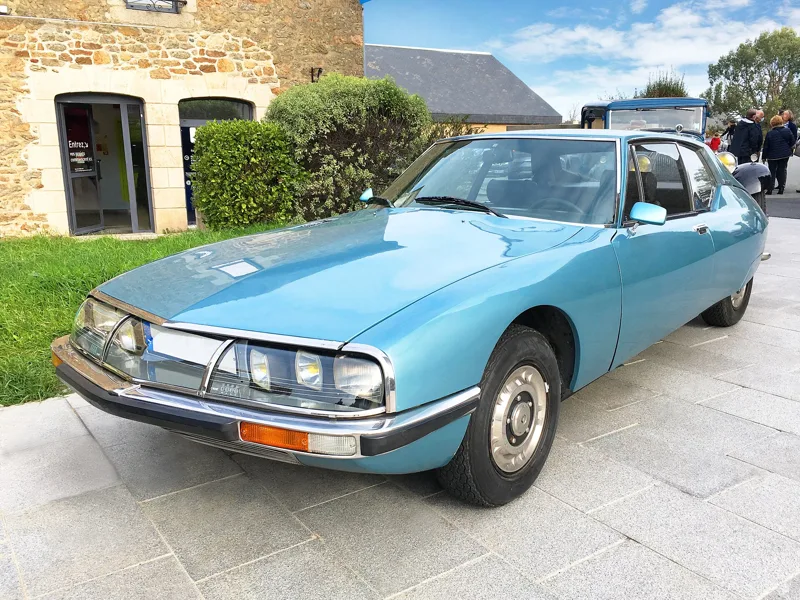
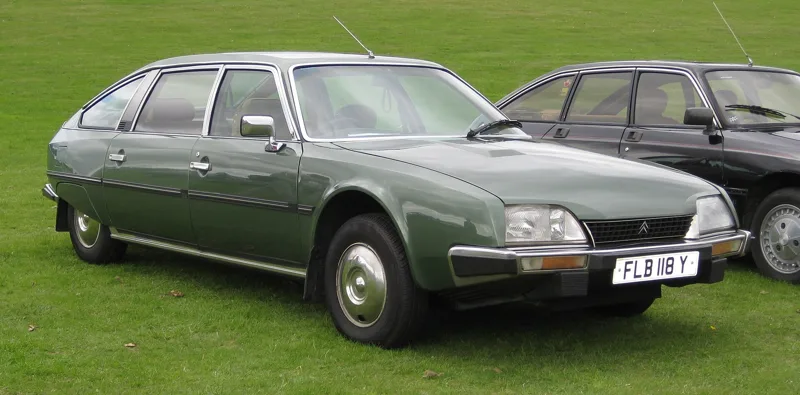
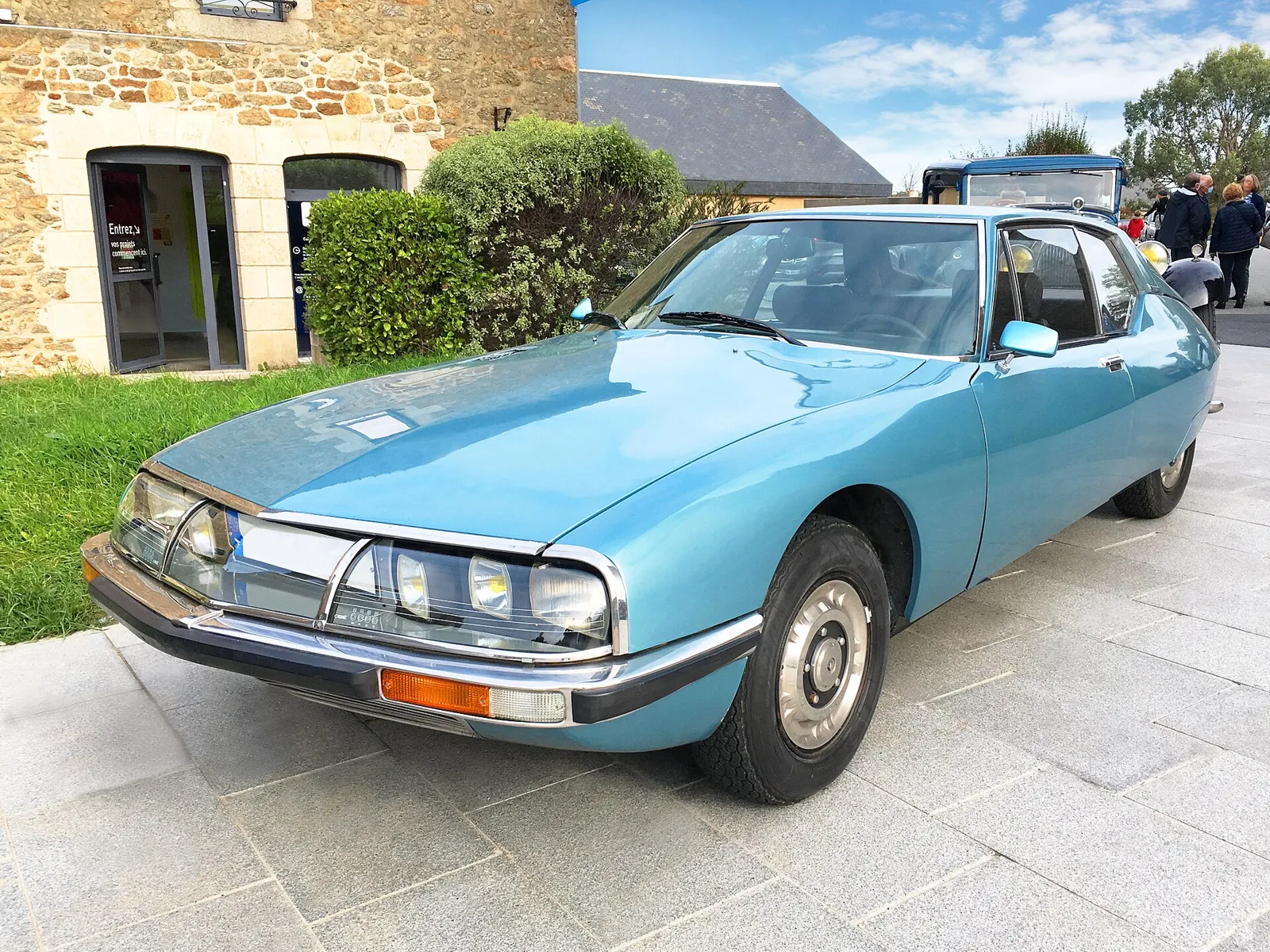
Citroen launched the SM in 1970 as a modernised DS with a luxury grand touring role, powered by a Maserati engine. It was too costly and too narrow in its seating to replace the DS as a family car, so the CX took over that job in 1974.
The SM reused DS parts, including axles, wheel bearings, steering knuckles, hydraulic components and the front disc brakes. The final DS was completed on 24 April 1975, and roughly eight months of estate stock had been built beforehand.
How did the DS perform in rallies?
Rallying rewards sustained speed on poor surfaces, which suited the car's suspension. The DS was competitive for almost its entire 20-year production run. It won the Monte Carlo Rally in 1959. It won again in 1966 after the BMC Mini-Cooper team was disqualified for rule infractions.
In the 1962 1000 Lakes Rally the winner was Pauli Toivonen in a DS19, and Robert Neyret claimed the Rallye du Maroc twice, in 1969 and 1970.
The car was still a force in 1974, when the London-Sahara-Munich World Cup Rally saw it beat more than 70 rivals, with only 5 of the field completing the event.
Why were the hydraulic components painted green?
From the 1967 model year Citroen switched to LHM, a mineral oil fluid that was much less harsh on the system than the earlier vegetable and synthetic fluids. LHM needed different seals, so the wrong fluid would destroy them quickly.
To avoid confusion, Citroen dyed LHM bright green and painted every hydraulic element green too, while the earlier parts were black. Earlier fluids absorbed moisture, and the DS's large fluid volumes let in far more moist air than a brake circuit would.
How did the DS affect Citroen's later design?
The DS made Citroen's name as an innovator, but the company then worried that later models would fall short of that standard. No clean-sheet models arrived between 1955 and 1970, although many mid-market designs were developed and never reached production.
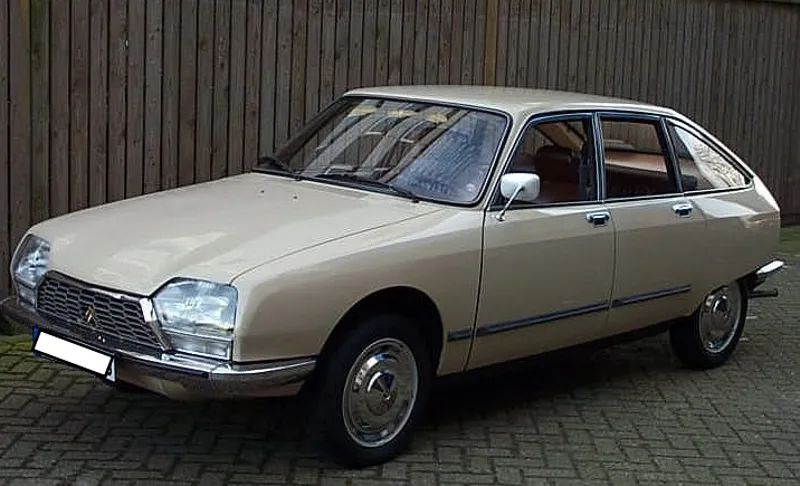
The GS of 1970 finally targeted the mid-range. It took the European Car of the Year award for 1971, and 2.5 million were sold, using a 41 kW (55 hp) air-cooled flat-four with hydropneumatic suspension.
Did a real assassination attempt involve a DS?
Yes. On 22 August 1962 an ambush was planned at Le Petit-Clamart, near Paris, to kill President Charles de Gaulle. The car was riddled with bullets and two tyres were punctured, yet it escaped at full speed, and de Gaulle praised the car and swore off other makes from then on.
The event was recreated in The Day of the Jackal, a 1973 film. Cary Grant reportedly ordered a DS for the 1962 film That Touch of Mink, and a modified flying DS was the villain's car in the 1965 French comedy Fantomas se dechaine.
Later the DS turned up in Back to the Future Part II in 1989 as a flying taxi of 2015. Gabriel Orozco's 1993 sculpture La DS cut the car lengthways and removed a third of its width.
What are classic DS values today?
Convertibles lead the market. A 1973 DS23 Injection Electronique Decapotable sold for 176,250 euros at Christie's in February 2006, and a similar car brought 343,497 euros at Bonhams in February 2009. Auction houses such as these have set the benchmark for the car's collectibility.
At Bonhams on 18 September 2009 a 1966 DS21 convertible sold for GBP 131,300, and on 23 January 2010 another 1973 DS21 convertible made 189,000 euros.
Anniversaries and the DS name today
On 9 October 2005, 1,600 DS cars drove past the Arc de Triomphe to mark the 50th anniversary of the launch. Citroen was the headline display at the Mullin Automotive Museum in 2017 and 2018, and at Pebble Beach in 2018 the car appeared on the show lawn for the first time.
In 2009 PSA created the DS Automobiles brand for higher-specification versions of existing models. Its first car, the DS 3 launched in March 2010, was based on the Citroen C3 and recalled the original's shark-fin side pillar.
The Citroen DS at a glance
The table gathers the core figures for the car across its production run, so the early and late engines can be compared directly.
| Item | Detail |
|---|---|
| Production | 1955 to 1975 |
| Body styles | Fastback, estate and convertible |
| Units built | 1,455,746 in six countries |
| Built at Quai de Javel | 1,330,755 |
| Launch | 6 October 1955, Paris Motor Show |
| Early engine | 1,911 cc four, 75 hp (56 kW) |
| Late injected engine | 2,347 cc, 141 hp (105 kW) SAE |
| Suspension | Hydropneumatic, self-levelling |
| Last car built | 24 April 1975 |
Frequently asked questions
Was the DS only built in France?
No. Citroen assembled cars in the UK at Slough until 1965, built the DS in South Africa from 1959 to 1975, and made an ID 19 Parisienne at Heidelberg, Victoria, in Australia.
Was the DS sold in Japan?
Yes, but the Japanese models were built in France and were left-hand drive, so they arrived as imports rather than local production.
What does the name DS mean?
It is a pun in French. DS sounds like the word for goddess, while the cheaper ID sounds like the word for idea.
Why does the DS need expensive hydraulic maintenance?
Early hydraulic fluids absorbed water, and disuse let moisture into the components, which caused deterioration. The large fluid reservoir rose and fell sharply as the suspension moved, so owners face costly upkeep.